Acne Scar Treatment in Korea: Best Options and Clinic Guide
A complete guide to acne scar treatment in Korea for 2026. Discover prices, top clinics, and advanced therapies like Potenza and JuveLook.
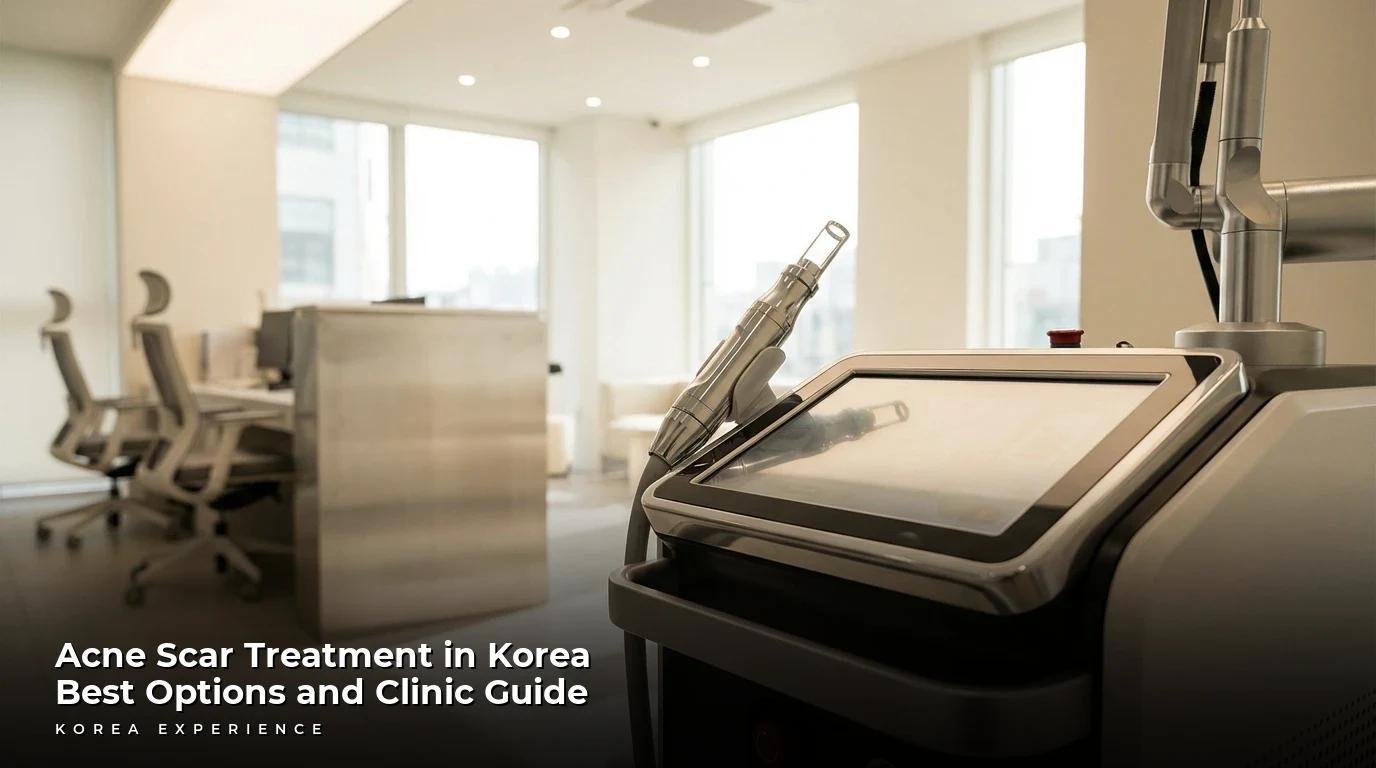
Finding effective acne scar treatment is often a lifelong journey for many, but South Korea has established itself as the global capital for skin revision. In 2026, the standard for treating atrophic scars in Seoul goes far beyond simple laser resurfacing. The Korean approach utilizes a sophisticated combination of radiofrequency (RF) microneedling, chemical reconstruction, and advanced biostimulators like JuveLook and Rejuran S.
The short answer: The best acne scar treatment in Korea for 2026 involves "Combination Therapy"—usually pairing Potenza (RF Microneedling) with JuveLook Volume (PDLLA) or Rejuran S. This multi-modal approach costs approximately 40% less than single-modality treatments in the US or Europe, with average package prices ranging from ₩300,000 to ₩800,000 ($220-$600 USD) per session.
Key Takeaways
- 1Potenza RF Microneedling combined with JuveLook is the gold standard for 2026 scar revision.
- 2Expect to pay 30-50% less in Seoul compared to Western clinics, with tax refunds available.
- 3Combination therapy (laser + subcision + booster) yields faster results than lasers alone.
Why Choose Korea for Acne Scar Treatment?
The medical tourism sector in South Korea welcomed over 500,000 international patients last year, with dermatology being the leading category. The primary reason isn't just price; it is the sheer volume of cases Korean dermatologists handle and the speed at which they adopt new technology.
In Western countries, a clinic might own one or two vascular or resurfacing lasers. In contrast, a standard specialized dermatology clinic in Gangnam or Sinsa-dong will typically operate 15 to 20 different energy-based devices. This allows for highly customized protocols. Instead of forcing your skin to adapt to the one machine they have, they select the machine that fits your specific scar type—whether it's rolling, boxcar, or ice-pick.
📊 Korea Dermatology Statistics
Furthermore, the "wait time" culture virtually doesn't exist in the private sector here. While you might wait 3 months for a specialist in London or Toronto, you can often book a consultation and same-day treatment in Seoul with just 3 to 5 days' notice, or even walk in at larger "factory-style" clinics.
Understanding Korean Scar Treatment Categories
Before booking a flight, it is crucial to understand that Korean dermatologists rarely rely on a single method. They classify scars deeply and attack them from multiple angles.
1. Energy-Based Devices (EBD)
This includes lasers and radiofrequency devices.
- Ablative Lasers: CO2 Fractional is the classic heavy hitter for deep resurfacing.
- Non-Ablative Lasers: PicoSure and PicoPlus are used for pigmentation and mild texture without breaking the skin barrier significantly.
- RF Microneedling: The current king of scar treatment (Potenza, Sylfirm X, Secret RF).
2. Biostimulators (Skin Boosters)
Korea is the pioneer of injecting ingredients directly into the scar tissue to promote healing.
- Rejuran S: A concentrated form of Polynucleotide (salmon DNA) specifically viscous enough to fill acne scars.
- JuveLook Volume: A hybrid of Hyaluronic Acid and PDLLA (Poly D, L-Lactic Acid) that stimulates collagen production for months.
3. Mechanical Manipulation
- Subcision: Physically breaking the fibrous bands tethering the scar down.
- TCA Cross: Using high-concentration acid to close ice-pick scars.
Pro Tip
If a clinic suggests only one type of laser for your scars, consider a second opinion. The consensus in 2026 is that "Combination Therapy" is the only way to treat mixed scar types effectively.
Top Treatment Options in 2026
Here is a detailed breakdown of the specific treatments you will encounter in Seoul's top clinics.
The Gold Standard: Potenza + Drug Delivery
Potenza has largely replaced older RF microneedling devices like Intracel in high-end Korean clinics. It uses ultrafine needles to puncture the skin and deliver radiofrequency energy deep into the dermis. This triggers a wound-healing response that builds collagen.
What makes Potenza unique in Korea is the "Pumping Tip" (CP-21 tip). This patented tip pushes topical boosters (like Exosomes or JuveLook) deep into the skin layers while the needles are inserted. This "Drug Delivery System" increases the absorption rate of skin boosters by up to 67% compared to topical application.
- Best for: Rolling scars, Boxcar scars, large pores.
- Pain Level: 6/10 (requires numbing cream).
- Downtime: 3-4 days of redness; makeup possible after 24 hours.
- Duration: 20-30 minutes for the full face.
The Volume Builder: JuveLook Volume (Lenisna)
While Rejuran was the buzzword of 2024, JuveLook dominates 2026. JuveLook comes in two forms: Standard (for pores/fine lines) and Volume (for scars/hollows).
For deep acne scars, doctors inject JuveLook Volume directly under the scar tissue. The PDLLA particles act as a scaffold. Over the next 6 weeks, your body breaks down the particles and replaces them with your own collagen. It is safer than permanent fillers and offers more structural support than Rejuran.
- Best for: Deep rolling scars, atrophic depressions.
- Pain Level: 4/10 (mixed with Lidocaine).
- Longevity: Results last 12-18 months.
The Precision Tool: Pico Fractional Laser
Picosecond lasers fire energy in trillionths of a second. This rapid speed creates "LIOB" (Laser Induced Optical Breakdown)—essentially tiny bubbles under the skin that stimulate collagen without burning the top layer. It is excellent for patients with darker skin tones (Fitzpatrick IV-V) who are at risk of hyperpigmentation from heat-based lasers like CO2.
- Best for: Shallow boxcar scars, pigmentation (PIH), uneven tone.
- Brands: PicoSure (USA), PicoPlus (Korea), PicoWay (USA).
- Cost: ₩80,000 - ₩150,000 per session.
For a broader look at skin treatments available, you might find our guide on best-dermatology-clinics-in-seoul-for-foreigners helpful for understanding the clinic landscape.
The "Korean Combination" Protocol
Most international patients have limited time—usually 1 to 2 weeks in Korea. To maximize results, Korean doctors utilize a "One-Day Multi-Program."
A typical severe acne scar package (approx. 2.5 hours) looks like this:
- Deep Cleansing & Mark-up: The doctor circles every individual scar.
- Anesthesia: 30-40 minutes of strong topical numbing cream.
- Step 1 - Subcision: The doctor uses a cannula to manually break the tethered scar tissue.
- Step 2 - Potenza: Full face pass to tighten skin, followed by targeted intensive passes on scarred areas.
- Step 3 - JuveLook Injection: Immediately injecting the booster into the subcised areas.
- Step 4 - Pico Fractional: A final pass to address surface texture and pigment.
- Step 5 - Cryo/LDM: Cooling therapy to reduce redness immediately.
📖 The Treatment Day Journey
Step 1: Arrival & Cleansing
Store belongings in locker, face wash in powder room.
Step 2: Visia Skin Analysis
Digital scan to map pore depth and pigment.
Step 3: Doctor Consultation
Detailed plan creation. Translator usually present.
Step 4: Numbing
Thick cream applied for 30-45 mins in a waiting area.
Step 5: The Procedure
Multi-step treatment (Laser, RF, Injection).
Step 6: Soothing Care
Modeling mask pack and LED light therapy.
Cost Analysis: Korea vs. Western Countries
The cost difference is substantial, primarily because the devices (often manufactured in Korea by companies like Lutronic and Jeisys) are domestic products, and the competition between clinics drives prices down.
💵 Price Comparison (Single Session)
Equivalent RF Microneedling
Potenza + Rejuran Combo
Typical Package Prices (2026 Estimates)
- Entry Level (Pico Laser only): ₩90,000 - ₩150,000 ($65 - $110).
- Mid-Range (Secret RF + PDRN): ₩250,000 - ₩350,000 ($185 - $260).
- Premium (Potenza + JuveLook + Subcision): ₩500,000 - ₩900,000 ($370 - $670).
Tax Refund
Foreign tourists are eligible for a VAT refund (approx. 7-8%) on cosmetic medical treatments. Ensure you bring your passport to the clinic and ask for the "Tax Free" receipt to scan at Incheon Airport.
Clinic Types: Factory vs. Specialist
This is the most critical decision you will make. In Korea, clinics generally fall into two categories.
1. Factory-Style Clinics (Gongjang-hyeong)
These are large chains (like Muse, Shinebeam, Toxnfill) processing hundreds of patients a day.
- Pros: Extremely cheap, transparent pricing on websites, English kiosks, very efficient.
- Cons: Short consultation (often with a consultant, not a doctor), rushed treatment, different doctor every time.
- Verdict: Good for simple Botox or general maintenance lasers. Not recommended for complex acne scar revision where doctor technique matters.
2. Specialist/Private Clinics
These are smaller, owner-operated clinics often led by a Board-Certified Dermatologist.
- Pros: The doctor designs the plan, consistent care, higher powered settings, custom manual techniques (subcision).
- Cons: 2-3x more expensive than factory clinics, requires booking weeks in advance.
- Verdict: Highly recommended for acne scars. You are paying for the hand skills required for subcision and precise laser depths.
Clinic Type Comparison
| Feature | Factory Clinic | Specialist Clinic |
|---|---|---|
| Consultation | 5 min (Manager) | 20 min (Doctor) |
| Price | $ (Cheap) | $$$ (Premium) |
| English Fluency | High (Staff) | Variable (Doctor) |
| Customization | Fixed Menu | Tailored Plan |
Where to Go: Major Medical Districts
Gangnam (Gangnam Station to Sinnonhyeon)
This 1-kilometer stretch contains the highest density of clinics in the world.
- Vibe: Fast-paced, modern, competitive.
- Target: Tourists and office workers.
- Access: Gangnam Station (Line 2) Exits 10, 11, or 12.
Cheongdam & Apgujeong
The luxury belt. Here you find celebrity clinics and "private spas."
- Vibe: Quiet, opulent, expensive.
- Target: VIPs, medical tourists seeking privacy.
- Price: Expect to pay 30-50% more than Gangnam station.
Hongdae (Hongik University)
- Vibe: Youthful, budget-friendly.
- Target: Students and younger travelers.
- Specialty: Good for acne management and basic lasers, less for deep scar revision.
Gangnam Medical Street(강남대로)
The Recovery Process: What to Expect
If you are traveling to Korea, you need to factor in downtime. "Downtime" for acne scar treatments in Korea is often described as "Social Downtime" (you look red/scabby) vs. "Medical Downtime" (you are in pain).
Immediate Aftermath (Day 0-2)
Your face will likely be red, swollen, and may have grid marks from the RF microneedling. If you had subcision, you may have small bruises.
- Activity: You can walk around and eat, but you will want to wear a mask. Fortunately, wearing masks is still very common in Korea due to fine dust, so you won't stand out.
- Skincare: Only use the regenerative cream prescribed by the clinic and gentle cleanser. No sunscreen on open wounds (use a hat/umbrella).
The Shedding Phase (Day 3-7)
The skin will feel like sandpaper as the microscopic scabs form.
- Activity: Makeup is usually allowed after 24-48 hours, but it may look textured.
- Skincare: Heavy moisturization is key. Use sheet masks daily (clinics often sell "repair" masks).
For advice on products to use during recovery, check out our guide to best-korean-face-masks-for-dry-sensitive-skin-2026.
"Many Western patients worry about looking 'scary' after treatment. In Seoul, walking around with a post-procedure mask or small taped spots is completely normal. No one stares. We actually recommend walking as it helps reduce facial swelling."
Booking Your Appointment: Practical Steps
1. Research and Contact
Do not just show up. Popular clinics are booked out 2-3 weeks in advance.
- Apps: Use Gangnam Unni or Goddess Ticket (mostly in Korean, but good for price checking).
- Messaging: Most clinics use KakaoTalk or WhatsApp. Look for the ID on their Instagram or website.
- English: Send your message in simple English. Include photos of your scars (side profile, varied lighting) for an online estimate.
For more details on navigating appointments, see our guide on booking-medical-consultations-in-korea-online-vs-walk-in.
2. The Consultation
When you arrive, you will likely see a consultant first who speaks English.
- Ask: "Will the doctor perform the consultation too?" (Essential for scar revision).
- Ask: "Is the tip for the Potenza genuine and new?" (Some unethical clinics reuse tips; ask to see the package opened).
3. Payment
- Most clinics accept foreign credit cards (Visa/Mastercard).
- Some offer a small discount (5-10%) for cash payments.
- Always ask for the Tax Refund Receipt immediately upon payment.
Managing Expectations
It is vital to have realistic expectations.
- One session is rarely enough. While Korean combination treatments are potent, deep scars usually require 3 sessions spaced 4-6 weeks apart for 50-70% improvement.
- Travel Timing. Do not do this the day before a beach vacation. Sun avoidance is critical.
- Collagen takes time. You will see a "glow" after 1 week, but the real scar filling from JuveLook and Potenza peaks at 3 months after the procedure.
For those prone to acne, ensuring your barrier is healthy before treatment is key. Read about cosrx-skincare-guide-best-products-for-acne-prone-skin-2026 to prep your skin.
Pros and Cons of Acne Scar Treatment in Korea
Korea Scar Treatment Analysis
- ✓Access to latest 2026 technology (Potenza, V-Ro)
- ✓Significant cost savings (30-50%)
- ✓High volume of cases = experienced doctors
- ✓Integrated aftercare (cryotherapy, LDM) included
- ✗Language barrier in smaller clinics
- ✗Follow-up care is difficult once back home
- ✗Risk of aggressive treatment for sensitive skin
- ✗Requires strict sun avoidance during travel
Emergency Info & Medical Disclaimer
Medical Disclaimer
The information in this article is for educational purposes only and does not constitute medical advice. Acne scar revision is a medical procedure with risks including infection, hyperpigmentation, and scarring. Always consult with a certified professional.
If you experience severe pain, excessive bleeding, or signs of infection (heat, pus) after your procedure:
- Medical Emergency: Dial 119
- Korea Disease Control & Prevention Agency (Medical Helpline): Dial 1339 (available in English)
Frequently Asked Questions
❓ Frequently Asked Questions
Have more questions?Contact us →
Acne scar treatment in Korea offers a compelling blend of advanced technology, skilled practitioners, and affordability. By choosing the right combination therapy—specifically the 2026 trend of Potenza paired with biostimulators like JuveLook—you can achieve significant improvements that might cost a fortune elsewhere. Just remember to research your clinic, manage your recovery time, and enjoy the journey to clearer skin.
About the Author
Korea Experience Team
Written by the Korea Experience editorial team - experts in Korean medical tourism, travel, and culture with years of research and firsthand experience.
⚠️ Medical Disclaimer
The information provided on this website is for general informational purposes only and does not constitute medical advice. Always consult with qualified healthcare professionals before making any medical decisions.
Explore more in Medical Tourism
World-class medical procedures at competitive prices. From plastic surgery and dermatology to dental care and health checkups — your complete guide to medical tourism in Korea.
Browse All Medical Tourism ArticlesContinue Reading
Explore more articles you might find interesting
Considering LASIK or LASEK eye surgery in Korea? Discover world-class clinics, advanced technology, costs, and a step-by-step guide for your vision correction journey.
Your 2026 guide to anti-aging in Korea. Discover prices for Botox, fillers, and skin boosters like Rejuran, plus clinic tips and recovery advice.
Discover the best K-Beauty sheet masks for 2026. A complete guide to top brands like Mediheal and Abib, essential ingredients, and prices starting at ₩1,000.
A complete guide to buying eyewear in Korea. Discover prices, 20-minute prescription glasses, trending brands like Gentle Monster, and contact lens tips.
Compare scar treatment options silicone sheets vs laser in Korea. We analyze costs, efficacy, and why Seoul is the global capital for skin repair in 2026.
Unlock your guide to rhinoplasty in Korea for 2026. Discover costs, top clinics, procedures, and essential tips for a successful medical tourism journey.