How to spot fake K-beauty products: A guide for online shoppers 2026
Don't risk your skin. Learn how to identify counterfeit Korean skincare with our 2026 guide, covering price analysis, packaging clues, and trusted retailers.
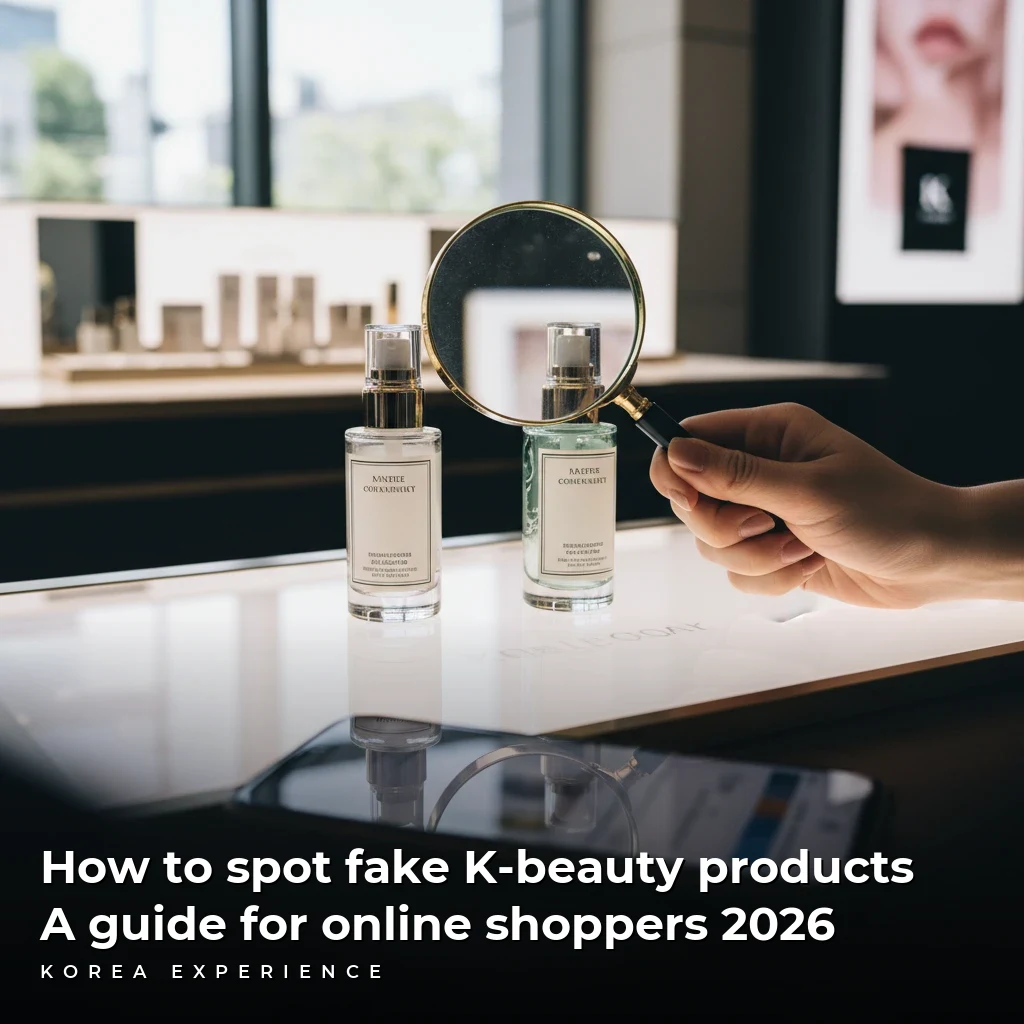
The most reliable way to spot fake K-beauty products is to verify the "HiddenTag" or QR code seal found on the packaging of over 85% of major Korean brands, while also strictly avoiding prices that are more than 30% below the official retail price found on sites like Olive Young Global or the brand’s official flagship store. In 2026, the proliferation of "super fakes"—counterfeits with high-quality packaging but dangerous ingredients—requires shoppers to verify the seller's authorized status rather than relying solely on visual inspection.
The short answer: Always cross-reference the batch code on websites like CheckCosmetic, use the HiddenTag app for verification, and avoid third-party sellers on marketplaces like Amazon or TikTok Shop unless they are listed as "Authorized Distributors" by the brand itself.
Key Takeaways
- 1Over 35% of K-beauty products sold on unauthorized discount platforms in 2026 are estimated to be counterfeit.
- 2The '30% Rule': If a product is permanently priced 30% lower than the official Korean retail price (won converted to USD), it is likely fake.
- 3Verify products immediately using apps like HiddenTag or BrandSafety, which take less than 60 seconds to authenticate.
The Rising Threat of Counterfeit K-Beauty in 2026
The global fascination with Korean skincare has created a massive shadow market. By 2026, the Korea Customs Service reported that the seizure of counterfeit cosmetics intended for export had risen by 150% compared to 2023 levels. For international fans of K-beauty, this poses a significant risk not just to their wallets, but to their health. Fake products often contain high levels of lead, mercury, and bacteria because they are manufactured in unsanitary underground facilities without the strict regulations that govern legitimate Korean cosmetic labs.
While visual indicators used to be easy to spot—typos, faded colors, or flimsy boxes—counterfeiters in 2026 have adopted AI-driven printing technologies that replicate packaging with 99% accuracy. This evolution means that the battle against fakes has moved from visual inspection to supply chain verification.
📊 The Counterfeit Crisis 2026
Where You Buy Matters: The Safe List vs. The Danger Zone
The single most effective step you can take to avoid fakes is choosing the right retailer. In the digital age, the platform determines the authenticity. Authorized retailers have direct contracts with brands like COSRX, Laneige, and Sulwhasoo, ensuring the supply chain remains unbroken from the factory in Gyeonggi-do to your doorstep.
Trusted Global Retailers
- Olive Young Global: As Korea’s #1 health and beauty store, their global site is the gold standard for authenticity.
- YesStyle / Stylevana: These are long-standing authorized distributors for hundreds of brands.
- Soko Glam: A curated US-based retailer with strict vetting processes.
- Brand Official Websites: Buying directly from the brand (e.g., Innisfree.com) is foolproof.
High-Risk Platforms
- TikTok Shop / Instagram Ads: While legitimate brands sell here, the platform is flooded with "drop-shippers" selling fakes.
- AliExpress / Temu / Shein: These marketplaces have extremely high rates of counterfeit cosmetics.
- Amazon / eBay (Third-Party Sellers): Even with "Prime" shipping, commingled inventory means a fake product from a third-party seller can be mixed with real stock.
Retailer Safety Comparison 2026
| Feature | Olive Young Global | Amazon (3rd Party) | TikTok Shop |
|---|---|---|---|
| Authenticity Guarantee | 100% Direct | Varies significantly | Low |
| Shipping Time | 5-7 Days | 1-2 Days | 10-20 Days |
| Price Consistency | Standard Retail | Price Wars | Suspiciously Low |
Analyzing the Price: The "Too Good to Be True" Calculation
In 2026, inflation and raw material costs in Korea have stabilized certain price points. If you know the base price in Korean Won (₩), you can calculate a realistic USD price.
A standard bottle of high-quality serum typically costs between ₩25,000 and ₩35,000 ($18–$26 USD) in Seoul. If you see that same serum selling for $8.99 on a random website, it is mathematically impossible for it to be genuine. Shipping a standard 150ml toner bottle internationally costs roughly $5-$10 in logistics fees alone. A product price that doesn't cover the cost of the liquid and the shipping is a major red flag.
💵 Real vs. Fake Pricing Examples
Sold by authorized retailer
Sold by unknown shop 'BeautyDeals24'
The 'Clearance' Trap
Beware of shops claiming "Closing Down Sale" or "Factory Reject" sales. Legit Korean brands rarely sell "factory rejects" to the public. They destroy imperfect batches to maintain brand reputation. If a label is crooked, the brand shreds it; they don't sell it for $5 on eBay.
If you are looking for legitimate ways to build your routine without breaking the bank, read our complete guide to Korean skincare routine for budget-friendly authentic recommendations.
Visual Inspection: Spotting the Subtle Flaws
Even with "super fakes," counterfeiters often cut corners on the final details. If you have the product in hand, use the following checklist. This inspection usually takes about 3 to 5 minutes.
1. The Font and Hangul (Korean Text) check
Counterfeiters often use optical character recognition (OCR) to copy text, leading to subtle errors in the Korean Hangul characters.
- Blurriness: Real K-beauty packaging has crisp, sharp text. Fakes often look slightly "bolded" or bleeding because of cheaper ink jet printing.
- Typos: Look for English typos like "Mousturizer" instead of "Moisturizer," or nonsensical Korean sentences.
- Font Spacing: The spacing between letters (kerning) is often uneven on fakes.
2. The Batch Code and Expiry Date
Legitimate Korean cosmetics printed in 2025 and 2026 will have a batch code and an expiry date stamped on the bottom of the bottle or the crimp of the tube.
- Real: The date is usually embossed or printed in a dot-matrix style that can be felt with a fingernail. Format is typically YYYY.MM.DD followed by "까지" (until).
- Fake: The date is often printed flat with the rest of the label, or the "Until" date is impossibly long (e.g., 5 years from now). K-beauty products generally have a shelf life of 30-36 months unopened.
3. The Texture and Scent Test
This is the most dangerous test, so perform it on your hand, not your face.
- Scent: Fakes often have a strong, overwhelming chemical or floral fragrance to mask the smell of cheap industrial bases. Real K-beauty, especially products aimed at sensitive skin, often has a very faint, clean scent or is fragrance-free.
- Texture: If a "watery toner" feels sticky like glue, or a "snail mucin" essence is as thin as water, it is fake.
📖 The 5-Minute Authenticity Check
Step 1: Shake the Bottle
Listen to the sound. Fakes often are not filled to the top, sounding hollow compared to the dense sound of a full, real product.
Step 2: Scan the Tag
Locate the HiddenTag sticker (usually holographic) and scan it with the official app.
Step 3: Check the Cap
Twist the cap. Real high-end packaging has a smooth, satisfying click or resistance. Fakes often feel loose, scratchy, or misaligned.
Digital Verification: Apps You Need in 2026
The K-beauty industry has aggressively adopted technology to fight counterfeits. The primary weapon in 2026 is HiddenTag.
HiddenTag is a smart hologram sticker technology. Unlike a standard QR code which can be photocopied, HiddenTag uses watermarking technology that cannot be duplicated by standard printers. When you scan it with the app, it connects to the brand's server to verify that specific serial number.
Brands using HiddenTag or similar verification:
- Clio
- Peripera
- 3CE (Stylenanda)
- Some By Mi
- Rom&nd
If you buy a product from these brands and it lacks a sticker, or the sticker looks like a flat printed image rather than a hologram, it is 100% fake.
For products without HiddenTag, you can use general cosmetic checkers like CheckCosmetic or CheckFresh. You input the brand and the batch code found on the bottle. If the database returns an error or says the product was manufactured in 2015, you have a fake.
Brand-Specific Watchlist: The Most Counterfeited Items of 2026
Certain "viral" products are targeted more aggressively by counterfeiters due to their high demand on social media.
1. COSRX Advanced Snail 96 Mucin Power Essence
This is arguably the most counterfeited item globally.
- The Tell: The pump on the fake is often stiff. The box cardboard on the fake is a cooler, blue-white, while the original is a warmer, off-white. The authentic snail mucin has a stringy, viscous texture; the fake is often watery. For a deep dive into authentic products, check our COSRX skincare guide.
2. Beauty of Joseon Relief Sun: Rice + Probiotics
Due to its massive popularity in the US and Europe, fakes are rampant.
- The Tell: The crimp at the top of the tube. Authentic tubes have a specific rectangular pattern on the crimp. Fakes often have simple vertical lines or no pattern. The fake formula often leaves a heavy white cast, whereas the original is famous for having none. Read more about identifying quality sunscreens in our best Korean sunscreen guide.
3. Laneige Lip Sleeping Mask
- The Tell: The font on the jar. The spacing of the letters in "LANEIGE" is often slightly too wide on fakes. The spatula included in the fake box often comes in a separate clear plastic bag, whereas the real one is usually in a frosted sleeve or slotted into the packaging differently depending on the region.
📋 Counterfeit Statistics 2026
The Dangers of "Commingled Inventory" on Amazon
Amazon remains a convenient place to shop, but it presents a unique risk called commingled inventory. In Amazon warehouses, products from different sellers (the official brand vs. a random third-party seller) that have the same barcode are sometimes stored in the same bin.
When a worker goes to pick your order, they grab a bottle from the bin. Even if you bought from the "Official Store" listing, you might physically receive the bottle sent in by the third-party seller if the inventory was commingled.
Buying K-Beauty on Amazon
- ✓Fast shipping (Prime delivery)
- ✓Easy returns policy
- ✓Customer reviews (though often fake)
- ✗Risk of commingled inventory
- ✗Higher prices than direct Korean sites
- ✗Hard to verify expiration dates before purchase
How to stay safe on Amazon:
- Look for "Sold by [Brand Name] and Fulfilled by Amazon."
- If the "Sold by" name is a random string of letters (e.g., "XUYEANG"), avoid it.
- Check the "Count" price. If it's significantly lower than the market average, be skeptical.
What to Do If You Bought a Fake
If you suspect you've received a counterfeit product, act quickly. Do not use the product.
- Document Everything: Take high-resolution photos of the packaging, the batch code, the texture of the product, and the shipping label.
- Contact the Seller: Send the evidence and demand a refund. Mention that you have verified it as counterfeit.
- Report the Listing: If you bought it on a platform like Amazon or eBay, report the item as counterfeit to protect other buyers.
- Chargeback: If the seller refuses a refund, contact your credit card company or PayPal to file a dispute for "Item Not as Described/Counterfeit."
Refund & Reporting Process
Stop Use
Take photos and seal the product back in the box.
File Claim
Submit evidence to platform or seller.
Escalate
If no response, contact bank for chargeback.
The Ultimate Solution: Shopping in Korea
Of course, the absolute safest way to buy K-beauty is to purchase it physically in South Korea. When visiting Seoul, you have access to flagship stores where authenticity is guaranteed.
Olive Young Myeongdong Flagship(올리브영 명동 플래그십)
However, even in Korea, you must be careful in certain tourist traps. Street stalls in Myeongdong or Namdaemun markets that sell "10+10" sheet mask bundles for incredibly low prices might be selling older stock or grey-market goods. Stick to recognized chains like Olive Young, Chicor, and specific brand stores (Innisfree, Etude House, Nature Republic).
For guidance on where to stay to be close to these trusted shops, check our guide on best areas to stay near shopping districts.
"Many tourists think buying from street vendors in Ewha or Hongdae is safe because 'it's Korea.' But even here, we have issues with expired products being sold to foreigners who can't read the Hangul dates. Always check the bottom of the bottle for '유통기한' (expiration date) or '제조' (manufactured date). If the date is more than 30 months old, do not buy it, even if it's 50% off."
Conclusion
As we move through 2026, the technology used by counterfeiters is becoming scarier, but the tools available to shoppers are also improving. By sticking to the 30% price rule, using the HiddenTag app, and purchasing only from authorized retailers like Olive Young Global or verified brand sites, you can protect your skin and your wallet.
Remember, K-beauty is about efficacy and gentle care. A fake product that damages your skin barrier defeats the entire purpose of the routine. When in doubt, it is always better to wait a week for shipping from a trusted source than to risk a next-day delivery of a questionable product.
❓ Frequently Asked Questions
Have more questions?Contact us →
About the Author
Korea Experience Team
Written by the Korea Experience editorial team - experts in Korean medical tourism, travel, and culture with years of research and firsthand experience.
Explore more in Shopping & K-Beauty
From Olive Young hauls to Myeongdong shopping tips — discover the best K-Beauty products, fashion trends, and shopping destinations in Korea.
Browse All Shopping & K-Beauty ArticlesContinue Reading
Explore more articles you might find interesting
The complete guide to The Hyundai Seoul, Apgujeong, and Trade Center stores. Discover luxury brands, tax refunds, and VIP services for travelers in 2026.
Save 30-70% on skincare by visiting Dongdaemun and Hwagok wholesale centers. We reveal pricing, locations, and the 2026 rules for bulk buying.
The ultimate 2026 guide to Innisfree in Korea. Discover the top 15 must-buy products, flagship store locations in Myeongdong and Seongsu, and tax refund tips.
Master international K-Beauty shipping from Korea in 2026. Discover top services, costs, regulations, and expert tips for safe delivery worldwide.
Discover the best Insadong traditional crafts and souvenirs in 2026. From authentic hanji paper to celadon ceramics, find prices and hidden shops here.
Discover the top hotels with beauty services spa and salon in Seoul. From Gangnam luxury to medical recovery stays, here is your complete 2026 guide.