Korean Moisturizer Guide: Gel vs Cream Formulas for Your Skin Type
Compare Korean gel vs cream moisturizers. Find the perfect formula for Seoul's 80% summer humidity or dry winters. Prices from ₩15,000.
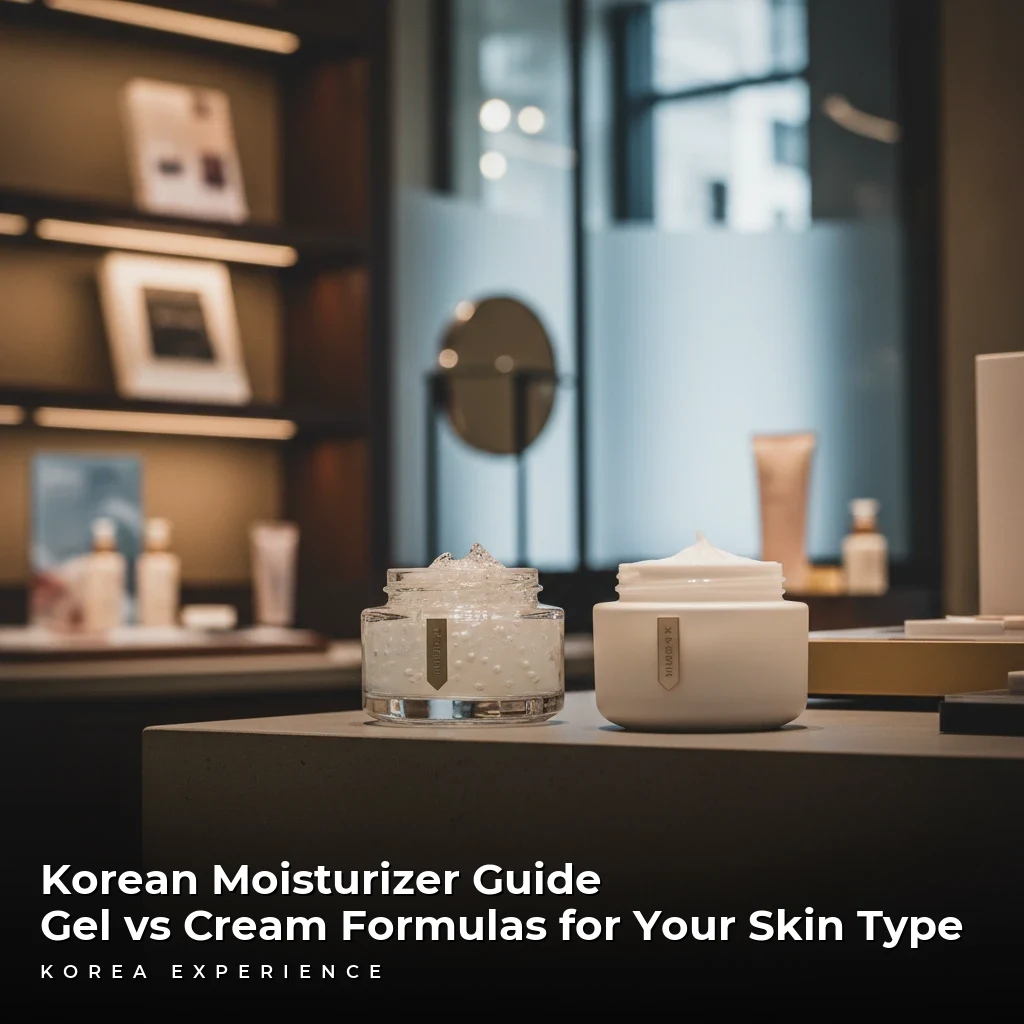
Walking into an Olive Young in Myeongdong or Gangnam can be an overwhelming experience for the uninitiated traveler. With over 1,300 locations across the peninsula, these beauty havens are packed with rows of jars, tubes, and pumps, all promising the coveted "chok-chok" (dewy) complexion. However, the most critical decision you will make isn't just about the brand—it is about the texture. The battle between Korean moisturizers comes down to two distinct heavyweights: the lightweight, water-based Gel versus the rich, occlusive Cream. Choosing the wrong one for the Korean climate or your specific skin type can lead to breakouts in the humid summer or flaking skin during the Siberian-wind winters.
The short answer: Gel moisturizers are water-based and ideal for oily skin or Korea's humid summers (June-August), absorbing in under 30 seconds. Cream moisturizers are oil-based, designed for dry skin or Korea's harsh winters (December-February), providing a heavy barrier that lasts 12+ hours.
Key Takeaways
- 1Gels are 80-90% water-based, making them perfect for Seoul's 85% summer humidity.
- 2Creams contain occlusives like ceramides and shea butter, essential for winters when temps drop below -10°C.
- 3Combination skin types should use the 'U-Zone/T-Zone' method: gel on the nose/forehead, cream on the cheeks.
The Fundamental Differences: Viscosity and Vehicle
To understand which product to buy during your trip to Korea, you must first understand the vehicle—the base in which the active ingredients are delivered. In Western skincare, the line is often blurred with "lotions," but K-Beauty is very specific about the distinction between a "Water Gel" and a "Deep Cream."
The primary difference lies in the ratio of oil to water. Gel moisturizers utilize a polymeric thickening agent that traps water molecules, creating a network that breaks upon contact with the skin. This results in that famous "bursting" sensation where the product feels like it turns into water immediately. Conversely, creams rely on an emulsion system where oil droplets are suspended in water (or vice versa), requiring emulsifiers to stay stable. This structural difference dictates everything from price point to absorption speed.
Gel vs. Cream: The Technical Breakdown
| Feature | Gel Formulas | Cream Formulas |
|---|---|---|
| Primary Base | Water-soluble polymers | Oil & Emollients |
| Absorption Time | 15-30 Seconds | 2-5 Minutes |
| Best Season | Summer (June-Aug) | Winter (Nov-Mar) |
| Key Finish | Matte or Natural | Dewy or Glow |
| Occlusivity | Low (Breathable) | High (Sealant) |
In 2026, the K-Beauty market has seen a surge in "hybrid" textures, but the binary choice remains the most important first step for shoppers. If you are visiting Korea, you need to match your purchase not just to your skin type, but to the current season of your visit. A thick cream that works wonders in Los Angeles might melt off your face during a humid day in Busan.
Gel Moisturizers: The Summer Warriors
If you are planning a trip to Korea between June and August, you will quickly encounter the formidable "Jangma" (rainy season) and the suffocating humidity that follows. During these months, humidity levels in Seoul frequently average above 80%, and temperatures hover around 30°C (86°F). In this environment, a heavy cream can feel like wearing a wool mask.
Who Needs Gels?
Gel moisturizers are the undisputed champions for:
- Oily and Acne-Prone Skin: Because they lack heavy oils (like mineral oil or petrolatum), they are non-comedogenic.
- Hot & Humid Climates: They evaporate and absorb quickly, providing a cooling effect (lowering skin temperature by roughly 3-5°C upon application).
- Morning Routines: They sit perfectly under makeup and sunscreen without pilling.
📊 Summer Skincare Stats
Key Ingredients in Korean Gels
When scanning the aisles of Olive Young, look for these star ingredients on the English ingredient list (usually found on the back of the box):
- Hyaluronic Acid (HA): Korea is famous for "multi-molecular" HA, meaning they use different sizes of molecules to penetrate different layers of skin.
- Birch Juice: A sap extract that is incredibly lightweight and hydrating, often replacing water as the first ingredient.
- Centella Asiatica (Cica): While found in creams too, gel-type Cica is massive for calming "heat rash" or acne caused by sweating.
- Aloe Vera: A classic, but often refined and fermented in Korean formulations for better absorption.
Shopping Tip
Look for the words "Water Cream" or "Soothing Gel" on the package. Even though it says "Cream," if the jar is translucent and the product looks jiggly, it is a gel hybrid designed for hydration without the grease.
Top Recommendations in 2026
- Dr.G Red Blemish Clear Soothing Cream: Despite the name, this is a gel-cream icon in Korea. It sells millions of units annually and is practically the standard-issue moisturizer for Korean men and women with sensitive skin.
- Torriden Dive-In Low Molecule Hyaluronic Acid Soothing Cream: A pure gel texture that focuses entirely on hydration depth.
- Round Lab Birch Juice Moisturizing Cream: A light gel-cream texture that is famous for its cooling properties.
For a deeper dive into how these fit into a full regimen, check out our complete guide to the 10-step Korean skincare routine.
Cream Moisturizers: The Winter Shields
Fast forward to January. The Siberian winds blow across the peninsula, dropping temperatures to -15°C (5°F) with a wind chill that cuts through down jackets. Inside, the "ondol" (floor heating) systems crank up, reducing indoor humidity to a desert-like 15-20%. This extreme shift causes "Trans-Epidermal Water Loss" (TEWL), where water rapidly evaporates from your skin.
Who Needs Creams?
Heavy creams are essential for:
- Dry and Mature Skin: Skin that produces less natural sebum needs an external oil source.
- Winter Travel: Even oily skin types often switch to creams in the Korean winter to prevent windburn.
- Nighttime Repair: The skin regenerates most actively between 10:00 PM and 2:00 AM; a thick cream acts as a sleeping pack.
Key Ingredients in Korean Creams
Korean creams distinguish themselves from Western counterparts by focusing on barrier repair rather than just occlusion.
- Ceramides: The holy grail of Korean winter skincare. These lipids mimic the skin's natural glue. Brands like Illiyoon and Aestura use patented "Ceramide capsules" visible to the naked eye.
- Snail Mucin: While available in essences, cream-formulated snail mucin provides a unique elasticity and repair function.
- Propolis: Bee glue that provides anti-inflammatory and deep nourishment properties.
- Shea Butter: A classic occlusive used in heavier formulations.
"Many foreign patients complain that their skin hurts when they visit Seoul in winter. I always tell them: hydration (water) is not enough. You need occlusion (oil) to seal it in. In Korea, we call this the 'barrier cream' step. Without it, the dry wind will evaporate your toner in minutes."
Top Recommendations in 2026
- AESTURA Atobarrier 365 Cream: The gold standard for barrier repair. It contains visible white capsules of ceramide that melt into the skin.
- Illiyoon Ceramide Ato Concentrate Cream: A budget-friendly, body-and-face giant often sold in large 200ml-500ml tubs for under ₩20,000.
- Sulwhasoo Concentrated Ginseng Renewing Cream: The luxury choice. Uses Hanbang (traditional herbal medicine) to revitalize aging skin.
The Hybrid: Gel-Creams and Emulsions
For those with "Combination Skin"—oily T-zone (forehead/nose) and dry U-zone (cheeks/jaw)—or for travelers visiting during the transitional seasons of Spring (April-May) and Autumn (September-October), the binary choice fails.
Enter the Gel-Cream. This texture looks like a cloud or sorbet. It has the quick absorption of a gel but leaves a slight silky film behind like a cream. It is the safest bet for travelers who aren't sure what the weather will be like.
Another category unique to Asian beauty is the Emulsion (or Lotion). This is a runny, milk-like liquid that is thicker than a toner but thinner than a cream.
- Oily skin usage: Use an emulsion as your only moisturizer.
- Dry skin usage: Use an emulsion before your heavy cream for an extra layer.
💵 Cost of Hydration: 2026 Average Prices
Ginseng-infused, premium packaging, department store exclusive.
High volume, simple effective ingredients, often 1+1 deals.
Shopping for Moisturizers in Seoul
Where you buy your moisturizer determines the brand selection and price. In 2026, the landscape is dominated by a few key players.
1. Olive Young
The Sephora of Korea, but more ubiquitous. You are rarely more than 500 meters from one in Seoul.
- Best for: Trendy, derm-backed brands (Dr.G, Torriden, Round Lab, AESTURA).
- Tip: Look for the "Best Pick" tags on the shelves. These are based on real-time sales data.
- Tax Refund: Instant tax refunds are available at the register for purchases between ₩30,000 and ₩500,000. You must have your passport.
Olive Young Myeongdong Flagship(올리브영 명동 플래그십)
2. Department Stores (Shinsegae, Lotte, Hyundai)
The ground floor is home to luxury "Hanbang" brands.
- Best for: Sulwhasoo, The History of Whoo, Hera.
- Experience: You will get a full consultation and many high-quality samples (GWP - Gift With Purchase).
3. Road Shops (Innisfree, Etude House, Nature Republic)
Stand-alone brand stores. While declining in number compared to the 2010s, they are still great for budget finds.
- Best for: Specific single-ingredient lines (Green Tea, Aloe).
How to Apply: The K-Beauty Way
Having the right product is only half the battle. Application technique is where the magic happens. Koreans rarely "rub" products in; they "pat" or "tap."
📖 The Correct Moisturizer Application
Step 1: Warm the Product
Take a dime-sized amount (for gel) or pearl-sized (for cream) and warm it between your fingertips for 5 seconds.
Step 2: Dot and Spread
Dot the moisturizer on forehead, cheeks, nose, and chin. Gently spread outward.
Step 3: The Chok-Chok Pat
Use your palms to gently press and pat the product into your skin until fully absorbed. Do not drag down.
Step 4: The Neck
Don't forget the neck! Apply in upward strokes to prevent sagging.
For those layering multiple products, remember the golden rule of viscosity: thin to thick. Toner first, then essence, serum, and finally your gel or cream moisturizer. If you are using a sleeping mask, that goes on last.
Before you apply your moisturizer, ensure your skin is prepped. A good toner balances the pH. Read our reviews on best Korean toners for every skin type to find your match.
Ingredient Deep Dive: Reading the Hangul Label
While most products have English ingredients, understanding the key Korean marketing terms can help you decode the bottle.
1. Sooboon (수분) vs. Yuboon (유분)
- Sooboon (Moisture/Water): If you see this, it's a hydrating product, likely a gel or light cream. Ideally for dehydrated skin.
- Yuboon (Oil): If a product claims to balance "Yuboon," it is addressing oil content.
- Yusooboon Balance: The holy grail—oil and water balance.
2. Jinjeong (진정)
- Means "Calming" or "Soothing." Usually implies Cica, Tea Tree, or Mugwort ingredients. Great for acne or sunburns.
3. Jangbyeok (장벽)
- Means "Barrier." This keyword almost guarantees the presence of Ceramides, Cholesterol, and Fatty Acids. This is a winter keyword.
If you are interested in niche brands that specialize in these ingredients, check out our guide to under-the-radar K-Beauty brands.
The Dualism Approach: Zone Treatment
One of the most effective strategies utilized by Korean facialists is "Zone Treatment." Instead of treating the face as a single canvas, they acknowledge that the T-zone (forehead, nose, chin) has more sebaceous glands than the U-zone (cheeks and jawline).
How to do it:
- Buy one affordable Gel moisturizer and one Cream moisturizer.
- Apply the Gel to your T-zone to control oil and prevent blackheads.
- Apply the Cream to your U-zone and neck to prevent flaking and tightness.
This method is particularly effective during the confusing transitional months of April and October.
The Zone Treatment Method
- ✓Targeted hydration exactly where needed
- ✓Prevents T-zone breakouts
- ✓Saves money in the long run (products last longer)
- ✗Requires buying two products initially
- ✗Takes slightly longer to apply
- ✗Need to travel with two jars
Travel Considerations: Packing for Korea
When packing your toiletries for a trip to Korea, consider the airline restrictions and the local availability.
- Buying Locally: I strongly recommend not bringing a full-sized moisturizer from home if you are coming to Korea. Save the luggage weight. Buy your moisturizer on Day 1 at Olive Young. It will be formulated for the local water and climate better than what you bring from home.
- The 100ml Rule: Most K-Beauty creams come in 50ml or 75ml jars, making them carry-on friendly. However, the larger "body and face" tubs (like Illiyoon) are often 200ml+ and must be checked.
📋 Shopping Logistics
Big sales at Olive Young usually happen at the start of each season (March, June, September, December). During these "Big Bang" sales, prices can drop by up to 60%.
Conclusion: Listen to Your Skin
The debate between Gel and Cream isn't about which is objectively "better." It is about which is better for you, right now. Korea's distinct four seasons mean that even locals change their moisturizer twice a year.
If you are visiting in summer, embrace the high-tech, cooling gels that make the humidity bearable. If you are visiting in winter, wrap yourself in the protective cocoon of barrier-repairing creams. And if you are unsure, the gel-cream hybrid is your trusty safety net.
Don't forget that the final step of any morning routine, regardless of your moisturizer choice, must be sun protection. Gel or cream, UV rays damage both. See our recommendations for the best Korean sunscreens to seal in your hydration.
❓ Frequently Asked Questions
Have more questions?Contact us →
About the Author
Korea Experience Team
Written by the Korea Experience editorial team - experts in Korean medical tourism, travel, and culture with years of research and firsthand experience.
Explore more in Shopping & K-Beauty
From Olive Young hauls to Myeongdong shopping tips — discover the best K-Beauty products, fashion trends, and shopping destinations in Korea.
Browse All Shopping & K-Beauty ArticlesContinue Reading
Explore more articles you might find interesting
Complete 2026 guide to recovery hotels in Seoul. Compare prices (₩100k-500k/night), find nursing services, and book the perfect aftercare stay.
Discover the best Lotte Department Store flagship locations. Compare Myeongdong vs Jamsil, find 2026 luxury brands, food courts, and duty-free prices.
A comprehensive guide to Korean chemical vs physical sunscreens. Compare SPF ratings, ingredients, and prices (₩15,000+) to find your perfect match in 2026.
Discover the top Korean candle brands and fragrance shops in Seoul. From Granhand to Tamburins, find the perfect scent souvenir. Prices start at ₩15,000.
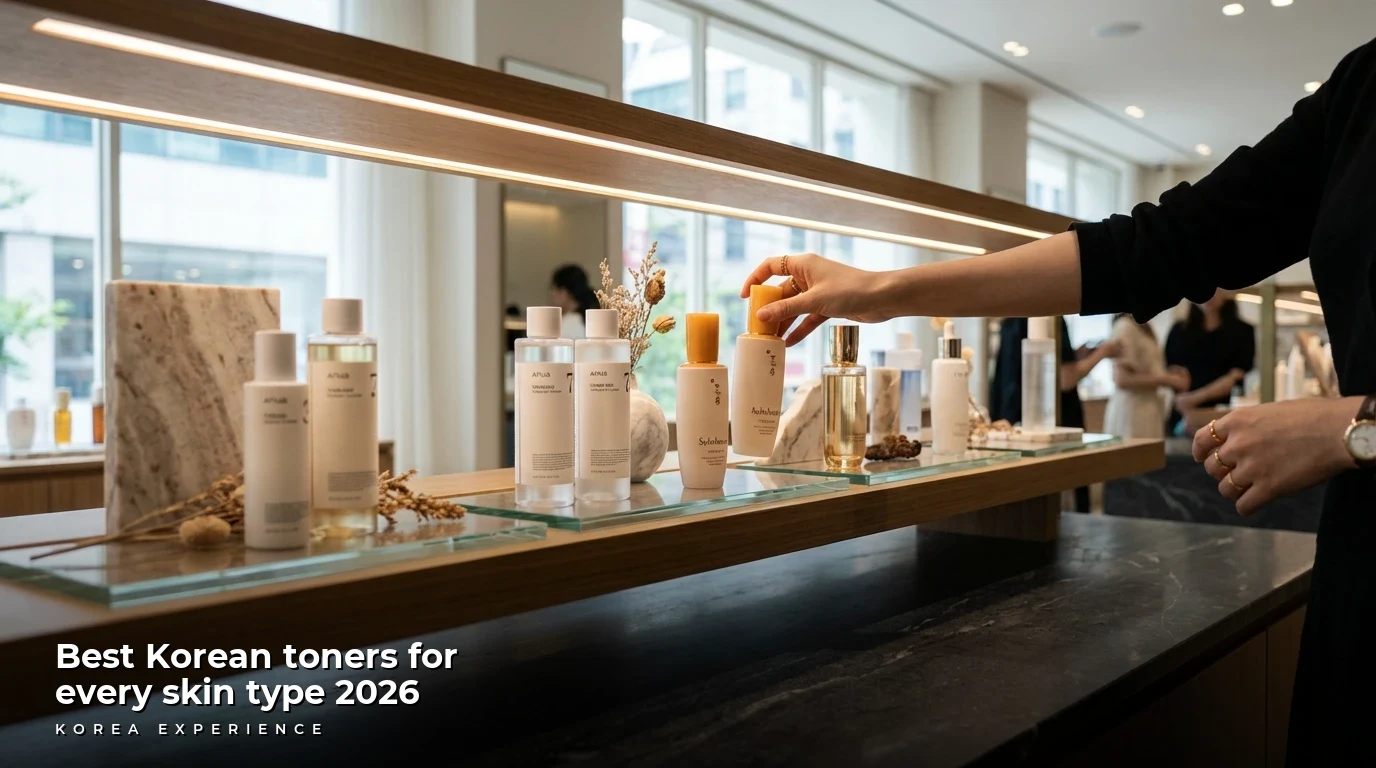
Discover the top-rated K-Beauty toners of 2026. From the viral Anua Heartleaf to Sulwhasoo luxury, find the perfect pH 5.5 match for your skin barrier.
Compare Potenza and Morpheus8 costs in Seoul for 2026. Save 70% with prices starting at $215 USD versus $1,500 in the West for skin tightening.