Same-Day Consultations and Procedures in Korea: Pros and Cons 2026
A complete guide to same-day medical treatments in Seoul. We analyze safety, costs (saving up to 40%), and efficiency for travelers in 2026.
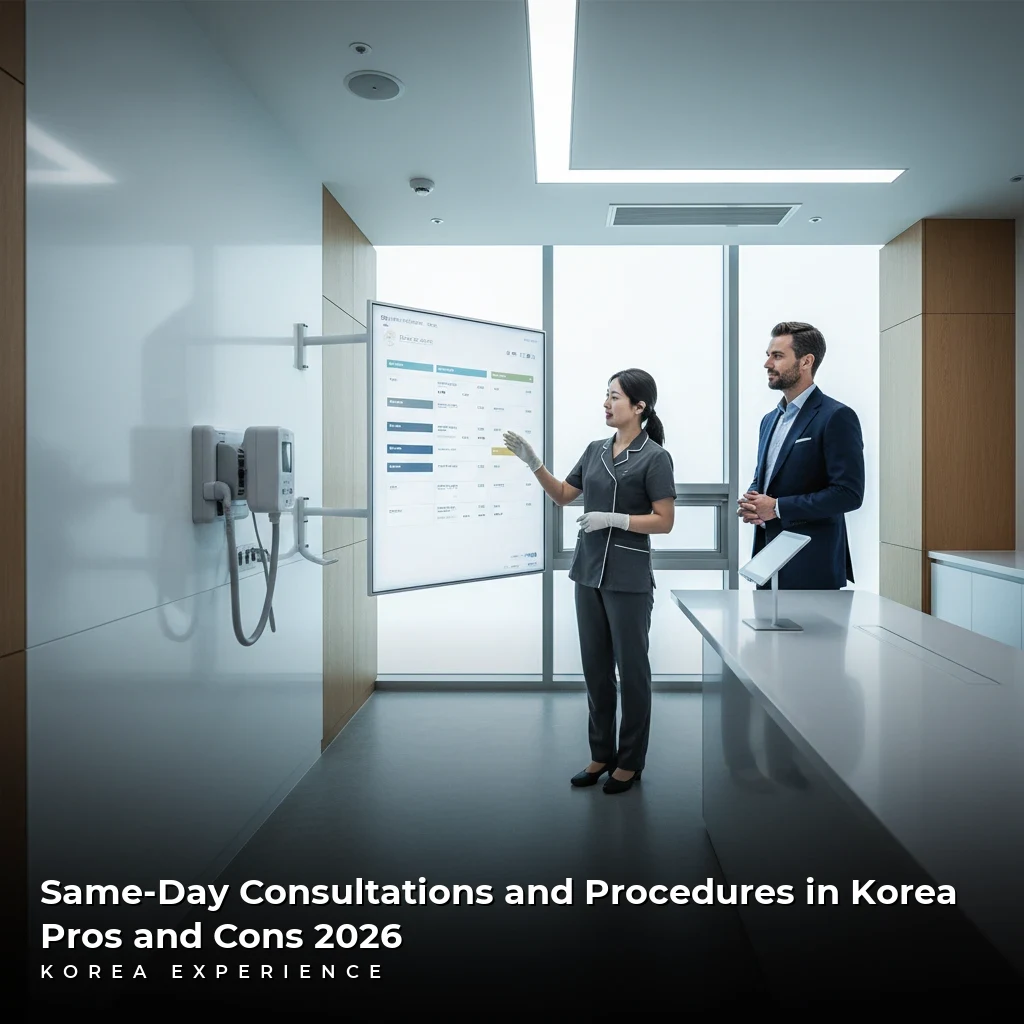
In the fast-paced world of Korean medical tourism, the concept of "same-day consultation and procedure" has become a defining feature of the industry. For international travelers landing at Incheon International Airport, time is often the most valuable currency. The ability to walk into a clinic in Gangnam, consult with a specialist, and undergo a treatment within a single 3 to 4-hour window is a revolutionary concept for those accustomed to the weeks-long waiting lists common in Western healthcare systems. However, while the efficiency is undeniable, it raises valid questions regarding safety, decision-making pressure, and post-procedure recovery.
The short answer: Same-day procedures are highly efficient for non-invasive treatments like dermatology, vision correction, and minor aesthetics, often saving travelers 3-5 days of itinerary time. However, they require rigorous prior research to avoid "factory" clinics and are generally not recommended for major invasive surgeries where comprehensive pre-operative screening is crucial.
Key Takeaways
- 1Efficiency is the primary benefit, compressing weeks of appointments into a 3-4 hour visit.
- 2Cost savings are significant, often 30-40% cheaper than US prices, plus VAT refunds of 7-10%.
- 3Not all procedures are safe for same-day execution; distinct limits exist for invasive surgeries.
- 4The 'Palli-Palli' culture ensures speed but can lead to decision fatigue for unprepared patients.
The Phenomenon of "Palli-Palli" Medicine
To understand why same-day procedures are so prevalent in Korea, one must understand the cultural concept of "Palli-Palli" (Quick! Quick!). This cultural urgency has permeated the medical sector, particularly in cosmetic and elective procedures. In 2026, Seoul boasts over 500 clinics concentrated in the Gangnam and Seocho districts alone, creating a hyper-competitive environment where efficiency is a key selling point.
For a traveler, this means the logistical friction is removed. You do not need a referral from a general practitioner. You do not need to wait two weeks for a consultation slot. Most clinics operate with extended hours, often until 8:00 PM or 9:00 PM on weekdays and 4:00 PM or 5:00 PM on Saturdays, specifically to accommodate this volume.
📊 Efficiency Statistics 2026
However, "fast" does not always equate to "rushed" in the negative sense. The infrastructure of these clinics is built for speed. From high-speed elevators in medical towers like the 18-story buildings near Gangnam Station Exit 10 to the digital integration of charts and photos, every step is optimized. But is this speed right for you?
Suitable vs. Unsuitable Procedures for Same-Day Service
The most critical factor in determining whether a same-day approach is a "Pro" or a "Cons" lies in the type of procedure you are seeking. Not all medical treatments are created equal, and the risks rise exponentially with the invasiveness of the surgery.
The Green Light: Ideal for Same-Day
These treatments carry low risk, require local anesthesia (numbing cream or drops), and have minimal downtime.
- Dermatology & Skincare: Laser toning, Ulthera, Thermage, and acne treatments.
- Injectables: Botox, fillers, and skin boosters like Rejuran Healer.
- Vision Correction: LASIK, LASEK, and SMILE eye surgeries (provided you pass the morning inspection).
- Dental: Cleaning, whitening, and simple resin fillings.
- Minor Aesthetics: Mole removal, thread lifts (non-incisional).
The Red Light: Avoid Same-Day
These require general anesthesia, fasting, blood work analysis that takes time, and mental preparation.
- Major Plastic Surgery: Rhinoplasty (nose jobs), breast augmentation, tummy tucks.
- Bone Contouring: Jaw shaving, zygoma reduction.
- Liposuction: Large volume removal.
General Anesthesia Warning
Never feel pressured to undergo a procedure requiring general anesthesia on the same day as your first consultation. Legitimate clinics will require blood tests, ECGs, and a fasting period of at least 8 hours prior to surgery.
For more detailed information on skin treatments specifically, check out our guide to best Korean skin clinics in Gangnam.
The Pros of Same-Day Consultations and Procedures
1. Unmatched Time Efficiency
The primary advantage is maximizing your travel itinerary. In many Western countries, the process involves a consultation day, a waiting period, and a separate procedure day. In Korea, you can land at Incheon Airport at 7:00 AM, take the AREX train (45-60 minutes) to Seoul, and be in a clinic by 10:00 AM. By 2:00 PM, you are finished.
This frees up the remainder of your trip for sightseeing or recovery. For example, a traveler visiting for 5 days can dedicate Day 1 to the procedure and Days 2-5 to enjoying the city, rather than having the procedure looming over the end of the trip.
2. Cost-Effectiveness
Time is money, especially when factoring in accommodation. By consolidating the medical portion of the trip, you reduce the number of days you need to be in the country solely for medical reasons.
Furthermore, many clinics offer "package pricing" for same-day decisions. It is not uncommon to see a 10-20% discount applied if the procedure is done immediately after the consultation. For high-ticket items like Ulthera (approx. ₩2.5 million) or SMILE eye surgery (approx. ₩2.8 million), this discount covers the cost of your hotel stay.
💵 Potential Cost Savings (Estimates)
Comparison based on 600-shot Ulthera treatment prices in 2026.
Consult fee + Procedure + 2 visits
Package deal + Tax Refund
3. Integrated Diagnostics
Korean clinics often possess diagnostic equipment that allows for immediate analysis. In a dermatology clinic, the Visia skin scanner takes 3 minutes to map your pores, wrinkles, and pigment. In an ophthalmology clinic, over 50 different eye tests are run in a streamlined "circuit" taking about 60-90 minutes.
This integration eliminates the "we need to send your labs out" delay common in other countries. You see the results on a screen with the doctor immediately.
The Cons of Same-Day Consultations and Procedures
1. The "Factory" Assembly Line Feel
The high volume of patients required to sustain this model can lead to a dehumanizing experience. In some large clinics (often called "factory clinics"), you may spend more time with a consultant (salesperson) than the actual doctor.
The doctor might enter the room for 3 minutes, confirm the treatment plan, mark your face, and leave. While efficient, this lacks the doctor-patient rapport that many Western patients expect. You are a number in a queue.
If a consultant tries to prevent you from seeing the doctor until after you've paid, leave immediately. This is a major red flag. The doctor must assess you before any financial transaction for the procedure occurs.
2. Decision Fatigue and Pressure
When you are jet-lagged and sitting in a high-end consultation room, the pressure to say "yes" can be overwhelming. Consultants are trained sales professionals. They may use tactics like "This special price is only valid if you do it today."
This environment makes it difficult to think critically or compare options. You might agree to additional treatments (upselling) like adding a skin booster to your laser treatment, increasing your bill from ₩500,000 to ₩1,500,000 in seconds.
3. Post-Procedure Logistics
Doing everything in one day sounds great until you realize you have to navigate the Seoul subway system during rush hour (6:00 PM - 8:00 PM) with a swollen face or dilated pupils.
If you have vision correction surgery, you cannot look at your phone to navigate Naver Maps. If you have had facial aesthetic procedures, wearing a mask is mandatory, but the humidity in summer can be uncomfortable.
For those considering more invasive options, read about booking medical consultations to understand how to stagger your appointments.
Detailed Process: What a "Same-Day" Actually Looks Like
To give you a realistic expectation, here is a typical timeline for a same-day dermatology visit in Gangnam.
The Same-Day Journey
Check-in
Registration, passport scan for tax refund, filling out English medical history forms.
Consultation
Meeting with the English coordinator and doctor. Skin analysis via scanner.
Payment & Prep
Payment is settled. Face cleansing and application of numbing cream (wait time 30-40 mins).
Procedure
Laser treatment, injections, or care. Usually takes 20-45 minutes.
Aftercare
Cooling mask, LED light therapy, and application of sunscreen/BB cream.
Pharmacy & Exit
Prescription pickup (usually on the ground floor) and tax refund slip collection.
Financial Breakdown and Logistics
One of the most compelling arguments for same-day procedures is the financial transparency. Korean clinics are accustomed to international patients and often have price lists (menus) available in English, Chinese, and Japanese.
The Deposit System
For same-day appointments, especially for popular doctors, you may be asked to pay a deposit via PayPal or Wise beforehand. This is usually 50,000 to ₩100,000 (approx. $35-$75). This amount is deducted from your final bill. If you cancel within 24 hours, it is usually non-refundable.
Tax Refunds
Almost all cosmetic procedures in Korea are eligible for a VAT refund (Tax-Free). This is generally between 7% and 10% of the total cost.
- Total Bill: ₩1,000,000
- Refund: Approx 70,000 - ₩80,000
- Process: You receive a slip at the clinic and scan it at the kiosk at Incheon Airport upon departure, or some clinics offer "Immediate Tax Refund" where they deduct it instantly if you present your passport.
📋 Financial Quick Facts
Note: The consultation fee is often waived if you proceed with a treatment on the same day.
Safety Protocols: How to protect yourself
While the system is safe, the "pros" only outweigh the "cons" if you verify the clinic's legitimacy. The speed of the process should not mean a skip in safety protocols.
- Board Certification: Ensure the doctor is a board-certified specialist. In dermatology, look for "Dermatologist" specifically, not just "General Practitioner performing dermatology."
- CCTV: By law (as of late 2023/2024), operating rooms where patients are unconscious must have CCTV recording capabilities to prevent "ghost surgeries" (where a different doctor performs the surgery than the one you hired). While less relevant for minor skin lasers, it is crucial for anything involving sedation.
- Emergency Equipment: Even small clinics should have a defibrillator and emergency oxygen visible or confirmed.
Red Flag Alert
If a clinic refuses to tell you the brand name of the Botox or filler they are using, or refuses to open the box in front of you, do not proceed. Authentic products (Juvederm, Restylane, or Korean brands like Botulax) should always be unboxed in your presence.
For those looking into more structural changes, seeing a specialist is non-negotiable. Check our guide on best rhinoplasty clinics in Gangnam for examples of vetting clinics.
Strategic Scheduling: The "Sandwich" Method
To mitigate the "Cons" of rushing, experienced medical tourists use the "Sandwich Method."
- Step 1 (Online): conduct a "virtual consultation" 2 weeks before flying. Send photos via KakaoTalk or WhatsApp to 3 different clinics. Get price estimates and recovery times.
- Step 2 (Arrival): Schedule the physical consultation for the morning of Day 2.
- Step 3 (Procedure): If you like the doctor, do the procedure immediately. If not, use your pre-researched backup clinic for the afternoon.
This method retains the efficiency of same-day treatment but removes the blind element.
📖 How to Prepare for a Same-Day Appointment
Step 1: Research & Shortlist
Select 3 clinics. Check Google Reviews and Gangnam Unni app (using translation).
Step 2: Online Inquiry
Message them on KakaoTalk. Ask: 'Is same-day treatment possible for [Procedure] on [Date]?'
Step 3: Pre-Flight Prep
Stop taking aspirin, Vitamin E, or blood thinners 1 week prior to reduce bruising.
Step 4: The Day Of
Arrive with a bare face. Bring your passport for the tax refund.
Comparison: Clinic Types
Not all venues offer the same "Same-Day" experience. It is important to choose the venue that matches your personality and budget.
Clinic Type Comparison
| Feature | Factory/Network Clinic | Boutique Private Clinic | University Hospital |
|---|---|---|---|
| Price | $ (Low) | $$ (Medium-High) | $$$ (High) |
| Wait Time | Long (Crowded) | Short (Reserved) | Very Long |
| Dr. Face Time | 2-5 mins | 15-30 mins | 10-20 mins |
| English Fluency | Coordinators only | Dr. often fluent | Dedicated Center |
| Same-Day Ability | Very High | High (if booked) | Low |
Managing Recovery on the Go
One of the hidden "Cons" is managing recovery while staying in a hotel or Airbnb. If you have a same-day procedure, you are discharged immediately.
- Ice Packs: Most hotels in Korea have small freezers, but double-check. Clinics will usually give you one ice pack.
- Sleeping Upright: If you get fillers or thread lifts, you may need to sleep elevated. Does your accommodation have extra pillows?
- Diet: If you have dental work or lip fillers, eating spicy Korean food (Kimchi, Tteokbokki) might be painful or cause swelling. Plan for softer, milder meals like Juk (Korean rice porridge) for the first 24 hours.
If you are debating between accommodation types for your recovery, read our comparison on Airbnb vs recovery hotels.
The Verdict: Is it right for you?
Same-day consultations and procedures are a marvel of Korean medical efficiency. They democratize access to beauty and health treatments, making them accessible to short-term visitors.
Pros Summary:
- Saves massive amounts of time.
- Cost-effective (package deals + tax refunds).
- Access to cutting-edge diagnostic tech instantly.
Cons Summary:
- Risk of feeling rushed or pressured.
- Less personal connection with the doctor in large clinics.
- Logistical challenges post-treatment (transit, food).
Summary: Same-Day Procedures
- ✓Efficiency: Complete diagnosis and treatment in <4 hours
- ✓Cost: Save 30-50% compared to Western prices
- ✓Technology: Immediate results from advanced scanners
- ✓Accessibility: Easy booking via KakaoTalk/WhatsApp
- ✗Pressure: Sales tactics can be aggressive
- ✗Impersonality: 'Factory' clinics lack warmth
- ✗Follow-up: No physical follow-up if you fly out
- ✗Swelling: Flying with fresh swelling can be uncomfortable
For the savvy traveler who has done their homework, the Pros generally outweigh the Cons for minor treatments. However, for anyone considering major surgery, the "Same-Day" allure should be resisted in favor of safety and deliberation.
Frequently Asked Questions
❓ Common Questions About Same-Day Procedures
Have more questions?Contact us →
By understanding the mechanics of the "Palli-Palli" medical system, you can leverage its speed to your advantage without compromising your health. Whether you are fixing your vision or refreshing your skin, Seoul offers a medical speedway that, when navigated correctly, is the envy of the world.
About the Author
Korea Experience Team
Written by the Korea Experience editorial team - experts in Korean medical tourism, travel, and culture with years of research and firsthand experience.
⚠️ Medical Disclaimer
The information provided on this website is for general informational purposes only and does not constitute medical advice. Always consult with qualified healthcare professionals before making any medical decisions.
Explore more in Medical Tourism
World-class medical procedures at competitive prices. From plastic surgery and dermatology to dental care and health checkups — your complete guide to medical tourism in Korea.
Browse All Medical Tourism ArticlesContinue Reading
Explore more articles you might find interesting

A complete guide to securing medical second opinions in Seoul's top hospitals. Costs, required documents, and booking steps for 2026 travelers.
A complete guide comparing acne treatments in Seoul. We analyze costs, downtime, and efficacy of Isotretinoin, lasers, and peels with 2026 pricing data.
The complete 2026 guide to emergency medical care in Seoul. Find the best international hospitals, ER costs, and English-speaking services for travelers.
Is Seoul safe for surgery in 2026? We analyze 1.5M patient stats, new CCTV laws, and the end of the 10% VAT refund to keep your procedure secure.
Comprehensive guide to vaginal rejuvenation in Seoul 2026. Compare costs (saving 30-50%), English-speaking clinics, laser treatments, and surgical options.
Unlock the secrets to brighter skin in Korea. Compare Glutathione IV drips and topical treatments, including costs, effectiveness, and safety in Seoul clinics.