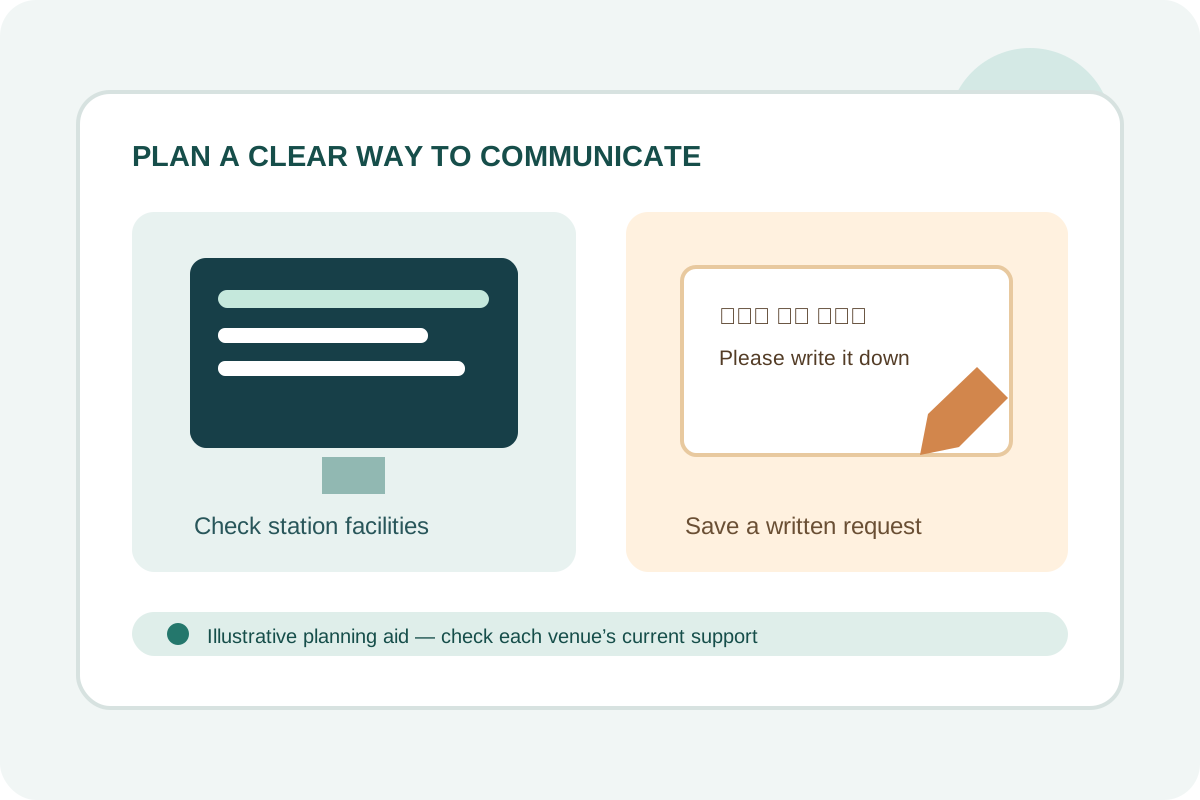
Plan how you will exchange information at each stop, rather than assuming every Seoul station or attraction offers the same support. Seoul publishes a station-by-station inventory that includes sign-language video phones, and the city’s accessible-tourism listings identify some venues with sign-language interpretation videos. Those listings help you plan; they do not confirm live availability, interpretation language, or a particular staff member’s ability to communicate with you.
This guide focuses on Deaf and hard-of-hearing visitors. Seoul’s broader wheelchair and step-free route guide covers mobility access separately.
Before you leave your hotel
Save the Korean name and address of each destination, a map pin, your hotel contact details, and any ticket or reservation. Keep them as text that you can show or send. If spoken announcements are difficult to follow, enable the visual notification features you already use on your phone and check station displays as you travel; a screen is useful support, but it may not show every service change.
You can show this request when you need written communication:
수어 통역이 필요합니다. 글로 써 주세요. — I need sign-language interpretation. Please write it down.
For a specific question, write one point at a time and ask the other person to type or write the answer. Save important details such as a changed platform, meeting point, or appointment time. This is a practical communication suggestion, not a guarantee that every service desk can provide interpretation.
Check subway support at the station you will use
Seoul Metropolitan Government’s Subway Accessibility Facilities inventory lists facilities by station, including a Sign Language Video Phone column. Search the origin, transfer, and destination stations individually. The list shows that the facility is present at some stations and absent from others; it is not a live status feed, and it does not state which sign language or interpretation service is available at each device.
If you plan to use one, ask station staff to confirm the device’s location and operating condition when you arrive. Keep your written destination and question ready in case the device is unavailable or not suitable for your communication needs. Seoul’s general accessibility information also describes visual and hearing support on public transport, while cautioning that smaller and older stations may not have every listed facility.
Choose venues by the support they actually list
Use Seoul’s Accessible Tourism directory to find individual attraction profiles. Some profiles describe sign-language interpretation videos accessed by QR code. For example, the city’s profile for the Seoul Yangnyeongsi Herb Medicine Museum mentions sign-language interpretation videos, an accessible information desk, and other features. Check the selected venue’s current page and contact it before travelling if the service is essential; a city profile may describe a particular facility or update date rather than all current operations.
Before booking a performance, tour, workshop, or guided visit, send the organizer a short written message asking:
- Is a sign-language interpreter or captioning available for this exact date and session?
- Which sign language, spoken language, or caption format is used?
- Is advance reservation required, and is there a fee?
- Can staff send a written summary or instructions if the requested support is unavailable?
Do not infer that a venue provides an interpreter simply because it appears in an accessible-tourism directory. Ask the operator to confirm the service and the details that matter to you.
If plans change
Keep a prepared text card with your hotel name, destination, and preferred contact method. If a train or appointment changes, show the relevant ticket or reservation and ask staff to write the next step. For a time-sensitive problem, ask a companion or staff member to help contact the operator if text communication is not enough. Do not rely on this guide as emergency dispatch or as confirmation that interpretation is available at a particular desk.
Quick planning checklist
- Look up every station you will use in Seoul’s facility inventory.
- Save destination names, Korean addresses, tickets, and important questions as text.
- Ask venues and tour operators to confirm interpretation or captions for your exact date.
- Keep a written fallback ready in case a device or service is unavailable.
Sources checked 17 November 2026. Facility lists and venue services can change; recheck the operator’s current information before travel.