For: visitors already in Seoul who need to decide whether to change a bus or subway journey during snow. Checked: 15 November 2026. Seoul’s cited winter plan covers 15 November 2026–15 March 2027; later seasons may use different measures. This is a how-to, not a live disruption feed.
First check the route you will actually take
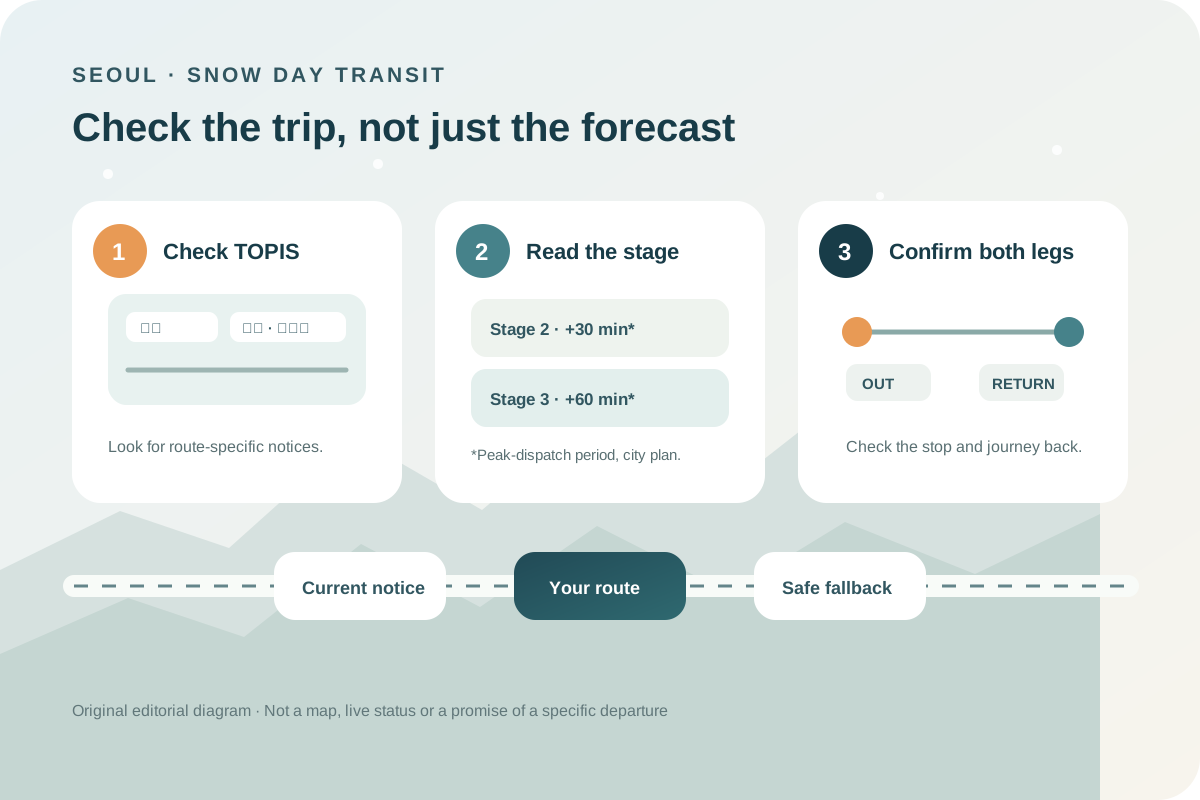
Open Seoul’s official TOPIS transport information system and check incidents, road controls, bus information and subway information for your route. The interface is primarily in Korean; the labels 돌발 (incidents), 통제 (controls), 버스 (bus) and 지하철 (subway) identify the relevant menus. A citywide snow response does not tell you whether a particular bus, station or train is operating normally. Check again before you leave and before you make a tight connection.
Seoul’s 2026 winter plan, announced on 11 November, describes these city-level measures:
| Snow response stage in the plan | What the city says it will do | What you still need to check |
|---|---|---|
| Snow-removal stage 2 | Extend the bus and subway peak-dispatch period by 30 minutes. | Your exact line, station, route and departure. The plan does not publish a guarantee for each service. |
| Snow-removal stage 3 | Extend the bus and subway peak-dispatch period by 60 minutes. | Current TOPIS information and the transport operator’s notice. |
| Subway service suspended | Put replacement buses into service. | Whether a suspension applies to your station/line and where replacement buses board. |
The “peak-dispatch period” extension is a city response measure, not a promise that every route has the same frequency or that the last train or bus will run later. Do not plan to catch a usual final service based on the extension alone.
A practical snow-day decision sequence
- Check timing and area: review the current snow alert and whether it covers your part of Seoul. For the broader alert-to-itinerary process, see how to respond to a snow advisory in Korea.
- Check TOPIS: look for a road control or incident along your bus route and check the bus/subway information panels. Use the operator’s own notice if TOPIS and an operator notice differ.
- Check the trip end-to-end: search the station exit or bus stop nearest your destination, then check the return route. Snow can make a short outdoor transfer or an uncovered stop inconvenient even when a route appears available.
- If a subway is suspended: follow the current replacement-bus instructions for the affected line. Do not assume a substitute bus starts at your usual stop or follows the normal route.
- Keep an alternative: choose a nearby indoor stop or postpone a cross-city journey if the route remains unclear. Ask your accommodation to help interpret an official notice if needed; do not rely on an old screenshot or a social post as current status.
Where to check official information
- TOPIS: current Seoul traffic controls, incidents and bus/subway information.
- Seoul winter measures: the city’s dated winter response plan and information channels.
- 120 Dasan Call Center: Seoul’s plan lists 120 as a source for public-transport operation information. The page does not promise a particular language service; ask your accommodation for help if you need it.
- Seoul Safety Nuri: the city identifies this as a place to check snow-removal status. Road clearing information is not the same as a confirmation that public transport is operating.
TOPIS is the place to check the current situation; the city plan explains response measures. Neither one guarantees a specific journey. If your route includes a flight, intercity train, attraction or reservation, check that provider separately before changing the booking.
The cover diagram illustrates a decision sequence. It is not a Seoul map, transit map, live service display or promise of a particular departure.