NH vs Hana Bank 2026: The Ultimate Korea Nomad Banking Guide
Hana Bank beats NH for nomads in 2026 with English apps and a $100,000 remittance limit. Discover why 16 Sunday branches make it the top choice.
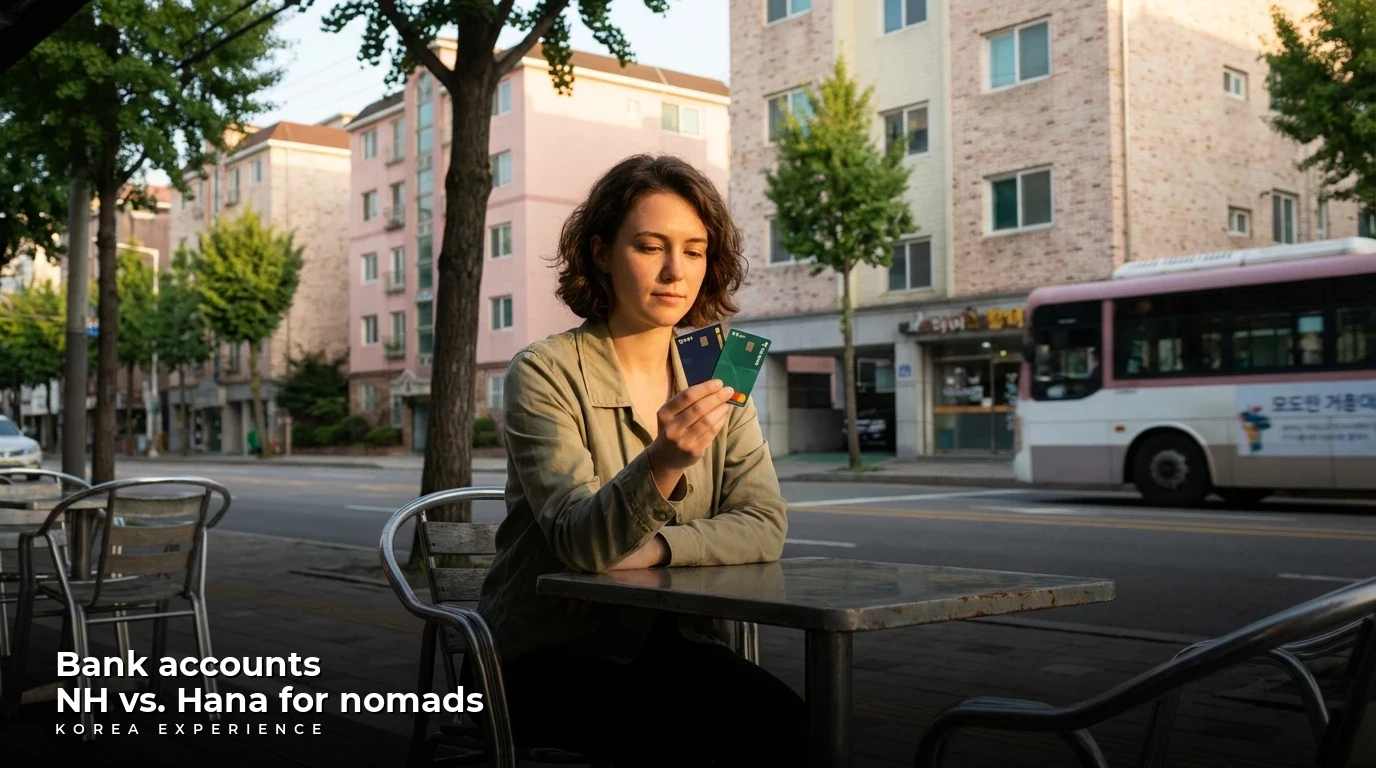
If you are trying to decide between NH Bank and Hana Bank as a foreigner in Korea, save yourself the headache: Hana Bank is the clear winner for digital nomads and expats. While NH dominates the countryside, Hana’s English-first apps, Sunday branches, and relaxed 2026 remittance rules make it the only logical choice for your Korean banking survival kit.
So, you're a nomad in Korea, holding your passport and wondering where to stash your Won. Let's cut right to the chase: Choose Hana Bank.
Seriously, don't overthink this one. If you are a foreigner—whether you're an English teacher, a digital nomad, or a student—Hana Bank (often branded as KEB Hana) is the superior choice over NH (NongHyup). Why? Because Hana has built its entire reputation on being the "foreigner bank." They have an app called Hana EZ that is actually in readable English (and 15 other languages), they have branches that open on Sundays specifically for us, and they are far more accustomed to dealing with names that are longer than three syllables.
Key Takeaways
- 1The short answer is: Go with Hana Bank. Unless you live in a rural village, Hana (KEB Hana) is superior due to its English app (Hana EZ), Sunday services, and staff trained to handle foreign passports.
- 2The magic number is $100,000. Starting in 2026, the government raised the documentation-free overseas remittance limit to $100,000 per year, a massive win for nomads moving capital.
- 3Don't leave the bank until your app is working. Korean banking security is complex. Ensure the teller helps you log into the app and verify your identity before you exit the branch.
📋 Quick Facts
The Verdict: Why Hana Wins in 2026
Here is the deal with the numbers: As of 2026, the government allows you to remit up to $100,000 USD per year without submitting extra documentation. Hana Bank's systems are optimized for this, integrating with Western Union and their own "Just Transfer" system to make moving money painless.
NH Bank, on the other hand, is fantastic if you live in a farming village with 50 people, but their digital infrastructure for foreigners often feels like it's stuck in 2010. Trust me on this one: Go Green (Hana), not the other Green (NH).
To understand why banking in Korea is unique, you have to understand a bit of history. For years, Korean internet security was built around "Public Certificates" stored on USB drives. While Korea has largely modernized, the legacy of this system remains. Historically, KEB (Korea Exchange Bank) was the bank for expats. When Hana Bank acquired KEB, they inherited that DNA. They realized that foreigners don't have Korean resident registration numbers in the same format as locals, and our names are often too long for standard database fields.
If you are struggling with connectivity to even get to the bank, check out our guide on eSIM vs USIM vs Pocket Wi-Fi Korea 2026 to ensure your phone is ready for the identity verification process.
Sunday Banking Expansion
Banks like Hana and Woori began expanding Sunday remittance centers for foreign workers in industrial areas.
Hana EZ Launch
Hana Bank launched the Hana EZ app specifically for foreigners, supporting 16 languages and passport scanning.
Passport Identity Verification
Hana Bank enabled passport-based digital identity verification, allowing limited app access without an ARC.
Mobile Residence Card
Major banks officially accept the government-issued Mobile Residence Card (Digital ARC) for ID verification.
Hana EZ Overhaul
Hana revamped the EZ app to include MileEZ rewards and lifestyle services like utility bill payments.
Remittance Deregulation
The annual limit for documentation-free overseas transfers increases to $100,000 across all financial institutions.
Breaking Down Your Options
Let's walk through the comparison table in real-world terms.
Option A: Hana Bank (The Nomad's Choice) Imagine you lose your debit card on a Saturday. At most banks, you're doomed until Monday. With Hana, you can trek to one of their Sunday branches (like in Hyehwa or Ansan) and actually talk to a human. For digital nomads who might not have a traditional 9-to-5 contract, Hana is also more lenient with "passport-based" services via their Hana EZ app. You might still face the "restricted account" limit (around 300,000 KRW daily withdrawal) at first, but the app interface makes managing this annoyance much easier.
Option B: NH Bank (The Rural Necessity) I learned this the hard way: I once lived in a small town where the nearest Hana Bank was a 45-minute bus ride away, but there was an NH Bank right next to my apartment. If you are in the countryside (and I mean deep countryside), NH is ubiquitous. They are everywhere. But be warned: their mobile banking app often requires Korean language proficiency, and setting up online transfers can involve a lot of paperwork. If you are a city-dwelling nomad, there is almost no reason to choose NH.
Option C: Neo-Banks (Toss / Kakao) "Why not just use KakaoBank?" I hear this all the time. Here is the thing: You usually need a valid ARC and a Korean phone number that matches your ARC perfectly to sign up. If you have those, KakaoBank is amazing—super fast, great UI. But if you are fresh off the plane or on a tourist visa, these digital-only banks will likely reject you instantly. They lack the physical branches to verify a passport manually.
| Feature | Hana Bank (KEB Hana) | NH Bank (NongHyup) | Neo-Banks (Toss/Kakao) |
|---|---|---|---|
| Foreigner Friendliness | ⭐⭐⭐⭐⭐ (Excellent) | ⭐⭐ (Poor) | ⭐⭐⭐ (Good, if you have ARC) |
| English App Quality | Hana EZ: 16 languages, intuitive | NH Smart: Clunky, bad translations | Toss: Great UI, limited English |
| Sunday Banking | ~16 dedicated branches | Very rare | 24/7 (Digital only) |
| Requirements | Passport + Visa (ARC preferred) | Passport + ARC + Employment Proof | ARC + Korean Phone Number |
| Best For | Nomads, Expats, Travelers | Rural residents, Teachers | Long-term residents |
| Online Remittance | Easy via Hana EZ app | Difficult setup | Very easy (Wise integration) |
| 2026 Changes | MileEZ rewards & Passport updates | Slow digital adoption | Expanded loan options |
Pros
- ✓The Hana EZ App is a Lifesaver: Supports 16 languages, passport scanning, and simplified international transfers.
- ✓Sunday Banking Branches: ~16 branches open on Sundays for foreigners (e.g., Wongok-dong, industrial centers).
- ✓No-Nonsense Remittance: Best positioned for the 2026 $100,000 limit with Western Union partnerships.
Cons
- ✗The Restricted Account Trap: New accounts often limited to ₩300,000/day withdrawals until income is proven.
- ✗Strict AML Checks: Large transfers from abroad may freeze accounts until explained due to strict compliance.
- ✗Branch Wait Times: Foreigner-heavy branches (Itaewon, Hongdae) can have 2-hour wait times.
Step-by-Step Guide to Opening Your Account
Ready to open that Hana account? Let's do this properly. You need your Passport, your ARC (if you have one), and your Korean SIM card.
Crucial: Ensure your SIM card is registered to your name. If you are using a "travel SIM" registered to a tour company, you cannot open a bank account. It must be a real number linked to your identity. If you run into issues with your card later, especially at automated machines, check our guide on Foreign Card Rejected at Korean Kiosks? Here's How to Fix It.
📖 How to Open a Hana Bank Account (The Stress-Free Method)
Step 1: Gather Your Golden Documents
Bring your valid Passport and ARC (if you have one). You also need a Korean Phone Number registered exactly to your name (e.g., JOHN SMITH vs SMITH JOHN matters). Proof of residence (housing contract) is often required.
Step 2: Choose the Right Branch
Visit a "Global Desk" branch or one in a foreigner district like Itaewon or Hongdae. Take a ticket for "New Account" or "Foreign Exchange".
Step 3: The Interview
State your purpose as "Living expenses" or "Salary". Do not say "Crypto". Sign your name multiple times. Ask specifically for a Check Card (Debit) with T-Money transport function.
Step 4: App Setup (Do NOT leave yet!)
Download Hana EZ while at the desk. Log in and verify identity via SMS. If "Name Mismatch" errors occur, the teller can fix it immediately. Set up your 4-digit Account Password and 6-digit Transfer Password.
Honestly, the biggest mistake I see newbies make is accepting the 'Restricted Account' limits forever. The bank gives you a 300,000 won daily limit initially, which is fine for coffee, but you can't pay rent with that. As soon as you pay your first month's utility bill (gas or electric) in your name, take that receipt back to the bank! That piece of paper proves you really live there and is usually enough for them to lift the restriction to a normal limit. Don't wait for them to offer—you have to ask.
Insider Secrets & Warnings
Here are the insider secrets that will save you tears.
The "Mobile ARC" Hack: Since March 2025, Korea has officially recognized the Mobile Residence Card. This is an app on your phone that acts as your ID. Hana Bank was one of the first to accept this. If you forget your plastic ARC at home, you can theoretically use the app at the counter. However, old habits die hard—some older tellers might still demand the plastic. Be patient, but know the law is on your side.
The Lunchtime Death Zone: Never, ever go to a bank in Korea between 11:30 AM and 1:30 PM. Korean office culture dictates that everyone takes lunch at the same time, and they all run errands during that hour. You will wait for 90 minutes. Go at 9:00 AM when they open.
The "Digital Certificate" Nightmare is Fading: For years, Korean banking required a "Public Certificate" (gongin-inzeungseo) stored on a USB. It was hell. In 2026, most of this has moved to "Mobile Certificates" or simple biometric verification in apps like Hana EZ. If a teller tries to sell you on a USB certificate, ask if you can just use the Mobile OTP (One Time Password) instead. It's much easier and lives on your phone.
Once you have your account sorted, you can easily shop at local stores. For tips on what to buy for your new apartment, read our Daiso Korea 2026 Survival Guide.
No Korean Phone/ARC? Here's What To Do
If you are a tourist or a nomad here for just 2 months and can't get a phone contract or ARC, do NOT try to open a traditional bank account. It is almost impossible and not worth the effort. Instead:
- Get a WOWPASS: A prepaid debit card for tourists. Load it with foreign currency cash at subway stations.
- Use NAMANE Card: Similar to Wowpass, but customizable. Good for transport and shopping.
- Hana Money / Travellog: Virtual prepaid card options, though WOWPASS is the physical card king for short-term visitors in 2026.
Foreigner-Friendly Sunday Branches
If you are stuck working all week, these are the holy grail locations that open on Sundays.
Hana Bank Wongok-dong Foreign Customer Center
- Address: 17 Wonbon-ro, Danwon-gu, Ansan-si, Gyeonggi-do
- Hours: Sunday 10:00 - 16:00
- Transit: Ansan Station (Line 4), Exit 1
- Note: Located in a multicultural district; staff have seen every visa type imaginable.
Hana Bank Hyehwa-dong Branch
- Address: Near Hyehwa Station, Jongno-gu, Seoul
- Hours: Sunday 10:00 - 16:00
- Transit: Hyehwa Station (Line 4)
- Note: Near the Philippine Market area. Go early as it gets crowded with people sending money home.
❓ Frequently Asked Questions
Have more questions?Contact us →
Conclusion
Look, navigating Korean bureaucracy can feel like a full-time job, but banking doesn't have to be the hardest part.
- Download the Hana EZ app before you even go to the bank to get familiar with it.
- Go to a Hana Bank branch (preferably a Global Desk).
- Bring your Passport, ARC, and Phone.
- Set up the app with the teller.
That’s it. Don't let the paperwork scare you. Once you have that Hana card in your wallet and the app on your phone, you unlock the real Korea—food delivery, easy subway rides, and effortless payments. You've got this!
Sources
- Hana Bank Official: Information on Hana EZ app upgrades and MileEZ rewards.
- Korea Times: Data on the 2026 remittance limit increase to $100,000.
- Ministry of Justice (HiKorea): Details on Mobile Residence Card acceptance at banks starting March 2025.
- Hana Financial Group: Information on global networks and Sunday banking locations.
- Korea JoongAng Daily: Reports on Hana EZ app features for non-Korean users.
About the Author
Korea Experience Team
Written by the Korea Experience editorial team - experts in Korean medical tourism, travel, and culture with years of research and firsthand experience.
Explore more in Living in Korea
Everything expats and long-term visitors need to know — from visa requirements and housing to banking, healthcare, and daily life tips.
Browse All Living in Korea ArticlesContinue Reading
Explore more articles you might find interesting

The ultimate 2026 guide to remote work in Jeju Island. Discover 500Mbps cafe speeds, top coworking spaces, and living costs for digital nomads.

A comprehensive guide to the top Korean banking apps for expats in 2026, ranking UX, English support, and digital remittance features.
With 36.1 percent of households living alone in 2026 Seoul solo dining is booming. Discover the best spots and apps to enjoy Korean BBQ without a local ID.

The ultimate guide to finding meaningful volunteer work in Seoul for 2026. Discover animal shelters, soup kitchens, and language exchange programs.

The ultimate guide to building a social circle in Korea. Discover where to meet locals, cultural etiquette, and the best apps for making Korean friends.
Discover the best apps and offline meetups for language exchange in Korea. Learn about costs, locations, safety tips, and how to make local friends.