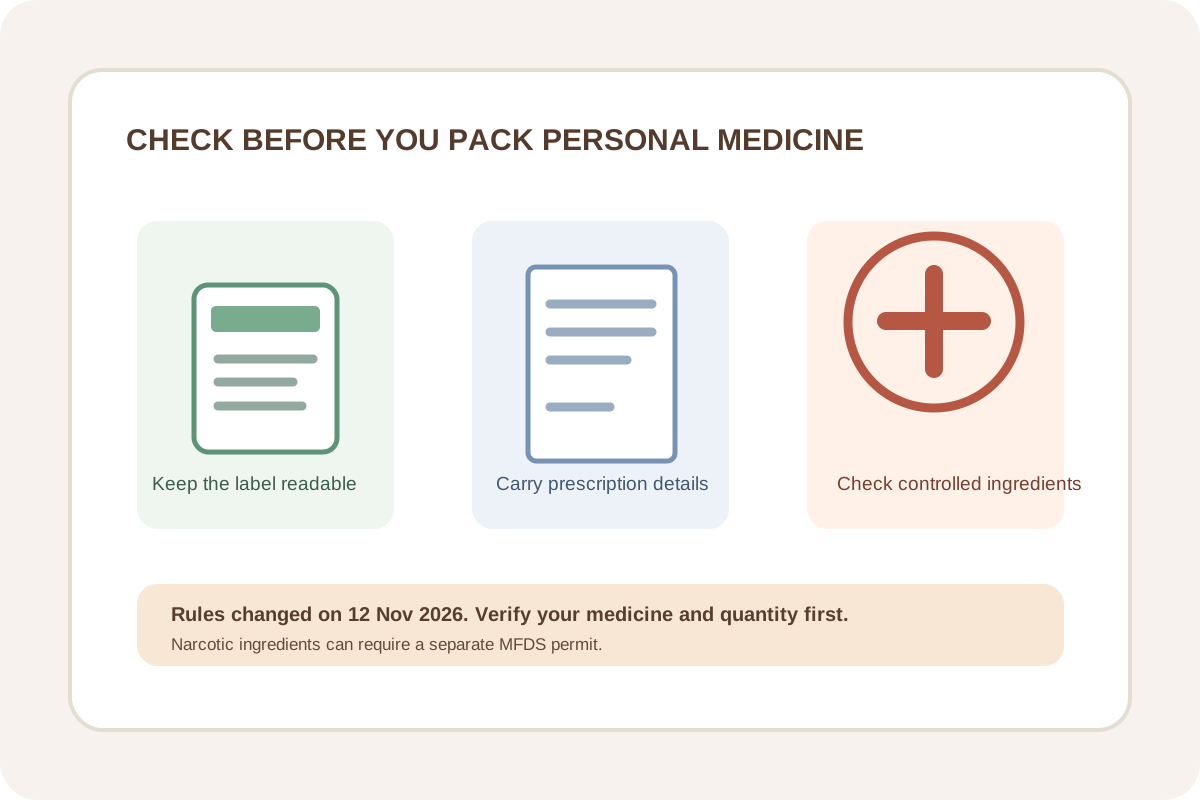
Check the active ingredients before packing medicine for Korea. A medicine bought legally abroad can still contain an ingredient that Korea controls separately. A recent customs change permits qualifying personal-treatment medicine in a traveler’s baggage within a stated quantity, but this general allowance does not cancel separate restrictions on narcotic ingredients or other regulated products.
This guide concerns medicine you bring into Korea for your own treatment. It does not cover buying pharmacy medicines in Korea or carrying Korean prescriptions home; those are separate questions.
The general personal-treatment allowance
On 11 November 2026, Korea’s Ministry of Food and Drug Safety (MFDS) and Korea Customs Service announced that, from 12 November 2026, a traveler may carry in medicine for self-treatment when it was prescribed or purchased through the country’s normal medical system and is formally approved by that country’s medicine regulator. The notice states a limit of six bottles; when more than six are needed under the medicine’s directions, it allows the amount for three months of use. It gives a weekly self-injection medicine as an example where three months can exceed six units.
This summary reflects the agencies’ official customs announcement, checked 17 November 2026. The announcement is in Korean. Product categories, regulated ingredients, packaging, and individual import requirements can affect how the rule applies. If your medicine or quantity is not clearly covered, confirm with Customs or MFDS before departure instead of treating the general number as a personal clearance guarantee.
Check whether the ingredient is controlled
Korea Customs warns that medicines sold legally overseas can contain narcotic ingredients controlled under Korean law. The Customs Service’s warning about medicines containing narcotic substances directs travelers to check ingredients; qualifying self-treatment imports of narcotics require approval from MFDS through its separate process.
Use the MFDS Drug Safety Korea English site and its Permit To Bring In Narcotics For Self-treatment service to check the current application route. Do this well before travel so you can ask what documents and lead time apply to your medicine. Do not rely on a pharmacy brand name, a foreign prescription, or a doctor’s letter as a substitute for an approval that the Korean authority requires.
Other medicines can also have individual import conditions. The Customs Service identifies exceptions such as items subject to separate legal requirements, import-prohibited or harmful products, and products whose ingredient labeling is unclear. If you take combination cold, sleep, pain, or attention medicines, check the active ingredients rather than only the product name.
Prepare information to show if asked
Keep the medicine in its labeled packaging where practical. Carry a copy of the prescription or a clinician’s medication list showing the generic name, strength, and directions, plus the original package or a clear photo of its ingredient panel. These are practical ways to identify what you carry; this guide does not claim that the same documents are legally required for every medicine.
If you have an MFDS approval, keep the approval information with the medicine and follow the conditions it states. Keep medicine that you may need during the flight in your hand luggage, subject to your airline and aviation-security rules.
A pre-flight checklist
- List each medicine’s active ingredient, strength, and prescribed directions.
- Check the ingredient against the current MFDS and Customs guidance, especially for narcotic or psychotropic ingredients.
- Calculate the quantity from the label and the length of your stay; do not assume a large package automatically qualifies.
- Apply for any required MFDS permit before travel and follow its terms.
- Keep labels and supporting medical information available to explain the medicines you carry.
If Customs or MFDS guidance does not clearly address your case, contact the relevant authority with the ingredient and quantity before packing. This page is a traveler checklist, not a legal classification of a specific medicine.
Rules checked 17 November 2026. The general allowance changed on 12 November 2026; verify the latest government instructions before every trip.