How to audition for K-Pop entertainment companies 2026
Complete guide to K-Pop auditions in 2026. Learn about global castings, the Big 4 agencies, and essential tips for international applicants.
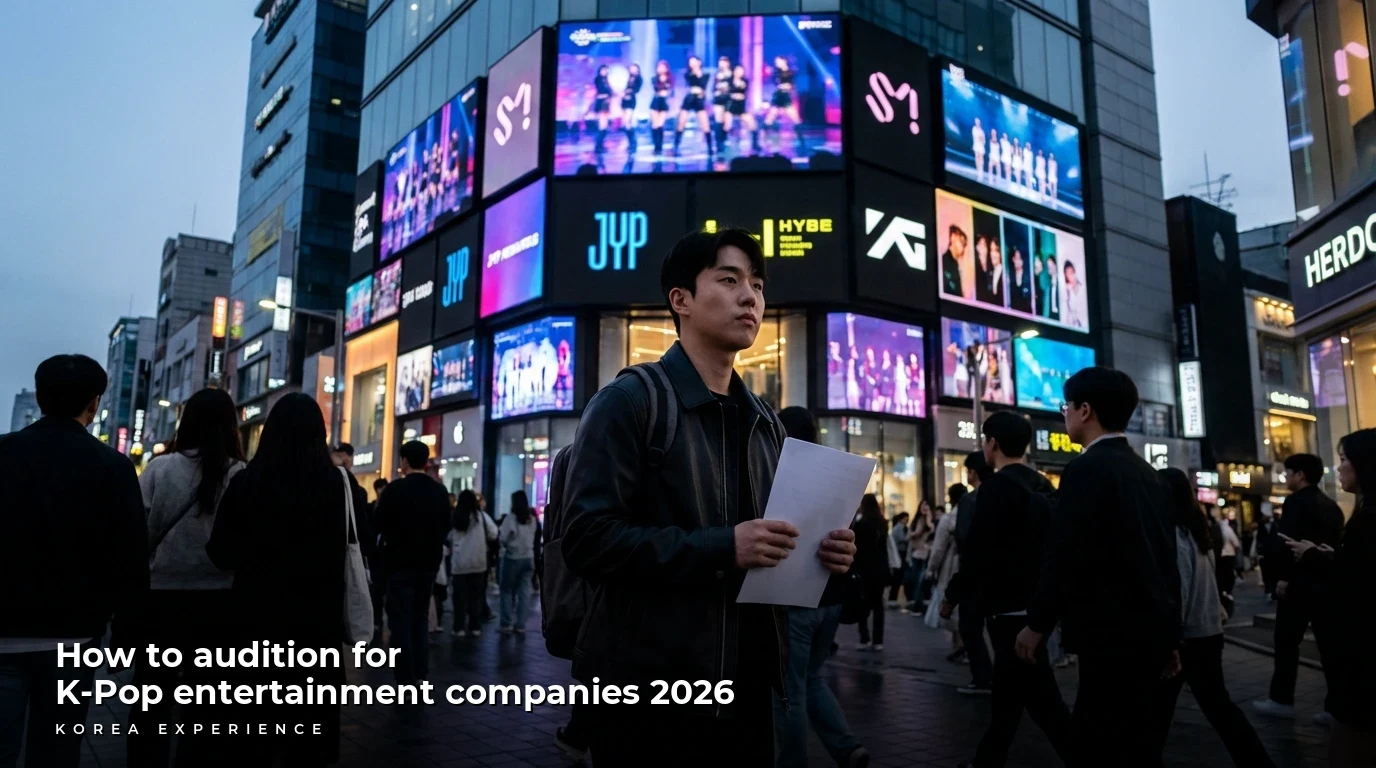
The landscape of K-Pop recruitment has shifted dramatically as we enter 2026. With the industry's explosive global expansion, the "Big 4" agencies—HYBE, SM, JYP, and YG—along with rising mid-tier companies, have streamlined their processes to scout international talent more aggressively than ever before. For aspiring idols living outside of South Korea, the dream is no longer just a fantasy; it is a structured, competitive career path that requires strategic planning, financial preparation, and immense dedication.
Related reading: Best K-Pop concert venues in Seoul ultimate guide.
Whether you are planning a dedicated audition trip to Seoul or submitting materials online from your bedroom in London or Los Angeles, understanding the nuances of the 2026 audition circuit is crucial. This guide covers everything from the specifics of "Saturday Auditions" to the logistical realities of navigating the Gangnam and Yongsan districts.
Learn more in our comprehensive guide to Collecting K-Pop photocards the global market and trading....
Key Takeaways
- 1Global auditions are now 60% of recruitment, with dedicated online portals for 2026
- 2Walk-in auditions often require arriving 2-3 hours before registration opens
- 3Average monthly living costs in Seoul for auditioners range from $1,500 to $2,200
Understanding the Agency Landscape in 2026
Before you book a flight or record a demo, you must understand who you are auditioning for. In 2026, the industry remains dominated by the "Big 4," but the distinct styles and requirements of each have evolved.
Related reading: Ultimate Guide to K-Pop Music Show Recordings in Seoul.
The Big 4: A Quick Profile
HYBE Corporation (home to BTS, TXT, NewJeans) continues to prioritize strong individuality and self-production skills. Their headquarters in Yongsan is a massive 19-story structure that stands as a beacon for K-Pop success. SM Entertainment focuses heavily on visuals and vocal prowess. Their infamous "Saturday Auditions" are legendary for their difficulty—historically, fewer than 10 people pass annually out of thousands. JYP Entertainment places a unique emphasis on character and personality alongside skill. JYP is known for banning trainees who have school violence records. YG Entertainment looks for distinctive "swag," rap ability, and unique vocal tones rather than traditional perfection.
Big 4 Agency Audition Focus (2026)
| Agency | Primary Focus | Preferred Age Range | Audition Style |
|---|---|---|---|
| HYBE | Self-production & Uniqueness | 12-19 years old | Global & Online Heavy |
| SM Ent | Top-tier Visuals & Vocals | 11-20 years old | Weekly Walk-ins |
| JYP | Character & Dance Lines | 12-18 years old | Monthly Centers |
| YG | Rap, Style & Stage Presence | 13-20 years old | Private & Scout based |
The Age Limit Reality
While agencies officially state they accept applicants up to age 22 or even 24, the "sweet spot" for trainees in 2026 remains between 13 and 17 years old. If you are over 19, your skill level must be significantly higher to compete with younger applicants who have more time to train.
Preparing Your Materials: Online Auditions
For most international applicants, the journey begins online. Since 2024, agencies have upgraded their servers to handle high-definition video submissions.
Video Requirements and Technicalities
When submitting online, you typically need to upload a video file between 50MB and 100MB. The duration is strictly capped, usually between 60 to 90 seconds. A file exceeding 2 minutes is often discarded automatically by the screening software before a human even watches it.
Ensure your lighting is natural. Ring lights are acceptable, but natural daylight facing a window remains the gold standard for showcasing your natural skin tone and visuals. Do not use filters. In 2026, AI detection tools are used by casting teams to flag filtered videos, resulting in immediate disqualification.
📖 How to Film the Perfect Online Audition
Step 1: Setup and Lighting
Stand 1.5 meters away from a plain white wall. Ensure the camera is at eye level. Wear fitted clothing that shows your body lines.
Step 2: Introduction
State your name, age (international age), and height clearly in English and Korean if possible. Look directly into the lens.
Step 3: The Performance
Perform your strongest skill first (vocal or dance). If dancing, ensure your whole body is in frame. If singing, do not use a microphone or heavy reverb.
The "Audition Tour": Visiting Seoul
For those committed enough to fly to Korea, an "Audition Tour" is a rite of passage. This involves spending 2 to 4 weeks in Seoul, attending walk-in auditions and taking classes at famous dance academies like 1MILLION or JustJerk.
Strategic Location: Where to Stay
Most agencies and training centers are located in two main districts: Gangnam (south of the river) and Mapo/Yongsan (north of the river). The distance between Gangnam Station and Hongik University Station (Mapo) is approximately 16 kilometers, taking about 45 minutes by subway Line 2.
📋 Seoul Travel Logistics
If you plan to focus on SM and JYP, stay in the Gangnam or Songpa areas. If you are targeting HYBE or YG, the Mapo or Yongsan districts are more convenient.
Visiting HYBE
HYBE is located in Yongsan. While you cannot enter the office areas, the building is a landmark.
HYBE Insight / Headquarters(Yongsan Trade Center)
Visiting SM Entertainment
SM has moved its headquarters to the Acro Seoul Forest complex in Seongsu-dong, often called the "Brooklyn of Seoul."
SM Entertainment (KWANGYA)(Acro Seoul Forest D-Tower)
The Walk-In Experience
Walk-in auditions are grueling. In 2026, the queue for SM's Saturday audition can start forming as early as 7:00 AM, even if registration begins at 11:00 AM. Be prepared to wait outside, regardless of the weather. Seoul winters can drop to -10°C (14°F), and summers are humid with temperatures reaching 30°C (86°F).
When you enter the audition room, you are usually in a group of 10. You will have approximately 30 seconds to perform. The judges are looking for potential, not necessarily a finished product. If they are interested, they will ask you to stay behind for a camera test or ask you to remove makeup/masks to see your natural structure.
"Do not wear school uniforms if you are a foreigner. It looks like a costume. Wear simple jeans and a white tee. Also, many applicants make the mistake of looking at the floor while dancing. Look at the judges. Confidence is 50% of the score."
Training Academies: The Stepping Stone
If you aren't ready for a direct agency audition, enrolling in a K-Pop training academy is a viable strategy. These academies often hold private auditions for agencies exclusively for their students.
Prices for these comprehensive programs have risen. A one-month intensive course including accommodation, vocal lessons, and dance training now averages around ₩3,500,000 ($2,600 USD). This usually includes 10-15 dance classes per week and 2 private vocal sessions.
💵 Audition Trip Budget (2 Weeks)
Full training program, studio apartment, private lessons
Goshiwon stay, convenience store meals, public auditions only
Vocal and Dance Preparation
Song Selection
Choosing the right song is critical. Avoid the most popular song of the moment (e.g., the latest Blackpink or NewJeans track) because judges will hear it 500 times that day.
2026 Song Selection Strategy
Vocals: Choose a song that highlights your mid-range. High notes are impressive, but stability is preferred. Adele, Ariana Grande, and IU remain staples, but try B-side tracks rather than lead singles. Dance: Do not remix the music yourself. Use the original track. If you are doing a cover dance, it must be perfect. If you are freestyling, show rhythm over complex tricks.
Visual Presentation
While skill is paramount, K-Pop is a visual medium. "Visual" doesn't just mean being handsome or beautiful; it means being well-groomed and having a distinct aura.
Hair should be clean and off your face. Skin should be well-moisturized. For the audition, wear minimal makeup—BB cream and lip balm are usually enough. The judges want to see the "blank canvas" they can work with.
The Reality of the Contract
If you pass the audition (a process that can take 3-4 rounds over 2 months), you will be offered a trainee contract. This is not a debut contract.
Trainee Life Statistics
- Average Training Period: 3 to 5 years.
- Weekly Practice: 60 to 80 hours.
- Debt: While major agencies like HYBE, SM, and JYP have largely abolished "trainee debt" (charging trainees for lessons/housing upon debut), many mid-tier agencies still utilize this system. Investment per trainee can exceed ₩100,000,000 ($75,000) per year.
📊 The Funnel
Visa and Legalities
Foreigners cannot simply stay in Korea indefinitely to train. You will generally enter on a tourist visa (B-1 or B-2, usually 90 days for most Western countries). If you sign a trainee contract, the agency will sponsor an E-6-1 (Arts & Entertainment) visa or a D-4-2 (General Trainee) visa.
Processing an E-6 visa can take 3 to 5 weeks. You may need to return to your home country to apply for this visa at the Korean consulate, requiring an extra flight budget of $800-$1,500 depending on your origin.
Pros and Cons of Pursuing the Idol Life
The Idol Dream: Reality Check
- ✓World-class training in dance and vocals
- ✓Potential for global fame and influence
- ✓Access to top producers and stylists
- ✗Extreme loss of privacy and strict dating bans
- ✗Physical exhaustion and injury risks
- ✗Uncertainty of debut despite years of training
Timeline of a Typical Audition Trip
If you are planning a 2-week trip to Seoul in 2026, here is a suggested itinerary to maximize your chances.
14-Day Audition Sprint
Arrival & Acclimation
Land at Incheon. Check into accommodation in Hongdae or Gangnam. Get a T-Money card.
Training & Prep
Take drop-in classes at 1MILLION or YGX Academy. Get a haircut/styling at a Korean salon.
Saturday Audition
Attend the SM Entertainment weekly audition. Arrive by 9 AM.
Academy Auditions
Participate in private auditions arranged by training centers if enrolled.
Departure
Fly out. Results are usually emailed within 2-4 weeks only to successful candidates.
Final Thoughts: The Mental Game
Auditioning for a K-Pop company is as much a mental challenge as it is a physical one. You will face rejection. You might travel 6,000 miles to be stopped after 20 seconds of singing. This is normal. Every idol you see on stage today, from Jungkook to Wonyoung, faced scrutiny and pressure.
The key in 2026 is preparation and persistence. With digital tools, online submissions, and a more globalized mindset from agencies, the door is wider than it has ever been—but the line to get in is longer. Treat your audition preparation like a professional job, manage your budget wisely, and keep your mental health as a priority.
❓ Frequently Asked Questions
Have more questions?Contact us →
About the Author
Korea Experience Team
Written by the Korea Experience editorial team - experts in Korean medical tourism, travel, and culture with years of research and firsthand experience.
Explore more in K-Culture
K-Pop, K-Drama, traditional arts, and modern culture — dive deep into the cultural phenomena that have captivated the world.
Browse All K-Culture ArticlesContinue Reading
Explore more articles you might find interesting

The ultimate guide to attending K-Pop fan meetings in Korea. Learn ticketing secrets, verified global platforms, and venue tips for international fans.

Complete guide to booking tickets for Korean actor fan meetings. Learn ticketing secrets, venue details, and membership tips for international fans.
Navigating moving companies in Korea can be complex. This guide covers international and local movers, costs, services, and essential tips for expats.
Considering plastic surgery in Korea? Learn what to expect, from choosing a clinic to recovery, costs, and essential tips for international visitors.
Discover premier breast reduction surgery in Korea for international patients. Learn about top clinics, costs, recovery tips, and essential travel info for 2026
The complete guide to attending K-drama filming, award shows, and press conferences. Essential ticket strategies and location tips for fans.