Korea Digital Nomad Visa F-1-D Complete Guide 2026
Unlock your dream of living and working remotely in South Korea with the F-1-D Digital Nomad Visa 2026. This guide covers eligibility, application, and life in Korea.
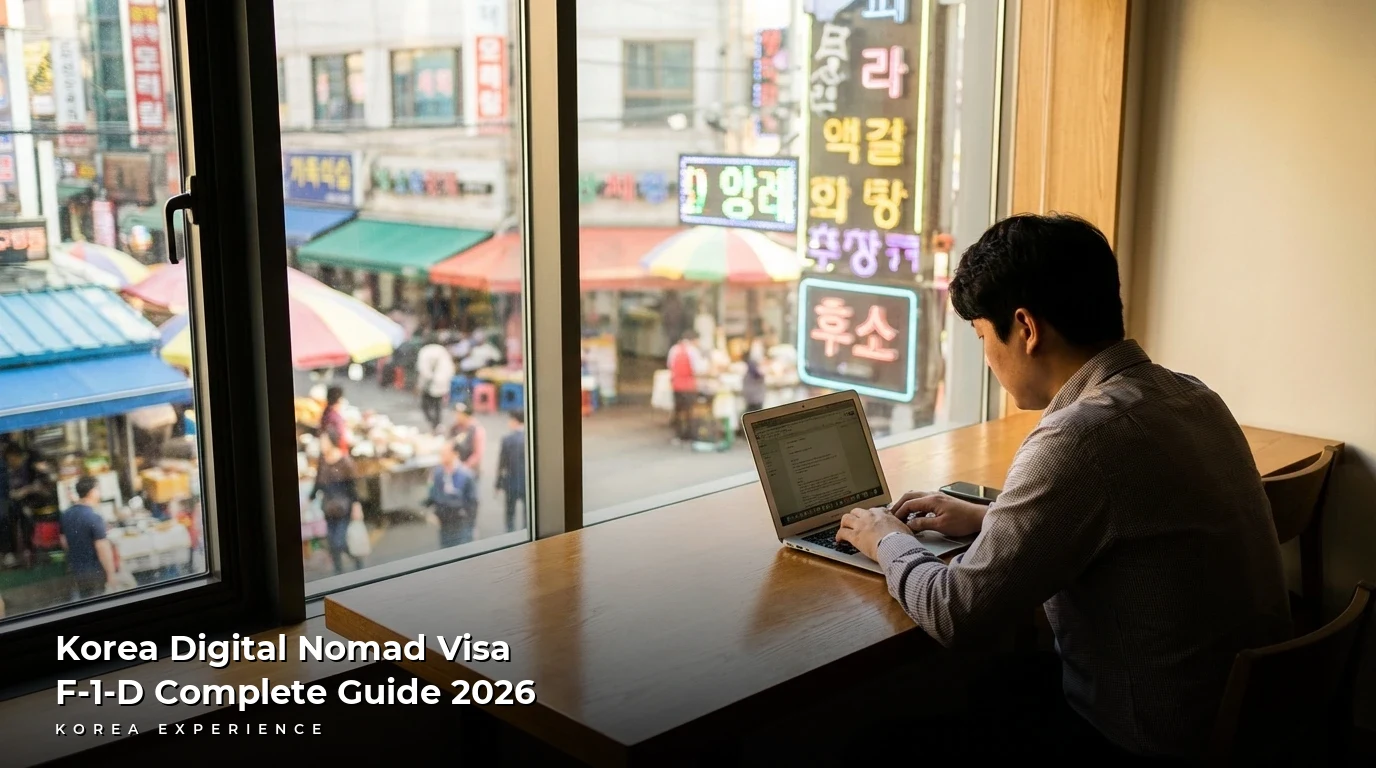
Your Ultimate Guide to the Korea Digital Nomad Visa F-1-D in 2026
South Korea, a vibrant hub of innovation, culture, and breathtaking landscapes, has long captured the imagination of people worldwide. From the dynamic streets of Seoul to the serene beaches of Jeju Island, the country offers an unparalleled blend of tradition and modernity. For years, professionals dreaming of experiencing this unique lifestyle while maintaining their remote careers faced significant hurdles with traditional visa categories.
Enter the Korea Digital Nomad Visa F-1-D, officially launched to cater to the growing global trend of remote work. This specialized visa category, refined for 2026, represents a game-changer for international professionals, offering a legitimate pathway to immerse themselves in Korean life for an extended period. No longer confined to short tourist stays or restrictive business visas, the F-1-D visa allows you to work remotely for an overseas employer while enjoying everything South Korea has to offer.
This comprehensive guide will walk you through everything you need to know about the Korea Digital Nomad Visa F-1-D in 2026. We’ll delve into the eligibility criteria, the step-by-step application process, financial considerations, and essential tips for thriving as a digital nomad in the Land of the Morning Calm. By the end of this article, you’ll have a clear roadmap to turn your Korean dream into a reality.
Understanding the Korea Digital Nomad Visa F-1-D
The Korea Digital Nomad Visa F-1-D is specifically designed for foreign nationals who work remotely for companies or clients based outside of South Korea. It allows for an initial stay of up to one year, with possibilities for extension, enabling digital nomads to truly integrate into Korean society beyond a typical tourist visit.
What is the F-1-D Visa?
The F-1-D visa falls under the "resident" visa category, distinct from short-term tourist (C-3) or long-term employment (E-series) visas. It acknowledges the evolving nature of work and aims to attract high-skilled remote professionals who can contribute to Korea's economy and cultural exchange without directly competing in the local job market. Unlike many other visa types, the F-1-D prioritizes flexibility and the remote worker lifestyle.
Benefits of the F-1-D Visa for Digital Nomads
Securing the Korea Digital Nomad Visa F-1-D opens up a world of opportunities:
- Extended Stay: Enjoy up to one year in Korea, with potential for renewal, far exceeding typical tourist visa limits.
- Legal Remote Work: Work legally for your foreign employer, eliminating concerns about visa compliance often faced by "under-the-radar" digital nomads.
- Cultural Immersion: Ample time to explore Korea's rich history, modern culture (like Hallyu, the Korean Wave), diverse cuisine, and stunning natural landscapes.
- Family Inclusion: The F-1-D visa program typically allows accompanying family members (spouse and minor children) to join the primary applicant, a significant advantage for those traveling with loved ones.
- Access to Services: With a long-term visa, you'll gain access to essential services like banking, mobile phone contracts, and potentially even healthcare, which are often challenging for short-term visitors.
Evolution of the Digital Nomad Visa in Korea
While the concept of digital nomadism isn't new, Korea's official F-1-D visa is a relatively recent development. Following pilot programs and growing international demand, the visa framework for 2026 has been refined to streamline applications and clarify requirements. The government's focus is on attracting professionals with stable income and a genuine interest in contributing positively to the Korean community, even if not through direct local employment. This evolution underscores Korea's commitment to becoming a global hub for remote work and international talent.
Eligibility Requirements for the F-1-D Visa in 2026
Meeting the specific eligibility criteria is paramount for a successful application for the Korea Digital Nomad Visa F-1-D. These requirements are designed to ensure applicants are financially stable, professionally qualified, and possess a clean record.
General Applicant Criteria
- Nationality: Open to citizens of countries that have bilateral agreements with Korea or are generally recognized for visa exemption or simplified visa procedures. Always check the specific list for 2026 provided by the Korean Ministry of Justice or your local embassy.
- Age: Typically, applicants must be 18 years of age or older.
- Education/Experience: While not always explicitly a degree requirement, demonstrating a professional background in a field suitable for remote work is crucial. This often means at least one year of professional experience in your current role or industry.
Financial Stability Proof
This is one of the most critical aspects. Applicants must prove they have sufficient funds to support themselves (and any accompanying family members) during their stay without needing to seek local employment.
- Minimum Income Threshold: For 2026, the projected minimum annual income threshold is approximately 80 million Korean Won (₩), which is roughly equivalent to USD 60,000-65,000, depending on exchange rates. This figure is typically set at twice the Korean gross national income (GNI) per capita.
- Proof of Funds: This can be demonstrated through bank statements, employment contracts, and tax returns covering the past 6-12 months. Documents must clearly show consistent income well above the minimum threshold.
Employment Status and Documentation
- Remote Employment: You must be employed by a company or client based outside of South Korea. Self-employed individuals working with international clients are also generally eligible.
- Proof of Employment:
- Employment Contract: A valid contract with your foreign employer explicitly stating your remote work arrangement.
- Client Contracts/Invoices: For freelancers, contracts with multiple international clients and recent invoices demonstrating consistent remote work.
- Letter from Employer: A letter from your company confirming your position, remote work status, salary, and duration of employment.
- Business Registration: For self-employed individuals, proof of business registration in your home country or country of operation.
Health and Criminal Record Checks
- Health Insurance: Mandatory proof of comprehensive private health insurance coverage for your entire intended stay in Korea, with a minimum coverage value typically around ₩100 million (approximately USD 75,000-80,000) for medical evacuation and treatment.
- Clean Criminal Record: A certificate of good conduct or a criminal record check from your home country and any country where you have resided for more than six months in the past five years. This is a non-negotiable requirement.
Table: F-1-D Visa vs. Other Common Visa Types (2026 Projections)
| Feature | Korea Digital Nomad Visa (F-1-D) | Tourist Visa (C-3) | General Employment Visa (E-series) |
|---|---|---|---|
| Purpose | Remote work for foreign entity | Tourism, short visits | Local employment in Korea |
| Max Initial Stay | 1 year | 90 days (typically) | 1-3 years (varies by E-type) |
| Work Permitted | Yes (remote, foreign employer) | No | Yes (local employer) |
| Income Requirement | High (approx. ₩80M/year) | None | Set by local labor laws/contract |
| Family Inclusion | Yes (spouse, minor children) | No | Yes (for some E-types) |
| Residency Potential | Medium (renewable) | Low (no extension for work) | High |
| Application Process | Moderate (extensive documents) | Simple (basic documents) | Complex (employer sponsorship) |
The Application Process: Step-by-Step Guide for 2026
Applying for the Korea Digital Nomad Visa F-1-D requires careful preparation and attention to detail. Follow these steps to maximize your chances of success.
Step 1: Gather Required Documents
Begin collecting all necessary documents well in advance. These generally include:
- Visa Application Form: Completed and signed.
- Passport: Original and photocopy, valid for at least 6 months beyond your intended stay.
- Passport-Sized Photos: Recent photos meeting specific dimensions (usually 3.5cm x 4.5cm).
- Proof of Remote Employment:
- Employer letter (as detailed above).
- Employment contract.
- Recent pay stubs (last 3-6 months).
- Bank statements showing salary deposits (last 6-12 months).
- Tax returns (last 1-2 years).
- For freelancers: Client contracts, invoices, and bank statements.
- Proof of Financial Capability: Bank statements showing sufficient savings in addition to income, or a combination of both to meet the ₩80 million annual income threshold.
- Criminal Record Check: Apostilled or legalized by your local authorities.
- Health Insurance Policy: Proof of comprehensive international health insurance with required coverage limits.
- Proof of Accommodation: Initial booking for at least the first few weeks or a signed lease agreement if you have one.
- Educational Certificates/Professional Licenses: Copies may be requested to support your professional background.
- Family Relation Certificate: If applying with family members (marriage certificate, birth certificates).
Step 2: Choose Your Application Location
You must apply for the F-1-D visa at a Korean Embassy or Consulate in your home country or country of legal residence. Applications cannot be made from within South Korea on a tourist visa.
Step 3: Schedule an Appointment and Submit Application
- Online Booking: Many embassies require online appointment scheduling. Check your local Korean embassy's website for specific instructions.
- In-Person Submission: Attend your appointment with all original documents and their photocopies. Be prepared for an interview.
- Application Fee: Pay the non-refundable visa application fee (typically around USD 50-150, but can vary by nationality and embassy).
Step 4: Interview and Processing
- Interview: You may be required to attend an interview where consular officers will ask questions about your remote work, financial situation, and intentions in Korea. Be honest and prepared to elaborate on your documents.
- Processing Time: Visa processing times can vary significantly, from 2 weeks to 2 months, depending on the embassy's workload and the complexity of your case. It is advisable to apply well in advance of your desired travel date.
Step 5: Visa Issuance and Travel to Korea
Once your visa is approved, it will be stamped in your passport. You can then make your travel arrangements to South Korea. Upon arrival, immigration officers will review your visa and grant you entry.
Insider Tip: Document Translation and Notarization
Ensure all non-English documents are officially translated into English or Korean and, if required, notarized or apostilled. Always check with the specific embassy for their exact requirements regarding translations. Over-preparing is always better than under-preparing.
Costs and Financial Considerations for Digital Nomads in Korea
Financial planning is crucial for a comfortable and stress-free life as a digital nomad in South Korea. While the F-1-D visa requires substantial income proof, understanding the cost of living will help you budget effectively.
Visa Application Fees and Initial Costs
- Visa Fee: As mentioned, approximately USD 50-150.
- Document Costs: Fees for criminal record checks, health insurance, document notarization, and translations can add up to a few hundred USD.
- Travel Insurance: Essential for the journey and initial period before comprehensive health insurance kicks in.
- Flight Tickets: A significant upfront cost.
Cost of Living in South Korea (2026 Projections)
The cost of living varies considerably between cities. Seoul, as a major global metropolis, is the most expensive.
Accommodation
- Seoul:
- Studio Apartment (One-room): ₩700,000 - 1,500,000 per month (USD 530 - 1,150). Prices vary greatly by district (Gangnam and Jamsil are pricier than Hongdae or Sinchon).
- Officetel (Studio/Small Apt.): ₩800,000 - 1,800,000 per month.
- Deposit (Jeonse/Wolse): Expect to pay a large upfront deposit (key money), often 10-20 times the monthly rent for Wolse (monthly rent) or significantly more for Jeonse (lump-sum deposit, no monthly rent). Budget for at least ₩5,000,000 - 10,000,000 (USD 3,800 - 7,600) for a standard deposit, though lower deposit options exist, usually with higher monthly rent.
- Busan/Other Major Cities:
- Studio Apartment: ₩400,000 - 800,000 per month (USD 300 - 600). Deposits are also lower.
- Co-living Spaces/Guesthouses (Short-term): ₩500,000 - 900,000 per month for initial weeks.
Utilities and Connectivity
- Utilities (Electricity, Gas, Water): ₩100,000 - 200,000 per month (USD 75 - 150) for a single person.
- Internet: High-speed internet is incredibly affordable and fast, typically ₩25,000 - 40,000 per month (USD 20 - 30).
- Mobile Phone: Plans with unlimited data start from ₩30,000 - 50,000 per month (USD 25 - 40).
Food and Groceries
- Groceries: ₩300,000 - 500,000 per month (USD 230 - 380) for cooking at home. Fresh produce can be expensive.
- Eating Out: Affordable street food (₩5,000 - 10,000), casual restaurants (₩10,000 - 20,000 per meal). Fine dining is comparable to Western prices.
Transportation
- Public Transport: Highly efficient and affordable. A single subway/bus ride in Seoul is around ₩1,250 - 1,450 (USD 1-1.15). A T-Money card is essential.
- Taxis: More expensive but still reasonable compared to many Western cities. Starting fare around ₩4,800.
Table: Estimated Monthly Expenses for a Single Digital Nomad (2026)
| Category | Seoul (₩) | Busan (₩) | Average USD Equivalent (Seoul) |
|---|---|---|---|
| Rent (Studio) | 800,000 - 1,500,000 | 400,000 - 800,000 | 600 - 1,150 |
| Utilities | 120,000 - 200,000 | 80,000 - 150,000 | 90 - 150 |
| Internet | 30,000 - 40,000 | 30,000 - 40,000 | 25 - 30 |
| Mobile | 30,000 - 50,000 | 30,000 - 50,000 | 25 - 40 |
| Groceries | 350,000 - 500,000 | 250,000 - 400,000 | 270 - 380 |
| Dining Out | 300,000 - 600,000 | 200,000 - 400,000 | 230 - 460 |
| Transport | 70,000 - 100,000 | 50,000 - 80,000 | 55 - 75 |
| Misc./Leisure | 200,000 - 500,000 | 150,000 - 300,000 | 150 - 380 |
| TOTAL | 2,100,000 - 3,490,000 | 1,190,000 - 2,220,000 | 1,450 - 2,665 |
| Note: Exchange rate ₩1,300 = USD 1 used for estimation. Prices are indicative for 2026. |
Financial Planning Tips
- Emergency Fund: Always have at least 3-6 months' worth of living expenses saved up.
- Budgeting: Use apps or spreadsheets to track your spending.
- Korean Bank Account: Open a local bank account as soon as possible after getting your Alien Registration Card (ARC) for easier money management. Look for banks like Kookmin Bank, Shinhan Bank, or Woori Bank.
Life as a Digital Nomad in Korea: Culture, Connectivity, and Community
Embracing life as a digital nomad in South Korea is an exciting journey. Beyond work, you'll discover a rich cultural tapestry, unparalleled connectivity, and growing communities.
Work-Life Balance and Coworking Spaces
Korea's strong work ethic is well-known, but as a digital nomad, you dictate your own hours.
- Coworking Spaces: Seoul, Busan, and even smaller cities boast numerous modern coworking spaces like WeWork, Fast Five, and local independent hubs. These offer reliable internet, professional environments, and networking opportunities. Prices typically range from ₩200,000 - 400,000 per month.
- Cafes: Korea is famous for its vibrant cafe culture. Many cafes offer free Wi-Fi and comfortable seating, making them popular spots for remote work.
High-Speed Connectivity
South Korea consistently ranks among the top countries for internet speed and accessibility.
- 5G Networks: Widespread and incredibly fast, enabling seamless remote work and communication.
- Public Wi-Fi: Abundant in cities, transportation hubs, and public areas.
Cultural Immersion and Exploration
The F-1-D visa gives you the luxury of time to explore Korea deeply.
- Historical Sites: Visit palaces like Gyeongbokgung, traditional villages like Bukchon Hanok Village, and ancient temples.
- Modern Culture: Dive into K-Pop, K-Dramas, fashion in districts like Myeongdong and Hongdae, and the vibrant nightlife of Gangnam.
- Nature: Hike in national parks like Bukhansan, relax on beaches in Busan or Jeju, or explore the picturesque countryside.
- Food: Indulge in diverse Korean cuisine, from street food favorites like Tteokbokki and Kimchi Jjigae to upscale dining.
Building Community
- Expat Groups: Join online expat groups on platforms like Facebook and Meetup for social events, advice, and networking. Search for "Digital Nomads Korea" or "Expats in Seoul."
- Language Exchange: Participate in language exchange programs to meet locals and practice your Korean.
- Hobby Groups: Join clubs or classes related to your interests, be it hiking, photography, or traditional Korean arts.
Navigating Time Differences
Working remotely for a company in a different time zone can be challenging. Many digital nomads in Korea adjust by working split shifts or scheduling core collaboration hours in the late afternoon or evening. Seoul's time zone (KST - Korea Standard Time) is GMT+9.
Navigating Practicalities: Housing, Healthcare, and Banking
Once your Korea Digital Nomad Visa F-1-D is secured, addressing practical aspects like housing, healthcare, and banking is crucial for a smooth transition.
Finding Accommodation
Securing housing can be one of the most challenging initial hurdles due to the unique deposit system.
- Short-term First: Consider booking an Airbnb, guesthouse, or serviced apartment for your first few weeks to allow time to search for a long-term rental.
- Real Estate Agents (Bongsan): Using a local real estate agent is highly recommended. They understand the market and can help navigate the complex contract process. Be prepared for a service fee (typically 0.3% - 0.5% of the annual rent).
- Types of Housing:
- One-room (Wonroom): Studio apartments, common for singles.
- Officetel: Hybrid office-residence units, often with basic appliances.
- Apartments (Apateu): Larger, typically unfurnished units suitable for families.
- Key Money (Deposit): Most landlords require a significant deposit. For "Wolse" (monthly rent), the deposit can be 5-20 times the monthly rent. For "Jeonse" (lump-sum deposit), you pay a large sum upfront, and no monthly rent, but this requires substantial capital. Always aim for a "Wolse" arrangement with the lowest possible deposit.
- Online Platforms: While agents are best, you can browse platforms like Zigbang, Dabang (requires some Korean or Google Translate), or expat housing groups on Facebook for ideas.
Healthcare System
With the F-1-D visa, you'll need to ensure you have adequate health coverage.
- Private International Health Insurance: Mandatory for the F-1-D visa. Ensure your policy meets the Korean government's minimum coverage requirements (e.g., ₩100 million for medical and evacuation).
- National Health Insurance Service (NHIS): After receiving your Alien Registration Card (ARC) and residing in Korea for a certain period (typically 6 months), foreign residents generally become eligible and are required to enroll in the NHIS. The monthly premiums are affordable, and coverage is comprehensive.
- Healthcare Quality: Korea boasts an excellent healthcare system with highly skilled doctors, modern facilities, and advanced technology. Wait times are generally short, and costs are reasonable, especially with NHIS.
Banking and Financial Management
Opening a local bank account is essential for managing daily finances.
- Alien Registration Card (ARC): This card is your primary form of identification as a long-term resident. You cannot open a full bank account without it. Apply for your ARC at your local immigration office shortly after arrival.
- Required Documents for Banking: Passport, ARC, and sometimes proof of address or employment (though remote employment might be less straightforward, a letter from your foreign employer can help).
- Major Banks: Kookmin Bank, Shinhan Bank, Woori Bank, Hana Bank, and Industrial Bank of Korea (IBK) are popular choices, offering English-speaking services and international transfer options.
- Credit Cards: Foreign credit cards are widely accepted, but having a local debit card is convenient for smaller transactions and certain online purchases.
Table: Key Steps Upon Arrival in Korea for F-1-D Visa Holders
| Step | Action | Estimated Timeline | Essential Documents |
|---|---|---|---|
| 1. Apply for Alien Registration Card (ARC) | Visit your local immigration office (Hikorea.go.kr for appointments). | Within 90 days of arrival | Passport, visa, photos, proof of address. |
| 2. Secure Long-term Accommodation | Work with a real estate agent or online platforms. | 2-4 weeks post-arrival (after ARC) | ARC, passport, employment proof, deposit. |
| 3. Open a Local Bank Account | Visit a major bank branch. | 1-2 weeks post-ARC issuance | ARC, passport, sometimes employment letter. |
| 4. Arrange Local Mobile Service | Visit a telecom provider store (KT, SKT, LG U+). | 1-2 weeks post-ARC issuance | ARC, passport. |
| 5. Register for National Health Insurance (NHIS) | NHIS will auto-enroll after 6 months; ensure your private insurance covers until then. | After 6 months of residency | ARC, proof of residency. |
Extending Your Stay and Future Prospects
The initial Korea Digital Nomad Visa F-1-D is typically valid for one year. For those who fall in love with Korea, extending your stay is often possible.
Visa Extension Process
- Application Period: You generally need to apply for an extension at your local immigration office (Immigration Office or Immigration Branch Office) within 60-90 days before your current visa expires.
- Requirements: Similar to the initial application, you will need to demonstrate continued eligibility:
- Continued Remote Employment: Proof that you are still working remotely for your foreign employer.
- Financial Stability: Updated bank statements and income proof.
- Health Insurance: Valid and continuous coverage.
- Clean Record: No criminal activities during your stay.
- Proof of Residency: Updated lease agreement.
- Review: Immigration authorities will review your compliance with visa conditions during your first year. Factors like any overstays or illegal activities could jeopardize your extension.
- Duration of Extension: Extensions are typically granted for another one-year period, with potential for further renewals based on government policy.
Long-term Residency and Permanent Stay
While the F-1-D visa is not a direct path to permanent residency, it can be a stepping stone for some.
- Other Visa Conversions: After an extended period on the F-1-D, if you find local employment that qualifies for an E-series visa, or meet the criteria for investor visas or highly-skilled worker visas, you may be able to convert your status.
- F-2 Residency Visa: In some cases, after several years of continuous legal residency (often 5+ years) and meeting specific financial and societal integration criteria, it might be possible to apply for an F-2 residency visa, which offers more freedom.
- Investment or Entrepreneurship: If your remote work sparks an interest in launching a business in Korea, certain investment or entrepreneur visas (D-8, D-9) could be options, though these have substantial capital requirements.
Contributing to the Digital Nomad Community in Korea
Many F-1-D visa holders actively contribute to the growing digital nomad community in Korea by:
- Sharing Knowledge: Organizing workshops or meetups to share insights on remote work, visa processes, or cultural tips.
- Volunteering: Engaging with local charities or cultural organizations.
- Promoting Korea: Becoming ambassadors for the country, encouraging more digital nomads to explore the possibilities of living and working remotely in Korea.
The Korea Digital Nomad Visa F-1-D represents not just a travel permit but an opportunity for a deep, enriching experience in one of the world's most dynamic countries. By understanding its requirements and making informed decisions, you can lay the groundwork for a successful and memorable chapter in your life.
Frequently Asked Questions (FAQ) About the Korea Digital Nomad Visa F-1-D (2026)
Q1: Can I apply for the F-1-D visa if I'm already in Korea on a tourist visa?
A1: No, you generally cannot. The Korea Digital Nomad Visa F-1-D must be applied for and obtained at a Korean Embassy or Consulate outside of South Korea, typically in your home country or country of legal residence. You will need to exit Korea to apply.
Q2: Is there an age limit for the F-1-D visa?
A2: While there isn't an upper age limit, applicants must be 18 years or older. The emphasis is on professional experience and financial stability rather than age.
Q3: What if my income fluctuates? How do I prove the minimum income requirement?
A3: The immigration authorities will look for consistent income over the past 6-12 months. If your income fluctuates, ensure your bank statements and tax returns for the past 1-2 years clearly demonstrate that your average annual income consistently meets or exceeds the minimum ₩80 million threshold. Providing a mix of pay stubs, bank statements, and tax documents will strengthen your case.
Q4: Can my family (spouse and children) join me on the F-1-D visa?
A4: Yes, the Korea Digital Nomad Visa F-1-D program typically allows accompanying family members (spouse and minor children) to apply for dependent visas (usually F-1-D dependent). You will need to provide proof of family relation (marriage certificate, birth certificates) and demonstrate sufficient financial means to support them.
Q5: What happens if I lose my remote job while on the F-1-D visa?
A5: Losing your remote job means you no longer meet a core eligibility requirement of the F-1-D visa. You are generally required to notify the immigration office of changes to your employment status. You may be given a grace period to find new remote employment or be required to depart Korea. It is crucial to maintain continuous valid remote employment to remain compliant with your visa conditions.
Conclusion: Your Journey to Becoming a Korean Digital Nomad
The Korea Digital Nomad Visa F-1-D in 2026 presents an incredible opportunity for remote professionals seeking to combine their careers with a rich cultural experience in South Korea. This comprehensive guide has hopefully illuminated the path, from understanding eligibility and navigating the application process to managing costs and embracing life in this dynamic country.
Key Takeaways for Your Journey:
- Preparation is Paramount: Start gathering documents, proving your financial stability, and verifying your remote work status well in advance.
- Understand the Costs: Be realistic about the cost of living, especially in major cities like Seoul, and ensure you have an adequate emergency fund.
- Embrace the Culture: Beyond work, actively seek to engage with Korean culture, language, and communities to make the most of your extended stay.
- Stay Compliant: Always adhere to visa regulations, especially regarding employment status and extensions, to ensure a smooth and legal residency.
The dream of living and working in South Korea is now more attainable than ever. With the Korea Digital Nomad Visa F-1-D, you have the golden ticket to explore ancient traditions, marvel at futuristic cities, savor unique cuisine, and build lasting memories. So, prepare your documents, pack your bags, and get ready to embark on an unforgettable adventure as a digital nomad in Korea!
For more insights into living and working in Korea, including detailed guides on housing, language learning, and cultural etiquette, be sure to explore our other articles on [Living in Korea] and [Korean Culture]!
About the Author
Korea Experience Team
Written by the Korea Experience editorial team - experts in Korean medical tourism, travel, and culture with years of research and firsthand experience.
Explore more in Living in Korea
Everything expats and long-term visitors need to know — from visa requirements and housing to banking, healthcare, and daily life tips.
Browse All Living in Korea ArticlesContinue Reading
Explore more articles you might find interesting
Everything you need to know about the South Korea Working Holiday Visa. Eligibility, application steps, costs, and finding a job in Seoul.
Unlock Korea's remote work potential with our guide to the Digital Nomad Visa. Discover eligibility, detailed requirements, and the step-by-step application process.
A complete guide to securing remote work and navigating the digital nomad lifestyle in South Korea under the 2026 visa regulations.
Master the F-5 visa application in 2026. Detailed guide on income, KIIP, and documents for securing permanent residency in South Korea.
A complete guide to South Korea F-6 and F-3 family visas. Learn income thresholds, document lists, and application steps for expats.
Complete guide to the 2026 F-2 resident visa in South Korea. Learn points requirements, income thresholds, and application steps for long-term residency.