Korean glass skin treatment guide 2026: Costs, clinics, and procedures
Everything you need to know about getting glass skin in Korea, from Rejuran Healer costs to the best clinics in Gangnam for 2026.
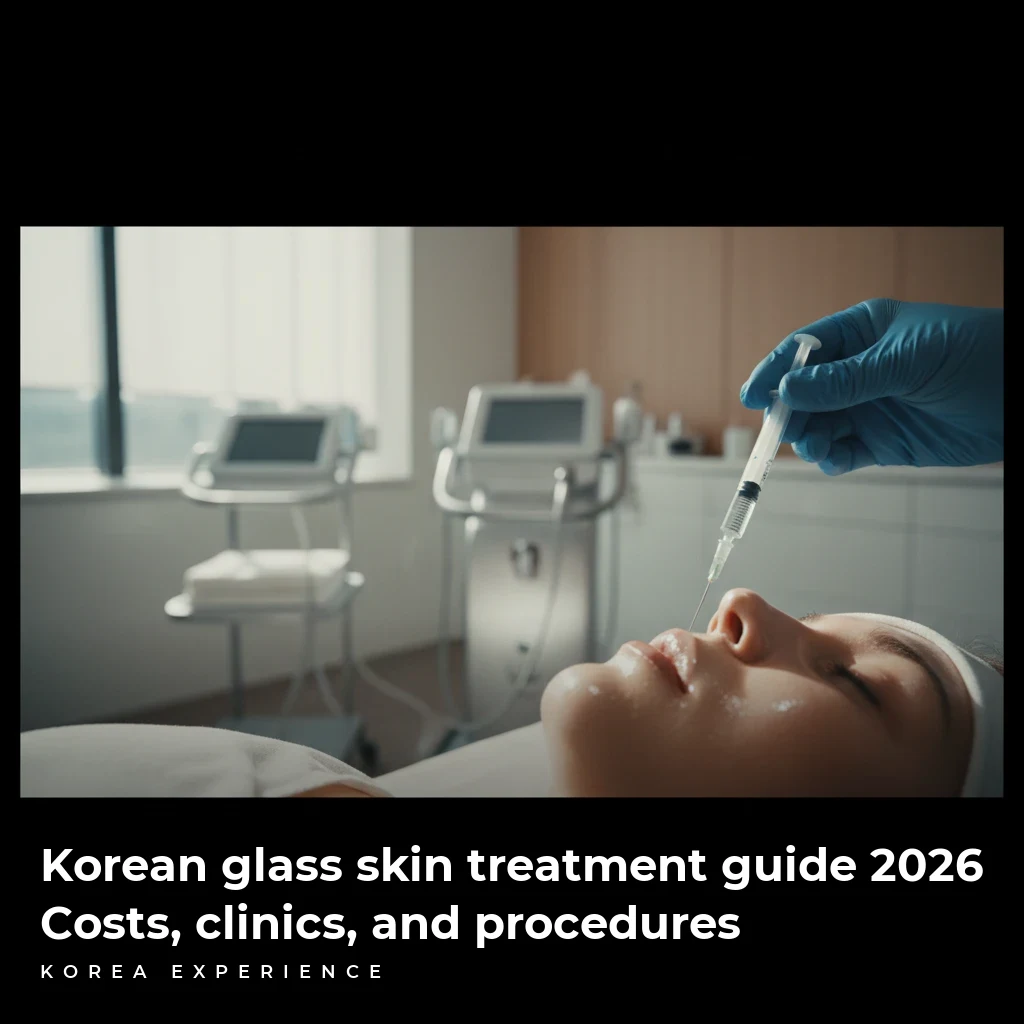
Achieving the coveted "Glass Skin" (Yuri-pibu) look in Korea is rarely the result of a single magical cream; it is almost always a systematic combination of clinical skin boosters, laser treatments, and meticulous maintenance performed by dermatologists. For international travelers visiting Seoul in 2026, the most effective path to glass skin involves injectable treatments like Rejuran Healer, Juvelook, and Skin Botox, often combined in a single session known as a "skin cocktail." These treatments work by physically injecting hydration and collagen-stimulating compounds directly into the dermis layer, bypassing the skin barrier that blocks most topical cosmetics.
The short answer: The primary clinical treatment for Glass Skin is Rejuran Healer (Salmon DNA), often combined with Skin Botox and Hyaluronic Acid. Expect to pay between ₩250,000 and ₩600,000 ($180–$430 USD) per session depending on the clinic tier.
Key Takeaways
- 1Rejuran Healer is the #1 treatment for glass skin, utilizing salmon DNA to repair skin barriers.
- 2Factory clinics charge ~₩250,000 for treatments that cost ₩600,000+ at private dermatologists.
- 3Downtime usually involves 'embossing' (bumps) on the face for 24 to 72 hours.
- 4Always bring your passport to the clinic to receive an immediate 7-8% tax refund.
- 5Book at least 2 weeks in advance for popular English-speaking clinics in Gangnam.
Understanding the "Glass Skin" Phenomenon
The term "Glass Skin" refers to a complexion that is so smooth, hydrated, and translucent that it resembles a pane of glass. While K-beauty products lay the foundation, the intense, reflective glow seen on Korean celebrities and influencers is achieved through medical aesthetics.
In 2026, the Korean approach to dermatology has shifted from merely fixing problems (like acne or wrinkles) to "skin quality improvement." This is a crucial distinction. Western dermatology often focuses on drastic anti-aging changes. Korean dermatology focuses on texture, hydration, and the water-oil balance of the skin.
📊 Skin Booster Popularity
The market in Seoul is massive. Within a 1km radius of Gangnam Station alone, there are over 450 registered aesthetic clinics. This density drives competition, lowering prices to roughly 30-40% of what you would pay in the United States or Singapore, while maintaining world-class technology.
Top 3 Treatments for Glass Skin in 2026
If you walk into a clinic asking for "Glass Skin," you will likely be prescribed one (or a mix) of the following three injectable treatments. Understanding what they do is vital for choosing the right package.
1. Rejuran Healer (The Gold Standard)
Rejuran is the undisputed king of Korean skin boosters. It is made of Polynucleotides (PN) derived from wild salmon DNA. The DNA fragment matches human DNA by 97%, minimizing reactions.
- What it does: It doesn't just hydrate; it heals. It thickens the skin barrier, reduces inflammation, and balances oil production.
- The Pain Factor: It is notoriously painful. The solution is viscous and has a higher pH than the body, causing a stinging sensation.
- The Cost: Average 2cc (standard face dose) is ₩280,000 ($200) at budget clinics to ₩550,000 ($400) at premium spots.
Pain Management
Rejuran is painful. Ask for "Rejuran HB Plus" (Hydro Booster), which contains lidocaine to reduce pain by roughly 50%. It costs about ₩50,000 more per cc but is worth it for pain-sensitive patients.
2. Juvelook (The Rising Star)
Juvelook has exploded in popularity in 2025 and 2026. It is a hybrid of Hyaluronic Acid (HA) and PDLLA (Poly D, L-Lactide).
- What it does: It stimulates the body's own collagen production. While Rejuran repairs the surface texture, Juvelook works on pore reduction and acne scars. It provides a softer, "blurry" filter effect to the skin.
- Best for: People with large pores or slight textural scarring.
- The Cost: Approximately ₩300,000 to ₩450,000 for a full face session.
3. Skin Botox (Dermatoxin)
Unlike traditional Botox injected into the muscle to freeze movement, Skin Botox is injected in micro-droplets into the superficial layers of the skin.
- What it does: It tightens the pores and creates an immediate "tight" sensation, giving that reflective, glass-like sheen. It does not freeze your facial expressions, but it does smooth out fine crinkles.
- Duration: Lasts 2-3 months (shorter than muscle Botox).
- The Cost: Very affordable, often ranging from ₩90,000 to ₩150,000 ($65-$110).
For a deeper dive into the variety of clinics available, you might want to read our guide on best Korean skin clinics in Gangnam, which categorizes them by specialty.
Comparison: Which Booster is Right for You?
Skin Booster Comparison 2026
| Feature | Rejuran Healer | Juvelook | Skin Botox |
|---|---|---|---|
| Primary Benefit | Barrier Repair & Hydration | Pore & Scar Filling | Tightening & Glow |
| Pain Level (1-10) | 8/10 | 5/10 | 4/10 |
| Downtime | 2-3 Days (Bumps) | 1-2 Days | 3-4 Hours |
| Time to See Results | 2 Weeks | 4 Weeks | 5-7 Days |
The Clinic Landscape: Factory vs. Private Dermatologist
One of the most confusing aspects for visitors is the vast price difference between clinics. You might see Rejuran advertised for ₩190,000 at one place and ₩600,000 at another. This is usually due to the distinction between "Factory Clinics" and "Private Board-Certified Dermatologists."
Factory Clinics (The Budget Option)
These are high-volume centers, often located in Gangnam or Hongdae.
- Pros: Extremely cheap, transparent pricing, fast service, foreign language coordinators often available.
- Cons: You wash your own face in a locker room. You rarely see the doctor until the needle is in your face. Consultations are done by sales consultants, not doctors. The waiting room feels like a busy bank.
- Target Audience: Young travelers, those on a budget, or experienced veterans who know exactly what they want.
Private Specialist Clinics (The Premium Option)
These are run by board-certified dermatologists (only about 2% of doctors in Korea are board-certified derms).
- Pros: The doctor analyzes your skin personally using scanning machines (like Mark-Vu). They customize the depth and mix of injections. Recovery care is extensive (cryotherapy, modeling packs).
- Cons: Prices are 2-3x higher. Booking is harder.
- Target Audience: Older travelers, those with specific skin diseases, or those seeking a luxury experience.
💵 Cost Comparison (Per Session)
Includes doctor consult, custom mix, full aftercare
Standard dosage, self-cleansing, minimal aftercare
The Process: Step-by-Step Guide
If you've never been to a Korean skin clinic, the efficiency can be overwhelming. Here is exactly what happens during a typical 90-minute visit.
Your Clinic Journey
Check-in & Storage
Store bags in lockers. Self-wash face if at a factory clinic.
Consultation
Skin analysis with a consultant or doctor. Package selection.
Numbing
Numbing cream applied to face. Wait 20-40 minutes.
The Procedure
Injections take 10-15 minutes. High intensity.
Aftercare
Cooling mask or LDM (ultrasound) to calm redness.
For those concerned about how to actually secure these appointments, especially with language barriers, check our guide on booking medical consultations in Korea.
Detailed Cost Breakdown (2026 Prices)
Travelers should budget carefully. While individual treatments are cheap, clinics often upsell packages. Here are the realistic market rates you will encounter in the Gangnam-gu district as of early 2026.
Injectables (Per Session):
- Rejuran Healer (2cc): ₩250,000 – ₩500,000
- Juvelook (Standard / 4cc): ₩300,000 – ₩450,000
- Skin Botox (Full Face): ₩100,000 – ₩200,000
- Chanel Injection (Filorga): ₩250,000 – ₩400,000
Devices (Lifting & Tightening):
- Shurink Universe (300 shots): ₩100,000 – ₩150,000 (Budget friendly HIFU)
- InMode FX: ₩80,000 – ₩150,000 per mode
- Ulthera (300 shots): ₩1,200,000 – ₩1,600,000 (The premium lifting option)
Tax Refund: International visitors are eligible for a tax refund on cosmetic procedures. The VAT is 10%. Most clinics will give you a refund receipt which you can scan at the kiosk at Incheon Airport (or instant refund kiosks in the city) to get about 7-8% back.
📋 Financial Quick Facts
Where to Go: Location Guide
While clinics are everywhere, 90% of medical tourism happens in the "Beauty Belt" of Gangnam.
1. Gangnam Station (Exits 10, 11, 12): The highest density of factory clinics. Fast, cheap, English-friendly but chaotic.
- Vibe: Busy, loud, efficient.
- Best for: Simple Botox, hair removal, and basic Rejuran on a budget.
2. Sinsa-dong / Garosu-gil: More boutique clinics and plastic surgery centers. Slightly more expensive, better interiors.
- Vibe: Trendy, upscale, quieter.
- Best for: Thread lifting, filler design, and comprehensive skin analysis.
3. Cheongdam-dong: The ultra-luxury district. This is where celebrities go.
- Vibe: Private rooms, valet parking, concierge service.
- Best for: High-end anti-aging like Ulthera and Thermage.
Muse Clinic (Representative Type)(뮤즈클리닉)
Note: The above represents a popular "type" of clinic chain found throughout Seoul (Muse, Toxnfill, PPEUM) which are safe bets for beginners.
Managing Downtime and Recovery
The "Glass Skin" treatments generally have low downtime compared to surgery, but you will not look perfect immediately.
The "Embossing" Effect: When you get Rejuran or any machine-injected booster, your skin will look like specialized reptilian skin or bubble wrap for about 24 to 48 hours. These bumps are the fluid sitting under the dermis. They will absorb.
Bruising: Needles hit capillaries. Small pinpoint bruises are common, especially around the eyes. These can be covered with makeup after 24 hours but may last 5-7 days.
Do not plan a photoshoot or a big date for at least 3 days after Rejuran. The 'embossing' marks are very visible. I always tell clients to bring a face mask and a hat for the subway ride back to the hotel. Also, avoid saunas (jjimjilbangs) for one week post-treatment!
If you are looking to combine this with other procedures, note that heat-based treatments usually shouldn't be done on the same day as certain fillers. Read more about anti-aging treatments in Korea to plan your schedule.
How to Book: Apps vs. Direct
Foreigners often struggle with booking because the local apps (Gangnam Unni, Babitalk) are in Korean and require local phone verification.
📖 How to Book as a Foreigner
Step 1: Choose Your Method
Use Instagram DM or WhatsApp. Most clinics monitor these channels for foreigners.
Step 2: Send Specific Details
Don't just say 'hello'. Send: Name, Country, Desired Treatment, Dates available.
Step 3: Deposit Payment
Many clinics now require a small deposit ($20-50) via PayPal or Wise to hold the slot due to no-shows.
Step 4: Confirmation
Save the map location and entry code if applicable. Arrive 10 mins early.
Pros and Cons of Getting Treated in Korea
Is it worth the flight? For most, yes, but there are caveats.
Korea Skin Treatment Assessment
- ✓Cost is 30-40% of Western prices
- ✓Latest technology (e.g., Potenza, Titanium Lifting)
- ✓High volume means doctors are very experienced
- ✓Tax refunds available
- ✗Communication nuances can be lost
- ✗Factory clinics feel impersonal/rushed
- ✗Follow-up care is impossible once you fly home
- ✗Risk of counterfeit products at shady clinics
Combining Treatments: The "Omakase" Approach
In 2026, the trend is customized "skin omakase." Instead of buying 2cc of Rejuran, you buy a "Glass Skin Package." A typical package might look like this:
- Aqua Peel: To clean out pores and blackheads (Prep).
- LDM (Local Dynamic Micro-massage): To hydrate and calm the skin (Base).
- Pico Toning: A laser to break up pigment and brighten tone (Clarify).
- Rejuran Healer + Skin Botox: The main event (Glow).
- Modeling Mask: To seal it all in (Finish).
Total Time: 2 hours. Total Cost: ~₩500,000 - ₩700,000 ($360 - $500).
This holistic approach yields better results than just doing injections alone. If you are pressed for time, there are faster options. Check our guide on best in-clinic facial treatments for busy travelers.
Frequently Asked Questions
❓ Common Questions About Glass Skin Treatments
Have more questions?Contact us →
Final Thoughts: Is it worth it?
The Korean Glass Skin treatment experience is about more than just the procedure; it's a cultural immersion into a society that values self-care and maintenance. The technology is faster, the needles are thinner, and the prices are unbeatable. However, managing your expectations is key. You will walk out looking bumpy and red, but give it 5 days, and you will understand why Seoul is the skincare capital of the world.
For those dealing with more significant texture issues beyond just hydration, you might want to explore acne scar treatment options in Korea for more intensive procedures.
About the Author
Korea Experience Team
Written by the Korea Experience editorial team - experts in Korean medical tourism, travel, and culture with years of research and firsthand experience.
⚠️ Medical Disclaimer
The information provided on this website is for general informational purposes only and does not constitute medical advice. Always consult with qualified healthcare professionals before making any medical decisions.
Explore more in Medical Tourism
World-class medical procedures at competitive prices. From plastic surgery and dermatology to dental care and health checkups — your complete guide to medical tourism in Korea.
Browse All Medical Tourism ArticlesContinue Reading
Explore more articles you might find interesting
Everything you need to know about medical tourism insurance for Korea in 2026, covering complications, costs, provider comparisons, and claim procedures.
Discover the top Korean skin care treatments for 2026, from Rejuran Healer to InMode lifting. Detailed costs, pain levels, and clinic guides included.
Discover the top-rated rhinoplasty clinics in Gangnam, Seoul. Expert reviews, pricing, before/after results, and everything you need to know for a successful nose job in Korea.
Everything you need to know about the South Korea Working Holiday Visa. Eligibility, application steps, costs, and finding a job in Seoul.

Save 15 to 30 percent on 2026 skin treatments by taking a $65 KTX train to Daegu instead of Gangnam. Compare exact prices, travel costs and VAT refunds.
Seoul has basically hacked the biological clock by combining high-speed 'K-Biotech' with the world's most aggressive regulatory fast-track.