Korean grocery shopping hacks e mart market kurly and local marts 2026
Master the art of grocery shopping in Korea with our 2026 guide to E-Mart, Market Kurly, and local markets. Save money and eat well.
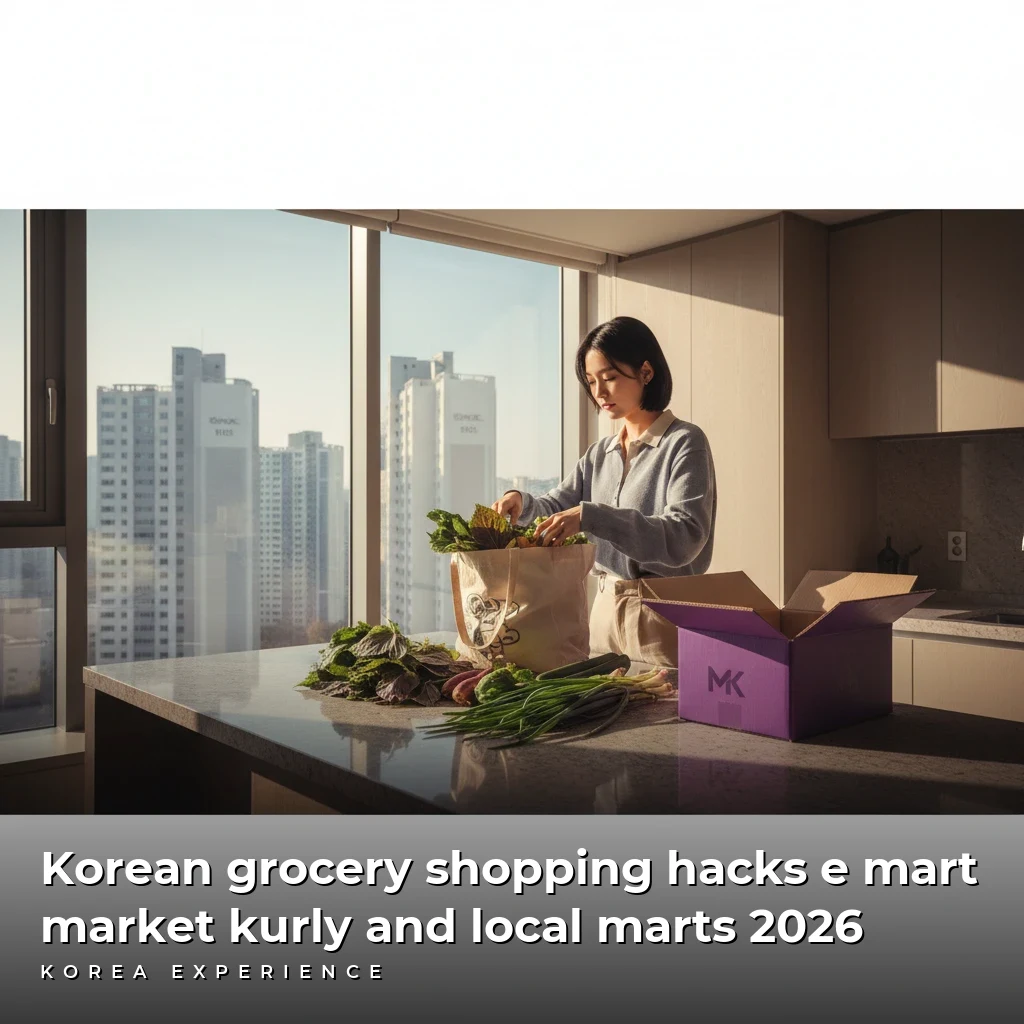
Navigating the grocery aisles in a foreign country can be a daunting task, but in South Korea, it is an adventure that blends high-tech convenience with traditional charm. As of 2026, the Korean grocery landscape has evolved into a hyper-efficient ecosystem where Artificial Intelligence optimizes delivery routes for Market Kurly and cashier-less checkout counters are becoming the standard at major hypermarkets like E-Mart. For expatriates and travelers, understanding how to balance the convenience of apps with the cost-savings of local markets is essential for maintaining a healthy budget and lifestyle.
The cost of living in Seoul has stabilized somewhat, but food prices remain significant, with the average monthly grocery bill for a single expat hovering between 450,000 and ₩600,000 depending on dietary habits. Whether you are craving imported cheese, searching for the freshest seasonal strawberries, or simply need 24-hour delivery, Korea offers a solution. This guide breaks down the "Big Three" of Korean grocery shopping: The Hypermarkets, The Online Giants, and The Local Marts, providing you with actionable hacks to save time and money.
Learn more in our comprehensive guide to Furniture shopping IKEA vs Korean brands your ultimate guide.
Key Takeaways
- 1Online Dawn Delivery services now cover 92 percent of the country with 7 AM guarantees
- 2Local markets offer produce prices 30 to 40 percent lower than major hypermarkets
- 3Hypermarkets discount prepared foods by up to 50 percent after 8 PM daily
The Hypermarket Titans: E-Mart, Homeplus, and Lotte Mart
When you first arrive in Korea, your safest bet for a "one-stop-shop" experience is one of the major hypermarkets. These are massive, multi-story complexes that sell everything from Samsung televisions to fresh Kimchi. As of 2026, E-Mart remains the market leader, followed closely by Homeplus and Lotte Mart. These stores are typically located near major subway stations, often connected directly via underground heavy-traffic passages.
For more details, check out our guide on Korean stock market investing as an expat.
The shopping experience here is distinct. You will often encounter "tasting ladies" offering samples of dumplings, noodles, or bulgogi. Statistically, shoppers who engage with these sample stations spend approximately 20 minutes longer in the store but report higher satisfaction with their purchases.
Learn more in our comprehensive guide to Moving Companies in Korea.
📊 Hypermarket Market Share 2026
The Mandatory Closing Day Rule
One critical hack every resident must know is the government-mandated closing schedule. To protect traditional markets, major hypermarkets are required to close twice a month, typically on the second and fourth Sundays. In 2026, this regulation remains strictly enforced. Attempting to shop on these days will result in finding locked doors.
Related reading: The Ultimate 2026 Guide to Hailing a Korean Taxi.
Check the Calendar
Always check your map app (Naver Map or KakaoMap) before heading out on a Sunday. If a specific branch is closed, the app will usually display a "Closed" badge in red. The closure dates affect over 400 major locations nationwide.
Timing Your Visit for Maximum Savings
If you are looking to stretch your budget, timing is everything. Korean hypermarkets operate on a strict freshness cycle. Prepared foods like sushi, fried chicken, and jokbal (braised pig's trotters) are made fresh daily.
To minimize waste, stores begin discounting these perishable items around 8:00 PM. Discounts start at 20% and can climb to 50% or even 70% by 10:00 PM, just before closing (usually at 11:00 PM). For a standard sushi platter usually priced at ₩19,900, a savvy late-night shopper might pay just ₩9,950.
The Discount Cycle
Store Opens
Full inventory, highest prices, freshest selection.
First Markdowns
Staff begin applying 10-15% discount stickers on perishables.
Deep Discounts
Prices drop by 30-40% on remaining ready-to-eat meals.
Clearance
Final clearance items up to 50-70% off before closing.
The "No Brand" Phenomenon
E-Mart's private label, "No Brand," has revolutionized budget shopping in Korea. Recognizable by its bright yellow packaging, No Brand products strip away marketing costs to offer significantly lower prices. In 2026, a 100-pack of wet wipes from No Brand costs approximately ₩1,200, compared to ₩3,500 for name brands. Their potato chips, cookies, and frozen meats are staples for expats.
The Online Revolution: Market Kurly and Coupang Fresh
While hypermarkets are great for browsing, the true innovation in Korean grocery shopping lies in "Dawn Delivery." This logistics miracle allows you to order groceries before a certain cutoff time at night and have them waiting at your doorstep before you wake up.
Delivery Service Comparison 2026
| Feature | Market Kurly | Coupang Fresh | SSG (E-Mart) |
|---|---|---|---|
| Order Cutoff | 11:00 PM | 12:00 Midnight | 10:00 PM |
| Delivery Arrival | Before 7:00 AM | Before 7:00 AM | Scheduled Time Slots |
| Free Shipping Min | ₩40,000 | Membership Required | ₩40,000 |
| English Support | Limited | Moderate | Limited |
Market Kurly: The Premium Choice
Market Kurly pioneered the Dawn Delivery service. It is famous for high-quality produce, a curated selection of imported goods (perfect for finding decent cheese or balsamic vinegar), and eco-friendly packaging. In 2026, they introduced the "Kurly Purple Box," a reusable cooling container that you leave outside your door to reduce cardboard waste.
The selection on Kurly is vast, with over 30,000 SKUs available. While slightly pricier than budget options, the quality control is rigorous. If you order a box of avocados, they arrive in perfect condition. The average cart size on Kurly is around ₩75,000.
Coupang Fresh: The Speed King
Coupang is effectively the Amazon of Korea. Their "Rocket Fresh" service requires a "Wow Membership," which costs ₩4,990 per month as of 2026. The membership pays for itself quickly if you order more than twice a month. Coupang's strength is speed and volume. You can buy bulk water, toilet paper, and fresh eggs in one order.
📖 How to Set Up Dawn Delivery
Step 1: Download the App
Search for 'Market Kurly' or 'Coupang' in your app store. Note that interfaces are primarily in Korean.
Step 2: Verify Identity
You will need your Alien Registration Card (ARC) and a Korean phone number tied to your name for identity verification.
Step 3: Input Address
Enter your address precisely. You must include the 'P.O. Box' or common entrance password so the delivery driver can enter your building at 4 AM.
Step 4: Place Order
Fill your cart and checkout before the nightly cutoff time to guarantee next-morning arrival.
Online Grocery Shopping
- ✓Saves roughly 3 hours per week in travel and shopping time
- ✓No heavy lifting—water and rice delivered to your door
- ✓Access to imported goods hard to find locally
- ✗Excessive packaging waste (though improving in 2026)
- ✗Requires Korean phone number and ARC for registration
- ✗Cannot hand-pick your own produce
Local Marts and Traditional Markets
Despite the tech-heavy competition, local neighborhood marts and traditional markets (Sijang) thrive because they offer something apps cannot: unparalleled freshness at rock-bottom prices. Every neighborhood has at least one medium-sized mart (often branded as "Lotte Super," "GS Super," or independent names like "Lucky Mart").
The Price Advantage
Local marts are generally 15% to 25% cheaper for produce than hypermarkets or online services. They source directly from regional agricultural hubs. For example, a basket of seasonal strawberries in spring might cost ₩12,000 at a department store, ₩9,900 at E-Mart, but only ₩6,000 at a local market.
💵 Produce Price Comparison (Average 2026)
Spinach (1 pack, approx 300g)
Spinach (Large basket, approx 400g)
The "Service" Culture
One of the most charming aspects of traditional markets is "Service" (pronounced 'seo-bi-su'). If you are a regular customer or buy a significant amount, vendors will often throw in extra items for free. Buying ₩10,000 worth of tangerines? Don't be surprised if the vendor tosses in two extra "just for the walk home."
"When shopping at a traditional market, always bring cash. While many stalls now accept cards in 2026, offering cash can sometimes give you leverage to haggle or get more generous portions. Also, look for the 'Onuri' gift certificates—foreigners can buy them at banks with a 5-10% discount and use them like cash at markets."
Finding the Best Local Spots
To find these gems, search for "Sijang" (Market) on your map app. Major ones like Gwangjang Market or Mangwon Market are famous, but smaller neighborhood markets offer a more authentic, less touristy experience.
Mangwon Market(Mangwon Sijang)
Convenience Stores: The Pantry Extension
In many countries, convenience stores are expensive last resorts. In Korea, CU, GS25, 7-Eleven, and Emart24 are integral parts of the grocery ecosystem. With over 55,000 locations nationwide in 2026, you are never more than a 2-minute walk from one in urban areas.
The 1+1 and 2+1 Magic
The secret to value here is the promotional tags. "1+1" (Buy one, get one free) effectively cuts the price in half, often making items cheaper than in hypermarkets. This is particularly true for beverages, ice cream, instant noodles, and snacks.
Keep the App
Most convenience store chains have apps (like 'Pocket CU' or 'The Pop' for GS25) that allow you to store your 'plus one' item digitally. If you buy a 2+1 coffee deal but only want to drink one now, you can save the other two coupons in the app to redeem later at any branch nationwide.
The Bento Box (Dosirak) Evolution
The quality of convenience store meals has skyrocketed. A "Dosirak" (lunch box) costs between ₩4,500 and ₩6,500 and provides a balanced meal with rice, protein (bulgogi, spicy pork, chicken), and various side dishes. They are delivered fresh twice daily.
2026 Trends: The Future of Shopping
As we move deeper into 2026, technology and sustainability are reshaping the experience.
- Eco-Friendly Focus: The government has banned single-use plastic bags in all retail formats. You must purchase a standard district garbage bag (usually white, green, or orange depending on the district) to carry your goods if you didn't bring a tote. These bags serve a dual purpose: carrier bag now, trash bag later. A 20-liter bag typically costs around ₩490.
- Cashless & Staffless: Many smaller E-Mart Everyday or convenience stores operate in "hybrid" modes, switching to unmanned, credit-card-entry-only systems late at night. Ensure you have a physical credit card with an IC chip to enter these stores after midnight.
📋 Shopping Essentials Checklist
Conclusion
Mastering grocery shopping in Korea is a rite of passage for any expat. It requires balancing the digital convenience of dawn delivery with the tactile, money-saving adventure of the local market. By utilizing the 1+1 deals at convenience stores, raiding the discount corner at E-Mart at 9 PM, and setting up your Kurly account for heavy items, you can eat like a king without breaking the bank.
Remember, the best approach is a hybrid one: buy your heavy staples online, your daily produce at the local mart, and your imported treats at the hypermarket. Happy shopping!
❓ Frequently Asked Questions
Have more questions?Contact us →
About the Author
Korea Experience Team
Written by the Korea Experience editorial team - experts in Korean medical tourism, travel, and culture with years of research and firsthand experience.
Explore more in Living in Korea
Everything expats and long-term visitors need to know — from visa requirements and housing to banking, healthcare, and daily life tips.
Browse All Living in Korea ArticlesContinue Reading
Explore more articles you might find interesting
Master the 2026 Olive Young Big Bang Sale with our guide. Save up to 70% using the global app, immediate tax refunds, and hidden coupons.
Master the art of K Pop photocard collecting in 2026 with our guide to global markets, trading etiquette, and exclusive Seoul shopping spots.
Discover how to mix a $15 Dior Seongsu latte with a $3.80 market pancake in 2026. Master the WOWPASS and Climate Card to conquer Seoul on any budget.
Stop paying full price! Save up to 70% during Big Bang sales and get instant tax refunds on purchases over 15,000 KRW with this 2026 guide.
Master Seoul's 2026 transit system. From the Climate Card saving you ₩62,000 to new AREX schedules, here is everything tourists need to navigate like a local.
Master Namdaemun Market bargaining tips with our 2026 guide. Save 10-20% on clothes and souvenirs while navigating Seoul's oldest market like a pro.