Sulwhasoo vs The History of Whoo: Is Luxury K-Beauty Worth It 2026
We analyze if Korean luxury skincare giants Sulwhasoo and History of Whoo are worth the $200+ price tags in 2026, comparing ingredients and results.
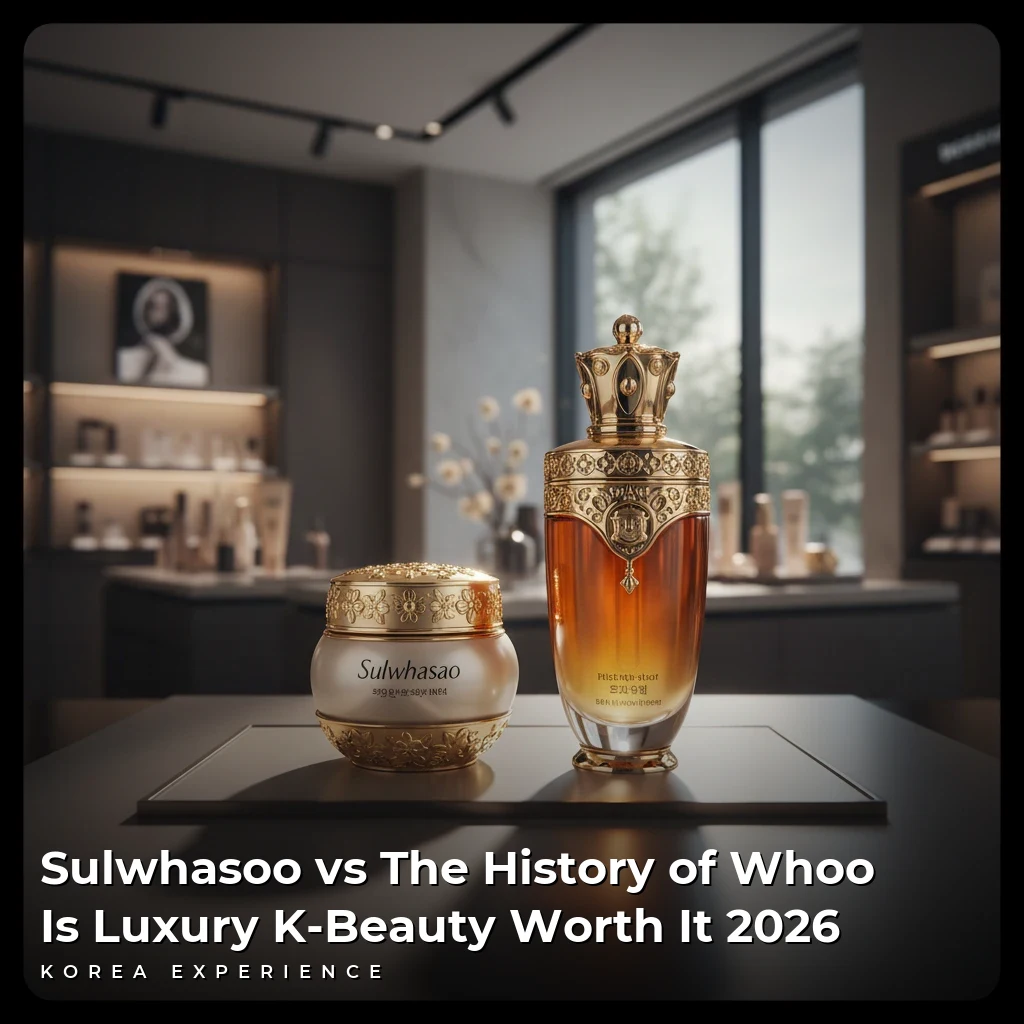
For many travelers landing at Incheon International Airport, the first thing that catches their eye isn't the architecture, but the massive, glowing advertisements for Sulwhasoo and The History of Whoo. These two titans represent the pinnacle of "Hanbang" (traditional Korean herbal medicine) skincare, commanding prices that often exceed $200 USD per bottle. But are they actually effective, or just expensive souvenirs in beautiful packaging?
The short answer: Yes, both brands are worth the investment in 2026 if your primary concerns are anti-aging, dryness, and barrier repair, but they serve different skin types. Sulwhasoo (Amorepacific) excels at holistic balance and inflammation control using Ginseng, making it better for combination/sensitive skin. The History of Whoo (LG Household & Health Care) offers richer, heavier formulations focused on extreme nourishment and wrinkle reduction, ideal for very dry or mature skin.
Key Takeaways
- 1Sulwhasoo's First Care Serum VI sells every 10 seconds globally and is the best entry point for beginners at ~₩140,000.
- 2The History of Whoo is significantly richer and more fragranced, targeting skin aged 40+ or extremely dry types.
- 3Buying in Korea (Duty-Free or Department Stores) saves 30-40% compared to US/European retail prices.
- 4Duty-Free sets often include 100-150ml of free samples, increasing the actual value proposition.
The Hanbang Heritage: Understanding the Price Tag
To understand why a 60ml jar of cream might cost ₩400,000 ($300 USD), you have to understand the technology. Unlike Western luxury brands that often rely on chemical actives like Retinol or Vitamin C, Korean luxury skincare focuses on fermentation and extraction technologies applied to traditional medicinal herbs.
In 2026, the technology has advanced significantly. Sulwhasoo now uses "Ginsenomics," a process that concentrates ginseng saponins by 6,000 times compared to raw ginseng. The History of Whoo claims to use recipes once reserved for the Empress of the Joseon Dynasty, utilizing fermentation that takes over 365 days to complete.
📊 The Luxury Market Scale
When you pay the premium, you are paying for:
- Rare Ingredients: Wild ginseng, deer antler velvet, and lotus.
- Formulation Texture: The "cosmetic elegance" is unmatched; these products absorb instantly despite being rich.
- Packaging: Heavy glass, gold plating, and intricate designs that double as vanity art.
Sulwhasoo: The Ginseng Authority
Sulwhasoo, the jewel of the Amorepacific empire, is arguably the most famous Korean beauty brand globally. Their philosophy is "Sang-Seng" (harmony between opposites). The scent profile is distinctly herbal—think pine forests, soil, and ginger—though the 2026 reformulations have slightly modernized this scent to be lighter.
The Hero Product: First Care Activating Serum VI
If you buy only one item, this is it. It is a "pre-serum" applied immediately after cleansing, before toner. It is designed to lower skin temperature and prep the skin to absorb subsequent products.
- Price (2026): ₩145,000 for 90ml.
- Key Ingredient: JAUM Activator™ (a blend of peony, sacred lotus, Solomon's seal, white lily, and rehmannia).
- Best For: All skin types, including acne-prone skin that needs calming.
The Ultimate Luxury: Concentrated Ginseng Renewing Cream
This cream has a cult following. It has a buttery texture that melts upon contact.
- Price (2026): ₩270,000 for 60ml.
- Performance: In clinical trials, 98% of users reported improved skin density after 4 weeks.
Shopping Tip
If the Concentrated Ginseng Cream is out of your budget, look for the "Essential Comfort" line. It provides 80% of the hydration benefits at about 50% of the cost (approx. ₩120,000 for the cream).
The History of Whoo: Royal Maximalism
If Sulwhasoo is "Quiet Luxury," The History of Whoo is "Unapologetic Opulence." Owned by LG Household & Health Care, Whoo's packaging looks like it belongs in a museum. The bottles are adorned with elaborate gold scrollwork and shapes inspired by Korean ceramic vases.
The scent is much stronger than Sulwhasoo—powdery, floral, and musk-heavy. It screams "expensive."
The Hero Product: Bichup Self-Generating Anti-Aging Concentrate
This is the direct competitor to Sulwhasoo's serums, but it is much thicker—almost like liquid honey. It is designed to "diagnose" skin issues and repair them.
- Price (2026): ₩185,000 for 50ml.
- Key Ingredient: ChoJahBidan (a complex that induces skin self-regeneration).
- Best For: Skin that feels "empty" or saggy. It provides an immediate lifting effect.
The Ultimate Luxury: Hwanyu Line
The Hwanyu Signature Ampoule is the most expensive skincare item you will likely encounter in a standard department store.
- Price (2026): ₩1,200,000 ($900 USD) for 50ml.
- Ingredients: Whole wild ginseng aged 35 years or more.
- Is it worth it? Unless you have unlimited funds, probably not. The law of diminishing returns hits hard here. The Bichup line is sufficient for 99% of users.
Foreigners often buy The History of Whoo for the packaging alone as gifts for mothers. If buying for a gift, ask for the "Bojagi" wrapping service. Most counters at Lotte or Shinsegae will wrap the box in traditional Korean silk cloth for free or a small fee (₩10,000). It makes a $200 gift look like a $1,000 gesture.
Head-to-Head Comparison: 2026 Edition
For the traveler with limited luggage space and a strict budget, you likely only want to invest in one brand. Here is how they stack up.
Sulwhasoo vs. The History of Whoo
| Feature | Sulwhasoo | The History of Whoo |
|---|---|---|
| Primary Ingredient | Ginseng & Jaum Complex | Deer Antler, Gold, Wild Ginseng |
| Scent Profile | Herbal, Earthy, Ginger (Spa-like) | Floral, Powdery, Musk (Perfume-like) |
| Texture | Lightweight, Absorbent | Rich, Sticky, Heavy |
| Target Age | 25 - 50 | 40 - 70+ |
| Packaging | Minimalist, Ceramic-feel | Ornate, Gold, Jewel-toned |
| Price Point | $$$ | $$$$ |
Where to Buy for the Best Value in 2026
Pricing in Korea is vastly different from pricing at Sephora in the US or luxury retailers in Europe. Due to the weak Korean Won (₩) against the USD in early 2026, buying locally is a financial no-brainer.
1. Duty-Free Shops (The Best Value)
Locations like Lotte Duty-Free (Myeongdong) or The Shilla Duty-Free (Jangchung-dong) offer the lowest base prices.
- Savings: Tax-free instantly.
- Bulk Sets: You can buy "Duo" sets of the First Care Serum for roughly $190 USD, whereas a single bottle costs $110 USD abroad.
- Note: You need your passport and a return flight ticket number to purchase.
2. Department Stores (The Best Service)
If you visit Shinsegae Gangnam or Hyundai Seoul (Yeouido), you pay full retail price, but the "Service" (samples) is legendary.
- The "Service" Culture: If you spend over ₩300,000, sales associates will often throw in travel-sized kits that equal the volume of a full-sized product.
- Tax Refund: You can still get an immediate tax refund at the counter for purchases under ₩500,000, or a slip for the airport for larger amounts.
For more on shopping logistics, check out our guide to best areas to stay near shopping districts.
💵 Price Comparison: First Care Serum (90ml)
Standard retail price + Tax
After exchange rate & discount
The Spa Experience: Trying Before Buying
If you are unsure about dropping $500 on a skincare routine, booking a facial is the best way to test the products on your skin for 60-90 minutes.
Sulwhasoo Dosan Flagship Store
Located near Dosan Park in Gangnam, this building is an architectural marvel designed by Neri&Hu. The golden brass latticework represents a lantern.
Sulwhasoo Dosan Flagship Store(설화수 도산 플래그십 스토어)
- Treatment Cost: ₩200,000 to ₩600,000.
- Vibe: Zen, quiet, dark, focused on deep muscle relaxation and scent.
The History of Whoo Spa (Nonhyeon)
Located in a quieter part of Gangnam, this spa feels like entering a royal palace.
- Treatment Cost: ₩250,000 to ₩500,000.
- Vibe: Bright, opulent, focused on lymphatic drainage and lifting techniques.
For those interested in medical-grade treatments rather than spa facials, you might want to compare these costs with skin clinics in Gangnam, where you can get laser treatments for similar prices.
Are There Cheaper Alternatives? (The "Dupes")
Perhaps you love the idea of Hanbang skincare but cannot justify the rent-level prices. The parent companies (Amorepacific and LG) create "mid-range" versions of these luxury brands using similar technology but less expensive raw ingredients.
📋 Budget Alternatives
- Hanyul (The Baby Sulwhasoo): Uses fermentation and traditional ingredients like Rice, Artemisia, and Yuzu. The Red Rice Essential Skin Softener (₩35,000) is a fantastic hydrator that mimics Sulwhasoo's essential water.
- Sooryehan (The Baby Whoo): Also uses fermented ginseng and herbal recipes. The packaging is still quite pretty, and the Ginseng Essence (₩50,000) is a solid anti-aging performer.
- Missha (The Chogongjin Line): The Chogongjin Sosaeng line comes in red and gold packaging that looks suspiciously like Whoo, and uses Gongjin fermentation. It is often 1/4th the price.
If you are building a full routine, check our 10-step method guide to see where these products fit in.
Step-by-Step: How to Shop Luxury Beauty in Korea
📖 The Luxury Shopping Strategy
Step 1: Passport Ready
Always carry your physical passport. Photos are rarely accepted for tax refunds or duty-free purchases.
Step 2: Visit Department Store B1/1F
Go to Lotte Main Store (Myeongdong) or Shinsegae (Gangnam). The luxury cosmetics are always on the 1st floor.
Step 3: The Consultation
Sit down. Ask for a skin test. They have devices to measure hydration and elasticity.
Step 4: Ask for 'Sample Heavy' Sets
Instead of buying single items, look for 'Special Sets' (Gihwek-set). These boxes usually cost the same as the single item but include 5-6 deluxe samples.
Pros and Cons of Investing in High-End K-Beauty
Before you swipe your card for ₩500,000, consider these factors.
Verdict: Luxury K-Beauty
- ✓Incredible texture elegance (non-greasy)
- ✓Formulations focus on barrier repair
- ✓High resale value of limited edition cases
- ✓Cheaper in Korea than anywhere else
- ✗Heavy fragrance can irritate sensitive skin
- ✗Glass bottles are extremely heavy for luggage
- ✗Diminishing returns on items over $300
- ✗Fermented ingredients can trigger fungal acne
FAQ: Common Concerns
❓ Frequently Asked Questions
Have more questions?Contact us →
Conclusion: The Final Verdict
Is it worth it? Yes.
In 2026, amidst a sea of 10-step routines and clinical acids, Sulwhasoo and The History of Whoo stand as testaments to slow beauty. They are not about overnight peeling or aggressive exfoliation. They are about feeding the skin nutrient-dense ingredients to build resilience over time.
For the traveler, buying a bottle of First Care Activating Serum or Bichup Concentrate is more than just skincare; it's buying a piece of Korean cultural heritage. Just remember to check your luggage weight allowance—those heavy glass bottles add up quickly.
If you are looking for more products to fill your suitcase, check out our personal list of products we keep re-buying in Korea.
About the Author
Korea Experience Team
Written by the Korea Experience editorial team - experts in Korean medical tourism, travel, and culture with years of research and firsthand experience.
Explore more in Shopping & K-Beauty
From Olive Young hauls to Myeongdong shopping tips — discover the best K-Beauty products, fashion trends, and shopping destinations in Korea.
Browse All Shopping & K-Beauty ArticlesContinue Reading
Explore more articles you might find interesting
Deciding between Laneige and Sulwhasoo? We compare prices (₩32,000 vs ₩140,000), ingredients, and results to help you choose the best K-beauty brand.
We analyze the Korean anti aging retinol vs peptides debate, comparing efficacy, prices (₩25,000+), and top K-Beauty brands for your 2026 skincare routine.
Discover why PDRN matches 95% of human DNA and how Juvelook PLLA costs ₩300,000 for results lasting 12 months in this 2026 ingredient guide.
Discover the best K-beauty products for 2026. From viral sunscreens ($15) to barrier creams, here is the ultimate shopping guide with prices and skin type
Your ultimate guide to Gangnam skincare clinics. Compare factory vs. luxury dermatology, check 2026 prices for Rejuran and Botox, and book like a local.
We analyze the top soothing ingredients of 2026: Mugwort, Propolis, and Heartleaf. Discover which ₩30,000 serum best suits your skin type.