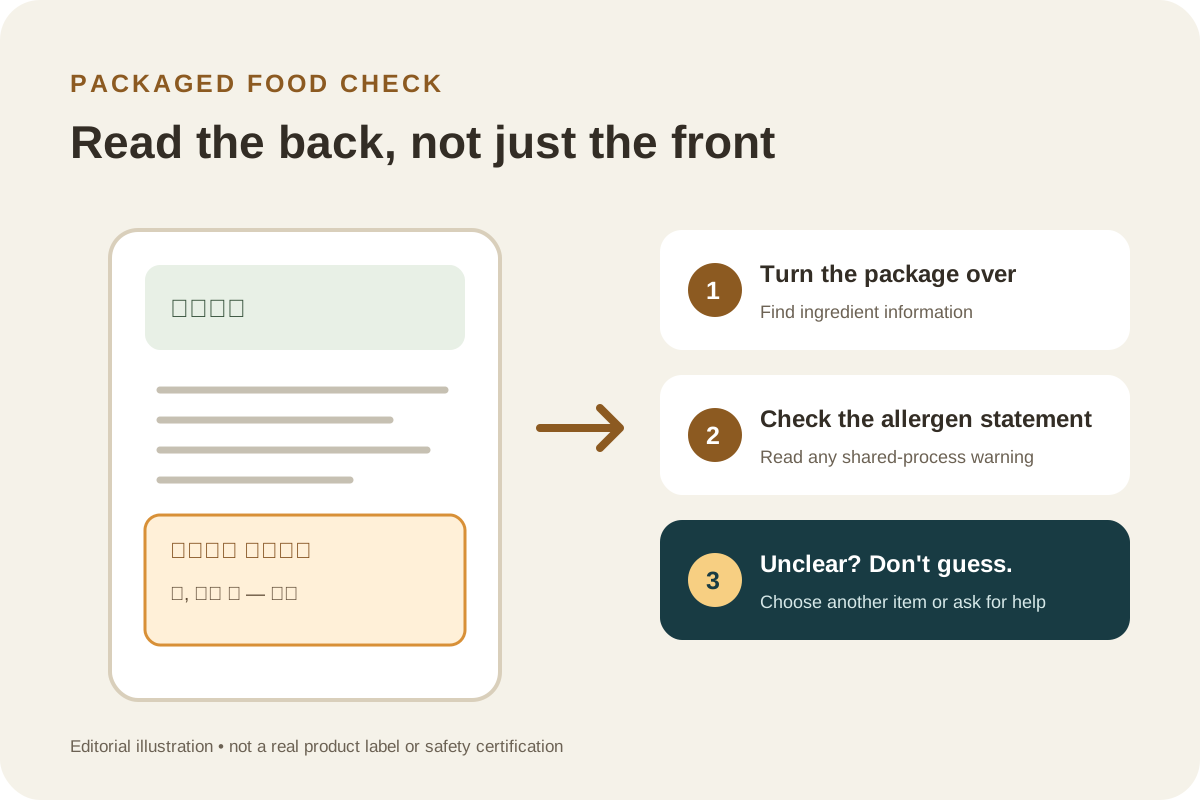
For a packaged food in Korea, check the product's current Korean ingredient list and allergen statement before buying. Do not decide from the front-of-pack flavor name or a translated product title. If you cannot confidently identify the ingredients relevant to your allergy, choose something else or ask a trusted Korean speaker to help.
Where to look on a package
Korea's Ministry of Food and Drug Safety (MFDS) says regulated food labels include ingredient information and a separate allergen statement near the ingredients. Look around the back or side panel for headings such as 원재료명 (ingredients) and 알레르기 유발물질 (allergen-causing substances). Packaging design varies; a product may use a different layout, and the label can be small.
The MFDS list includes poultry eggs, milk, buckwheat, peanuts, soybeans, wheat, mackerel, crab, shrimp, pork, peach, tomato, sulfur dioxide under a specified condition, walnuts, chicken, beef, squid, clams (including oysters, abalone and mussels), and pine nuts. The exact Korean wording and product formulation matter. This list is not a translation card or a complete list of every possible personal trigger.
| Label clue | How to use it |
|---|---|
| 원재료명 | Review the full ingredient list; do not rely only on a product name, image or flavor description. |
| 알레르기 유발물질 | Check the separate allergen statement against the allergens you personally avoid. |
| Wording that warns of possible mixture or shared production | Treat it as relevant when the allergen is a serious concern; choose another product if you are unsure. |
| No clear label, unreadable text or uncertain translation | Do not guess. Use a product you can verify or ask for help before buying. |
MFDS explains that cross-contact warnings may apply when products with and without an allergen use the same manufacturing process. Read the whole statement; do not assume a short ingredient translation answers the shared-production question.
Packaged goods and restaurant meals are different tasks
This page is about packaged products with labeling under Korea's food-labeling rules. It does not certify convenience-store food, a brand, product line or restaurant as safe for you. A prepared meal may involve shared equipment or handling that a package-label guide cannot verify. For restaurant questions and cross-contact, see how to navigate Korean restaurant menus with allergies. For gluten-specific dining preparation, use the gluten-free Korea guide.
A careful buying routine
- Keep the names of your known allergens in Korean and your preferred language. Have a fluent speaker verify the terms before travel; machine translation can miss ingredient and processing nuance.
- Turn the package around and read both the ingredient list and the separate allergen/warning text.
- Compare the exact product label with your own restrictions, including any cross-contact warnings.
- If anything is missing, unclear or outside the label's scope, do not treat silence as a safety guarantee. Choose another item or get qualified help.
For a severe allergy, follow your clinician's travel plan and carry prescribed emergency medication as directed. This article is food-label navigation, not medical advice or a product safety certification.
Illustration note: The original cover is a simplified label-reading diagram, not a real Korean package or a product endorsement. Use the text steps above; do not infer a product's ingredients from the drawing.
Sources checked 15 November 2026: MFDS Food Labeling System and Food Safety Korea allergen labeling guide. Label rules and individual product formulations can change; inspect the actual package.