Korean Sunscreen Guide 2026: Chemical vs Physical Explained
A comprehensive guide to Korean chemical vs physical sunscreens. Compare SPF ratings, ingredients, and prices (₩15,000+) to find your perfect match in 2026.
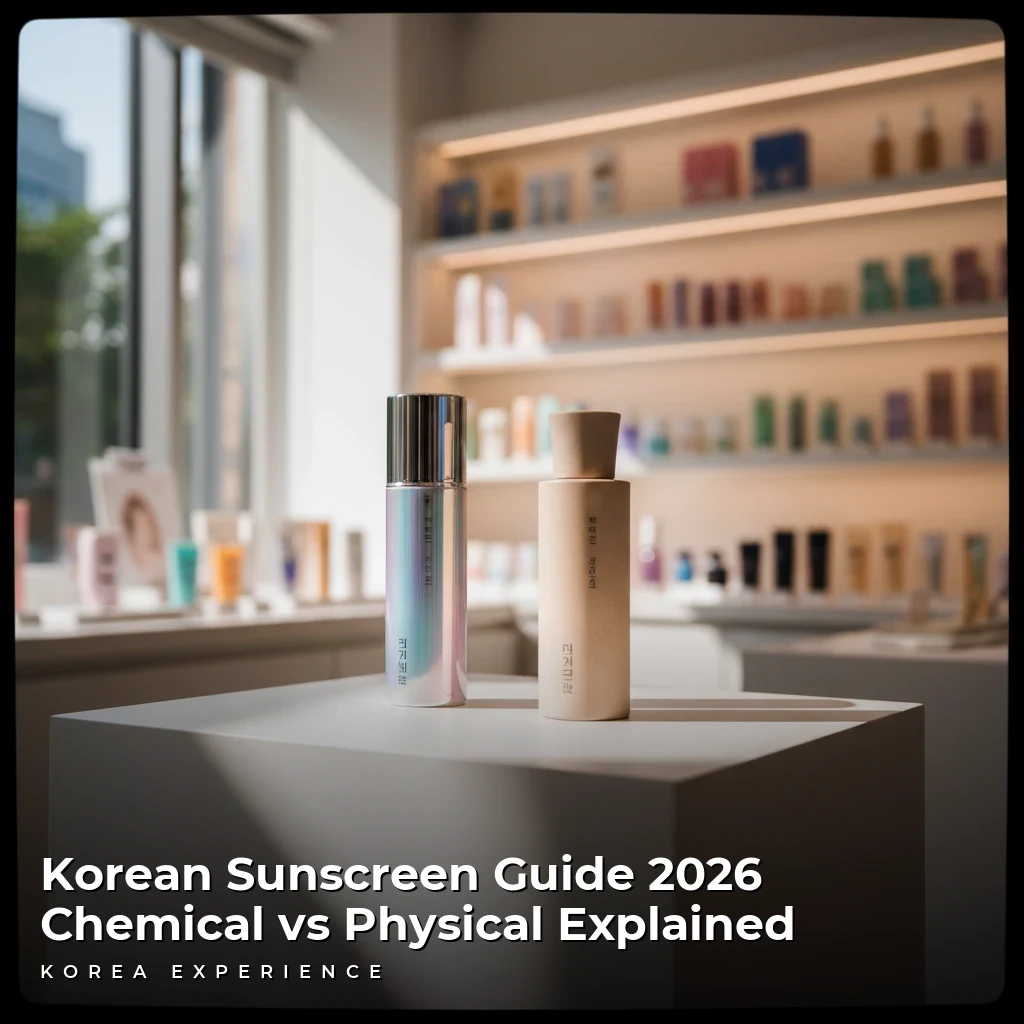
Understanding the difference between Korean chemical and physical sunscreens is the first step to mastering the famous "glass skin" routine. If you are shopping at Olive Young or browsing Duty-Free at Incheon Airport, the sheer volume of options can be overwhelming.
The short answer: Korean chemical sunscreens (organic) use advanced filters like Uvinul A Plus to absorb UV rays without a white cast, making them ideal for daily wear under makeup. Physical sunscreens (inorganic) use Zinc Oxide or Titanium Dioxide to reflect rays, offering immediate protection better suited for sensitive skin, children, or post-procedure care.
Key Takeaways
- 1Chemical sunscreens in Korea use next-gen filters unavailable in the US
- 2Physical sunscreens are recommended for sensitive skin and post-laser care
- 3PA++++ is the standard rating, indicating PPD 16+ or 93% UVA blockage
- 4Average price for high-quality sunscreen is ₩25,000 (approx $19 USD)
The Fundamental Difference: Mechanisms of Action
When you walk into an Olive Young store in Myeongdong or Hongdae, you will see shelves lined with hundreds of tubes. To make the right choice, you must understand the mechanism. In Korea, chemical sunscreens are often labeled as "Organic" (Yugi-ja-cha), while physical sunscreens are labeled as "Inorganic" (Mugi-ja-cha).
Chemical Sunscreens (Organic Filters)
Chemical sunscreens work by absorbing UV rays into the skin, converting them into heat, and then releasing that heat from the body. Because the active ingredients are organic compounds (carbon-based), they tend to be thinner, more elegant cosmetically, and leave zero white cast.
However, they typically require 15 to 20 minutes to become fully effective after application. In the past, older chemical filters (like Oxybenzone) were known to cause irritation. However, Korean formulations in 2026 utilize advanced filters that are photostable and far less irritating.
Physical Sunscreens (Inorganic Filters)
Physical sunscreens sit on top of the skin and act as a shield, reflecting and scattering UV rays away from the body. The primary ingredients are minerals: Titanium Dioxide and Zinc Oxide.
The main advantage is that they are effective immediately upon application. They are also less likely to clog pores or cause allergic reactions, which is why dermatologists in Gangnam recommend them after laser treatments. The downside is the texture; they can be thicker and historically left a "white cast" or ghost-like appearance, though 2026 nano-technology has significantly minimized this issue.
📋 Mechanism Comparison
Decoding Korean Labels: SPF and PA Ratings
In Western countries, you primarily look for SPF (Sun Protection Factor). In Korea, the PA rating is equally important. Understanding these metrics is crucial for buying the right product.
What is SPF 50+?
SPF measures protection against UVB rays, which are the primary cause of sunburn and skin cancer.
- SPF 15: Blocks ~93% of UVB rays.
- SPF 30: Blocks ~97% of UVB rays.
- SPF 50: Blocks ~98% of UVB rays.
In Korea, the maximum listed rating is SPF 50+. Even if a product tests at SPF 70 or 80 in the lab, it will be labeled as SPF 50+ to prevent consumer misconceptions that higher numbers mean you can stay in the sun indefinitely.
What is PA++++?
The PA system (Protection Grade of UVA) is developed in Japan and widely used in Korea. It measures protection against UVA rays, which penetrate deeper into the skin and cause premature aging (wrinkles, dark spots).
- PA+: Some UVA protection.
- PA++: Moderate UVA protection.
- PA+++: High UVA protection.
- PA++++: Extremely High UVA protection (PPD 16 or higher).
Most premium Korean sunscreens in 2026 boast a PA++++ rating. This means they block over 93% of UVA radiation, whereas many standard Western sunscreens may only offer PA++ or PA+++ equivalent protection.
The 2021 Controversy & Reform
In 2021, a controversy erupted when several Korean sunscreens were found to have lower SPF than claimed. Since then, the Korean Ministry of Food and Drug Safety has implemented strict verification standards. In 2026, all major brands (Round Lab, Dr.G, etc.) undergo rigorous double-testing to ensure the label matches the actual protection.
Chemical Sunscreens: The K-Beauty Standard
Korean chemical sunscreens are world-renowned because they feel like lightweight moisturizers rather than sticky sunblock. This is largely due to "Next-Generation Filters" that are approved in Korea and Europe but often still pending FDA approval in the US.
The Superior Ingredients
Unlike US sunscreens that rely on Avobenzone (which degrades quickly in sunlight) or Oxybenzone (hormone disruptor concerns), Korean sunscreens use:
- Bemotrizinol (Tinosorb S): Highly photostable, protects against both UVA and UVB.
- Bisoctrizole (Tinosorb M): A hybrid filter that both absorbs and reflects.
- Diethylamino Hydroxybenzoyl Hexyl Benzoate (Uvinul A Plus): excellent photostability in the UVA range.
These ingredients allow for formulas that are hydrating, non-greasy, and perfect for the "cloud skin" or "glass skin" look.
Top Chemical Contenders in 2026
1. Round Lab Birch Juice Moisturizing Sun Cream
- Price: ₩25,000 (often 1+1 at Olive Young).
- Texture: Essence-like, absorbs instantly.
- Best For: Dry to combination skin.
- Key Stat: Consistently ranks #1 on Hwahae (Korea's top beauty app) with over 5 million units sold globally.
2. Beauty of Joseon Relief Sun: Rice + Probiotics
- Price: ₩18,000 - ₩22,000.
- Texture: Creamy but light.
- Best For: Normal to dry skin, those wanting a dewy finish.
- Insight: Containing 30% rice extract, this product went viral globally for feeling like a luxury moisturizer.
If you are buying chemical sunscreen in Korea, look for 'Aqua' or 'Watery' in the name. These formulas are designed specifically for Korea's humid summers (reaching 85-90% humidity in August) and work perfectly under cushion foundation without pilling.
For a deeper dive into specific product rankings and SPF verification, check out our best Korean sunscreen guide.
Physical Sunscreens: The Safe Haven
While chemical sunscreens dominate the cosmetic market, physical (mineral) sunscreens hold a massive share of the dermatological market in Korea. If you visit a skin clinic in Gangnam for laser toning or microneedling, you will be sent home with a physical sunscreen.
Understanding "Non-Nano"
A major selling point in 2026 is "Non-Nano" physical sunscreen. This means the particles of Zinc Oxide or Titanium Dioxide are larger than 100 nanometers.
- Benefit: They cannot penetrate the skin barrier, making them safe for the bloodstream.
- Drawback: Larger particles reflect more visible light, leading to a stronger white cast.
However, Korean R&D has developed "micronized" technologies that reduce the whiteness significantly compared to Western mineral sunscreens.
Top Physical Contenders in 2026
1. Dr.G Green Mild Up Sun+
- Price: ₩28,000 (usually sold in a set).
- Texture: Soft matte finish.
- Best For: Sensitive skin, acne-prone skin, oily skin.
- Key Stat: Holds the highest repurchase rate among sensitive skin users in Olive Young for 3 consecutive years.
2. Etude House SoonJung x Director's Mineral Filter Sun Cream
- Price: ₩20,000.
- Texture: Light lotion.
- Best For: Extremely reactive skin.
- Insight: Developed in collaboration with Director Pi, a famous Korean ingredient analyst, specifically to be free of 10 harmful ingredients.
Chemical vs Physical Comparison
| Feature | Chemical (Organic) | Physical (Inorganic) |
|---|---|---|
| Active Agents | Carbon-based compounds | Zinc Oxide, Titanium Dioxide |
| White Cast | None (Transparent) | Minimal to Moderate |
| Activation Time | 15-20 Minutes | Immediate |
| Irritation Risk | Low (with new filters) | Very Low (Hypoallergenic) |
| Texture | Light, Watery | Creamy, Matte |
The Rise of Hybrid Sunscreens (Mixed Filters)
In 2026, the line between chemical and physical is blurring. "Hybrid" sunscreens use both organic and inorganic filters to achieve high SPF protection while minimizing irritation and white cast.
These are particularly popular in the "Tone-Up" category. Tone-up sunscreens are slightly tinted (often pink, peach, or purple) to brighten the complexion and color-correct sallowness. They function as a primer and sunscreen in one.
- Top Pick: d'Alba Waterfull Tone-Up Sun Cream.
- Price: ₩32,000.
- Effect: Gives a "glass skin" glow while providing SPF 50+ PA++++ protection.
Where to Buy: Olive Young vs. Duty Free
Knowing where to buy can save you up to 40% on costs.
Olive Young
This is the Sephora of Korea, but more accessible. There are over 1,300 stores across the country.
- Pros: Frequent "1+1" deals (buy one get one free), ability to test products, accessible everywhere.
- Cons: Can be crowded, especially the Myeongdong flagship.
- Strategy: Visit during the "Olive Young Sale" (usually early March, June, September, December) for up to 50% off.
Duty-Free (Lotte, Shilla)
Located in airports and major city centers.
- Pros: Tax-free instantly, bulk packages (sets of 4 or 6) available at steep discounts.
- Cons: You need your passport and ticket; can't open the "sealed" bags until you leave the country (for downtown duty-free purchases).
- Pricing: A set of 3 Dr.G sunscreens might cost $45 USD at Duty-Free, whereas buying three individually at Olive Young could cost $60+ USD.
For more shopping tips, read our Coex Mall shopping guide which includes a massive Olive Young and Duty-Free access.
Olive Young Flagship Store (Myeongdong)(올리브영 명동 플래그십)
How to Choose Based on Your Skin Type
Selecting the right sunscreen is not just about protection; it is about how it interacts with your skin's biology and your lifestyle.
Oily & Acne-Prone Skin
- Recommendation: Physical (Mineral) or Matte Chemical.
- Why: Zinc Oxide has mild astringent properties that can help control oil. Chemical sunscreens that are too "glowy" can make oily skin look greasy by 2:00 PM.
- Product: Dr.G Green Mild Up Sun+ or Round Lab Birch Juice (it is light enough for oily skin too).
Dry & Dehydrated Skin
- Recommendation: Chemical (Organic).
- Why: You need humectants. Korean chemical sunscreens often contain Hyaluronic Acid, Birch Sap, or Propolis.
- Product: Beauty of Joseon Relief Sun or Isntree Hyaluronic Acid Watery Sun Gel.
Sensitive & Post-Procedure Skin
- Recommendation: strictly Physical (Inorganic).
- Why: Chemical filters convert UV to heat, which can aggravate rosacea or sensitive skin. Physical filters reflect the heat. If you are getting treatments done, refer to our Gangnam skin clinic guide for post-care tips.
📖 The Two-Finger Application Method
Step 1: Measure
Squeeze two strips of sunscreen along the entire length of your index and middle fingers.
Step 2: Dot
Dot the product evenly across your forehead, cheeks, nose, chin, and neck.
Step 3: Blend
Gently massage into the skin. If using physical sunscreen, pat it in rather than rubbing to minimize white cast.
Common Myths About Korean Sunscreen
Myth 1: "Korean Sunscreen isn't waterproof."
Truth: Historically, many Korean daily sunscreens were not water-resistant because they were designed for commuting and office wear (incidental exposure). However, in 2026, the "Leports" (Leisure + Sports) category has exploded. Brands like Laneige and Innisfree offer highly water-resistant formulas labeled "Waterproof" or "Sweatproof."
Myth 2: "SPF 50 is enough for all day."
Truth: No sunscreen lasts all day. In the humid Korean summer, sweat breaks down the film. Reapplication is key. Koreans solve this with Sun Cushions or Sun Sticks.
- Sun Sticks: Waxy balms you swipe over makeup (e.g., AHC Natural Perfection).
- Sun Cushions: Large compacts with a puff applicator (e.g., Scinic Enjoy All Round Airy Sun Cushion).
If you are following a rigorous regimen, such as the 10-step Korean skincare routine, sunscreen is always the final step of the morning routine.
Price Breakdown: Budget vs. Luxury
Is expensive sunscreen worth it? In Korea, the law of diminishing returns applies heavily to skincare. A ₩20,000 product often performs 95% as well as a ₩100,000 product in terms of sun protection, though the luxury item may have anti-aging peptides or rare herbal ingredients.
💵 Sunscreen Price Comparison
Hanbang ingredients, premium scent, anti-aging focus
Pure hydration, effective protection, best value
Environmental Impact: Reef Safety
With many travelers heading from Seoul to Jeju Island or further afield to Southeast Asia, "Reef Safe" has become a buzzword in K-Beauty.
- The Issue: Ingredients like Oxybenzone and Octinoxate can bleach coral reefs.
- The Solution: Many Korean brands have voluntarily removed these ingredients even in their chemical formulations to obtain "Reef Safe" certification.
- Check the Box: Look for the "Reef Friendly" icon on the packaging, especially if you plan to swim in Jeju.
Seasonal Adjustments
Korea has four distinct seasons, and your sunscreen choice should change with them.
- Summer (Jun-Aug): High humidity (80%+). Use lightweight, matte, or waterproof formulas. Sun sticks are essential for reapplication over sweat.
- Winter (Dec-Feb): Dry, cold winds. Use moisturizing chemical sunscreens that act as a barrier against the wind.
- Spring/Fall: Moderate weather. The UV index can still be very high (7-8) in May. Don't skip protection just because it is breezy.
📊 Korean Sunscreen Market 2026
Conclusion
The debate between chemical and physical sunscreen in Korea isn't about which is "better" overall, but which is better for you.
If you want an invisible finish, hydration, and are wearing makeup, Korean Chemical Sunscreens are vastly superior to their Western counterparts due to advanced filters like Tinosorb S. If you have sensitive skin, rosacea, or are pregnant, Korean Physical Sunscreens offer robust protection with minimal irritation and improved textures that avoid the dreaded "ghost face."
For 2026, the smartest move for travelers is to buy a "1+1" set at Olive Young: keep one chemical sunscreen for daily city exploration and one physical sunscreen for those days when your skin feels sensitive or tired.
❓ Frequently Asked Questions
Have more questions?Contact us →
About the Author
Korea Experience Team
Written by the Korea Experience editorial team - experts in Korean medical tourism, travel, and culture with years of research and firsthand experience.
Explore more in Shopping & K-Beauty
From Olive Young hauls to Myeongdong shopping tips — discover the best K-Beauty products, fashion trends, and shopping destinations in Korea.
Browse All Shopping & K-Beauty ArticlesContinue Reading
Explore more articles you might find interesting
Compare Korean gel vs cream moisturizers. Find the perfect formula for Seoul's 80% summer humidity or dry winters. Prices from ₩15,000.

Complete 2026 guide to recovery hotels in Seoul. Compare prices (₩100k-500k/night), find nursing services, and book the perfect aftercare stay.
Compare Starfield COEX and Suwon malls in 2026. Find the best K-fashion, Aqufield spas, and the iconic Starfield Library. Prices and transport info included.
Discover the best Lotte Department Store flagship locations. Compare Myeongdong vs Jamsil, find 2026 luxury brands, food courts, and duty-free prices.
Deciding between Laneige and Sulwhasoo? We compare prices (₩32,000 vs ₩140,000), ingredients, and results to help you choose the best K-beauty brand.
Compare top Korean sheet masks from Mediheal to Dr.Jart+ with 2026 prices. Find masks from ₩1,000 at Olive Young to luxury ₩20,000 treatments.