The 2026 Master Guide to Korean Table Manners
Sticking your chopsticks vertically into your rice is the ultimate no-no in Korea because it looks exactly like a funeral ritual—honestly.
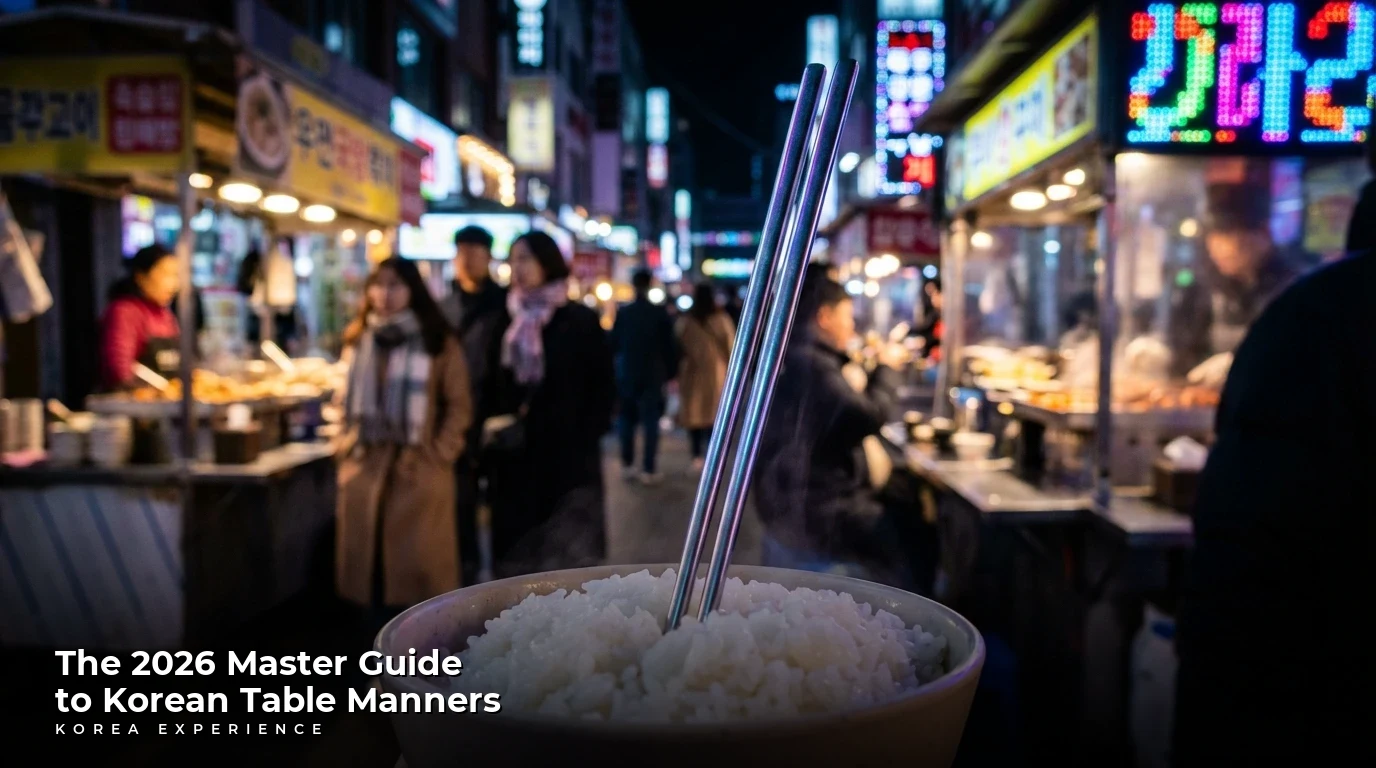
So, you've finally made it to Seoul. You're sitting in a beautiful restaurant, the smell of sizzling pork belly is everywhere, and you're feeling like a total pro because you've already mastered the "Annyeong-haseyo" (Hello). But then, you do it. You're talking, your hands are busy, and you stick your chopsticks vertically into your bowl of rice to keep them steady. Suddenly, the table goes quiet. Your Korean friend looks like they just saw a ghost.
The short answer is: Never, under any circumstances, stick your chopsticks straight up in your rice bowl. This is called Sapsi and it is reserved exclusively for Jesa (ancestral memorial rites) to feed the spirits of the dead.
For the perfect pairing of manners and food, find the best Korean BBQ restaurants in Seoul.
Key Takeaways
- 1Never stick your chopsticks straight up in your rice bowl—this is called Sapsi and is reserved exclusively for Jesa (ancestral memorial rites). If you do it at a dinner party, you will see some very uncomfortable faces around the table.
- 2The maximum no-show penalty the Fair Trade Commission (FTC) now allows restaurants to charge as of 2026 is 40%. If you book a trendy spot and don't cancel at least two days in advance, you could lose almost half the cost of your meal.
- 3If you are a tourist without a local phone number or an ARC, download CatchTable Global—it is the only legitimate way to book the best Michelin spots and BBQ joints in 2026 without hitting the identity verification wall.
📋 Korean Table Manners Quick Facts
Honestly, I've been there, and it's the quickest way to realize that in Korea, your rice bowl isn't just a food container—it's a ritual space. Sticking your chopsticks straight up into your rice is called Sapsi. This gesture is strictly reserved for Jesa, which are ancestral memorial ceremonies where you offer food to the spirits of family members who have passed away. At a funeral or memorial, the spoon is often stuck into the center of the rice bowl and the chopsticks are laid across specific dishes to "help" the spirit eat. By doing this during a normal meal, you're basically mimicking a funeral ritual, which is considered incredibly unlucky and disrespectful to the living.
But that's not the only rule about your bowl. Unlike in China or Japan, where you might lift your bowl to your mouth to shovel in those last few grains of rice, in Korea, your bowl stays firmly on the table at all times. Traditionally, the upper classes (the Yangban) ate from heavy brass or porcelain bowls that were too hot or too heavy to lift comfortably. Lifting the bowl was associated with beggars or people who didn't have a table to eat on.
The Silver, the Poison, and the Stainless Steel: A History
Korean Chopstick Evolution
Introduction of Chopsticks
The tradition of eating with sticks spreads from China to the Korean peninsula.
Royal Silver Discovery
King Muryeong of Baekje begins using silver chopsticks to detect arsenic in royal meals.
Sasojeol Published
Scholar Yi Deokmu writes 'Elementary Etiquette for Scholar Families,' codifying modern table rules.
Stainless Steel Era
Durable, hygienic stainless steel replaces brass and wood as the standard material.
CatchTable Global Debut
The first major reservation platform for foreigners launches, removing local phone verification.
New Penalty Regulations
The FTC implements strict no-show fees and restaurants begin charging for premium banchan refills.
You might be wondering, "Why on earth are these chopsticks so flat and slippery?" If you're used to the wooden ones you get with takeout in New York or London, Korean metal chopsticks feel like you're trying to eat with two flat-head screwdrivers. But the history behind them is actually fascinating. It dates back to the 6th century during the Baekje Kingdom. King Muryeong and the royal family started using silver chopsticks because they believed silver would change color if it touched arsenic or other poisons in their food. It was basically a high-tech security system for your dinner!
Eventually, the common people wanted to look as "royal" as possible, but since silver was way too expensive, they used bronze (known as Bangjja), and eventually, in the 1970s, the country moved to stainless steel for mass production. The flat shape we see today isn't just to make things hard for you; it's an engineering choice that allows you to "grip" heavy or slippery items much more effectively than round sticks once you get the hang of it.
And let's talk about the spoon—the other half of the Sujeo set. Korea is unique in East Asia because the spoon is just as important, if not more important, than the chopsticks. Since the Korean diet is built on rice and soup (the "DNA" of the meal), the spoon is the primary tool. You use it for your rice and your stew, while the chopsticks are reserved for the banchan (side dishes). Just remember: never hold both in the same hand at once!
Korean vs. Japanese vs. Chinese Chopsticks
East Asian Chopstick Comparison
| Feature | Korean (Jeotgarak) | Japanese (Hashi) | Chinese (Kuaizi) |
|---|---|---|---|
| Material | Stainless Steel / Metal | Wood / Bamboo / Lacquer | Wood / Bamboo / Plastic |
| Shape | Flat and rectangular | Tapered with pointed tip | Long and cylindrical |
| Usage | Paired with a spoon (Sujeo) | Primarily chopsticks only | Chopsticks (spoon for soup) |
| Bowl Lifting | Major Taboo (stays on table) | Required / Encouraged | Common for rice |
| Beginner Difficulty | High (Heavier / Slippery) | Low (Lightweight / Grip) | Medium (Long / Blunt) |
| 2026 Reservation | CatchTable Global focus | TableCheck / AutoReserve | WeChat / Meituan focus |
Korean Sujeo Setup: Pros and Cons
- ✓Unmatched Hygiene: Metal doesn't absorb bacteria or food odors like wood. You can sterilize your utensils in boiling water.
- ✓Double Functionality: The flat edge of Korean chopsticks lets you 'cut' through soft foods like kimchi or pancakes without needing a knife.
- ✓Eco-Friendly: Since they are virtually indestructible, metal chopsticks are the ultimate sustainable dining tool.
- ✗The Learning Curve: They are slippery. Trying to pick up a tiny piece of spinach with flat metal can feel like a frustrating game of Operation.
- ✗Heat Transfer: If you leave your metal spoon or sticks in a boiling bowl of Sundubu-jjigae for too long, they will get burning hot.
- ✗The Noise Level: It is very easy to make clashing sounds against metal bowls, which is considered a bit rude in polite settings.
From K-BBQ to the 2026 Fine Dining Scene
Not every meal in Korea is a formal affair with 20 rules. If you're grabbing Tteokbokki at a street stall in Myeongdong, nobody is going to care if you eat with your hands or stand up. But if you're booked for a Hanjeongsik (traditional full course) or a corporate dinner, you need to know which environment you're stepping into.
The Casual K-BBQ Experience: This is the bread and butter of Korean social life. The biggest thing here is the "Community First" rule—you aren't just eating your own steak; you're sharing everything. In 2026, many BBQ spots have moved to a "self-bar" for banchan because of rising labor costs. Also, if you're the youngest, it's usually your job to do the grilling!
Check out the best Korean BBQ restaurants in the Gangnam edition for top picks.
The Formal Hanjeongsik: This is the "Nobility Feast." You'll likely be in a Hanok (traditional house) and you might even be sitting on the floor on cushions. The table will be laid out in a very specific way: rice on your left, soup on your right, hot foods on the right, and cold foods on the left. It's a slow-paced meal, often costing anywhere from ₩45,000 to over ₩200,000 per person in 2026.
The 2026 Michelin Scene: Reservation culture in Seoul has gone completely digital and competitive. Top spots release their bookings in "drops" on CatchTable Global. Because of the new 2026 FTC rules, if you're a "no-show," you can lose 40% of the meal's cost instantly. For more, see our CatchTable reservation guide for Michelin restaurants.
How to Navigate a Formal Korean Dinner
📖 How to Navigate a Formal Korean Business or Family Dinner
Step 1: The Seating Power Play
Wait for the host or the oldest person to sit down first. The seat of honor is usually the one furthest from the door. If you are the youngest, aim for the seat closest to the door.
Step 2: The Opening Acknowledgment
Before you even pick up your spoon, say 'Jal-meokgesseumnida.' It literally means 'I will eat well,' and is the Korean version of 'Bon Appetit.' Wait for the elder to take the first bite before you start.
Step 3: Mastering the Sujeo
Keep your rice bowl on the table—never lift it! Use your spoon for the rice and soup, and your chopsticks for the side dishes (banchan). Never hold both in the same hand at once.
Step 4: The Closing Ceremony
Once done, place your utensils back on the table where you found them—don't leave them in the bowl. Say 'Jal-meokeosseumnida' to show your appreciation. Wait for the elder to stand up before you leave.
In 2026, the biggest mistake people make isn't just about chopsticks—it's about the speed of eating. If you finish your meal way before the elder at the table, it looks like you're rushing them or didn't enjoy the food. Try to match their pace. If they are talking a lot, slow down! It's about the harmony of the table, not just filling your stomach.
The Stuff Nobody Tells You: Hidden Rules and 2026 Hacks
Here is the "local friend" advice I learned the hard way after years in Seoul.
First, the "Banchan Refill" shift. For decades, side dishes were free and unlimited. But in 2026, with the cost of labor and vegetables like perilla leaves and lettuce skyrocketing, more restaurants are questioning the "unlimited" rule. Some places are now charging ₩1,000 to ₩2,000 for a third refill of premium items. Always look for the sign that says "추가 반찬은 셀프" (Additional side dishes are self-service).
For a complete overview of 50 must-try Korean foods, see our comprehensive food guide.
Second, the "No-ARC" struggle. Most Korean apps like KakaoTaxi or the local version of CatchTable require "identity verification" which is a nightmare for tourists. The solution is to use the CatchTable Global version—a separate app specifically designed for foreigners that lets you use a foreign credit card for deposits.
Finally, let's talk about the "Politeness Piece." In many cultures, taking the last piece of food on a shared plate is fine. In Korea, that last piece of meat or pancake will often sit there for ten minutes because everyone is too polite to take it. If you want it, it's polite to offer it to the eldest person first. If they refuse, then you can claim it!
Pro Tip: Chopstick Grip
If you're finding the metal chopsticks too heavy or slippery, try holding them a bit higher up. Most people "choke up" on them like a pencil, but holding them near the top gives you much better leverage for those heavy pieces of Galbi (short ribs).
Never Blow Your Nose at the Table
Never, ever blow your nose at the table. In Korean culture, this is considered extremely unhygienic and rude. If the spicy stew gets to you, excuse yourself to the restroom or at least turn completely away and be as discreet as possible.
No Korean Phone/ARC? Here's What To Do
Most local services require identity verification via a Korean SIM card. To bypass this, download the CatchTable Global app. You can sign up with your Google or Apple ID and use your home-country Visa or Mastercard for deposits. If you encounter a physical waiting kiosk that only accepts Korean numbers, look for a small QR code for "International Guests" at the bottom of the screen—it will let you join the waitlist using just your email!
Frequently Asked Questions
❓ Frequently Asked Questions
Have more questions?Contact us →
Your Action Plan
Look, Korean table manners might seem like a lot to take in, but don't let it stress you out. At the end of the day, Koreans are incredibly welcoming to foreigners and they don't expect you to be perfect. As long as you're making an effort—waiting for the elders, using two hands to pour, and staying away from the "chopstick-in-the-rice" disaster—you're going to have an amazing time.
In your first 24 hours in Korea, do this: Download CatchTable Global and link your home credit card while you're still on the hotel Wi-Fi. Go to a local BBQ spot and practice your Sujeo skills. Remember: Spoon for rice, chopsticks for everything else! Practice saying "Jal-meokgesseumnida" before you take your first bite.
Dining in Korea is more than just eating; it's about connection, respect, and sharing. Even if you fumbled with your slippery metal chopsticks, the fact that you respected the culture will open so many doors for you. Now go out there and enjoy that feast—you've earned it!
Sources
- Asian Inspirations - Detailed rules on utensil use and funeral taboos
- Korea Experience - Critical updates on the 2026 reservation landscape and no-show penalties
- 90 Day Korean - Comprehensive guide on social hierarchy and dining social norms
- Korea.net - Historical origins of metal chopsticks and the Sujeo set
- Asia News Network - Reports on the 2026 economic shifts in Korean restaurant pricing
About the Author
Korea Experience Team
Written by the Korea Experience editorial team - experts in Korean medical tourism, travel, and culture with years of research and firsthand experience.
Explore more in K-Culture
K-Pop, K-Drama, traditional arts, and modern culture — dive deep into the cultural phenomena that have captivated the world.
Browse All K-Culture ArticlesContinue Reading
Explore more articles you might find interesting
Visit real-life Lovely Runner spots in Suwon for under ₩3,000. Find Sol’s house at Mong Ted cafe and the confession bridge in this 2026 guide.
Scoring limited K-pop goods in 2026 is a high-stakes game of speed, strategy, and logistics.
Visit the ₩100 million wedding venue and The Hyundai Seoul. This 2026 guide covers 17+ locations from Seoul to Germany with travel tips and cost breakdowns.
Put your hands down! While it looks polite elsewhere, using the 'prayer pose' in Korea is actually a major cultural blunder that makes you look like you're...
Discover Seoul's 2026 vinyl culture where 20,000 records meet premium highballs. Explore hidden listening bars with entry fees starting at 10,000 KRW.
The short answer? Always use two hands when pouring or receiving a drink and never, ever fill your own glass—it's the fastest way to signal you're a tourist.