Laser hair removal diode vs Alexandrite vs IPL in Korea 2026 guide
Compare Diode, Alexandrite, and IPL laser hair removal in Korea. Discover 2026 prices starting at ₩5,000, best machines, and effectiveness for your skin type.
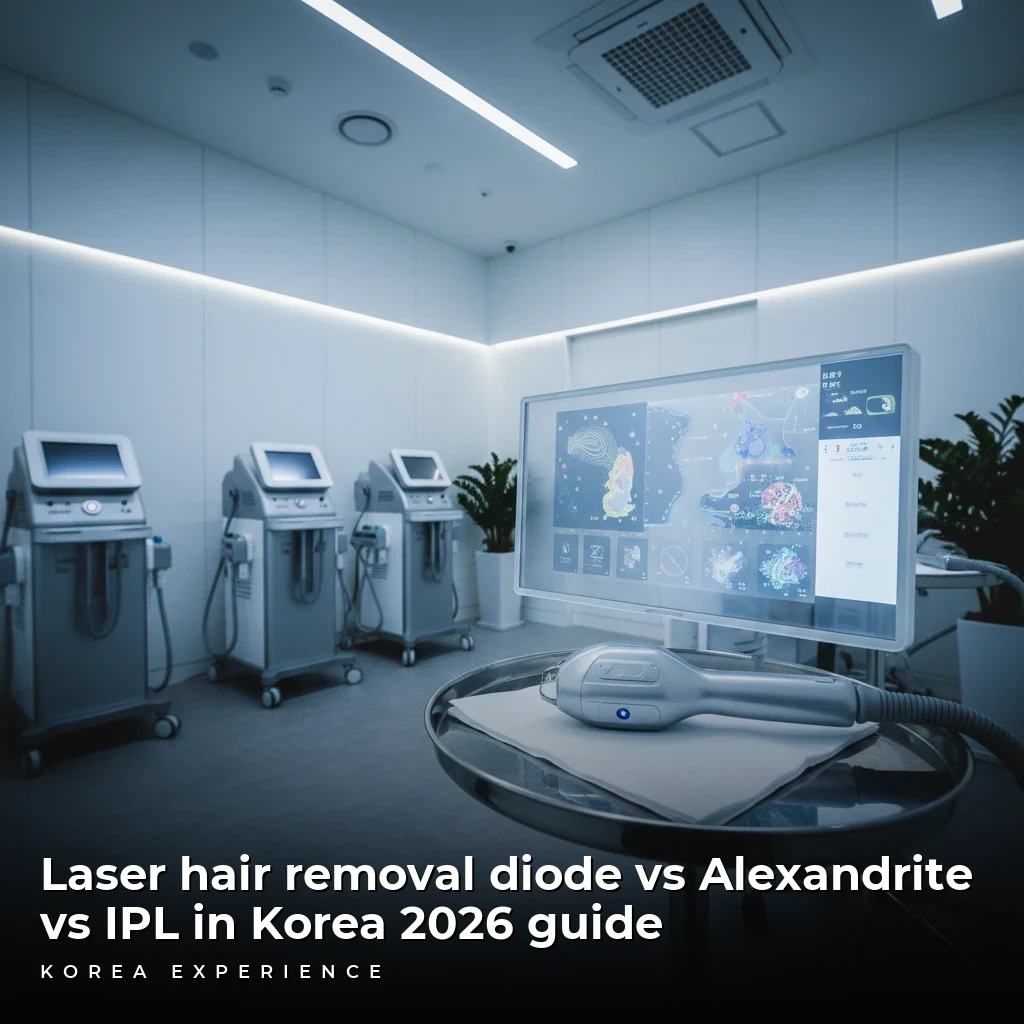
When choosing between Diode, Alexandrite, and IPL for hair removal in Korea, the decision depends entirely on your skin tone, hair thickness, and pain tolerance. For the majority of international visitors with light to medium skin tones (Fitzpatrick I-IV), Diode lasers (808nm/810nm) are generally considered the "Gold Standard" in Korean clinics due to their deep penetration, speed, and ability to handle slightly darker skin better than Alexandrite. However, Alexandrite (755nm) remains superior for very fair skin with fine hair, offering a "snappier" but highly effective treatment. IPL (Intense Pulsed Light) is technically not a laser; it is less effective for permanent reduction and is rarely recommended in top-tier Korean dermatology clinics for hair removal anymore, as the price gap between true laser and IPL has closed significantly in Seoul.
The short answer: For 90% of travelers visiting Korea in 2026, a Diode laser or a hybrid machine (Alexandrite + Nd:YAG) like the Clarity II or GentleMax Pro is the best choice. Diode offers the best balance of comfort and results for mixed skin types, while IPL should be avoided for permanent hair removal goals.
Key Takeaways
- 1Diode (808nm) is the most versatile option for mixed skin types and is standard in Korean 'factory' clinics.
- 2Alexandrite (755nm) is most effective for very fair skin with fine hair but carries higher burn risks for tanned skin.
- 3Korean laser prices are 70-80% lower than the US/Europe; underarm treatments can cost as little as ₩5,000 ($3.50 USD).
Medical Disclaimer
The content in this article is for informational purposes only and does not constitute medical advice. Always consult with a certified dermatologist before undergoing laser treatments. In Korea, call 1339 for medical consultation services in English.
Understanding the Technology: How It Works
To understand the battle of Laser Hair Removal Diode vs Alexandrite vs IPL, you must first understand the mechanism: Selective Photothermolysis. The laser targets the melanin (pigment) in your hair follicle. The light energy converts to heat, damaging the follicle to inhibit future growth.
The primary difference between these technologies is the wavelength of light used, measured in nanometers (nm). The wavelength determines how deep the laser penetrates and how attracted it is to melanin versus hemoglobin or water.
The Fitzpatrick Scale and Safety
Safety in Korea is paramount. Korean dermatologists assess you based on the Fitzpatrick scale (Skin Types I through VI).
- Type I-III (Pale to Beige): Alexandrite is highly effective.
- Type III-IV (Beige to Light Brown): Diode is the safest and most effective.
- Type V-VI (Dark Brown to Black): Nd:YAG (1064nm) is required to avoid burning the skin.
📊 Efficacy Comparison
Alexandrite Laser (755nm): The Precision Specialist
The Alexandrite laser emits a wavelength of 755nm. It has a very high absorption rate for melanin, making it incredibly effective for people with light skin and dark hair.
Pros and Cons in the Korean Context
In Seoul, you will often find the Candela GentleMax Pro, which combines Alexandrite and Nd:YAG. It is considered a premium treatment.
- Best for: Skin Types I-II with dark hair.
- The Sensation: Often described as a rubber band snapping against the skin. It is generally sharper pain than Diode but faster per pulse.
- Drawbacks: It has a higher risk of causing hyperpigmentation (dark spots) on olive or darker skin tones because it loves melanin so much it might target the skin instead of the hair.
Pro Tip
If you have very fine, light brown hair (often called "peach fuzz" on the face), Alexandrite is usually more effective than Diode. Ask for the "GentleMax Pro" specifically when booking in Gangnam.
Diode Laser (808nm/810nm): The Korean Standard
The Diode laser operates at 800-810nm. This longer wavelength penetrates deeper into the dermis, bypassing surface pigmentation more effectively than the Alexandrite. This makes it safer for a broader range of skin tones (Types I-V).
Why Korea Loves Diode
Korean skin usually falls into Type III or IV. Diode lasers are the workhorses of the Korean beauty industry. Machines like the Soprano Titanium or domestic Korean brands like Jeisys use Diode technology.
- In-Motion Technology: Many Diode lasers in 2026 use a "sweeping" motion rather than a "stamping" motion. This gradually heats the dermis, making it significantly less painful—often described as a "hot stone massage" rather than snapping.
- Speed: Diode lasers often have larger spot sizes, allowing for very fast treatment of large areas like backs or legs (often under 20 minutes for full legs).
IPL (Intense Pulsed Light): The Budget Contender
IPL is technically not a laser. Instead of a single, focused wavelength, it emits a broad spectrum of light (500-1200nm) like a camera flash.
The Reality of IPL in 2026
While IPL devices are popular for at-home use, professional clinics in Korea rarely use standalone IPL for hair removal anymore. The technology is considered outdated for this purpose compared to high-power diodes. IPL energy is scattered, meaning the follicle gets less directed heat, leading to hair reduction rather than permanent removal.
However, you might see "IPL" listed for skin rejuvenation (treating redness or sunspots) in the same clinics. Do not confuse the two treatments.
Laser Technology Showdown
| Feature | Alexandrite (755nm) | Diode (810nm) | IPL (Broad) |
|---|---|---|---|
| Skin Types | I - III (Fair) | I - V (Most) | I - III Only |
| Pain Level | Medium/Sharp | Low/Dull Heat | Medium |
| Sessions Needed | 6-8 | 8-10 | 12+ |
| Penetration | Superficial | Deep | Shallow |
| Korean Price | $$$ | $$ | $ |
The "Factory Clinic" vs. Boutique Experience
If you are coming to Korea for treatments, you must understand the venue types. This distinction impacts which laser you will receive.
The "Factory" Clinic (Gongjang-hyeong)
These are high-volume, low-cost clinics found near Gangnam Station, Hongdae, and Myeongdong.
- Experience: You check in via kiosk, wash your own face/apply numbing cream in a communal room, and move to a treatment bed where a doctor performs the procedure very quickly.
- Equipment: Usually domestic Korean Diode lasers or basic Apogee machines.
- Cost: Extremely low. Underarms can be ₩5,000 - ₩9,000 ($3.50 - $6.50 USD).
- Time: In and out in 30 minutes.
The Boutique Clinic
- Experience: Private rooms, 1-on-1 consultation, staff applies numbing cream for you.
- Equipment: Imported premium lasers (GentleMax Pro Plus, Soprano Titanium).
- Cost: 3x to 5x the factory price.
- Time: 60-90 minutes.
For a deeper dive into choosing the right facility, check our guide on best plastic surgery clinics for foreigners in Seoul.
Cost Analysis: Korea vs. Global Prices
The primary driver for medical tourism in this sector is cost. In 2026, the price disparity remains massive.
📋 Price Comparison (Per Session)
💵 Seoul Laser Hair Removal Pricing 2026
GentleMax Pro, Private Room, Full legs
Full legs + Underarms package
Prices vary by district. Clinics in Gangnam-gu generally charge 20-30% more than clinics in Seodaemun-gu (Sinchon/Hongdae), which cater to university students.
Popular Machines in Korean Clinics (2026)
When booking, ask specifically which machine uses. Here are the top contenders:
- Clarity II (Lutronic): A Korean-made masterpiece dominating the market. It is a dual-wavelength system (755nm Alex + 1064nm Nd:YAG). It uses "Intelligent Cooling" to prevent burns and is incredibly fast.
- Soprano Titanium (Alma): Famous for being virtually painless. It combines three wavelengths (755/810/1064) simultaneously. Great for cowards regarding pain!
- Apogee Elite (Cynosure): An older but reliable standard for Alexandrite treatments. Very common in budget clinics.
- GentleMax Pro Plus (Candela): The luxury standard. High power, large spot size, excellent cooling.
If you are interested in other aesthetic treatments while visiting, read about anti-aging treatments in Korea.
The Procedure: What to Expect in Seoul
Navigating a Korean clinic can be intimidating if you don't speak the language, though most large clinics have English coordinators.
The Treatment Journey
Shaving
You MUST shave the area 24 hours prior. Clinics charge ₩10,000-20,000 penalty if they have to shave you.
Check-in
Identity verification (Passport required for tax refund) and payment upfront.
Numbing
Optional numbing cream applied (20-30 min wait). Many skip this for simple underarm treatments.
The Laser
Goggles on. The doctor performs the procedure. Underarms take 2 minutes; legs take 15-20.
Aftercare
Soothing gel applied. Prescription for steroid cream given if prone to folliculitis.
"Many foreigners are surprised that the doctor doesn't chat much in factory clinics. They are focused on efficiency. Don't take it personally! Also, make sure to wear loose clothing. Skinny jeans after leg laser is a nightmare."
Pain Management and Recovery
Diode vs. Alexandrite Pain:
- Diode (In-Motion): Feels like hot pinpricks or a build-up of heat. Pain score: 3/10.
- Alexandrite: Feels like a rubber band snap. Instant sharp pain that fades immediately. Pain score: 5/10.
- Nd:YAG: Feels like deep heat. Pain score: 6/10.
Cooling Systems: Korean machines utilize advanced cooling. The Cryogen cooling spray (on Alexandrite machines) blasts the skin with a -26°C chemical immediately before the laser pulse, numbing the surface. Contact cooling (on Diode machines) uses a chilled sapphire tip (around -4°C to 4°C) that glides over the skin.
Recovery: Expect redness (erythema) and follicular edema (bumps that look like goosebumps) for 2-24 hours. This is a good sign—it means the follicle was heated successfully.
Sun Exposure Warning
You cannot have laser hair removal if you have a fresh tan or sunburn. The laser will target the pigment in your skin instead of the hair, causing burns. Avoid sunbathing for 2 weeks before and after treatment.
Recommended Areas for Treatment
1. Gangnam Station (Exit 10 & 11)
The epicenter of factory clinics.
- Pros: Lowest prices, highest competition, English menus almost everywhere.
- Cons: Crowded, impersonal, wait times can be long even with reservations.
- Travel: Line 2 (Green Line). Approx. 45 mins from Incheon Airport via Bus 6009.
2. Sinsa-dong (Garosu-gil)
The boutique hub.
- Pros: Luxury service, top-tier machines (GentleMax Pro), privacy.
- Cons: Significantly more expensive.
- Travel: Line 3 (Orange Line), Sinsa Station.
3. Hongdae (Hongik Univ. Station)
The student budget hub.
- Pros: Cheap, trendy, great for walking in.
- Cons: Often younger, less experienced staff.
- Travel: Line 2 & AREX Line.
Muse Clinic (Gangnam Branch)(뮤즈클리닉 강남점)
Men's Laser Hair Removal in Korea
Laser hair removal for men is booming in Korea in 2026. The "clean boy" aesthetic means many Korean men opt for full facial hair removal (beard sculpting) and lower leg hair reduction.
- Beard Removal: Requires Nd:YAG or high-power Diode because facial hair is deep and dense. It is significantly more painful than body hair removal.
- Leg Hair: Many men choose "reduction" rather than full removal, asking for fewer sessions to simply thin out the hair.
For men interested in grooming, you might also like our guide on buying a used car in Korea if you are staying long-term and need transport to clinics outside Seoul.
Pros and Cons of Laser Hair Removal in Korea
Laser Treatment in Korea
- ✓Cost is 70-90% cheaper than Western countries
- ✓Access to the latest 2026 technology and dual-wavelength machines
- ✓High hygiene standards even in budget clinics
- ✓VAT Tax Refund available for tourists (keep your passport handy)
- ✗Communication can be brief/impersonal in factory clinics
- ✗Requires multiple sessions (hard for short-term tourists)
- ✗Strict penalty fees for late arrival or unshaven areas
- ✗Cannot be done on tanned skin (limits summer travel plans)
How Many Sessions Do You Need?
This is the most common misconception. One session will not make you hair-free.
- Hair Growth Cycles: Hair grows in three stages: Anagen (growth), Catagen (transition), and Telogen (rest). Laser only works on Anagen hair.
- The Math: At any given time, only 15-20% of your body hair is in the Anagen phase. Therefore, one session kills 15-20% of the hair.
- The Schedule: You need treatments every 4-6 weeks for the face and 6-8 weeks for the body.
- Travel Strategy: If you are in Korea for only a week, get one session to slow growth and enjoy the cheap price, but don't expect permanent results unless you plan to return or continue treatment at home.
For those planning a longer stay to complete a full course (5-10 sessions), consider reading about best neighborhoods for expats in seoul 2026.
Frequently Asked Questions
❓ Laser Hair Removal FAQ
Have more questions?Contact us →
Final Verdict: Which Should You Choose?
In the battle of Laser Hair Removal Diode Vs Alexandrite Vs IPL, the winner for the international traveler in Korea 2026 is clear:
- Choose Diode (808nm) if you want the safest, most comfortable all-rounder, especially if you have light-to-medium skin (Types II-IV). It is the standard in Korea for a reason.
- Choose Alexandrite (755nm) only if you have very pale skin (Type I-II) and want aggressive results on fine hair, and are willing to tolerate a bit more "snap."
- Avoid IPL for professional treatments in Korea. The cost savings are negligible compared to the loss in efficacy.
Korea offers an incredible opportunity to access top-tier dermatological technology at a fraction of global prices. Whether you visit a bustling factory clinic in Gangnam or a serene boutique in Sinsa, the technology available in 2026 is world-class.
For more beauty insights, check out our guide to best korean skin clinics in gangnam 2026 to find the perfect venue for your treatment.
About the Author
Korea Experience Team
Written by the Korea Experience editorial team - experts in Korean medical tourism, travel, and culture with years of research and firsthand experience.
⚠️ Medical Disclaimer
The information provided on this website is for general informational purposes only and does not constitute medical advice. Always consult with qualified healthcare professionals before making any medical decisions.
Explore more in Medical Tourism
World-class medical procedures at competitive prices. From plastic surgery and dermatology to dental care and health checkups — your complete guide to medical tourism in Korea.
Browse All Medical Tourism ArticlesContinue Reading
Explore more articles you might find interesting
Discover top 2026 laser tattoo removal in Korea. Picosecond tech removes ink 40% faster with prices starting at ₩50,000 per session.
Compare Potenza and Morpheus8 costs in Seoul for 2026. Save 70% with prices starting at $215 USD versus $1,500 in the West for skin tightening.

Discover the best K-beauty products for 2026. From viral sunscreens ($15) to barrier creams, here is the ultimate shopping guide with prices and skin type
Compare Kakao T and Uber in Korea for 2026. Discover prices starting at ₩4,800, foreign card tips, and how to navigate Seoul like a local.

Compare Korean gel vs cream moisturizers. Find the perfect formula for Seoul's 80% summer humidity or dry winters. Prices from ₩15,000.
Discover the 15-step Korean head spa experience, best anti-hair loss shampoos, and scalp scaling clinics in Seoul with prices starting at ₩50,000.