Living in Korea

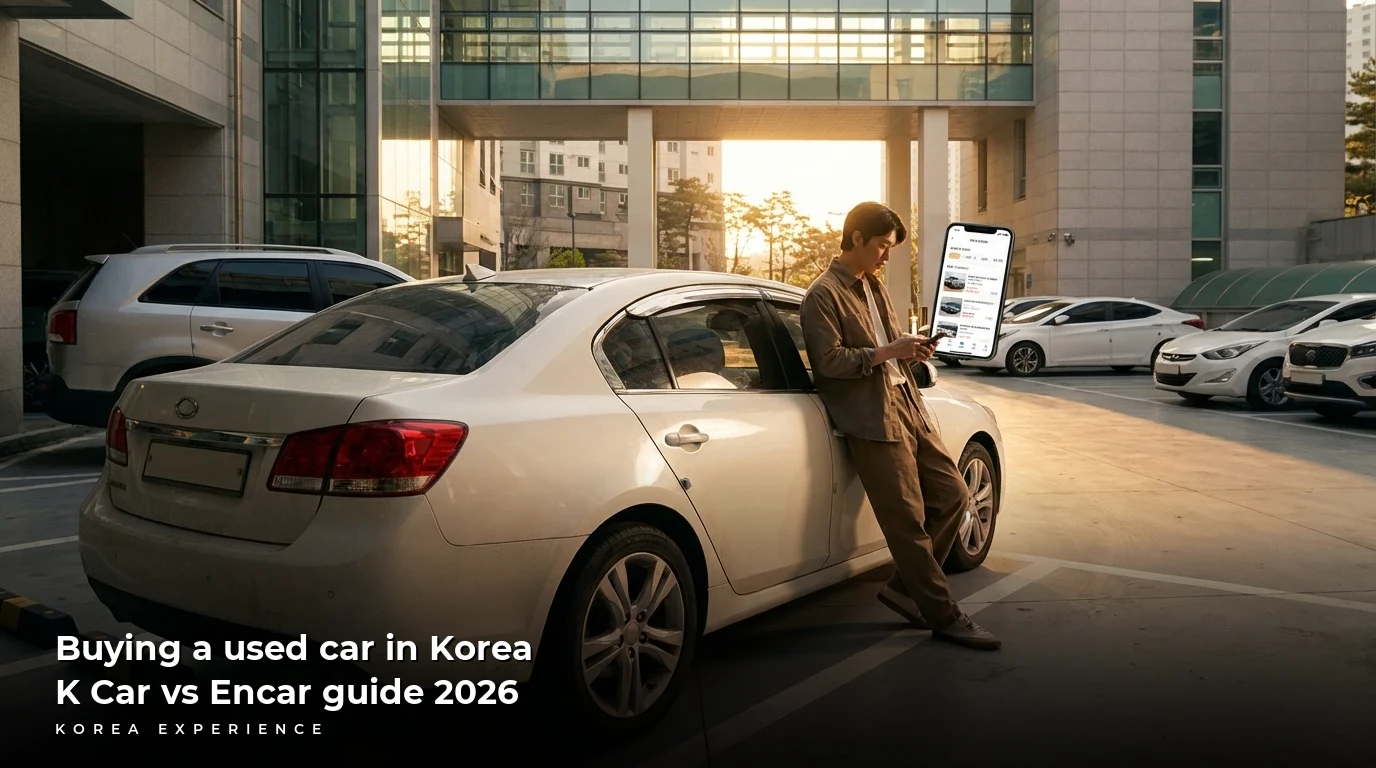
Buying a Used Car in Korea K-Car vs Encar Guide 2026

Navigate Korea's used car market like a pro in 2026. This guide details K-Car and Encar platforms, helping expats make informed decisions for car ownership.

Introduction: Navigating Korea's Used Car Market as an Expat

Imagine cruising down the scenic coastal roads of Jeju Island, exploring the ancient temples of Gyeongju, or simply enjoying the convenience of weekend getaways beyond Seoul's efficient public transport. For many international residents and long-term travelers in Korea, owning a car transforms the experience, offering unparalleled freedom and access to hidden gems. However, the prospect of buying a used car in Korea can seem daunting, especially with language barriers and unfamiliar processes.

The Korean used car market is robust and dynamic, offering a wide array of vehicles to suit various budgets and needs. While new cars are readily available, a used vehicle often makes more financial sense for expats on shorter-term stays or those looking to save money. This comprehensive guide is designed specifically for you, the international audience, to demystify the process. We will dive deep into two of the most prominent players in the Korean used car landscape: K-Car and Encar. By the end of this guide, you will understand their distinct approaches, how to navigate their platforms, and ultimately, how to make a confident and informed purchase in 2026.

We'll cover everything from initial research and required documentation to vehicle inspection and registration, providing practical tips and insider knowledge to ensure your car-buying journey in Korea is as smooth as possible. Get ready to hit the road with confidence!

Understanding the Korean Used Car Market Landscape

Before comparing specific platforms, it is crucial to grasp the general environment of the used car market in Korea. It is a highly competitive and regulated market, which generally works in favor of the consumer, offering a good balance of choice, transparency, and value.

Key Characteristics of the Korean Used Car Market

  1. Dominance of Domestic Brands: Hyundai, Kia, and Genesis (Hyundai's luxury sub-brand) overwhelmingly dominate the market. While foreign brands like Mercedes-Benz, BMW, Audi, and even Tesla are popular as new car purchases, their used car availability and parts can sometimes be less common or more expensive than their domestic counterparts.
  2. Strict Vehicle Inspections: Korea has stringent regular vehicle inspection requirements. This means most vehicles on the road are generally well-maintained and meet safety standards. However, pre-purchase inspections are still highly recommended.
  3. Online Platforms are King: The market has largely shifted online, making it incredibly convenient for buyers to browse thousands of listings from the comfort of their homes. This is where K-Car and Encar truly shine.
  4. Used Car Complexes: While online platforms are dominant, large physical used car complexes exist throughout the country, such as those in Suwon, Bucheon, Incheon, and Goyang. These complexes house numerous dealerships under one roof, offering a vast selection but often requiring more careful negotiation and vetting.
  5. Pricing Trends: Used car prices are generally influenced by factors common globally: mileage, age, condition, model popularity, and accident history. Korean cars tend to depreciate relatively quickly, especially within the first few years, which can be advantageous for used car buyers.

Essential Documentation for Expats

As an international resident, you will need specific documents to buy and register a car. Prepare these in advance to streamline your purchase:

  • Alien Registration Card (ARC): This is your primary identification document. Ensure it is valid and up-to-date.
  • Korean Driver's License or International Driving Permit (IDP): You will need a valid license. If you have an IDP, ensure it's properly translated and recognized in Korea, or ideally, convert your foreign license to a Korean one.
  • Proof of Residency: This could be your rental agreement (Jeonse or Wolse contract) or other official documentation showing your address in Korea.
  • Bank Account Information: For payment and setting up auto-debit for insurance and other fees.
  • Certificate of Seal (In-gam Jeungmyeongseo) or Signature Certificate: While less common for individuals, some transactions might require this, especially if you are using a proxy or a very traditional dealership. However, for K-Car or Encar, a signature will generally suffice.

Understanding this foundational context sets the stage for a deeper dive into the two major platforms that simplify the buying a used car in Korea experience for expats.

K-Car: The Direct-Purchase Experience

K-Car is unique in the Korean used car market because it operates as a direct-purchase, direct-sale model. Unlike traditional dealerships or marketplaces, K-Car buys cars directly from owners, inspects them, refurbishes them if necessary, and then sells them directly to consumers. This model aims to maximize transparency and trust.

What is K-Car?

K-Car is a brand owned by SK Encar, a prominent player in the automotive sector. However, while SK Encar (now simply "Encar") is a marketplace, K-Car is a dealer itself. It positions itself as a premium, reliable used car provider, emphasizing quality assurance and a no-haggle pricing policy. Their cars are often slightly more expensive than comparable models on Encar, reflecting the added value of their inspection process and guarantees.

Advantages of Buying from K-Car

  1. Unmatched Transparency and Reliability: K-Car conducts a rigorous 140-point inspection on every vehicle. They provide detailed inspection reports, often including photos, online. Their "no accident history" guarantee is a major selling point.
  2. Fixed, Transparent Pricing: Prices are non-negotiable. What you see online is what you pay. This removes the stress of haggling, which can be particularly challenging for expats unfamiliar with Korean negotiation tactics.
  3. Warranty and Return Policy: K-Car typically offers a limited warranty (e.g., 6 months/10,000 km for engine and transmission) and, crucially, a "3-day return policy" (sometimes referred to as a "3-day ride-and-decide" period). This allows you to test the car thoroughly and return it for a full refund if unsatisfied, provided it meets certain conditions.
  4. Convenient Online and Offline Experience: You can browse, select, and even complete much of the purchase process online. They also have numerous physical branches (직영점 - direct stores) across Korea where you can inspect cars in person.
  5. Dedicated Customer Service: While the primary language is Korean, their professional staff often have experience assisting foreign buyers, and they offer a relatively straightforward process.

Disadvantages of Buying from K-Car

  1. Higher Prices: Due to the extensive inspection, refurbishment, warranty, and fixed-price model, K-Car vehicles are generally priced 5-15% higher than similar cars found on marketplace platforms like Encar.
  2. Limited Negotiation: The fixed-price model means no room for bargaining, which might be a drawback for those who enjoy negotiating for a better deal.
  3. Smaller Inventory (Compared to Encar): While K-Car has a substantial inventory, it's limited to vehicles they have directly purchased and processed, making it smaller than the collective listings on Encar.

The K-Car Purchase Process for Expats

  1. Browse Online: Visit the K-Car website (www.kcar.com). Use translation tools if needed, but the interface is quite intuitive with vehicle details, photos, and inspection reports.
  2. Select a Vehicle: Filter by make, model, year, mileage, and price. Pay close attention to the 140-point inspection report (진단 보고서) and vehicle history.
  3. Inquire/Visit a Branch: If you're serious, contact a K-Car representative or visit one of their direct stores (직영점) to see the car in person and take a test drive. Popular locations include Seoul (e.g., Gangnam, Gangseo), Incheon, Bucheon, Suwon, and Busan.
  4. Reservation/Purchase: You can often reserve a car online with a small deposit. For the final purchase, you will need your ARC, driver's license, and proof of address. K-Car handles much of the paperwork for transfer and registration.
  5. Payment: K-Car accepts various payment methods, including bank transfer, credit card (for a portion, usually), and financing options. Expats may find financing more challenging without a strong credit history in Korea.
  6. Delivery/Pickup: Arrange for pickup at a K-Car branch or home delivery.
  7. 3-Day Return Policy: Utilize this period to thoroughly check the car, perhaps even getting an independent mechanic to look at it, before committing fully.

K-Car provides a peace-of-mind option for expats who prioritize reliability, transparency, and a streamlined, hassle-free buying experience, even if it comes at a slightly higher cost.

Encar: The Online Marketplace Giant

Encar, originally SK Encar, is the largest online used car marketplace in Korea. Unlike K-Car, Encar acts as a platform connecting individual sellers, small dealerships, and larger dealer groups with buyers. It hosts an enormous inventory, offering the widest selection and often more competitive pricing, but requires more diligence from the buyer.

What is Encar?

Encar (www.encar.com) is essentially the Korean equivalent of eBay Motors or AutoTrader, but with a much higher penetration rate. Thousands of used cars are listed daily by professional dealers and private sellers across the country. Encar's primary role is to provide a platform for listings, tools for searching, and optional services for verification.

Advantages of Buying from Encar

  1. Vast Inventory and Selection: With hundreds of thousands of listings, Encar offers the broadest range of cars, from budget-friendly compacts to luxury sedans and SUVs. This increases your chances of finding the exact make, model, trim, and color you desire.
  2. More Competitive Pricing: Because it's a marketplace with multiple sellers, competition drives prices down. You can often find excellent deals, and there is usually room for negotiation.
  3. Direct Contact with Sellers: You can communicate directly with dealers or private sellers, allowing for more detailed questions and potentially better insight into the car's history.
  4. Nationwide Coverage: Listings come from all corners of Korea, meaning you can find cars available even in smaller cities or provinces.

Disadvantages of Buying from Encar

  1. Variable Reliability and Transparency: The biggest drawback is the inconsistent quality and reliability of sellers. While Encar offers verification services, not all listings have them. You might encounter unscrupulous dealers or misrepresentations.
  2. Risk of Misleading Information: Some listings might have incomplete or intentionally misleading information regarding accident history, mileage tampering, or vehicle condition.
  3. Negotiation Required: Prices are often negotiable, which can be an advantage, but also a disadvantage for expats uncomfortable with haggling or concerned about language barriers.
  4. No Standard Warranty or Return Policy: Unless specified by the individual dealer, you typically won't get a standard warranty or return policy like K-Car's. Any warranty would be from the selling dealer, which varies greatly.
  5. More Complex Paperwork: While dealers handle most of it, the overall process can feel less guided than with K-Car.

The Encar Purchase Process for Expats

  1. Browse Online: Go to www.encar.com. The website is comprehensive, with extensive search filters. Again, use translation tools, but familiarize yourself with common car terms.
  2. Filter and Research: Use filters to narrow down your search. Pay attention to "Encar Jin-dan" (엔카진단 - Encar Diagnosis) or "Encar Bo-jeung" (엔카보증 - Encar Warranty) certified listings, which indicate a certain level of verification by Encar. This is crucial for reducing risk.
  3. Contact Seller and Inspect: Once you find a promising listing, contact the seller (dealer or private party) to arrange a viewing and test drive. This is often the most critical step.
    • Ask for the car's history report: Request the vehicle registration card (자동차등록증) and a copy of the official car history report (자동차등록원부 or 사고이력조회) from Carisyou. This shows previous ownership, accident history, and any liens.
    • Independent Pre-Purchase Inspection (PPI): Highly recommended. Hire a local mechanic or a specialized inspection service (e.g., Carisyou inspection service) to examine the car thoroughly. This small investment can save you significant money and headaches later.
  4. Negotiation: Be prepared to negotiate the price. Research similar listings to understand the market value.
  5. Paperwork and Payment:
    • The dealer will handle the transfer of ownership documents (자동차양도증명서).
    • You'll need your ARC, driver's license, and proof of address.
    • Payment is usually via bank transfer. Avoid cash deals from unknown private sellers.
  6. Registration and Insurance: The dealer usually facilitates the transfer of registration. You must secure car insurance before driving the car off the lot.
  7. Post-Purchase Check: Even with a successful purchase, a visit to a trusted mechanic for an initial service and check-up is a good idea.

Encar is excellent for buyers looking for the widest selection and potentially better deals, but it demands more active participation, due diligence, and potentially professional assistance (like a mechanic for inspection) to mitigate risks.

Regardless of whether you choose K-Car or Encar, the general steps for buying a used car in Korea as an expat share common ground.

Step 1: Budgeting and Research

  • Determine Your Budget: Beyond the purchase price, factor in registration fees (approx. 7% of car price), acquisition tax, insurance (can be high for new drivers or expats), annual road tax, fuel, maintenance, and parking.
  • Identify Your Needs: Consider car size, fuel efficiency, passenger capacity, and driving habits.
  • Research Models: Look up popular and reliable models like the Hyundai Avante (Elantra), Kia Morning (Picanto), Kia K5 (Optima), or Hyundai Grandeur. These have readily available parts and good resale value.

Step 2: Online Search and Shortlisting

  • Utilize K-Car (www.kcar.com) and Encar (www.encar.com) to browse.
  • Use filters: year, mileage, price, fuel type, transmission, features.
  • Prioritize Encar "Encar Jin-dan" (verified) listings or K-Car's transparent reports.
  • Note down car IDs, contact numbers, and locations.

Step 3: Initial Contact and Vehicle Inspection

  • Contact Seller: Call or message to confirm availability, ask basic questions, and schedule a viewing. If language is a barrier, ask a Korean friend to help or use a translation app.
  • Visit and Inspect:
    • Check the exterior for significant dents, scratches, and inconsistent paintwork (can indicate repairs).
    • Examine the interior for wear and tear, functionality of electronics, air conditioning.
    • Pop the hood: Look for fluid leaks, corrosion, or signs of poorly done repairs.
    • Crucially, verify the car's identification number (VIN) and engine number match the official documents.
  • Test Drive: Drive on various road types. Listen for unusual noises, check braking, steering, and acceleration. Ensure all dashboard lights (check engine, ABS, etc.) are off after starting.

Step 4: Pre-Purchase Inspection (PPI)

  • Highly Recommended for Encar purchases. Arrange for a professional mechanic to inspect the car. Many independent garages offer this service. They can identify hidden issues not obvious to an untrained eye. Expect to pay around 50,000 - 100,000 Korean Won for a comprehensive check.
  • For K-Car, their 140-point inspection and return policy largely mitigate the need for a separate PPI, though it's still an option for absolute peace of mind.

Step 5: Negotiation (Encar only) and Agreement

  • Encar: Based on your research and PPI results, negotiate the price. Be polite but firm. Highlight any defects found during inspection to justify a lower offer.
  • K-Car: No negotiation.

Step 6: Payment and Paperwork

  • Payment: Typically via bank transfer. Ensure all funds are cleared before signing transfer documents.
  • Ownership Transfer: The seller (or dealer) will initiate the ownership transfer at a Vehicle Registration Office (차량등록사업소). You will need your ARC, driver's license, and proof of address. The dealer will usually handle the complexities, but ensure you receive all original documents, especially the updated vehicle registration certificate (자동차등록증).
  • Fees: Pay the acquisition tax, registration tax, and any associated fees.

Step 7: Car Insurance

  • Mandatory: You cannot drive a car in Korea without valid liability insurance.
  • Shop Around: Get quotes from multiple insurance companies (e.g., Samsung Fire & Marine, Hyundai Marine & Fire, KB Insurance, DB Insurance).
  • Required Documents: ARC, driver's license, vehicle registration certificate.
  • Full Coverage vs. Liability: Decide on the level of coverage. For older cars, liability might be sufficient; for newer or more expensive cars, full coverage is wise.

Step 8: Road Tax and Post-Purchase

  • Annual Road Tax: This is paid semi-annually or annually, based on engine displacement. The Vehicle Registration Office will send you bills.
  • Maintenance: Schedule routine maintenance. Find a trusted local mechanic.

Following these steps meticulously will significantly enhance your chances of a successful and stress-free buying a used car in Korea experience.

Essential Considerations Before You Buy

Beyond the platform choice, several practical considerations impact your long-term car ownership experience.

Accident History and Mileage Tampering

  • Accident History: Always request the car's accident history report (사고이력조회) from a service like Carisyou or get the official "registered original record" (자동차등록원부). This details any major repairs or incidents. K-Car provides this upfront; for Encar, you must request it.
  • Mileage Tampering: While less common on official platforms, it's a risk with private or shady sellers. Compare dashboard mileage with service records and inspection reports. The Carisyou report also tracks mileage at official inspections.

Vehicle Maintenance History

A well-documented maintenance history (정비이력) is a golden find. It indicates a responsible previous owner. Ask for service records or receipts. If none are available, a thorough PPI becomes even more critical.

Fuel Type and Efficiency

  • Gasoline (휘발유): Most common, generally good performance.
  • Diesel (경유): More fuel-efficient for long distances, but can have higher emissions and maintenance costs for older models. Regulations on older diesel cars in urban areas are tightening.
  • LPG (액화석유가스): Historically restricted to specific users (taxis, rental cars, disabled persons), but now available to the general public. Cheaper fuel, but fewer fueling stations and slightly less power.
  • Hybrid/Electric: Growing in popularity, offering excellent fuel economy or zero emissions, but higher initial cost.

Consider your driving habits and budget when choosing a fuel type.

Car Insurance Specifics for Expats

  • High Initial Premiums: Expats, especially those new to driving in Korea, often face higher insurance premiums initially because they lack a local driving history.
  • Named Driver vs. Open: You can choose to insure only named drivers (cheaper) or allow anyone to drive (more expensive). Ensure your policy covers anyone who might drive your car.
  • Korean Insurance System: Familiarize yourself with the basic "no-fault" aspects and how claims are processed.
  • Roadside Assistance: Most policies include basic roadside assistance (견인 서비스).

Ongoing Costs of Car Ownership

  • Road Tax (자동차세): Paid annually or semi-annually, based on engine size (cc).
  • Fuel Costs: Volatile, but generally on par with global prices.
  • Maintenance: Regular oil changes, tire rotations, brake checks.
  • Parking Fees: Can be substantial in urban areas. Residential parking often requires a separate application and fee.
  • Tolls (통행료): Korea has extensive toll roads. Consider buying an Hi-Pass transponder for convenience.
  • Vehicle Inspection (정기검사): Mandatory every 1-2 years depending on vehicle age.

Factoring in these ongoing costs is crucial for a realistic budget and a smooth car ownership experience in Korea.

Comparing K-Car and Encar: A Detailed Analysis

To help you make an informed decision, let's directly compare K-Car and Encar across several key aspects.

Comparison Table 1: Platform Overview

FeatureK-CarEncar
ModelDirect purchase, direct sale dealerOnline marketplace (C2C, B2C)
OwnershipAll cars owned by K-Car until soldListings from various individual & professional sellers
TransparencyHigh (detailed inspection reports, fixed pricing)Variable (depends on seller, look for verified listings)
Price RangeGenerally 5-15% higherMore competitive, room for negotiation
Inventory SizeSubstantial, but limited to K-Car's stockMassive, nation's largest inventory
Target BuyerValue peace of mind, ease of transaction, warrantySeek best deals, wider selection, comfortable with due diligence

Comparison Table 2: Reliability and Support

FeatureK-CarEncar
InspectionMandatory 140-point internal inspectionOptional Encar Jin-dan (Diagnosis) by third party, not all listings
Accident HistoryGuaranteed clean history (no major accidents) providedMust request/verify from individual seller
WarrantyStandard limited warranty (e.g., 6m/10k km)Varies by seller; some dealers offer, some don't
Return Policy3-day ride-and-decide full refund policy (conditions apply)Generally none, unless explicitly offered by seller
Customer SupportDedicated K-Car staff, more guided processEncar provides platform support; direct dealer/seller communication
English SupportLimited but generally more accessible for foreignersHighly variable by individual seller/dealer

Comparison Table 3: Process and Effort

FeatureK-CarEncar
Purchase FlowStreamlined, mostly online, less paperwork for buyerMore involved, requires direct seller contact & negotiation
NegotiationNone (fixed price)Expected, can lead to better deals
Pre-Purchase Inspection (PPI)Less critical due to K-Car's inspection & return policyHighly recommended, often essential for peace of mind
Time InvestmentGenerally quicker and less stressfulCan be more time-consuming due to vetting multiple sellers
Risk FactorLowMedium to High (if not diligent with verification)

Insider Tips for a Smooth Transaction

Even with the best platforms, a little extra knowledge can go a long way when buying a used car in Korea.

Negotiation Tactics (for Encar)

  • Be Informed: Know the market value of the car you're looking at.
  • Highlight Defects: Use any issues found during your PPI as leverage for a lower price.
  • Be Polite but Firm: Korean culture values respect, but don't be afraid to state your offer clearly.
  • Walk Away: Be prepared to walk away if you're not getting a fair deal. There are always other cars.
  • Check Hidden Fees: Clarify all costs: car price, transfer fees, dealer commission, administrative fees. Some dealers might try to add unnecessary charges.

Avoiding Scams and Misleading Listings

  • "Mikkam" (미끼 매물) - Lure Listings: These are fake listings with impossibly low prices designed to attract buyers. Once you call, they'll say the car is sold and try to push you into a more expensive, less desirable vehicle. If a deal seems too good to be true, it probably is.
  • Mileage Tampering: Look for inconsistencies in service records or the official Carisyou report.
  • "Sagocha" (사고차) - Accident Cars: Dealers might downplay accident severity. Always rely on the official accident history report.
  • Pressure Sales Tactics: Don't feel rushed. Take your time, inspect thoroughly, and consult with a trusted friend or mechanic.

Post-Purchase Essentials

  • Find a Trusted Mechanic: Build a relationship with a local garage (카센터). Ask for recommendations from other expats.
  • Hi-Pass Transponder: For convenience on toll roads. You can purchase one at rest stops or online, then register it to your car.
  • Dashcam (블랙박스): Highly recommended. Many drivers in Korea use them for insurance purposes and to protect themselves in case of disputes.
  • Emergency Kit: Keep a basic emergency kit in your car (jumper cables, first-aid kit, warning triangle).
  • Language Practice: Learn basic car-related Korean phrases for maintenance and emergencies.

Internal Linking Opportunities

While this guide focuses on buying, related topics could include:

  • "Getting Your Korean Driver's License: A Comprehensive Guide for Expats"
  • "Understanding Car Insurance in Korea: A Deep Dive for Foreigners"
  • "Driving Etiquette and Road Rules in Korea"
  • "Navigating Public Transportation in Korea: Beyond Car Ownership"

These additional resources would further empower expats seeking to integrate fully into Korean life.

Frequently Asked Questions (FAQ)

Q1: Can I buy a car in Korea without a local driver's license?

A1: You typically need a valid Korean driver's license or an International Driving Permit (IDP) along with your original foreign license. It's highly recommended to convert your foreign license to a Korean one if you plan to stay long-term, as IDPs have validity limits.

Q2: What are the total costs associated with buying a used car besides the purchase price?

A2: Expect to pay additional fees including: acquisition tax and registration tax (approx. 7% of the car's value), a small stamp duty, administrative fees (dealer's fee), and mandatory car insurance. Annual road tax, fuel, and maintenance costs are ongoing.

Q3: Is it possible for expats to get a car loan in Korea?

A3: Yes, but it can be more challenging than for Korean nationals. Lenders typically require a longer period of residency, a stable income, and a strong credit history in Korea. Some specialized financing companies or K-Car itself might offer options, but interest rates may be higher.

Q4: What happens if I buy a car from Encar and later discover a major problem?

A4: If you bought a car without an "Encar Warranty" or similar dealer guarantee, you generally have limited recourse. This is why a thorough pre-purchase inspection (PPI) is crucial. If the problem was intentionally hidden or constitutes fraud, you might have legal avenues, but these can be complex for foreigners. K-Car's 3-day return policy is designed to mitigate this risk.

Q5: How do I sell my car when I leave Korea?

A5: You can sell your car through K-Car (they buy directly), list it on Encar (as a private seller or through a dealer), or sell it to another expat. K-Car offers convenience, while Encar or direct sales to expats might yield a better price but require more effort. Ensure all ownership transfer paperwork is correctly completed to avoid future liabilities.

Conclusion: Driving Your Korean Dream in 2026

Buying a used car in Korea might seem like a complex endeavor for international residents, but with the right knowledge and resources, it is an entirely manageable and rewarding experience. By understanding the intricacies of the market and leveraging platforms like K-Car and Encar, you can confidently navigate the process and find a vehicle that perfectly suits your needs.

To recap, if peace of mind, transparency, a fixed price, and a solid warranty are your top priorities, K-Car offers a highly reliable, albeit slightly more expensive, solution. Their direct-purchase model and 3-day return policy minimize risk and stress.

Conversely, if you're comfortable with more active research, negotiation, and due diligence, Encar provides an unparalleled selection and the potential for more competitive pricing. Remember to prioritize "Encar Jin-dan" (verified) listings and invest in a professional pre-purchase inspection when buying through the marketplace.

Whichever path you choose, arm yourself with the necessary documentation, understand the associated costs, and don't hesitate to seek assistance from trusted friends or professionals. Owning a car in Korea unlocks incredible opportunities for exploration and convenience, transforming your stay into a truly unforgettable adventure. So, buckle up, make an informed decision, and get ready to experience all the beauty and excitement Korea has to offer, one road trip at a time!

About the Author

Korea Experience Team

Written by the Korea Experience editorial team - experts in Korean medical tourism, travel, and culture with years of research and firsthand experience.

⚠️ Medical Disclaimer

The information provided on this website is for general informational purposes only and does not constitute medical advice. Always consult with qualified healthcare professionals before making any medical decisions.

Continue Reading

Explore more articles you might find interesting