Shipping Korean products home: Customs guide and costs 2026
Send K-Beauty and souvenirs home safely. Compare EMS vs. Surface rates, learn 2026 customs limits for US/EU, and save up to 40% on shipping fees.
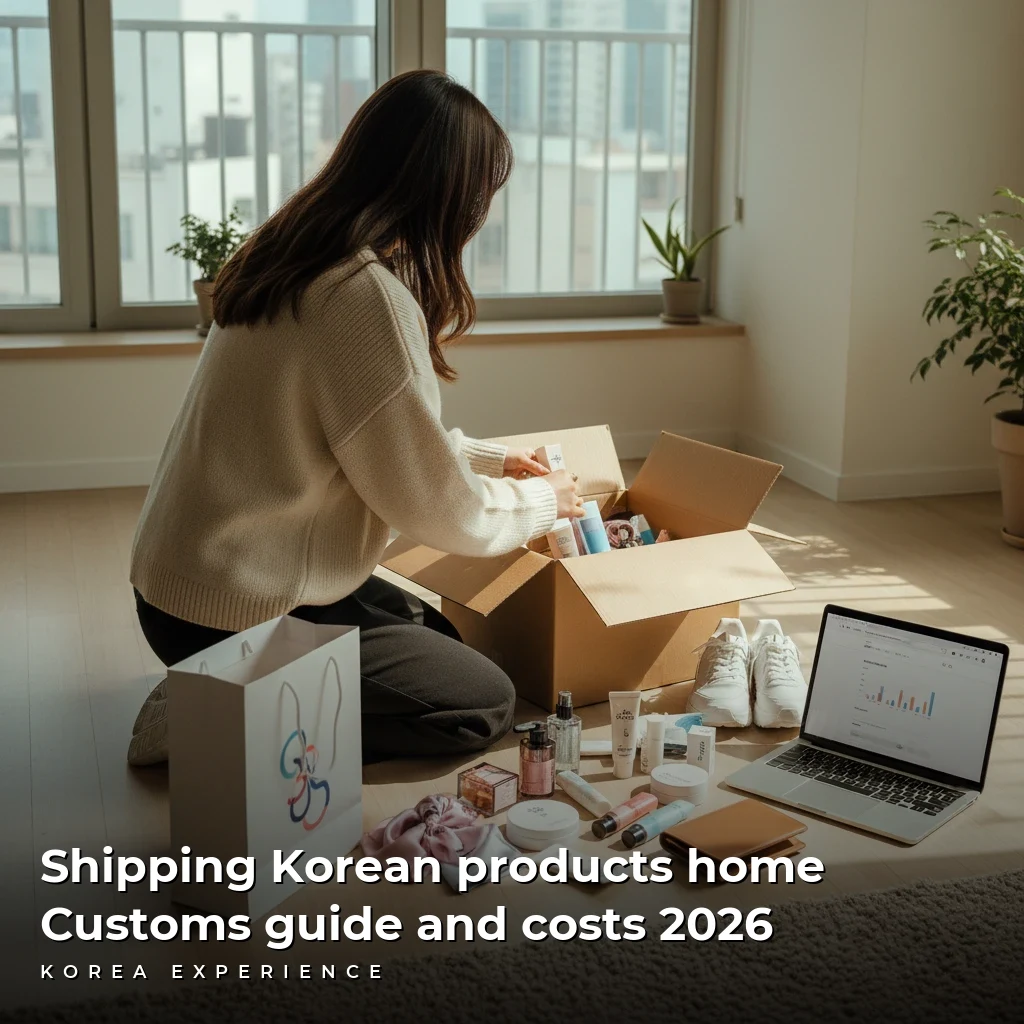
The most reliable way to ship products from Korea to international destinations is through Korea Post (Ucheguk) using their EMS (Express Mail Service) for speed or Surface Mail (boat) for heavy, non-urgent items. For a 5kg box sent to North America or Europe, you can expect to pay approximately ₩80,000–₩110,000 ($60–$85 USD) via EMS, which takes 3–5 business days, while Surface Mail will cost around ₩35,000 ($26 USD) but takes 60–90 days. Private couriers like DHL and FedEx are available but typically cost 30–50% more than EMS for personal shipments.
The short answer: For packages under 2kg, use "K-Packet" or "Small Packet" airmail. For heavy boxes (10kg+) where time isn't an issue, Surface Mail saves you over 50% on costs. For the best balance of speed, tracking, and insurance, EMS is the gold standard for travelers.
Key Takeaways
- 1EMS is the fastest reliable option (3-5 days) but costs ~₩20,000 per kg for long distances
- 2Surface (ship) mail is 60% cheaper but takes 2-3 months to arrive
- 3US travelers have an $800 duty-free allowance; EU residents pay VAT on all items
- 4Lithium batteries and perfumes with high alcohol content are strictly prohibited in air mail
Understanding the Korean Shipping Landscape
South Korea boasts one of the most efficient logistics networks in the world. Whether you have spent your trip raiding Olive Young for skincare or buying K-pop albums in Myeongdong, getting those items home is a straightforward process if you know the rules.
The primary service provider is Korea Post (Ucheguk). You can identify their branches by the orange and white logo with a bird. In 2026, they remain the most accessible option for tourists because they have English-language forms, standardized box sizes, and integration with international postal systems (like USPS, Royal Mail, and La Poste).
📋 Korea Post Overview
While private couriers like FedEx, DHL, and Hanjin Express exist, they are primarily B2B focused in Korea. For a traveler walking in off the street, private courier rates can be exorbitantly high—often exceeding ₩200,000 ($150) for a medium-sized box that would cost half that via EMS.
The Four Main Shipping Tiers
- EMS (Express Mail Service): The most popular choice. It includes full tracking, insurance up to a certain amount, and priority handling.
- EMS Premium (UPS): Korea Post partners with UPS for this service. It handles heavier items (up to 70kg) and items slightly larger than standard EMS limits.
- International Parcel (Air): Slightly cheaper than EMS, takes 10–14 days. Tracking is less granular in some destination countries.
- International Parcel (Surface/Ship): The budget king. Your box goes into a shipping container. It takes 2–4 months. Tracking is only updated when the ship departs and arrives.
Surface Mail Risks
Surface mail is extremely cheap, but your box will be at sea for weeks. High humidity in shipping containers can damage clothes or paper products. Always wrap items in plastic or use silica gel packets if choosing this method.
Detailed Cost Breakdown by Region (2026 Estimates)
Shipping costs are calculated based on the greater of actual weight or volumetric weight. However, Korea Post EMS is unique in that for many destinations, they strictly use actual weight unless the box is unusually large compared to its weight.
As of early 2026, fuel surcharges have stabilized, but they still add about 15-20% to the base rate. The prices below include estimated surcharges for a Zone 3 destination (North America, Europe) and a Zone 1 destination (Southeast Asia).
💵 Shipping Cost Comparison (5kg Box)
60-90 Days
30-45 Days
Weight Brackets and Strategies
- 0kg – 2kg (The "Small Packet" Zone): If your items weigh less than 2kg, you can use "K-Packet" or "Small Packet Air." This is significantly cheaper. Sending 1.5kg of sheet masks to the UK via K-Packet costs around ₩25,000, whereas EMS would be nearly ₩50,000.
- 2kg – 10kg (The EMS Sweet Spot): This is where EMS offers the best value per kilogram. A 10kg box to New York costs approximately ₩165,000.
- 10kg – 20kg (The Surface Zone): Once you hit 10kg, air freight becomes very expensive. A 20kg box via EMS is nearly ₩300,000. That same 20kg box via Surface is only about ₩75,000.
If you have been shopping for heavy items, such as winter coats or ceramics, Surface mail is the only logical choice for budget travelers. For skincare enthusiasts buying heavy toners and glass bottles, this is also a great option.
If you are looking to buy heavier skincare items to ship home, check out our guide to best under-the-radar K-Beauty brands to make sure you're buying products worth the shipping weight.
Step-by-Step Guide to Sending a Package
Sending a package from a Korean post office is a streamlined experience, but the language barrier can be intimidating. Here is exactly how to do it.
📖 How to Ship via Korea Post
Step 1: Buy a Box
Enter the post office and find the stack of flat boxes. Size 5 (48x38x34cm) is the most common large size and costs ₩2,300. Assemble it with the provided tape.
Step 2: Pack Your Items
Use the free bubble wrap (Bbop-bbop-i) to secure fragile items. Shake the box; if it rattles, add more newspaper or bubble wrap.
Step 3: Pre-Register Online
Use the Korea Post website or app to 'Pre-register' your shipment. This generates a QR code and gives you a 3-5% discount.
Step 4: Print the Label
Take your QR code to the counter (or self-service kiosk). The staff will weigh the box, scan the code, and print the label.
Step 5: Pay and Track
Pay via credit card or cash. You will receive a receipt with an EMS tracking number starting with 'EM' and ending in 'KR'.
Box Sizes and Costs
Korea Post sells sturdy boxes in six standard sizes. Using their boxes is highly recommended as they fit perfectly on the automated conveyor belts, reducing the risk of damage.
- Size 1: Tiny, for jewelry or a few lipsticks (₩700)
- Size 3: Good for a few books or clothes (₩1,100)
- Size 5: The standard "move home" box (₩2,300)
- Size 6: The largest allowable EMS size (₩2,900) – Note: Some countries restrict Size 6 due to volume limits.
Customs, Duties, and Taxes: The Hidden Costs
The shipping fee you pay at the counter in Seoul is not the final cost. When the package arrives in your home country, local customs may charge import duties and taxes.
📊 Duty-Free Thresholds (2026)
United States
The US has a very generous de minimis value of $800 USD. This means if you ship a box of clothes and skincare worth $750, you will likely pay $0 in duties. If you ship multiple boxes that arrive on the same day, customs will combine the value.
European Union
The EU is stricter. As of July 2021, the VAT exemption for low-value goods was removed. You must pay VAT (ranging from 17% to 27% depending on the country) on everything.
- The IOSS Issue: Korea Post does not typically collect EU VAT at the point of sale for personal shipments. This means your package will be held by your local post office (e.g., La Poste, DHL, PostNord) until you pay the VAT plus a "handling fee" (usually €10–€15).
- Strategy: Be prepared for this extra cost. If sending a gift, mark it clearly as "Gift," though VAT may still apply on gifts over €45.
United Kingdom
The threshold is £135. Below this, no customs duty is charged, but VAT applies. For gifts (private individual to private individual) valued under £39, there is usually no VAT or duty.
Accurate Declarations
Do not lie on the customs declaration. If you declare a box of 50 sheet masks and a leather jacket as "Used Clothes - Value $10," customs officers have the right to open, inspect, and reassess the value. This can lead to fines, seizure of goods, or the destruction of the package.
If you bought luxury items, perhaps a custom scent from a workshop, ensure you declare it honestly. Check out our experience with custom perfume making in Seoul to see why these items are worth shipping with care.
Prohibited Items: What You Cannot Ship
The most common reason packages are returned to the sender (at your expense) is the inclusion of prohibited items. In 2026, aviation security rules are stricter than ever.
Air Mail vs. Surface Mail Restrictions
- ✓Fast delivery (Air)
- ✓Lower theft risk (Air)
- ✓Less weather damage (Air)
- ✗NO Lithium Batteries (Air)
- ✗Strict liquid limits (Air)
- ✗NO Perfume/Aerosols (Air)
The "Big Three" Prohibitions
-
Lithium Batteries: You absolutely cannot send loose lithium batteries or power banks via air mail.
- Built-in batteries: If the battery is built inside a device (like a used phone or a Bluetooth speaker), it might be allowed if it meets strict Wh (Watt-hour) limits and is packed specifically, but Korea Post often rejects these at the counter to be safe.
- Surface Mail Exception: You can sometimes send batteries via Surface mail, but you must declare them explicitly.
-
Liquids with High Alcohol Content:
- Perfumes, nail polish, and diffusers are considered "Dangerous Goods" (flammable) by IATA. They will be pulled from the plane.
- Skincare exception: Toners, lotions, and creams are generally fine as long as they are not flammable. However, if a bottle breaks and leaks, the whole shipment may be discarded. Tape the lids shut!
-
Food Products:
- Fresh fruit, meat (including jerky), and dairy are universally banned.
- Kimchi: You can ship Kimchi, but it must be in a specialized fermentation-proof can or vacuum-sealed multiple times. Korea Post sells specific "Kimchi containers."
- Snacks: Dried seaweed (Gim), Ramen, and chips are fine.
If you are looking to ship snacks, make sure you pick the best ones. Read our guide to must-try Korean convenience store food for inspiration on what is safe to pack.
Using Third-Party Logistics Services
Sometimes, the post office isn't the right fit. Perhaps you have oversize luggage or need English-speaking support.
Hanjin Express & Lotte Global Logistics
These major Korean logistics companies often have counters at Incheon Airport and major department stores.
- Pros: They handle the packing for you (for a fee). They are experts at shipping Kimchi and golf clubs.
- Cons: More expensive than Korea Post.
Baggage Delivery Services
If you just want to get your luggage from your hotel to the airport (so you don't have to carry it on the subway), services like TRIP EASY or Zimzero operate between Seoul hotels and Incheon/Gimpo airports.
- Cost: ~₩20,000–₩30,000 per bag.
- Booking: usually required 24 hours in advance.
Incheon Airport Post Office(인천공항 우체국)
Tips for Safe Packing
When sending a package 10,000 kilometers, packing is your responsibility. Insurance claims for "damaged contents" are notoriously difficult to win if the exterior box is intact.
- The Shake Test: Once packed, shake the box hard. If you hear anything moving, it is not packed tight enough.
- Liquid Defense: Put every single liquid item in an individual Ziploc bag. Air pressure changes in cargo holds can cause bottles to pop open.
- Tape the H-Pattern: Tape along the center seam, and then tape the side seams (making an 'H'). Do this on the top and bottom.
- Photograph Everything: Take a photo of the open box showing all items, and a photo of the sealed box with the label. This is crucial for customs disputes or insurance claims.
If you are buying clothes at Dongdaemun or GoTo Mall, ask the vendor for 'vac-packing' (apchuk). Many wholesale vendors have industrial vacuum sealers. It reduces the volume of winter coats by 70%, which can save you a fortune if your shipping carrier charges by volumetric weight!
Sending K-Pop Merchandise
A significant portion of outbound mail from Korea consists of K-Pop albums and merchandise.
- Posters: Never fold them! Buy a poster tube (Jigwan-tong) at the post office or a stationery store like Artbox. You can tape the tube to the side of your box, but it is safer to put the tube inside a larger box.
- Photocards: These are high-value but look like paper to customs. Place them in "top loaders" (hard plastic cases), sandwich them between cardboard, and tape them securely. Do not let them float loose in the box.
If you are interested in the trading culture, check out our deep dive into collecting K-pop photocards.
Dealing with Returns and Issues
If your package is undeliverable, it will be returned to Korea. On the EMS form, you can select what happens in this case: "Return to Sender" or "Abandon."
- Warning: If you select "Return to Sender," you (or the sender in Korea) will have to pay the return shipping fee, which is often higher than the original shipping cost.
- If you are a tourist who has already left Korea, "Return to Sender" means the package goes back to your hotel or Airbnb host, who likely won't pay the fee to accept it. In this scenario, checking "Abandon" might be the financially safer, albeit painful, choice.
Carrier Service Comparison
| Feature | Korea Post (EMS) | FedEx/DHL | Surface (Boat) |
|---|---|---|---|
| Cost (5kg to US) | ~$80 | ~$140 | ~$30 |
| Speed | 3-5 Days | 2-3 Days | 60-90 Days |
| Customs Ease | Standard | Strict/Complex | Standard |
| Tracking | Excellent | Real-time | Poor |
Frequently Asked Questions
❓ Common Shipping Questions
Have more questions?Contact us →
Final Thoughts
Shipping items home from Korea is a rite of passage for many travelers. While the costs have risen slightly in 2026, the convenience of traveling light without lugging 20kg of souvenirs to the airport is often worth the price.
By choosing EMS for valuable, light items and Surface Mail for heavy, durable goods, you can optimize your spending. Just remember the golden rules: declare honestly, pack tightly, and never, ever send a lithium battery by air.
Happy shopping and safe shipping!
About the Author
Korea Experience Team
Written by the Korea Experience editorial team - experts in Korean medical tourism, travel, and culture with years of research and firsthand experience.
Explore more in Shopping & K-Beauty
From Olive Young hauls to Myeongdong shopping tips — discover the best K-Beauty products, fashion trends, and shopping destinations in Korea.
Browse All Shopping & K-Beauty ArticlesContinue Reading
Explore more articles you might find interesting
Save up to 20% on your 2026 Korea trip with Wowpass instant discounts. Learn how to get 5% cashback on a 100,000 KRW Olive Young haul and skip transit fees.

Discover the secrets of Korean body care, from 15-step scalp spas to traditional milk scrubs. Learn routine steps, costs, and best products for 2026.
Master the 2-step K-Beauty ritual for glass skin. Learn why 92% of Korean women double cleanse, best products for 2026, and how to shop at Olive Young.
Master international K-Beauty shipping from Korea in 2026. Discover top services, costs, regulations, and expert tips for safe delivery worldwide.
Don't risk your skin. Learn how to identify counterfeit Korean skincare with our 2026 guide, covering price analysis, packaging clues, and trusted retailers.

Save 15 to 30 percent on 2026 skin treatments by taking a $65 KTX train to Daegu instead of Gangnam. Compare exact prices, travel costs and VAT refunds.