T-Money vs Wowpass vs Namane: Best Tourist Cards 2026
Choosing the best tourist card in Korea for 2026? This data-backed comparison of T-Money, Wowpass, and Namane will guide your decision for travel and payments.
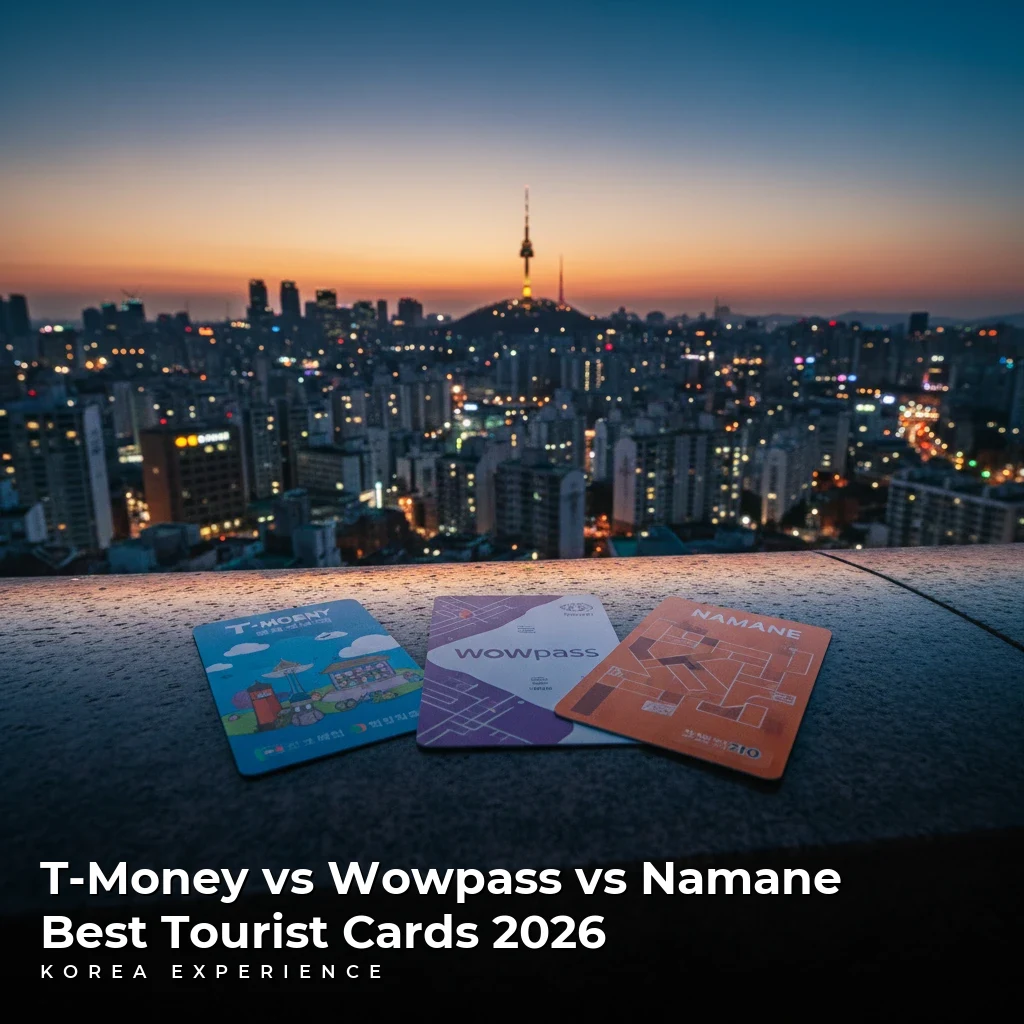
Navigating the vibrant streets and efficient public transport of South Korea requires more than just a good map; it demands a seamless payment solution. For international travelers and expats, the choice between T-Money, Wowpass, and Namane card can significantly impact your daily convenience and financial experience. In 2026, with an increasingly digital and integrated payment ecosystem, understanding the nuances of each option is more crucial than ever. This comprehensive, data-backed guide will break down the features, benefits, and drawbacks of these popular tourist cards, ensuring you make the best choice for your Korean adventure.
Whether you're planning a short vacation or an extended stay, optimizing your payment methods can save you time, money, and hassle. From hopping on the Seoul subway to grabbing a snack at a convenience store, your chosen card will be your constant companion. Let's dive into a detailed comparison to equip you with all the knowledge you need for an effortless journey through Korea.
Key Takeaways
- 1Wowpass offers the most comprehensive solution for foreigners in 2026, combining transport, prepaid payments, and currency exchange.
- 2T-Money remains the simplest and most widely accepted transport card, perfect for budget travelers or those preferring cash for general spending.
- 3Namane card provides unique personalization options and strong prepaid debit features, ideal for travelers who value customization and digital integration.
Understanding Korea's Digital Payment Landscape for Travelers
South Korea operates as a highly cashless society. From major department stores to small cafes, card payments are the norm. While international credit/debit cards are often accepted, they can incur foreign transaction fees, and sometimes even fail to process at specific terminals, particularly in smaller local shops or for public transport. This is where dedicated tourist cards become invaluable. They offer a localized payment method, often with better rates for currency exchange, and crucially, provide access to Korea's world-class public transportation network.
Embrace Digital Payments
Korea is at the forefront of digital transactions. Relying solely on cash will severely limit your convenience. Using a local card streamlines transport, shopping, and dining experiences, often making transactions quicker and more secure than handling physical currency.
In 2026, the convergence of transport functionality with general payment features has become a key differentiator among these cards. Many travelers arrive with significant cash in their home currency and need efficient ways to convert it into Korean Won and spend it seamlessly. These tourist cards address this need, providing a bridge between your foreign funds and local spending. The average transaction value in Seoul using these cards for daily expenses like food and coffee typically falls between ,000 and 5,000, illustrating their utility for frequent small purchases.
T-Money: The Enduring Classic for Public Transport
The T-Money card has been the backbone of South Korea's public transportation system for decades. It's an essential item for anyone planning to use the subway, buses, or even taxis extensively.
What is T-Money?
T-Money is a rechargeable smart card primarily used for public transportation. It offers discounted fares compared to single-use tickets and allows for free transfers between different lines and modes of transport within a specific time window, usually 30-60 minutes depending on the city and time of day. Beyond transport, T-Money can also be used for small purchases at convenience stores, vending machines, and some cafes.
Acquisition and Recharge
Acquiring a T-Money card is straightforward. You can purchase one at most convenience stores (such as GS25, CU, 7-Eleven, E-Mart24) or from vending machines located within subway stations. The initial card cost is typically ,500 to ,000. Recharging the card can be done at these same locations. Subway station machines often offer English language support, making the process easier for foreigners.
📖 How to Get and Recharge Your T-Money Card
Step 1: Purchase Your Card
Visit any convenience store (CU, GS25, 7-Eleven) or a subway station vending machine. Request a 'T-Money card'. The initial card cost is around ,000.
Step 2: Load Funds
At the convenience store, tell the cashier 'T-Money chungjeon' (충전) and the amount (e.g., 'iman-won' for 0,000). At subway machines, select 'Recharge' and follow the on-screen instructions. You can typically load between ,000 and 0,000 at a time.
T-Money Usage and Fares (2026)
In 2026, standard adult fares for public transport using T-Money remain highly competitive. A single subway ride in Seoul typically costs ,400 (base fare, additional for longer distances), while a local bus ride is around ,200. These fares are approximately 00-00 cheaper than using single-use tickets, adding up to significant savings over a multi-day trip. With millions of daily transactions, the T-Money system processes an average of over 10 million transactions per day across the greater Seoul area, demonstrating its widespread acceptance and efficiency.
T-Money Card: Pros and Cons
- ✓Universal Acceptance: Works on all public transport nationwide (subway, bus, some taxis).
- ✓Cost Savings: Discounted fares and free transfers on public transport.
- ✓Easy Acquisition: Available at nearly every convenience store and subway station.
- ✓Simple Recharge: Cash-based recharge is quick and widely available.
- ✗No Foreign Card Link: Cannot link to international credit/debit cards for auto-recharge.
- ✗Cash-Dependent for Recharge: Primarily requires Korean Won for loading funds.
- ✗Limited Payment Use: Primarily for transport, limited merchant acceptance.
- ✗No Customization: Standard card design, no personalized options.
"Even with newer options, I still keep a T-Money card for its sheer simplicity and reliability. It's a lifesaver for quickly jumping on a bus or subway without fumbling for cash or worrying about app glitches. For short trips, it's often all you need for transport."
Wowpass: The All-in-One Solution for Foreigners
Introduced to specifically cater to international visitors, Wowpass is a relatively newer player that combines multiple functionalities into a single card. It aims to be the ultimate payment companion for tourists in Korea.
What is Wowpass?
Wowpass is a prepaid debit card designed for foreigners that integrates a T-Money function, a currency exchange service, and a local payment card. You can load it with foreign currency (e.g., USD, EUR, JPY) at designated kiosks, and it converts it to Korean Won for spending. The T-Money balance is separate but included on the same physical card, allowing seamless use for both transport and general purchases.
Acquisition and Usage
Getting a Wowpass involves using dedicated kiosks, primarily found in major subway stations, airports (Incheon, Gimpo), and popular tourist areas like Myeongdong and Hongdae. You insert your passport for verification, deposit foreign currency, and the card is issued. The associated mobile app allows you to track your balance, spending history, and locate kiosks. The exchange rates are generally competitive, often better than airport money changers, with a small commission typically around 1-2%. The network of kiosks has expanded significantly, reaching over 120 locations nationwide by late 2025.
📊 Wowpass Network Growth (2026 Projections)
Using Wowpass for purchases is like using a local debit card. It's accepted anywhere a standard Korean credit/debit card is, which covers most establishments. For transport, simply tap the card reader like a regular T-Money. Maintaining two separate balances (Won for debit, Won for T-Money) requires a bit of attention, but the app simplifies management. For example, you can transfer funds from your debit balance to your T-Money balance via the app. A typical exchange transaction at a Wowpass kiosk, converting $100 USD, would yield approximately 35,000 (depending on current exchange rates and the 1.5% average service fee).
Wowpass: Pros and Cons
- ✓Integrated Solution: Combines transport, prepaid debit, and currency exchange.
- ✓Foreign Currency Exchange: Convert major currencies directly to Korean Won at competitive rates.
- ✓Wide Acceptance: Functions as a local debit card for most purchases.
- ✓Mobile App: Easy balance tracking, transfer funds, and kiosk location finder.
- ✓Passport Verification: Streamlined for foreigners, no Korean bank account needed.
- ✗Kiosk Dependent: Initial acquisition and foreign currency top-ups require specific kiosks.
- ✗Two Separate Balances: Requires managing funds for general purchases and T-Money separately.
- ✗Exchange Fees: Small commission fee (typically 1-2%) on currency exchange.
- ✗Refund Process: Can be complex for remaining foreign currency balance, often requiring a kiosk visit.
"My first trip to Korea was a cashless nightmare before Wowpass. Now, I load my USD, exchange it at a kiosk near Incheon Airport (Terminal 1, Level 1, near Gate 6, open 07:00-22:00), and I'm set for everything. It genuinely simplifies things, especially for longer stays where you're making frequent payments. Just remember to keep your T-Money balance topped up separately."
Namane Card: Personalization Meets Practicality
The Namane card emerged as another contender, distinguishing itself with its focus on personalization and robust payment capabilities. It offers a unique blend of style and substance.
What is Namane Card?
The Namane card is a prepaid debit card that includes a transportation function, similar to T-Money, and allows users to customize its design. This means you can upload your own photos, artwork, or choose from various templates to create a truly unique card. It functions as a general payment card accepted at most merchants and can also be used for public transport.
Acquisition and Usage
Namane cards are acquired at designated kiosks, often found in major subway stations, tourist information centers, and shopping malls. The process involves selecting your design via an app or kiosk, paying the card issuance fee (typically ₩5,000 to ₩10,000 depending on design complexity), and then loading funds. The main differentiating factor is the design process, which can take about 2-3 minutes at the kiosk after selecting your image. Namane card kiosks are prevalent in Seoul, with over 50 locations across Gangnam, Hongdae, Myeongdong, and other popular districts by early 2026.
📋 Namane Card Essentials
Loading funds onto your Namane card can be done in several ways: via the mobile app (linking an international credit card is possible, though fees may apply), at kiosks (cash or Korean debit card), or at convenience stores (cash only). This flexibility in top-up methods is a significant advantage. The card's payment function is generally accepted widely, offering a similar experience to a local debit card. Its transport function mirrors T-Money, providing discounted fares and transfer benefits. A useful feature in the Namane app is the ability to easily transfer funds between your payment balance and your transport balance, offering greater control than Wowpass for managing funds.
Namane Card: Pros and Cons
- ✓Unique Personalization: Customize your card with personal images or designs.
- ✓Flexible Top-Up: Reload via international credit cards (with fees), kiosks, or convenience stores.
- ✓Wide Acceptance: Functions as a local debit card for general purchases.
- ✓Integrated Transport: Offers T-Money functionality for public transport.
- ✓App Management: Easy fund transfers between payment and transport balances.
- ✗Higher Initial Cost: Card issuance fee is generally higher than T-Money.
- ✗Kiosk Dependent: Initial acquisition and custom design printing require a kiosk visit.
- ✗International Card Fees: Top-ups with foreign credit cards may incur fees (typically 3-5%).
- ✗Fewer Kiosks than T-Money: While growing, its kiosk network is smaller than T-Money recharge points.
"I love my Namane card. It's not just a payment method; it's a statement. I put a design from my favorite artist on it. It works everywhere, and managing funds through the app is super convenient. For me, it's the perfect blend of practical utility and personal style."
Head-to-Head Comparison (2026 Perspective)
Let's put these three powerhouses side-by-side to help you decide which is truly the best tourist card for your 2026 trip to Korea.
Initial Setup & Cost
The first step is getting the card itself. Costs vary for the physical card and the ease of acquisition.
💵 Initial Card Costs & Setup
Card purchase including design customization fee.
Card purchase only, no minimum load required to buy.
Card purchase, often bundled with a minimum foreign currency exchange (e.g., $20 USD equivalent).
T-Money is the most budget-friendly upfront. Wowpass has a slightly higher cost but offers immediate currency exchange. Namane is the most expensive initially, but you're paying for the unique personalization feature. Acquisition ease depends on your location, with T-Money being the most ubiquitous, while Wowpass and Namane require specific kiosks. Finding a T-Money vending machine at a subway station can take less than 2 minutes, while a Wowpass kiosk might require a specific location search taking 10-15 minutes if you're not near a major hub.
Transportation Coverage and Fares
All three cards offer similar functionality for public transport, effectively acting as T-Money cards.
Transportation Feature Comparison
| Feature | T-Money | Wowpass (T-Money function) | Namane (T-Money function) |
|---|---|---|---|
| Subway/Bus Coverage | Nationwide | Nationwide | Nationwide |
| Standard Adult Fare (Seoul) | ,400 (subway), ,200 (bus) | ,400 (subway), ,200 (bus) | ,400 (subway), ,200 (bus) |
| Transfer Benefits | Yes (free within 30-60 min) | Yes | Yes |
| Taxi Payment | Most taxis | Most taxis | Most taxis |
For transportation, there's no significant difference in terms of functionality or fares. The key distinction lies in how you load the transport balance. T-Money requires cash (Korean Won). Wowpass allows transfers from its general payment balance (converted from foreign currency). Namane also allows transfers from its general payment balance (which can be topped up via foreign credit card, though with fees). A typical daily commute in Seoul using public transport for a tourist could easily involve 4-6 taps, amounting to approximately ,000-,000.
General Payment Convenience & Acceptance
This is where Wowpass and Namane truly shine compared to a standalone T-Money.
- T-Money: Accepted at convenience stores, some vending machines, and limited cafes. Not widely accepted for general shopping or restaurants.
- Wowpass: Functions as a full-fledged local prepaid debit card. Accepted at virtually all merchants that accept credit/debit cards in Korea. This includes restaurants, department stores, online shopping (though some online merchants may still require local bank verification), and cafes.
- Namane Card: Also acts as a full prepaid debit card, with broad acceptance across most merchants. Its integration with a personalizable design doesn't affect its payment functionality.
An estimated 98% of Korean merchants accept card payments, meaning Wowpass and Namane offer near-universal payment access. In contrast, T-Money's general payment acceptance is likely under 15% of all merchants.
Currency Exchange & Recharge Options
This is a critical factor for international travelers managing foreign currency.
- T-Money: Requires Korean Won cash for all recharges. No direct foreign currency exchange or foreign card top-up.
- Wowpass: Primary benefit is direct foreign currency exchange at kiosks (USD, EUR, JPY, CNY, etc.). Also supports Korean debit card top-ups. Foreign credit card top-ups for the payment balance are generally not supported for security reasons, emphasizing cash exchange.
- Namane Card: Offers diverse top-up methods. Kiosks accept Korean Won cash or Korean debit cards. The mobile app allows for top-ups using international credit/debit cards, although be aware of potential foreign transaction fees (typically 3-5% on top of your bank's fees). This flexibility is a major plus for travelers who prefer to minimize carrying cash. For example, topping up 0,000 via a foreign credit card might incur an additional ,500-,500 in fees.
App Functionality & Management
Modern travel demands digital convenience.
- T-Money: Basic app (Mobile T-Money) available, but primarily for linking to Android phones for mobile payment. Doesn't offer balance tracking for physical cards without NFC functionality.
- Wowpass: Robust mobile app allows real-time balance checks for both general payment and T-Money balances, transaction history, kiosk locations, and easy transfers between your Wowpass and T-Money balances.
- Namane Card: Excellent mobile app for managing both payment and transport balances, transferring funds, viewing transaction history, and even re-designing your card (though physical card design is fixed).
The Wowpass and Namane apps significantly enhance user experience, providing transparency and control that T-Money lacks for physical card users.
Refundability & Remaining Balance
What happens to your unused funds at the end of your trip?
- T-Money: Remaining balance (up to 0,000) can be refunded at convenience stores for a small fee (typically 00). For amounts over 0,000, you need to visit a T-Money service center. The card itself is non-refundable.
- Wowpass: Remaining Korean Won on your payment balance can be converted back to your original foreign currency at a kiosk, though exchange rates and fees apply. T-Money balance refund is separate, similar to a regular T-Money card. Be prepared for potential complexities and kiosk queues for refunds.
- Namane Card: The payment balance can be refunded to a Korean bank account (not ideal for tourists). For foreign card top-ups, refunds may be processed back to the original card, potentially incurring fees. T-Money balance refund is separate. This is arguably the most complex refund process for foreigners.
For small remaining balances (under 0,000), many travelers opt to spend it at a convenience store or just keep the card as a souvenir.
Comprehensive Tourist Card Comparison (2026)
| Feature | T-Money | Wowpass | Namane Card |
|---|---|---|---|
| Primary Use | Transport | All-in-One (Transport + Prepaid + FX) | Prepaid + Transport + Personalization |
| Foreign Card Top-up | No | No (prepaid) | Yes (with fees) |
| Foreign Currency Exchange | No | Yes (Kiosk) | No |
| Kiosk Requirement | No (convenience store) | Yes (acquisition & FX) | Yes (acquisition & design) |
| App Functionality | Limited (Android only) | Excellent | Excellent |
| General Payment Acceptance | Limited | Wide | Wide |
| Refund Process (Foreigners) | Simple (cash) | Kiosk-dependent (cash/FX) | Complex (Korean bank/original card) |
Which Card is Right for You? Persona-Based Recommendations
Choosing the best tourist card in Korea ultimately depends on your travel style, priorities, and duration of stay.
The Budget-Conscious Traveler: T-Money
If your primary goal is affordable and efficient public transport, and you prefer to manage your general spending with a mix of international credit cards and cash, T-Money is your best bet. It has the lowest initial cost and is the easiest to acquire and recharge with Korean Won. You'll save on transport fares and transfers, making your daily commutes seamless. For a 7-day trip with daily public transport use, you could save approximately ,000-,500 on fares alone compared to single-use tickets.
The All-Inclusive / Long-Term Stay Traveler: Wowpass
For those seeking an integrated solution that covers transport, general payments, and convenient foreign currency exchange, Wowpass is ideal. It minimizes the need for multiple cards or frequent visits to money changers. It's particularly beneficial for longer stays (10+ days) or if you plan to visit multiple cities across Korea. The mobile app provides excellent financial oversight, giving you peace of mind. A traveler converting $500 USD over a two-week trip through Wowpass could save approximately 5,000-0,000 in exchange fees compared to airport kiosks.
Seamless Travel with Wowpass
If you're looking for the ultimate convenience and an almost entirely cashless experience as a foreigner in Korea, Wowpass is the leading choice. Its ability to convert foreign currency directly into spendable Korean Won, coupled with T-Money functionality, makes it an unrivaled option for modern travelers.
The Style-Savvy / Digitally Fluent Traveler: Namane Card
If personalization is a priority and you appreciate the flexibility of topping up your card with your international credit card (despite potential fees), the Namane card is a fantastic option. It offers the same broad payment acceptance and transport benefits as Wowpass but with the added flair of a custom design. It's great for those who want a souvenir that's also highly functional. It also offers slightly more flexible app-based fund transfers between payment and transport balances. Its appeal is especially strong for younger travelers or those who enjoy unique memorabilia.
Practical Tips for Using Your Tourist Cards in 2026
Regardless of your choice, here are some universal tips to enhance your experience:
- Always Carry Some Cash: While Korea is cashless, some small vendors, traditional markets, or specific local eateries might still prefer cash. Having 0,000-0,000 in your wallet is a good practice.
- Check Your Balance Regularly: Use the mobile apps (for Wowpass/Namane) or check at subway gates/convenience stores (for T-Money) to avoid running out of funds mid-journey or at checkout.
- Guard Your Card: Treat your tourist card like a debit card. If lost, your loaded funds could be gone. Neither T-Money, Wowpass, nor Namane offers robust protection against unauthorized use if the card is lost, unlike some international bank cards.
- Understanding Transfer Rules: For T-Money, transfers are free between different modes of transport (e.g., subway to bus, bus to bus) within a specific time (usually 30-60 minutes) and if you tap out and tap back in correctly. Tapping the same line or route twice without an intermediate transfer will incur a new charge. A single transit journey with one transfer might take 45 minutes on average across Seoul.
- Top-Up Before You Need It: Don't wait until your balance is critically low, especially if you're in a less populated area where recharge points might be scarce. A subway station's last top-up machine may be out of order in a remote area.
"From personal experience, always have a small emergency fund on your card. Nothing is worse than getting off a bus only to realize you can't tap into the subway because your T-Money balance is insufficient. Also, for Wowpass, remember that the general payment balance and T-Money balance are separate on the same card it's a common oversight!"
Future Outlook: What's New for Tourist Cards in 2026?
The Korean payment landscape is constantly evolving. In 2026, we anticipate continued integration of digital payment solutions, possibly leading to more streamlined processes for foreigners. There's a growing trend towards mobile-first solutions. While physical cards remain prevalent, future updates might see enhanced NFC capabilities on smartphones (especially for iOS users, which has been historically limited), further simplifying payments and transport. Discussion about a unified payment platform for all tourist cards is ongoing, potentially simplifying refunds and interoperability, but concrete timelines are not yet established. The number of non-cash payments in Korea continues to rise, exceeding 90% of all transactions by volume, indicating a strong push towards even greater digital convenience.
Conclusion: Empowering Your Korean Journey
Choosing the right tourist card is a small but significant decision that impacts your daily life in Korea. In 2026, T-Money remains the reliable and simple choice for pure transportation. Wowpass stands out as the comprehensive, all-in-one solution for currency exchange, general payments, and transport, perfectly suited for the modern international traveler. Namane card offers a unique blend of personalization and payment flexibility, catering to those who want a distinctive touch.
Ultimately, each card has its strengths. Consider your length of stay, your comfort with carrying cash, your need for currency exchange services, and your desire for customization. With this data-backed comparison, you're now equipped to make an informed decision and embark on your unforgettable Korean adventure with confidence and convenience.
❓ Frequently Asked Questions About Korean Tourist Cards
Have more questions?Contact us →
About the Author
Korea Experience Team
Written by the Korea Experience editorial team - experts in Korean medical tourism, travel, and culture with years of research and firsthand experience.
Explore more in Travel & Tourism
From Seoul's neon-lit streets to Jeju's volcanic landscapes — discover the best of Korea with insider travel tips, itineraries, and seasonal guides.
Browse All Travel & Tourism ArticlesContinue Reading
Explore more articles you might find interesting

Compare Wowpass vs. Namane for 2026. Learn why the 1,550 KRW subway fare means you need a Climate Card Tourist Pass to save money in Seoul.
The short answer is: pick WOWPASS if you want to turn your home cash into Korean Won in 10 seconds at the airport.

Stretch your budget in 2026 as 1 USD hits 1,400 KRW. Save up to 10 percent on tax refunds and cut 3 percent in card fees with our ultimate travel money guide.
Compare Korea's best SIM and eSIM options for 2026. Data plans from ₩3,000/day, airport pickup details, and speed tests for KT, SKT, and LG U+.
Discover how to mix a $15 Dior Seongsu latte with a $3.80 market pancake in 2026. Master the WOWPASS and Climate Card to conquer Seoul on any budget.
Ditch Google Maps and download these 10 essential apps for South Korea in 2026. Learn how to save $29 with the Climate Card and hail taxis with foreign cards.