Korean Temple Stay Guide 2026: Non-Buddhist & Beginner Tips
Discover how to book a Korean temple stay in 2026 without being Buddhist. Experience 1,700 years of history and vegan meals for just 70,000 KRW per night.
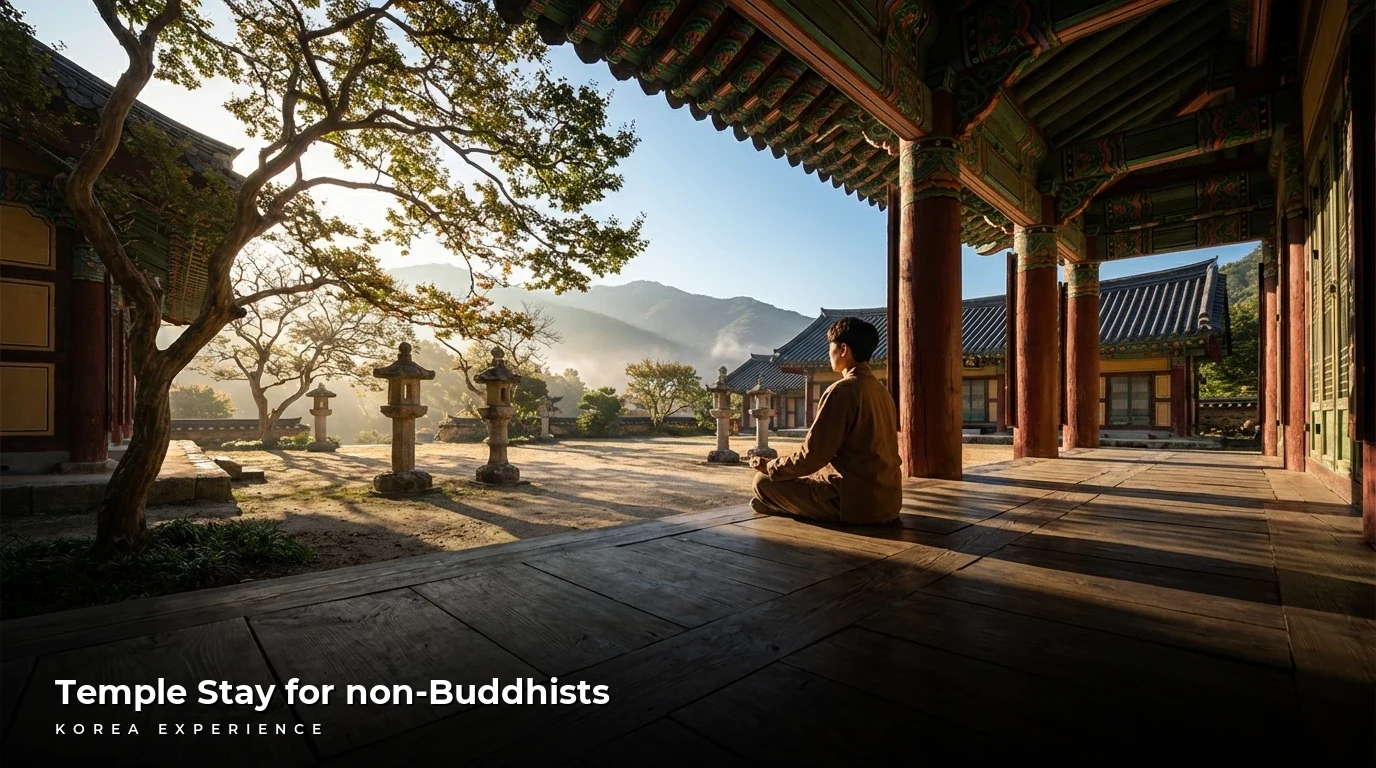
Think you need to be a devout Buddhist to sleep in a Korean monastery? Think again. This is your complete, no-nonsense guide to trading Seoul’s neon lights for mountain serenity, eating the world’s best vegan food, and surviving the 4 AM wake-up call even if you’ve never meditated a day in your life.
So, you want to stay in a Korean temple, but you're worried you might accidentally join a monastery or offend a monk? Let me stop you right there. The short answer is: No, you absolutely do not need to be Buddhist to do a Temple Stay. In fact, the program is specifically designed for people exactly like you—curious travelers, stressed-out city dwellers, and non-Buddhists looking for a cultural deep dive.
For a broader look at what to expect across different types of cultural accommodations, check out our Korean Temple Stay Guide 2026, but if you are specifically worried about the religious aspect, keep reading.
Key Takeaways
- 1You absolutely do NOT need to be Buddhist, religious, or even spiritual to join a Temple Stay. Most participants are regular travelers seeking a digital detox.
- 2For about ₩70,000 ($50), you get accommodation, three healthy meals, and cultural activities, immersing yourself in 1,700 years of history.
- 3If you are stressed about the strict schedule, book a 'Rest-oriented' program to skip the 4 AM chanting and sleep in.
Since the program started back in 2002, over 6 million people have participated, and about 11% of them were foreigners just like you. The monks are not expecting you to know the sutras or how to chant. They are expecting you to be respectful, quiet, and willing to turn off your phone for a few hours. Whether you are looking to eat the famous vegan food, do some meditation, or just sleep in a beautiful room in the mountains, this is one of the most accessible and unique experiences you can have in Korea.
📋 Quick Facts
The Origins of the Temple Stay Program
It is fascinating to understand how this became a mainstream tourism "thing." Go back to 2002. South Korea and Japan were co-hosting the FIFA World Cup. It was a massive event, and Korea had a problem: they didn't have enough hotel rooms for the flood of international soccer fans coming in.
The government and the Jogye Order (the biggest sect of Buddhism in Korea) had a lightbulb moment. They thought, "We have all these beautiful, historic temples in the mountains with plenty of floor space. Why don't we let the tourists sleep there?"
It started as a practical solution to a housing shortage, but something unexpected happened. The soccer fans loved it. It wasn't just a place to crash; it was a total cultural immersion. The government realized they had struck gold. They formalized it, created the Cultural Corps of Korean Buddhism in 2004, and turned it into a permanent tourism staple.
The Beginning
The 'Templestay' program officially launches to host visitors during the Korea-Japan FIFA World Cup due to hotel shortages.
Official Support
The Cultural Corps of Korean Buddhism is established to manage and standardize the program nationwide.
The Netflix Effect
Chef’s Table (Volume 3) features Nun Jeong Kwan of Baekyangsa, causing an explosion of interest in temple cuisine.
Pandemic Shift
Programs pivot heavily toward 'Rest-oriented' stays to support mental health and isolation needs during COVID-19.
20th Anniversary
The program celebrates two decades, having hosted over 6 million total participants (locals + foreigners).
Digital Expansion
Enhanced online booking systems and specialized themes (vegan, trekking, digital detox) become standard for the 2025-2026 seasons.
Fast forward to 2017, and a Buddhist nun named Jeong Kwan appeared on Netflix’s Chef’s Table, blowing everyone’s mind with her vegan cooking. Suddenly, foodies from New York and Paris were trekking to Korean mountains not just for enlightenment, but for the kimchi. Now, as we head into 2026, it's evolved into a sophisticated program with online booking, English-speaking monks, and even "pet-friendly" temple stays.
Choosing Your Program: Experience vs. Rest
When you go to book, you’re going to see three main options. Don't panic; it’s simple.
1. Experience-Oriented Templestay
This is the "full package." If you’re only in Korea for a week and want the maximum culture shock, pick this. You’ll have a schedule. You’ll be waking up at 3:30 or 4:00 AM for chanting (Yebul). You’ll do the 108 prostrations (bows) which is basically a spiritual HIIT workout. You’ll make lotus lanterns or prayer beads. It’s busy, active, and you’ll leave exhausted but accomplished.
2. Rest-Oriented Templestay
Honestly? This is my favorite. This is for the digital nomad or the expat who is just tired. You get the room and the food, but the schedule is empty. You don't have to wake up at 4 AM if you don't want to. You can spend the day reading by a stream, hiking, or just napping on the heated floor. It’s cheaper (usually around ₩50,000-₩70,000) and way more chill.
3. One-Day Program
This is for people who want the Instagram photo but not the back pain of sleeping on the floor. It’s usually 2-3 hours long. You get a tour, maybe a tea ceremony (Da-Seon) with a monk, and then you leave. Great if you’re short on time or just arrived via Incheon Airport and have a long layover.
| Feature | Experience-Oriented | Rest-Oriented | One-Day Program |
|---|---|---|---|
| Cost | ₩70,000 - ₩100,000 | ₩50,000 - ₩70,000 | ₩20,000 - ₩30,000 |
| Structure | Highly Structured | Very Loose / Flexible | Compact |
| Wake Up Time | 3:30 AM - 4:00 AM (Mandatory) | Flexible (Optional) | N/A (Daytime only) |
| Activities | 108 Bows, Chanting, Tea Ceremony | Walking, Reading, Meditating | Tea time, Tour, Meditation |
| Meals | Communal (Formal Etiquette) | Cafeteria style (Casual) | Usually included (Lunch) |
| Best For | Cultural immersion seekers | Burned-out professionals | Travelers on tight schedule |
The Reality of Temple Life: Pros and Cons
Before you book, you need to know what you are signing up for. It is not a hotel.
Pros
- ✓Total Digital Detox: Temples force you to put the phone down and look at the trees. It is a mental reset button.
- ✓Healthy, Clean Eating: Farm-to-table vegetables, fermented sauces aged for years, and zero processed junk.
- ✓Cultural Access: You get access to parts of the temple tourists never see and chat with monks who have fascinating worldviews.
Cons
- ✗The Bedding Situation: You are sleeping on the floor on a thin yo (mattress). If you have back problems, the first night can be rough.
- ✗The 4 AM Wake-Up: If you choose the Experience program, the pre-dawn drum beat is non-negotiable and brutally early.
- ✗Strict Etiquette: No drinking, no smoking, no loud talking, and no meat. Not for those looking for a party.
A Note on Comfort
The floor sleeping situation is the number one complaint from Western tourists. Pro Tip: Ask for an extra blanket or mat when you check in. Usually, they have spares in the closet, and doubling up makes a huge difference. Also, winter is cold and summer is hot. Korean temples are often old wooden buildings. While the floors are heated (Ondol), the air can be freezing in January. Bring thermal layers to wear under your temple uniform. In summer? Bug spray. Mountain mosquitoes are no joke.
Top Temple Recommendations for 2026
If you are wondering where to go, here are three distinct options based on what you are looking for.
1. Jinkwansa Temple (Seoul)
- Best For: Foodies and History Buffs
- Location: Eunpyeong-gu, Seoul (Accessible via Subway Line 3)
- Price: ₩70,000 - ₩90,000
- Highlights: Famous for its temple food and proximity to the Hanok Village. The jujube tea at the tea house inside the grounds is legendary. It is incredibly accessible if you are staying in Seoul.
2. Golgulsa Temple (Gyeongju)
- Best For: Active Travelers and Martial Arts Fans
- Location: Gyeongju
- Price: ₩60,000 - ₩80,000
- Highlights: This is an ACTIVE temple stay. It is the home of Sunmudo (Zen martial arts). You will be doing martial arts training, archery, and yoga. Bring gym clothes to wear under your uniform!
3. Baekyangsa Temple (Jeollanam-do)
- Best For: Culinary Pilgrimage
- Location: Naejangsan National Park
- Price: ₩150,000+ (for Chef's Table program)
- Highlights: Home to Chef Jeong Kwan. The cooking class with her books out months in advance, so plan your trip around the availability of that specific program. The fall foliage here is spectacular.
If you are planning to visit these temples during the spring, make sure to check our 2026 Korea Cherry Blossom Forecast to align your stay with peak bloom dates.
Step-by-Step Guide to Booking and Surviving
📖 How to Book and Survive Your First Temple Stay
Step 1: Step 1: Choosing Your Temple
Don't just pick a random one. Do you want to hike? Pick Seoraksan. Do you want food? Pick Jinkwansa. If it's your first time, filter for temples that explicitly state 'English Program Available' on the Templestay website.
Step 2: Step 2: The Booking Process
Go to the official website (eng.templestay.com). Select your region and date. You will usually need to pay via credit card immediately to secure the spot.
Step 3: Step 3: Packing the Essentials
You don't need a sleeping bag, but you DO need toiletries. Temples provide soap, but rarely shampoo or toothpaste. Bring a water bottle and a towel.
Step 4: Step 4: Arrival and Etiquette
Check-in is usually around 2:00 PM. You’ll be given a uniform (vest and baggy pants). Change immediately. Leave your ego and your loud voice at the gate.
The "Socks" Rule
I cannot stress this enough: BRING SOCKS. You will take your shoes off and put them on 50 times a day. Being barefoot in a Buddha hall is considered rude (and in winter, the floors are cold). Wear clean, hole-free socks.
Payment Challenges
This is a massive pain point for tourists. The online payment systems often demand a Korean phone verification or "3D Secure" that fails on foreign cards. This is a common issue in Korea, similar to the challenges discussed in our Namane vs. Wowpass Guide.
No Korean Phone/ARC? Here's What To Do
The online payment systems often fail with foreign cards. Here is the solution:
- Email the temple directly. Find the "Program Manager" email on the specific temple's page.
- Subject line: "Foreigner Reservation Inquiry - [Date] - [Name]"
- Write: "I do not have a Korean phone number or ARC. Can I pay via PayPal or pay cash upon arrival?"
- Many temples (especially popular ones like Golgulsa or Haeinsa) are used to this and will manually reserve your spot.
Expert Advice on Etiquette
Many foreigners worry they will offend the monks by doing the bowing wrong. Honestly? The monks don't care if your form is perfect. They appreciate that you are trying. But the one thing that does annoy them is noise. If you are chatting loudly in the dorms at 10 PM, that is the biggest offense. Silence is the currency of the temple. Spend it wisely.
When you see a monk or nun, you don't need to say "Hello." Just stop, put your hands together in prayer position (Hapjang), and do a half-bow. It’s the universal sign of respect there.
Also, Don't Waste Food. In the temple, taking food and not eating it is bad karma and bad manners. "Baru Gongyang" (formal meal) requires you to clean your bowl with a slice of radish and water and drink the water. Take small portions; you can always go back for seconds.
Frequently Asked Questions
❓ Frequently Asked Questions
Have more questions?Contact us →
Conclusion
Look, a Temple Stay isn't a luxury resort vacation. It’s not about pampering; it’s about presence. It’s about waking up to the sound of a bell ringing through the fog, breathing air that doesn't smell like car exhaust, and realizing that you can actually survive 24 hours without checking Instagram.
Your mission: Go to the Templestay website right now. Filter for "Rest-oriented" if you're nervous, or "Experience-oriented" if you're brave. Book a night at a temple like Jinkwansa (easy access from Seoul) or Golgulsa (if you want to kick butt with martial arts monks). Pack your socks, leave your stress in the city, and just go. You might not achieve enlightenment, but I promise you’ll leave with a clearer head—and a great story.
Sources
- Templestay Official Website - https://eng.templestay.com/
- Visit Korea (KTO) - https://english.visitkorea.or.kr/
- Cultural Corps of Korean Buddhism - http://jokb.org/
- Korea Times - https://www.koreatimes.co.kr/
- Adventure Korea - https://adventurekorea.com/
About the Author
Korea Experience Team
Written by the Korea Experience editorial team - experts in Korean medical tourism, travel, and culture with years of research and firsthand experience.
Explore more in Travel & Tourism
From Seoul's neon-lit streets to Jeju's volcanic landscapes — discover the best of Korea with insider travel tips, itineraries, and seasonal guides.
Browse All Travel & Tourism ArticlesContinue Reading
Explore more articles you might find interesting
Avoid 4-6 hour scams and $50+ losses. Learn to spot 2026 Korean cult recruiters in Hongdae using our guide on red flags, tactics, and safety tips.
Rent Seoul's Ddaereungi bikes for just ₩1,000 ($0.75) without an ARC or local number. Here is the 2026 foreigner hack for riding along the Han River.
As of late 2025, the President returned to the Blue House. Tours are suspended. Here is how to visit the museum and film set instead.
The short answer is that South Korea remains one of the safest places on the planet for solo travelers in 2026.
Secure your 2026 Hallasan hike with this guide to the 1,500 daily slots, free reservation system, and how to book without a Korean number.
Discover Seoul's best kept secrets for 2026. From Sindang-dong cocktail bars to Mullae art alleys, explore the city like a local. Prices and maps included.