Korean Temple Stay Guide 2026: Best Programs, Costs & Etiquette
A complete guide to 2026 Korean Temple Stays. Programs cost ₩50,000-₩100,000. Learn booking tips, etiquette, and the best temples for English speakers.
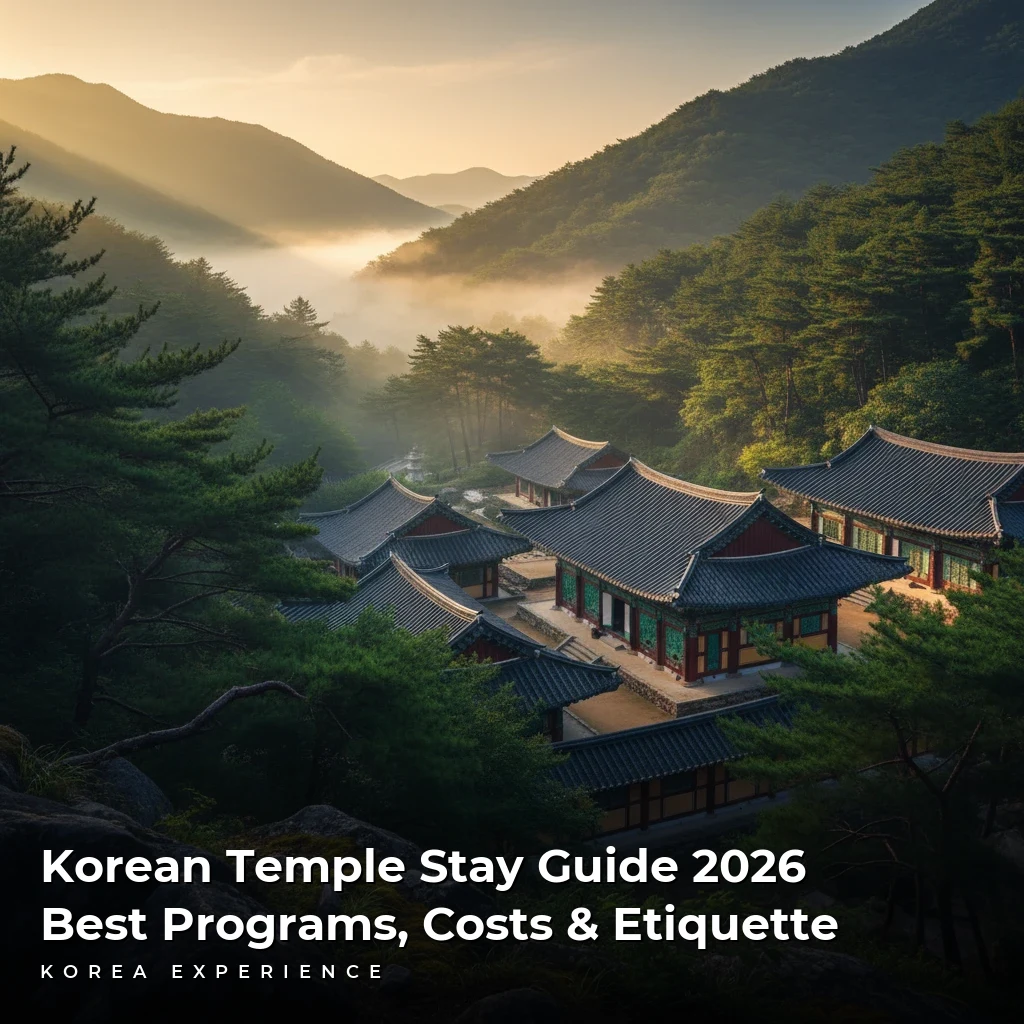
Can you find peace in one of the world's most hyper-connected countries? A Korean Temple Stay offers a profound answer to this question, inviting travelers to step out of the neon glare of Seoul and into the rhythmic serenity of monastic life. Whether you are seeking a spiritual reset, a cultural deep-dive, or simply a night away from your smartphone, the Temple Stay program—officially organized by the Cultural Corps of Korean Buddhism—provides an accessible yet transformative experience. Since its inception during the 2002 World Cup, over 6 million participants have donned the grey monastic vest, yet many international travelers still find the booking process and etiquette intimidating.
The short answer: A Korean Temple Stay typically costs between ₩50,000 and ₩100,000 per night, includes three vegetarian meals, and offers two main program types: "Experience-oriented" (activities provided) or "Relaxation-oriented" (free time). Reservations should be made 3-4 weeks in advance via the official Templestay.com website.
Key Takeaways
- 1Most stays cost ₩50,000 to ₩100,000 per night, covering accommodation and vegan meals
- 2Programs are split into 'Experience' (guided activities) and 'Relaxation' (free time)
- 3English-language programs are available at major temples like Jogyesa, Bongeunsa, and Golgulsa
- 4Pack slip-on shoes and socks; modest clothing is mandatory even in summer
- 5Morning chanting often begins at 3:30 AM or 4:00 AM
Understanding the Korean Temple Stay
The Korean Temple Stay program is a unique cultural program that allows participants to experience the life of Buddhist practitioners at traditional temples which preserve the 1,700-year history of Korean Buddhism.
Unlike a hotel or a guesthouse, a temple is a sacred space where monks live and practice asceticism. While the program was popularized in 2002 to accommodate World Cup tourists, it has evolved into a sophisticated wellness tourism sector. As of 2026, there are approximately 140 temples across South Korea operating these programs, with about 30 of them offering specialized English-language instruction.
📊 Program Growth
The Philosophy: "I" vs. "We"
In the fast-paced modern society of Korea, where the "Pali-Pali" (Hurry-Hurry) culture dominates, the temple stay acts as a counterbalance. The core philosophy revolves around "Cham-Seon" (Seon Meditation), focusing on finding one's true self. It is not about religious conversion; statistics show that nearly 40% of participants identify as non-religious or of different faiths.
Types of Programs: Which One Fits You?
Before booking, it is crucial to understand the distinction between the program types. Choosing the wrong one can lead to disappointment—either being bored by lack of structure or overwhelmed by too many activities.
Temple Stay Program Types
| Feature | Experience-Oriented | Relaxation-Oriented (Freestyle) |
|---|---|---|
| Structure | Highly Structured | Loose/Flexible |
| Wake-up Time | Mandatory (3:30-4:30 AM) | Optional (usually) |
| Activities | 108 Bows, Lotus Lantern Making, Tea Ceremony | Walking, Reading, Rest |
| Interaction | High (with Monks & Group) | Low (Solitary) |
| Price | Higher (₩70,000-₩100,000) | Lower (₩50,000-₩70,000) |
1. Experience-Oriented Program
This is recommended for first-timers and short-term travelers. It follows a strict schedule packed with cultural activities. You will learn temple etiquette, perform the 108 prostrations (bows), make prayer beads, and engage in "Dado" (tea ceremony) with a monk.
- Best for: Families, culture enthusiasts, solo travelers wanting to meet people.
- Intensity: Moderate to High.
2. Relaxation-Oriented (Freestyle) Program
This program provides the space and meals but leaves the schedule largely up to you. You are expected to attend the ceremonial meal offerings and perhaps the morning chanting, but the rest of the day is yours to hike, meditate, or sleep.
- Best for: Burned-out expats, writers, repeat visitors.
- Intensity: Low.
The Cost of Finding Peace
Budgeting for a temple stay is relatively straightforward as the packages are all-inclusive. There are rarely hidden costs once you arrive at the temple, as commerce within the sacred grounds is limited.
💵 Average Temple Stay Costs (Per Night)
Includes uniform, room, and 3 meals
Pro Tip: Cultural Day Discounts
The Cultural Corps often runs "Templestay Weeks" where prices are slashed to ₩20,000 or ₩30,000. These usually occur in November regarding "Travel Month." Check the official website for promotions.
Best Temples for International Travelers (2026 Edition)
While over 100 temples offer stays, language barriers can be a significant hurdle. Below are the top-rated temples that offer dedicated English programs and high-quality facilities.
1. Jingwansa (Seoul) - The Culinary Masterpiece
Located in the Bukhansan National Park but technically within Seoul, Jingwansa is world-renowned for its temple food. The temple gained global fame after being featured on Netflix's Chef's Table.
Jingwansa Temple(진관사)
2. Golgulsa (Gyeongju) - The Warrior's Path
For those who find sitting still difficult, Golgulsa offers a dynamic alternative. It is the headquarters of Sunmudo, a traditional Korean Buddhist martial art.
Golgulsa Temple(골굴사)
3. Jogyesa (Central Seoul) - The Accessible Choice
If you are short on time and cannot leave the city center, Jogyesa offers a sanctuary amidst the skyscrapers of Insadong.
Jogyesa Temple(조계사)
If you are looking to combine your temple stay with other historic sites, check out our guide on historic K-Drama sets and palaces to plan a full itinerary.
The Daily Routine: A 24-Hour Timeline
A temple stay is not a hotel stay; the schedule is dictated by the sun and monastic duties. While every temple varies slightly, here is a standard timeline for an Experience-oriented stay.
Standard Temple Stay Itinerary
Arrival & Orientation
Check-in, change into uniform, learn bowing etiquette.
Temple Tour
Guided tour explaining the architecture and history.
Barugongyang (Dinner)
Formal monastic meal eaten in silence.
Yebul (Evening Chanting)
Ceremonial chanting with monks and 108 bows.
Tea Ceremony
Conversation with a monk over tea.
Lights Out
Strict bedtime to prepare for early rising.
Wake Up
Pre-dawn awakening.
Morning Yebul
Morning chanting ceremony.
How to Book: A Step-by-Step Guide
The reservation ecosystem has improved drastically over the last decade. You no longer need to call temples individually.
📖 How to Book a Temple Stay
Step 1: Visit Official Website
Go to eng.templestay.com. This is the only government-official booking platform.
Step 2: Filter by Region & Language
Use the search filters to select 'English' capability. This is critical if you do not speak Korean.
Step 3: Select Program Type
Choose between 'Experience' or 'Freestyle' (Relaxation). Check the 'Schedule' tab to see the itinerary.
Step 4: Payment
Most temples require prepayment via credit card. Foreign cards are generally accepted on the platform.
Essential Etiquette and Rules
Entering a temple is entering a different cultural dimension. The rules exist to maintain the sanctity of the space and the focus of the practitioners.
1. Clothing (The Uniform)
Upon arrival, you will be given a vest and baggy trousers (pants).
- What to wear underneath: In summer, wear a light t-shirt. In winter, thermal underwear (Heattech) is absolutely essential as temples are drafty.
- Footwear: Wear shoes that are easy to slip on and off. You will take them off at least 20 times a day.
- Socks: You must wear socks in the Dharma halls. Bare feet are considered disrespectful and unhygienic in communal worship spaces.
2. Silence (Mook-eon)
"Mook-eon" means noble silence. While you don't need to be silent the entire time, loud talking, laughing, or running is prohibited. Speakers on phones should never be used; use headphones if you must listen to something in your room.
3. Bowing (Hapjang)
When you meet a monk, another participant, or enter a hall, you perform "Hapjang." Place your palms together at chest level and bow slightly (about 30-45 degrees). You do not need to bow all the way to the waist for a greeting.
Many foreigners worry about the religious aspect of bowing. In Korean Buddhism, bowing to the Buddha statue is not idol worship, but a gesture of lowering one's ego and respecting the Buddha nature that exists within yourself. If you are uncomfortable with prostrations due to religious reasons, simply standing respectfully is acceptable in most programs.
The Food: Barugongyang
Temple food is a highlight for many. It is strictly vegetarian (often vegan) and avoids the "five pungent spices" (garlic, green onion, chives, onions, and leeks), which are believed to distract the mind during meditation.
The formal meal, Barugongyang, involves four wooden bowls. The ritual emphasizes equality, cleanliness, and gratitude.
- Rice Bowl: The largest bowl (Baru).
- Soup Bowl: The second largest.
- Side Dish Bowl: For vegetables (Namul).
- Water Bowl: For cleaning.
Zero Waste Policy: You must eat absolutely everything you take, including the single piece of kimchi used to wipe your bowl clean with water at the end. This is to teach the value of labor and nature's gifts.
If you enjoy healthy eating, you might also like our guide to best Korean desserts for when you return to the city!
Seasonal Considerations
Korea has four distinct seasons, and the temple experience changes drastically with each.
- Spring (April-May): The most visually stunning time. Temples are decorated with thousands of colorful paper lanterns for Buddha's Birthday. The weather is crisp (10°C - 20°C).
- Summer (July-August): Hot and humid (25°C - 35°C). Lotus flowers bloom at temples like Buyeo's Gungnamji. Warning: Mosquitos in mountain temples can be fierce.
- Autumn (September-November): The best time for hiking. The mountains surrounding temples like Baekdamsa turn fiery red and orange.
- Winter (December-February): Extremely cold (-10°C). However, the sight of a snow-covered temple is hauntingly beautiful. Floor heating (Ondol) makes the rooms cozy, but moving between buildings is freezing.
For a broader look at when to plan your trip, consult our month-by-month weather guide.
Accommodation and Amenities
Do not expect a hotel suite.
- Sleeping: You will likely sleep on the floor using a "Yo" (mattress pad) and "Ibul" (blanket). If you have back problems, bring an inflatable camping mat or ask if the temple has thicker pads.
- Bathrooms: Most major temples now have modern, western-style toilets and communal showers. Some rooms have en-suite bathrooms, but many Experience programs use gender-segregated communal blocks.
- WiFi: Most administrative areas and rooms have WiFi, but signal may be weak in the prayer halls (intentionally).
Pros and Cons of a Temple Stay
Is it right for you?
Temple Stay Reality Check
- ✓Digital Detox: A forced break from screens
- ✓Healthy Eating: Gut-cleansing vegan food
- ✓Cultural Immersion: Access to restricted areas
- ✓Cost-Effective: Accommodation + 3 meals for under $80
- ✗Early Mornings: 3:30 AM wake-up calls
- ✗Physical Comfort: Sleeping on the floor can be hard
- ✗Strict Rules: No alcohol, smoking, or meat
- ✗Accessibility: Many temples have steep stairs
Integration into Your Itinerary
A temple stay works best as a "bridge" in your travel itinerary—perhaps between the bustle of Seoul and the coastal vibe of Busan.
3-Day Wellness Route: Seoul to Mountains
The Dualism Concept: Experience the best of both worlds — premium luxury moments paired with authentic budget-friendly experiences in one route.
Day 1: Insadong
Stay at a Hanok hotel, visit Jogyesa for evening vibes.
Day 2: Jingwansa
Transfer to Jingwansa for an overnight temple stay.
Start with the comfort of a hotel in Insadong, then transition to the austerity of the temple for a balanced experience.
If you need a break from the quiet life after your stay, check out our guide to best weekend getaways for expats for more lively options.
Frequently Asked Questions
❓ Temple Stay FAQ
Have more questions?Contact us →
Final Thoughts
A Korean Temple Stay is more than just a cheap accommodation option; it is a challenge to the modern lifestyle. It asks you to slow down, eat consciously, and sit with your own thoughts—activities that are increasingly rare in 2026. Whether you choose the intense physical discipline of Golgulsa or the gourmet healing of Jingwansa, you will leave with a lighter mind and perhaps slightly sore legs.
Ready to book?
Visit eng.templestay.com to browse available programs. Remember, the most popular temples near Seoul book up 1-2 months in advance for weekends!
About the Author
Korea Experience Team
Written by the Korea Experience editorial team - experts in Korean medical tourism, travel, and culture with years of research and firsthand experience.
Explore more in Travel & Tourism
From Seoul's neon-lit streets to Jeju's volcanic landscapes — discover the best of Korea with insider travel tips, itineraries, and seasonal guides.
Browse All Travel & Tourism ArticlesContinue Reading
Explore more articles you might find interesting
Discover the top 15+ English-friendly temple stays in Korea. From Seoul to mountains, learn booking tips, costs (₩50k-80k), and schedules for 2026.
Complete 2026 guide to Korean jjimjilbangs. Learn naked spa etiquette, scrub prices (₩25,000+), sleeping tips, and top 5 Seoul spas for relaxation.
Unlock your guide to rhinoplasty in Korea for 2026. Discover costs, top clinics, procedures, and essential tips for a successful medical tourism journey.

A complete guide to Korea's unique lump-sum housing deposit system. Learn costs, loans, and safety tips for foreigners navigating Jeonse in 2026.

Complete guide to booking tickets for Korean actor fan meetings. Learn ticketing secrets, venue details, and membership tips for international fans.
Discover the best English-speaking clinics in Seoul. From major university hospitals to local care, get costs, locations, and expert tips for 2026.