Acne treatment in Korea: Isotretinoin vs lasers vs chemical peels 2026
A complete guide comparing acne treatments in Seoul. We analyze costs, downtime, and efficacy of Isotretinoin, lasers, and peels with 2026 pricing data.
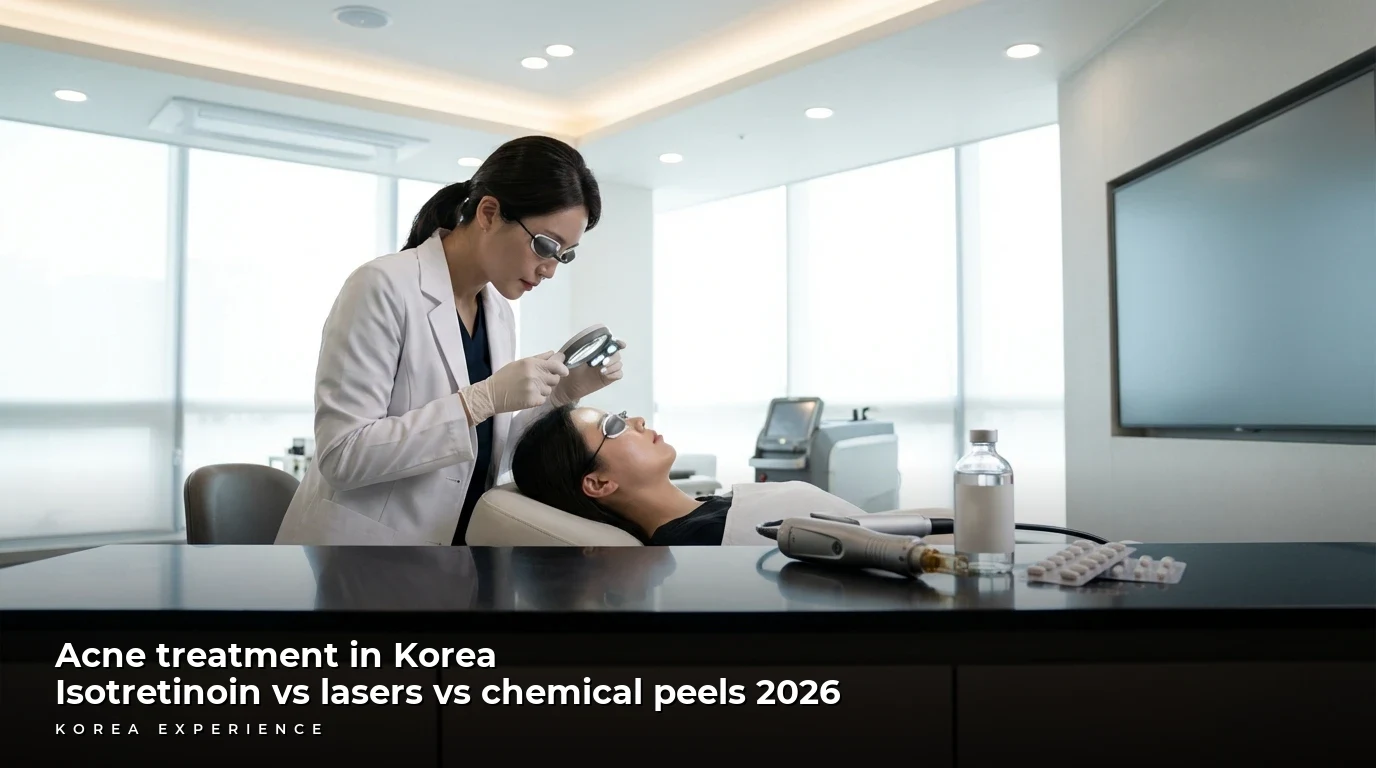
Choosing the right acne treatment in South Korea can be overwhelming given the sheer volume of advanced options available. You are likely wondering which method offers the fastest results, the best long-term cure, or the most travel-friendly recovery time.
The short answer: Isotretinoin offers a long-term systemic cure for cystic acne but requires months of treatment; lasers like Agnes and Gold PTT provide targeted, faster results for active breakouts and scarring with 1-3 days of downtime; chemical peels are best for maintenance and mild congestion with immediate recovery.
Key Takeaways
- 1Isotretinoin in Korea is prescribed in low doses (10mg) to minimize side effects, costing approx ₩20,000 for a month supply.
- 2Korean laser treatments (Agnes, Gold PTT) target sebaceous glands directly and often require 3-5 sessions spaced 2-4 weeks apart.
- 3Chemical peels like the 'Aladdin Peel' are popular for rapid resurfacing but come with 3-4 days of visible skin flaking.
Medical Disclaimer
The information provided in this article is for educational purposes only and does not constitute medical advice. Always consult with a board-certified dermatologist before starting any treatment. For medical emergencies in Korea, dial 119. For medical translation services, dial 1339.
Understanding the Korean approach to acne
Korea is often referred to as the skincare capital of the world, and for good reason. In 2026, the medical tourism sector in Seoul alone sees over 150,000 international visitors specifically for dermatology. Unlike Western approaches that often rely heavily on strong oral antibiotics first, Korean dermatologists favor a "multimodal" approach. This means they rarely prescribe just one cream or one pill. Instead, they combine physical treatments (lasers/extractions) with internal regulation (medication) and barrier repair (skin boosters).
When you visit a clinic in Gangnam or Sinsa-dong—where over 500 clinics are concentrated within a 5km radius—you will likely undergo a Visia skin analysis. This machine scans your face to count porphyrins (bacteria), hidden spots, and sebum levels. This data-driven approach allows the doctor to customize a plan that often blends the three main contenders: Isotretinoin, Lasers, and Chemical Peels.
"Foreign patients often want a 'one-shot' cure because their travel time is limited. However, acne is a chronic inflammatory disease. For travelers staying less than 2 weeks, we usually avoid high-downtime lasers and focus on barrier repair and extraction, unless they plan to return."
Isotretinoin: The internal solution
Isotretinoin (commonly known by brand names like Roaccutane, Accutane, or Isotren in Korea) is a vitamin A derivative. It works by shrinking the oil glands (sebaceous glands), reducing oil production by up to 90% within 6 weeks of usage.
The "Low-Dose" Korean philosophy
In the West, doctors often prescribe high doses (0.5mg to 1mg per kg of body weight) for a shorter duration. In Korea, the standard of care in 2026 leans heavily toward low-dose intermittent therapy. Doctors frequently prescribe 10mg daily or even 10mg every other day.
This approach significantly reduces common side effects like severe chapped lips, nosebleeds, and joint pain, making it more manageable for tourists who want to enjoy their trip without feeling physically drained. However, the treatment course is longer—often 6 to 12 months—meaning you will need to continue the medication after you leave Korea.
Cost and availability
Isotretinoin is a prescription-only drug in Korea. You cannot buy it over the counter at a pharmacy (Yak-guk).
- Consultation Fee: ₩10,000 – ₩30,000 ($7.50 – $22 USD) at a local clinic.
- Medication Cost: Approximately ₩15,000 – ₩25,000 ($11 – $19 USD) for 30 pills (10mg generic).
- Process: You visit the clinic, see the doctor for about 5-10 minutes, get a paper prescription, and take it to the pharmacy usually located on the same floor or building.
Strict Pregnancy Warning
Isotretinoin causes severe birth defects. Korean doctors are extremely strict about this. You may be required to sign a waiver stating you are not pregnant and will not become pregnant during treatment and for at least one month after stopping.
For those interested in how this integrates with other treatments, check out our guide on best dermatology clinics in Seoul for foreigners to find English-speaking doctors who can manage this prescription.
Laser treatments: The high-tech intervention
If Isotretinoin is the slow-burn internal fix, lasers are the precise, external weapon. Korean clinics utilize cutting-edge technology to destroy acne bacteria and sebaceous glands without damaging the surrounding skin.
1. Gold PTT (Photothermal Therapy)
This is one of the most popular treatments in Seoul for 2026. It involves applying gold nanoparticles to the skin, which travel down into the pores. A laser is then used to heat these gold particles, selectively destroying the oil glands.
- Pain Level: Low (2/10).
- Downtime: None. You can wear makeup immediately.
- Frequency: 3-5 sessions recommended.
- Cost: ₩150,000 – ₩250,000 per session.
2. Agnes RF
Agnes is a Korean invention. It uses a micro-insulated needle to deliver radiofrequency energy directly into a specific acne pore to destroy the sebaceous gland permanently. It is technically a "cure" for that specific pore—acne will not return in that exact spot.
- Pain Level: Moderate to High (6/10). Numbing cream is applied for 30 minutes.
- Downtime: 1-3 days of redness and potential pustules as debris is purged.
- Target: Recurrent cystic acne in the same spot (e.g., chin or jawline).
3. V-Beam / Excel V (Vascular Lasers)
These lasers target the redness (post-inflammatory erythema) left behind by acne. They operate on a 595nm or 532nm wavelength to collapse the dilated blood vessels.
- Efficiency: excellent for "red acne marks."
- Cost: ₩100,000 – ₩200,000 per mode.
📋 Laser Treatment Stats
If you are planning a trip specifically for these treatments, you should consider the timing. Lasers often require avoiding direct sunlight. Read our guide on the best time to visit Korea to plan your trip during autumn or winter when UV index is lower.
Chemical Peels: The resurfacing maintenance
Chemical peels in Korea (often called "Scaling") are distinct from the deep phenol peels seen in the West. They are generally milder and integrated into a facial routine.
Aqua Peel (The "Tourist Favorite")
This is a 3-step hydradermabrasion process using AHA, BHA, and suction. It cleans out pores and hydrates. It is not a cure for acne but creates a clean canvas.
- Cost: ₩30,000 – ₩70,000 ($22 – $52 USD).
- Frequency: Can be done weekly.
Aladdin Peel (FCR Peel)
This contains microscopic spicules (coral calcium) that are rubbed into the skin. It feels like rubbing crushed glass on the face. It stimulates massive cell turnover.
- Effect: Treats active acne and superficial scarring.
- Downtime: Your face will be red for 24 hours, and you will peel heavily (like a snake) from day 3 to day 5.
- Cost: ₩100,000 – ₩180,000 ($75 – $135 USD).
Jessner’s / Salicylic Acid Peels
Standard chemical exfoliation to unclog pores. Often used as a prep step before extractions.
Treatment Comparison Matrix
| Feature | Isotretinoin | Lasers (Agnes/PTT) | Chemical Peels |
|---|---|---|---|
| Primary Target | Total Oil Production | Specific Glands/Bacteria | Surface Debris/Cell Turnover |
| Time to Results | 2-3 Months | 2-4 Weeks | Immediate Glow (Aqua) / 1 Week (Aladdin) |
| Pain Level | None | Moderate | Low to High (Aladdin) |
| Long-term Cure | High Probability | Permanent for treated pores | Maintenance Required |
Which treatment fits your travel itinerary?
Your choice depends heavily on how long you are staying in Korea. Since medical tourism is often time-bound, here is a breakdown based on trip duration.
Short Trip (3-5 Days)
- Recommended: Aqua Peel, Gentle LDM (Ultrasound) management, Extraction, Prescription for topical antibiotics.
- Avoid: Agnes RF or Aladdin Peel. You do not want to spend your short holiday peeling or looking swollen in photos.
- Strategy: Get a prescription for Isotretinoin to take home (if your country allows importation—check customs rules) and do a deep cleansing facial.
Medium Trip (2 Weeks)
- Recommended: Gold PTT (2 sessions spaced 1 week apart), V-Beam laser for redness.
- Strategy: Do the aggressive treatment on Day 2. Recover by Day 5. Do a follow-up or soothing treatment on Day 10.
- Activity: While recovering, you can enjoy indoor activities. Check out Coex Mall complete shopping and dining guide for a sun-safe environment.
Long Term (1 Month+)
- Recommended: Full acne package (Agnes + Toning + Peels).
- Strategy: You can undergo the "Spartan" treatments. The Aladdin peel is great here because you can hide out in your Airbnb for the 3 days of shedding.
📊 Tourist Treatment Preferences
The "Gangnam Style" Combination
The reality is that you rarely choose just one. A typical "Acne Package" at a factory clinic (large volume clinic) or a boutique clinic involves a sequence.
Example Session (90 minutes):
- Cleansing: Professional double cleanse.
- Extraction: Manual removal of comedones using a sterile needle (very thorough in Korea).
- Scaling: Mild acid application to loosen debris.
- Laser: Gold PTT or Sebacia laser treatment.
- Cryotherapy: Cooling the skin to -10°C to reduce inflammation.
- Modeling Mask: A thick rubber mask (spirulina or tea tree) to seal in moisture.
- LED Light Therapy: Blue light to kill bacteria.
This comprehensive session costs between ₩150,000 and ₩300,000 depending on the laser used.
💵 Cost Comparison (Per Session/Month)
Extraction + Laser + Aftercare
Consultation + 1 Month Pills
Booking and Process Timeline
Navigating the Korean medical system is efficient. Here is what the journey looks like for a foreigner.
Your Acne Treatment Journey
Research & Booking
Contact clinics via WhatsApp/KakaoTalk. Send clear photos of your skin without makeup.
Consultation
Visia skin scan. Doctor creates a plan. Numbing cream applied (20-40 mins).
Procedure
The treatment takes 30-60 mins. Cooling mask applied immediately after.
Recovery
Avoid sauna, swimming, and heavy sweating. Apply prescribed repair cream.
Post-Treatment Care in Korea
Aftercare is just as important as the procedure. The Korean air can be dry, especially in winter, and the urban pollution (yellow dust) in spring can irritate treated skin.
- Sun Protection: This is non-negotiable. After lasers or peels, your skin is photosensitive. You must use SPF 50+ PA++++.
- Recommendation: Read our review on best Korean sunscreen guide to find a physical blocker that won't sting sensitive skin.
- Regenerative Creams: Pharmacies sell "Cica" creams or EGF (Epidermal Growth Factor) ointments specifically for post-laser skin. Brands like Cell Fusion C or Zeroid are clinic favorites.
- Pimple Patches: If active spots purge after treatment, cover them with hydrocolloid patches (Olive Young sells packs of 102 patches for roughly ₩6,000).
📖 How to Handle Post-Laser Purging
Step 1: Don't Pick
Lasers like Agnes bring debris to the surface. It will look like a whitehead. Do not squeeze it.
Step 2: Apply Patch
Place a hydrocolloid patch over the whitehead to absorb exudate.
Step 3: Hydrate
Use a hyaluronic acid serum to prevent tight skin sensation.
Pros and Cons: A Balanced View
To help you finalize your decision, let's look at the trade-offs.
Isotretinoin vs. Laser/Peels
- ✓Isotretinoin treats the root cause systemically
- ✓Lasers offer faster visible improvement for scarring
- ✓Peels are affordable and great for skin texture
- ✓Korean clinics offer high-tech combos rarely found elsewhere
- ✗Isotretinoin has systemic side effects (dryness, liver load)
- ✗Lasers require multiple sessions for permanent results
- ✗Peels have downtime (shedding) that impacts travel photos
- ✗Language barrier can make communicating side effects difficult
Conclusion
The "best" treatment depends entirely on your goals.
- Choose Isotretinoin if you have persistent, cystic acne that has resisted antibiotics and you are willing to commit to a 6-month course.
- Choose Lasers (Gold PTT/Agnes) if you have active acne combined with scarring and want to utilize Korea's advanced technology during a 2-week trip.
- Choose Chemical Peels if you have mild congestion, want a glow up, or are on a budget.
For many travelers, the sweet spot is a hybrid approach: getting a deep cleaning and laser session in Seoul to jumpstart the process, and returning home with a prescription for low-dose Isotretinoin to maintain the results.
Whatever you choose, the dermatology infrastructure in Korea is world-class, offering treatments at 30-50% of the cost found in the US or Europe. Just remember to book in advance—the best English-speaking clinics in Gangnam are often booked out 2-3 weeks ahead.
For more beauty insights, check out our guide to best Korean skin clinics in Gangnam.
❓ Frequently Asked Questions
Have more questions?Contact us →
About the Author
Korea Experience Team
Written by the Korea Experience editorial team - experts in Korean medical tourism, travel, and culture with years of research and firsthand experience.
⚠️ Medical Disclaimer
The information provided on this website is for general informational purposes only and does not constitute medical advice. Always consult with qualified healthcare professionals before making any medical decisions.
Explore more in Medical Tourism
World-class medical procedures at competitive prices. From plastic surgery and dermatology to dental care and health checkups — your complete guide to medical tourism in Korea.
Browse All Medical Tourism ArticlesContinue Reading
Explore more articles you might find interesting
A complete guide to same-day medical treatments in Seoul. We analyze safety, costs (saving up to 40%), and efficiency for travelers in 2026.
Compare scar treatment options silicone sheets vs laser in Korea. We analyze costs, efficacy, and why Seoul is the global capital for skin repair in 2026.
Compare Ultherapy, Thermage, and Shurink costs and results. Discover why Seoul offers treatments at 30-50% less than global rates with our 2026 guide.
A complete guide comparing PicoSure and Q-Switch lasers for tattoo removal in Korea, including costs, pain levels, and success rates for 2026.
A complete guide to Korean post-procedure care, featuring top pharmacy creams, deswelling treatments, and recovery protocols with 2026 pricing data.
Comprehensive guide to laser skin treatments in Seoul including costs for Fraxel, Pico, and Shurink, plus 2026 clinic recommendations.