Cost of living in Seoul vs Busan comparison 2026
Discover the real cost differences between Seoul and Busan for 2026. Detailed rent, food, and transport breakdowns for expats and travelers.
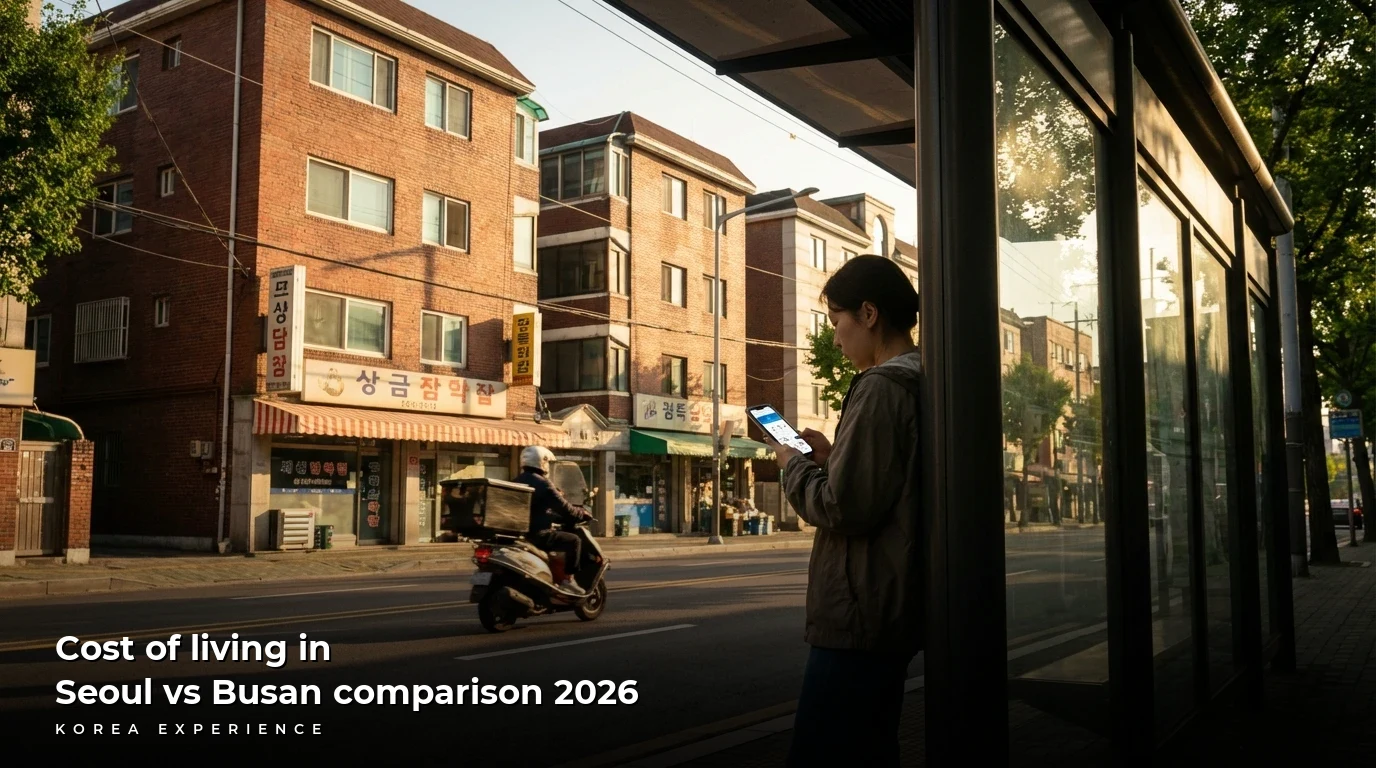
Deciding between the electric pulse of the capital and the laid-back coastal vibe of the southern port city is the most common dilemma for expats and long-term travelers in South Korea. As we enter 2026, the economic landscape of the peninsula has shifted, with inflation impacting housing and dining costs differently across regions. While Seoul offers unmatched career opportunities and global connectivity, Busan presents a compelling case for a higher quality of life at a significantly lower price point.
In this comprehensive guide, we break down every aspect of your potential budget, from high-rise apartment deposits to the price of a latte in Gangnam versus Haeundae. Whether you are a digital nomad, an English teacher, or a corporate expat, understanding these financial nuances is crucial for planning your move.
For more details, check out our guide on Living in a goshiwon vs officetel pros cons and costs.
Key Takeaways
- 1Busan's housing costs are approximately 30-40% lower than Seoul for comparable quality apartments in 2026.
- 2Public transportation costs are nearly identical, with base subway fares hovering around ₩1,500 in both cities.
- 3Seoul offers more variety in international cuisine, but dining out in Busan is generally 15-20% cheaper for local Korean food.
The Housing Market: Rent and Deposits
The single largest differentiator in the cost of living between Seoul and Busan is housing. In 2026, Seoul's real estate market remains one of the most competitive in Asia, driven by high demand in key districts like Gangnam, Mapo, and Yongsan. Conversely, Busan offers a renter's market where your Won stretches significantly further, often affording you ocean views for the price of a semi-basement in the capital.
For more details, check out our guide on Sending money abroad bank transfer vs wise comparison.
Understanding the Deposit System
Before comparing monthly rents, it is essential to address the "Key Money" system. In Korea, you typically pay a large deposit (Bojeung-geum) to lower your monthly rent (Wolse).
Deposit vs. Rent Dynamic
The "Jeonse" system (huge deposit, zero rent) is declining in popularity due to high interest rates in 2026. Most expats now opt for "Wolse" (monthly rent). Generally, increasing your deposit by ₩10,000,000 (approx. $7,500 USD) will reduce your monthly rent by roughly 50,000 to ₩70,000.
Seoul: The Premium Price Tag
In Seoul, a standard 20-square-meter "Officetel" (studio apartment) in a central area typically requires a deposit of 10 million to ₩20 million. As of early 2026, the average monthly rent for such a unit ranges from 850,000 to ₩1,200,000. If you are looking for a separated one-bedroom apartment, expect prices to start at ₩1.5 million per month.
Busan: Coastal Value
Busan offers a stark contrast. In popular areas like Seomyeon or Gwangalli, a similar modern studio commands a deposit of only ₩5 million. Monthly rent usually falls between 450,000 and ₩650,000. This means you can save roughly ₩500,000 ($375 USD) per month on rent alone by choosing the southern coast.
💵 Monthly Rent Comparison (Standard Studio)
High accessibility, smaller space
Larger space, often near beach
In 2026, many landlords in Seoul are now requesting 'management fees' (gwanri-bi) separately from rent to bypass rent increase caps. Always ask for the total monthly output. A 700k rent might actually be 900k once the 200k internet and cleaning fee is added.
Food and Dining: Cost of Calories
While rent creates a massive divide, food costs are more nuanced. The price of groceries in supermarkets like Emart or Homeplus is relatively standardized across the country. However, the dining-out culture creates a divergence in daily spending.
Grocery Shopping
South Korea remains one of the most expensive countries in Asia for fresh fruit and dairy. In 2026, a carton of milk (1L) averages ₩3,200, and a pack of four apples can easily cost ₩12,000 regardless of the city.
However, Busan has a distinct advantage regarding seafood and local produce markets. The proximity to the port means fresh fish is approximately 20% cheaper in local markets compared to Seoul.
Grocery Basket Comparison (2026 Average)
| Item | Seoul Price | Busan Price | Difference |
|---|---|---|---|
| Local Beer (500ml) | ₩3,000 | ₩3,000 | 0% |
| Chicken Breast (1kg) | ₩14,500 | ₩13,800 | -5% |
| Apples (1kg) | ₩12,000 | ₩11,500 | -4% |
| Restaurant Meal (Mid-range) | ₩18,000 | ₩14,000 | -22% |
Dining Out and Nightlife
Seoul is the capital of trends. If you frequent trendy cafes in Seongsu-dong or wine bars in Hannam-dong, you will pay a premium. A standard Americano in Seoul averages ₩5,000, while a cocktail hits ₩18,000.
Busan’s food scene is robust but less pretentious. A hearty meal of Dwaeji Gukbap (Pork Soup Rice), the city's soul food, costs about ₩9,000 in 2026. In Seoul, a similar quality soup dish would likely be 11,000 to ₩12,000.
Jagalchi Market(자갈치시장)
Transportation: Getting Around
Public transportation in South Korea is world-class: clean, efficient, and affordable. Both cities utilize a unified card system (T-Money or Cashbee), making transit seamless.
Subway and Bus Fares
As of the 2026 fare adjustments, the base fare for the subway in Seoul is ₩1,550 for the first 10km. Busan follows closely at ₩1,500. While the individual ride cost is negligible, the total monthly spend differs based on city layout.
Seoul is massive. Commuting from a residential area like Bundang to a workplace in Gangnam can take 45 minutes and cost ₩3,200 one way due to distance surcharges. Busan is more linear; most commutes stay within the base fare range.
📋 Transit Costs 2026
Taxi Rates
Taxi fares saw a nationwide hike recently. The base fare for a standard taxi is ₩4,800 in Seoul and roughly the same in Busan. However, traffic congestion in Seoul is significantly worse. A 10km taxi ride in Seoul might cost ₩18,000 and take 40 minutes due to idling time, whereas the same distance in Busan might cost ₩14,000 and take 20 minutes.
Pro Tip: Transit Passes
In Seoul, investigate the "Climate Card" (Giho Card). For a flat monthly fee (approx. ₩65,000), you get unlimited access to subways and buses within Seoul city limits. Busan offers the "Dongbaek Pass," which provides cash-back rewards for frequent transit users.
Utilities and Connectivity
South Korea has some of the fastest internet speeds in the world, and costs are generally uniform nationwide. However, utility bills fluctuate based on the climate and the age of the building.
Internet and Mobile
A standard 1Gbps internet connection costs approximately ₩40,000 per month in both cities. Unlimited 5G mobile data plans hover around 65,000 to ₩80,000 per month across all major carriers (SKT, KT, LG U+).
Heating and Electricity
This is where the geography matters. Seoul is significantly colder in winter, with temperatures regularly dropping to -15°C. Heating is primarily done via "Ondol" (gas floor heating).
- Seoul Winter Bill: Expect to pay 150,000 to ₩250,000 per month for gas in a small apartment during January and February.
- Busan Winter Bill: Being on the southern coast, Busan is milder. Temperatures rarely drop below -5°C. Your gas bill will likely be 30-40% lower, averaging ₩100,000.
Conversely, Busan can be more humid in summer, potentially leading to slightly higher electricity bills for air conditioning, though the difference is less drastic than the winter heating gap.
📊 Average Monthly Utilities (Studio)
Lifestyle and Entertainment Costs
Your lifestyle preferences dictate your budget. Seoul offers endless entertainment, from K-Pop concerts to 24-hour PC bangs. Busan focuses on nature, beaches, and hiking.
Fitness and Wellness
Gym memberships in Seoul are pricey due to real estate costs. A decent gym in Gangnam or Mapo charges 80,000 to ₩120,000 per month. In Busan, you can find excellent facilities for ₩60,000.
Leisure Activities
Movie tickets are standardized at ₩15,000 nationwide. However, "free" entertainment is where Busan shines. Access to beaches like Haeundae, Gwangalli, and Songjeong is free. In Seoul, leisure often involves consumption—cafes, shopping malls, and ticketed exhibitions.
Lifestyle Trade-offs
- ✓Seoul: World-class concerts, exhibitions, and unlimited nightlife options.
- ✓Busan: Free access to beaches, hiking trails, and a slower pace of life.
- ✗Seoul: High pressure to spend socially; 'Cafe hopping' adds up quickly.
- ✗Busan: Fewer international cultural events and niche hobby communities.
Total Budget Scenarios (2026 Estimates)
To help you visualize the total cost, we have constructed three common personas. These estimates include rent, utilities, food, transport, and moderate entertainment.
1. The English Teacher (Budget Conscious)
- Profile: Lives in provided housing (no rent), cooks at home often, uses public transit.
- Seoul Spend: ₩1,200,000 / month.
- Busan Spend: ₩1,000,000 / month.
- Verdict: Without rent, the difference is marginal, mostly saved on cheaper local dining and transport surcharges.
2. The Digital Nomad (Freelancer)
- Profile: Rents a nice studio, works from cafes daily, eats out 1-2 times a day, enjoys nightlife.
- Seoul Spend: ₩3,500,000 / month.
- Busan Spend: ₩2,400,000 / month.
- Verdict: The gap widens significantly (₩1.1M difference) due to rent and cafe/nightlife costs.
3. The Corporate Expat (Family of 3)
- Profile: 3-bedroom apartment, international school fees (excluded here for simplicity), car ownership, family dining.
- Seoul Spend: ₩6,500,000 / month (excluding school fees).
- Busan Spend: ₩4,500,000 / month.
- Verdict: Housing creates a massive ₩2M gap here. A 3-bedroom in Seoul is exponentially more expensive than in Busan.
📖 How to Secure a Budget Apartment
Step 1: Download the Apps
Install 'Zigbang' and 'Dabang'. These are the Zillow of Korea. Use them to gauge market prices, not necessarily to book.
Step 2: Visit a 'Budongsan'
Go to a physical real estate office (Budongsan) in your desired neighborhood. They have inventory not listed online.
Step 3: Negotiate the Deposit
If you have cash on hand, offer to raise the deposit (Key Money) to lower the monthly rent.
Conclusion: Which City Fits Your Wallet?
In 2026, the financial verdict is clear: Busan is approximately 20% to 30% cheaper than Seoul overall, with the majority of those savings coming from housing costs.
If your priority is career advancement, networking, and being at the center of Asian pop culture, the "Seoul Premium" is worth paying. The opportunities for high-income employment are concentrated in the capital, which can offset the higher cost of living.
However, if you are a remote worker, a retiree, or someone who values work-life balance and nature, Busan offers a superior quality of life for the money. You can live in a larger apartment near the ocean for the price of a shoebox in Seoul, enjoying a milder winter and fresher air.
Ultimately, both cities offer a safe, modern, and dynamic lifestyle that is competitively priced compared to Western capitals like London or New York.
❓ Frequently Asked Questions
Have more questions?Contact us →
About the Author
Korea Experience Team
Written by the Korea Experience editorial team - experts in Korean medical tourism, travel, and culture with years of research and firsthand experience.
Explore more in Living in Korea
Everything expats and long-term visitors need to know — from visa requirements and housing to banking, healthcare, and daily life tips.
Browse All Living in Korea ArticlesContinue Reading
Explore more articles you might find interesting

Discover Korea's best markets beyond Seoul. Explore Busan, Jeju, and Daegu with specific food prices, transport tips, and 2026 travel data.
Discover 2026 Seoul transit updates including the 1,550 won base fare and new Climate Card options that save money for travelers taking over 3 rides daily.
Discover the top districts for living in Seoul in 2026. Detailed rental costs, commute times, and lifestyle analysis for expats moving to Korea.

Discover top night markets in Seoul, Busan, and Jeonju. We compare food prices (₩3,000-15,000), opening hours, and must-try dishes for your 2026 trip.

Compare medical tourism in Busan vs Seoul for 2026. Discover price differences, clinic quality, recovery spots, and pros/cons for your procedure.
Compare KTX and SRT high-speed trains in Korea. Discover price differences (10% cheaper), station locations, and how to book tickets for your 2026 trip.