Your Guide to Korea's D-10 Job Seeker Visa After Graduation
Unlock your post-graduation career in Korea with the D-10 Job Seeker Visa. Learn eligibility, application steps, and job search strategies for international graduates.
Navigating Post-Graduation Life in Korea with the D-10 Job Seeker Visa
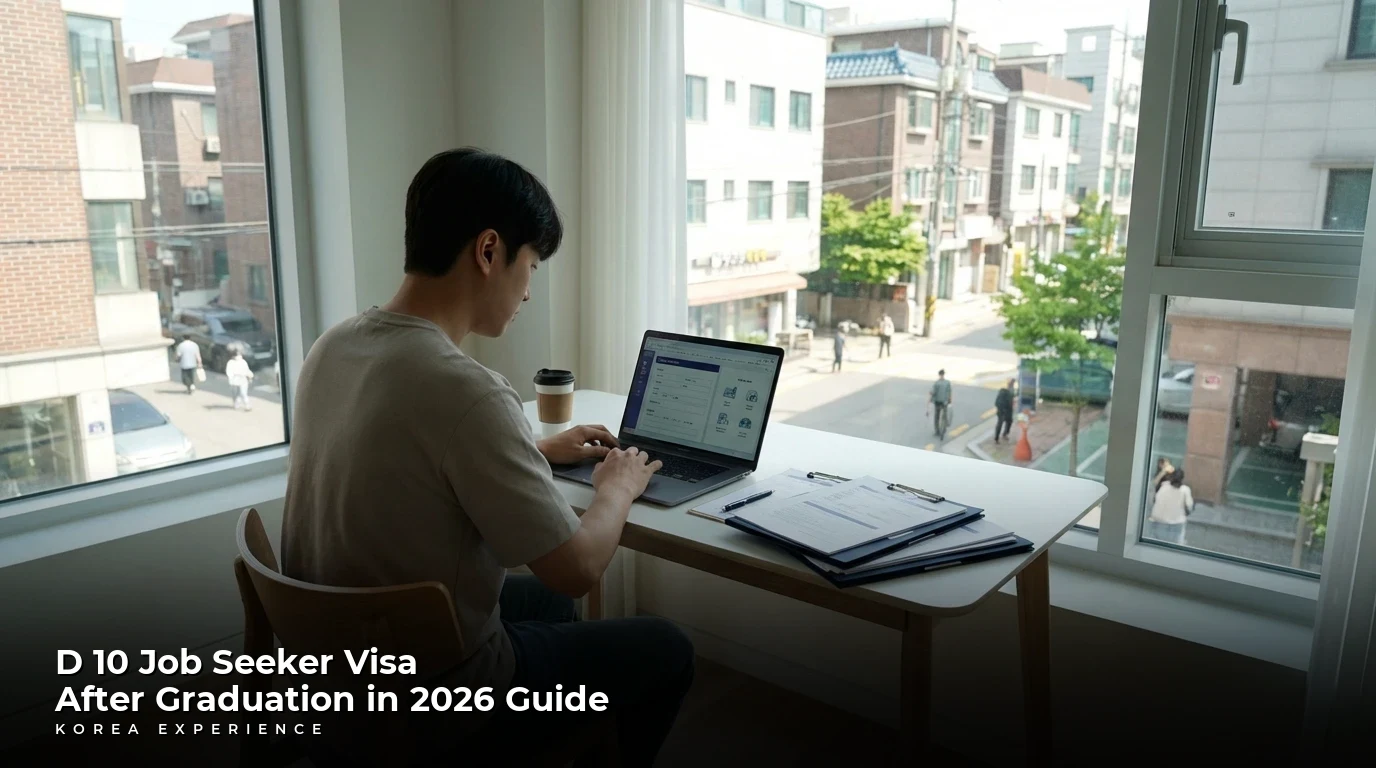
The dream of many international students studying in South Korea extends beyond graduation. It's the dream of building a career, embracing the vibrant culture long-term, and making Korea home. However, as student visas like the D-2 approach expiry, a critical question arises: how can I legally stay and pursue employment opportunities? This is where the D-10 Job Seeker Visa becomes your essential bridge.
This comprehensive guide is designed for international graduates, or those soon to graduate from Korean universities, who aspire to find professional employment and transition to a long-term working visa in Korea. We'll demystify the D-10 Job Seeker Visa, walking you through everything from eligibility and application procedures to effective job search strategies and how to maximize your time on this unique visa. By the end of this post, you'll have a clear roadmap to navigate your post-graduation career path in Korea.
Understanding the D-10 Job Seeker Visa: Your Post-Graduation Bridge
The D-10 Job Seeker Visa, officially known as the "Job Seeking Visa," is a temporary visa granted to foreign nationals who wish to stay in Korea for the purpose of seeking employment. It's a crucial stepping stone for international graduates from Korean educational institutions, allowing them to remain in the country and actively search for a job without the immediate pressure of an expiring student visa.
This visa acknowledges the value international talent brings to the Korean economy and provides a structured pathway for those who wish to contribute their skills and expertise. Unlike a working visa, the D-10 itself does not permit full-time employment, but it grants the legal status necessary to interview, network, and secure a job offer that will then enable a transition to a more permanent work visa (such as an E-7 Professional Visa or E-2 English Teaching Visa).
What is the D-10 Visa's Core Purpose?
The primary objective of the D-10 Job Seeker Visa is to facilitate job searching activities. This includes:
- Attending interviews.
- Participating in career fairs and networking events.
- Utilizing job search platforms and services.
- Conducting research on potential employers.
- Undertaking short-term internships or training (with prior approval, often limited hours).
It's a declaration of intent to the Korean government: "I am actively seeking professional employment in Korea."
D-10 Visa at a Glance
| Feature | Description to my current position and beyond, I have a deep understanding of the Korean job market and its challenges.
The purpose of the D-10 Job Seeker Visa is to facilitate these activities, acting as a crucial stepping stone. It's not just a stay permit; it's a strategic period for you to secure a job offer that will qualify you for a change to a more stable, long-term working visa such as the E-7 Professional Visa (for specialized professions) or even an E-2 English Teaching Visa. Without a D-10 visa, your options to legally remain in Korea after your student visa expires are extremely limited, often requiring you to leave the country.
Essential Eligibility Requirements for the D-10 Visa
Before you start preparing your application, it's crucial to understand if you meet the fundamental criteria for the D-10 Job Seeker Visa. The Korean Immigration Service carefully assesses each applicant to ensure they genuinely intend to seek employment and possess the necessary qualifications.
Academic Qualifications
The most common pathway to a D-10 visa for international graduates is directly from a Korean educational institution.
- Graduation from a Korean University: You must have graduated, or be scheduled to graduate soon, with at least an associate's degree (전문학사), bachelor's degree (학사), master's degree (석사), or doctorate (박사) from a Korean college or university. This means your student visa (D-2) would have been tied to your enrollment in one of these programs.
- Research or Training (D-4 visa holders): In some cases, individuals who completed specific research or training programs under a D-4 visa might also be eligible, provided their program is recognized as highly specialized and directly related to a field with high demand for foreign professionals.
Financial Solvency
Proof of sufficient funds is paramount. The Korean government wants assurance that you can support yourself financially during your job search period without becoming a burden on the state.
- Minimum Funds: You must demonstrate proof of funds amounting to at least 1,500,000 Korean Won per month (approximately 1,100-1,200 USD, depending on exchange rates) for the duration of your requested visa period, typically 6 months. This translates to roughly 9,000,000 Korean Won for a 6-month initial visa.
- Acceptable Proof: Bank statements from a Korean bank account showing this balance are preferred. The account should be in your name. If using an overseas account, you might need additional documentation like a bank certificate translated and notarized, along with recent transaction history.
No Criminal Record
You must have a clean criminal record, both in Korea and in your home country. Any serious offenses could lead to visa denial. For Korean university graduates, this is usually straightforward, as you would have already undergone background checks for your student visa.
Previous Visa Status and Timing
- Direct Transition: The D-10 visa is most commonly applied for as a direct transition from a D-2 Student Visa. You should apply before your D-2 visa expires, ideally within a few weeks of your graduation ceremony.
- Other Visas: While less common, individuals on certain other short-term visas might be able to change to a D-10, but the requirements can be more stringent, often requiring proof of a specific skill or previous career experience aligning with Korea's needs.
Age and Skill Set (Implicit)
While there isn't a strict age limit, the D-10 visa is implicitly geared towards recent graduates and young professionals. Furthermore, the immigration office often assesses the "employability" of the applicant. This means your major, your Korean language proficiency, and any existing professional networks can subtly influence the outcome. Having a high TOPIK (Test of Proficiency in Korean) score, for instance, significantly boosts your chances, as it demonstrates a commitment to integrating into the Korean workforce.
| Eligibility Aspect | Key Requirement | Important Notes (or D-4 for specialized programs). You cannot apply for a D-10 if you are already out of status.
The Application Process: Step-by-Step for Your D-10 Visa
Applying for the D-10 Job Seeker Visa requires careful attention to detail and adherence to the guidelines of the Korean Immigration Service. While the process may seem daunting, breaking it down into manageable steps makes it much clearer.
Step 1: Gather All Required Documents
This is arguably the most critical step. Start collecting your documents well in advance of your current visa's expiration date. Refer to the "Key Documents Required" section below for a comprehensive list. Ensure all documents are original or certified true copies, and any necessary translations are officially done.
Step 2: Prepare Your Job Search Plan
The Korean Immigration Service needs to see that you have a concrete plan for finding employment. This is not just a formality; it should be a realistic and detailed outline of how you intend to spend your time on the D-10 visa. Include:
- Target industries and job roles.
- Specific companies you plan to apply to.
- Job portals you will use (e.g., Job Korea, Saramin, LinkedIn, Incruit).
- Networking events or career fairs you plan to attend.
- Any skill development courses you might take (e.g., advanced Korean language, specific software).
- If you have prior job search activities (even on a student visa), mention them.
Step 3: Book an Appointment at the Immigration Office
The Korean Immigration Service operates by appointment only for most visa applications and changes. You can book an appointment online via the Hi Korea website (www.hikorea.go.kr).
- Location: You must visit the Immigration Office (출입국관리사무소) that has jurisdiction over your registered address. For instance, if you live in central Seoul, you would typically go to the Seoul Immigration Office located in Mok-dong, Yangcheon-gu. Be sure to select the correct office for your area.
- Timing: Appointments can fill up quickly, especially during peak graduation seasons (February/August). Book your appointment as soon as you have most of your documents ready, preferably a few weeks before your current visa expires.
Step 4: Attend Your Appointment and Submit Application
On the day of your appointment:
- Arrive Early: Give yourself ample time to find parking or navigate public transportation.
- Bring All Documents: Have all original documents and their copies organized in a folder. It's wise to have an extra copy of anything important.
- Application Form: Fill out the Application for Change of Status of Sojourn (체류자격 변경허가 신청서). You can often download this from the Hi Korea website beforehand to fill out at home, or request one at the immigration office.
- Pay the Fee: The application fee for a change of status is currently 130,000 Korean Won (subject to change). This can be paid at the immigration office via a bank within the building or at an ATM.
Step 5: Interview (If Required)
While not all D-10 applicants are interviewed, some might be. The immigration officer may ask about your job search plans, your motivation for staying in Korea, and your financial situation. Be prepared to articulate your intentions clearly and confidently. Strong Korean language skills can be a significant advantage here.
Step 6: Await Decision
After submitting your application, you will typically receive a receipt with a processing number. The processing time can vary, from a few days to several weeks. You can check the status of your application online via the Hi Korea website using your application number. Once approved, you will need to revisit the immigration office (or have your Alien Registration Card mailed to you, depending on the office's procedure) to pick up your updated Alien Registration Card (ARC), which will reflect your new D-10 visa status.
Practical Tip: Throughout this process, maintain a professional and polite demeanor. The immigration officers handle numerous cases daily, and clear, organized submissions facilitate a smoother process for everyone. Always double-check the latest requirements on the Hi Korea website, as regulations can change.
Key Documents Required for Your D-10 Visa Application
A well-prepared document portfolio is your best asset when applying for the D-10 Job Seeker Visa. Missing or incorrect documents are the most common reasons for delays or denials.
Here's a detailed checklist of what you'll typically need:
-
Application for Change of Status of Sojourn (체류자격 변경허가 신청서):
- Completed and signed. Download from Hi Korea or obtain at the Immigration Office.
-
Passport:
- Original and a photocopy of the biographical page.
-
Alien Registration Card (ARC) (외국인등록증):
- Original and a photocopy (front and back).
-
One Standard Passport-Sized Photo:
- 3.5cm x 4.5cm, white background, taken within the last 6 months.
-
Graduation Certificate (졸업증명서) or Certificate of Expected Graduation (졸업예정증명서):
- Original from your Korean university. If applying with an expected graduation certificate, you will need to submit the actual graduation certificate once issued.
-
Academic Transcript (성적증명서):
- Original from your Korean university, showing all your courses and grades.
-
Proof of Financial Solvency:
- Bank Statement: Original bank statement (from a Korean bank preferred) showing a minimum balance of approximately 9,000,000 Korean Won (for a 6-month D-10 visa) or 1,500,000 Korean Won per month of stay. The statement should be issued recently.
- If using an overseas account: A bank certificate, translated and notarized, along with recent transaction history to prove the funds are readily accessible.
-
Housing Contract (거주지 증명서류):
- A copy of your rental agreement (lease contract) in your name.
- If staying with a friend, you might need their housing contract, a letter of invitation from them, and a copy of their Alien Registration Card or Korean ID.
-
Job Search Plan (구직활동 계획서):
- A detailed, typed document outlining your strategy for finding employment in Korea, as discussed in the "Application Process" section. Be specific.
-
Resume/Curriculum Vitae (이력서):
- A Korean-style resume, or at least a resume tailored for the Korean market. Include your academic background, skills, and any relevant experience.
-
Proof of Previous Job Search Efforts (If extending D-10):
- When applying for an extension, you must provide tangible evidence of your efforts, such as:
- Copies of job applications submitted.
- Interview invitations or thank-you letters.
- Certificates of participation in career fairs or employment programs.
- Proof of attending job counseling sessions.
- When applying for an extension, you must provide tangible evidence of your efforts, such as:
-
Application Fee:
- 130,000 Korean Won (subject to change).
Important Notes:
- Originals and Copies: Always bring both the original documents and a photocopy of each. The immigration officer will typically check the original and keep the copy.
- Translations: If any document is not in Korean or English, it must be officially translated and notarized.
- Website Check: Always refer to the official Hi Korea website (www.hikorea.go.kr) for the most up-to-date and precise list of documents, as requirements can change without prior notice.
Preparing these documents meticulously will greatly streamline your application process and enhance your chances of approval for the D-10 Job Seeker Visa.
Leveraging Your D-10 Visa: Job Search Strategies and Tips
The D-10 Job Seeker Visa provides precious time, but it's not a guarantee of employment. To maximize your chances of success, you need a proactive and strategic approach to your job search. This involves understanding the Korean job market, utilizing the right resources, and adapting your application materials.
1. Utilize Online Job Portals
Korea has several popular online job search platforms. Familiarize yourself with them and check them regularly for new postings:
- Job Korea (잡코리아): One of the largest and most comprehensive job boards in Korea.
- Saramin (사람인): Another major platform with a vast array of job listings.
- Incruit (인크루트): Similar to Job Korea and Saramin, offering many opportunities.
- LinkedIn: Essential for professional networking and finding roles in global companies or those specifically seeking foreign talent.
- Wanted (원티드): Popular for IT, design, and startup roles, often with a more modern interface.
- Worknet (워크넷): A government-run portal, useful for finding jobs and vocational training.
2. Network Actively
Networking is critically important in Korea, where connections (인맥) often play a significant role.
- University Career Centers: Your university's career services department can be an invaluable resource, offering resume critiques, interview practice, and connections to alumni or companies.
- KOTRA (Korea Trade-Investment Promotion Agency): KOTRA often hosts job fairs and provides employment support for foreign nationals looking to work in Korea, particularly in export-oriented companies.
- Foreign Chambers of Commerce: Chambers like AmCham (American Chamber of Commerce in Korea), EuroCham, etc., organize events where you can meet professionals from multinational companies.
- Online Professional Groups: Join relevant LinkedIn groups or online communities for foreigners working in Korea.
- Alumni Networks: Leverage your university's alumni network for insights and potential referrals.
3. Tailor Your Resume (이력서) and Cover Letter (자기소개서)
Korean recruitment practices differ from those in many Western countries.
- Korean Format: Many companies prefer resumes in a specific Korean format (이력서) and a self-introduction letter (자기소개서). These often emphasize academic background, extracurricular activities, and personality traits.
- Key Information: Be prepared to include a professional headshot, your Korean name (if you have one), and sometimes even family background details (though this is becoming less common).
- Highlight Korean Skills: Emphasize your Korean language proficiency (TOPIK scores), cultural understanding, and any experience working in Korea. These are significant advantages.
- Quantify Achievements: Use numbers and data to demonstrate your accomplishments in previous roles or projects.
4. Prepare for Interviews
Korean interviews can be rigorous.
- Company Research: Thoroughly research the company's mission, values, products, and recent news.
- Behavioral Questions: Be ready for questions about your teamwork skills, problem-solving abilities, and how you handle stress.
- Cultural Fit: Interviewers often assess your "cultural fit" within the company. Demonstrate respect, humility, and a willingness to learn.
- Language: Depending on the role, the interview might be entirely in Korean, English, or a mix of both. Practice your answers in the relevant language.
5. Consider Internships (인턴십)
While on a D-10 visa, you can sometimes undertake short-term internships, usually with prior approval from immigration and limited hours. Internships can be an excellent way to gain Korean work experience, build your professional network, and potentially lead to a full-time offer.
Insider Knowledge: One of the most common pitfalls for D-10 visa holders is underestimating the importance of Korean language proficiency. Even for roles designated as "global" or "English-speaking," a strong command of Korean (TOPIK Level 4 or higher) significantly broadens your job prospects and demonstrates your commitment to living and working in Korea. Don't stop practicing and improving your Korean.
Understanding Your Rights and Responsibilities on a D-10 Visa
Holding a D-10 Job Seeker Visa grants you specific rights and comes with clear responsibilities. It's crucial to understand these to maintain your legal status and successfully transition to long-term employment.
Permitted Activities
As a D-10 visa holder, your primary permitted activity is, of course, job searching. This includes:
- Attending Interviews: Engaging in formal and informal interviews with potential employers.
- Networking Events: Participating in career fairs, seminars, and industry events to make connections.
- Skill Development: Attending short-term vocational training or language courses to enhance your employability.
- Part-Time Work (Limited): You are generally permitted to engage in very limited part-time work that does not interfere with your job search activities. This usually requires prior permission from the Immigration Office and has strict hourly restrictions (e.g., typically 20 hours per week during weekdays, unlimited on weekends/holidays, but always confirm current regulations). The work must be in a field similar to what you're seeking full-time employment for, or be considered a vocational training. This is not for general labor or simply making money.
Restrictions
The D-10 is a job seeking visa, not a working visa.
- No Full-Time Employment: You absolutely cannot engage in full-time employment without first changing your visa status to an appropriate work visa (e.g., E-7, E-2, etc.). Doing so is a serious violation and can lead to fines, deportation, and future entry bans.
- Limited Part-Time Work: As mentioned, any part-time work must be approved and adhere to strict conditions. Do not assume you can pick up any job; always check with the Immigration Office first.
- No Business Activities: You cannot start your own business or engage in entrepreneurial activities under this visa.
Reporting Changes
You have a legal obligation to report certain changes to the Immigration Office within specific timeframes:
- Change of Address: You must report any change in your residential address within 14 days of moving. This can often be done online via Hi Korea or in person at your local district office (Dong Office, 동사무소) or Immigration Office.
- Contact Information: While not explicitly a "change of status," it's good practice to keep your contact details updated with immigration.
Consequences of Violations
Violating the terms of your D-10 visa can lead to severe consequences:
- Fines: Monetary penalties for minor infractions.
- Deportation: For serious violations, such as unauthorized full-time employment.
- Entry Bans: Being deported or violating visa terms can result in a ban from re-entering Korea for a certain period, impacting future visa applications.
Transitioning to an E-Series Visa
The ultimate goal of the D-10 Job Seeker Visa is to secure a job offer and transition to a long-term work visa.
- Common Work Visas: The most common work visas for professionals are the E-7 Professional Visa (for specific specialized occupations) and the E-2 English Teaching Visa (for teaching English). There are other E-series visas for various industries.
- Employer Sponsorship: To obtain an E-series work visa, your prospective employer must sponsor you. This involves a separate application process where the company provides documentation about the job, your qualifications, and their financial stability.
- Application Process: Once you have a job offer, you and your employer will submit an application for change of status to your local Immigration Office. It is critical to apply for this change before your D-10 visa expires.
D-10 Visa vs. Common Work Visas
Understanding the differences is key to planning your long-term stay.
| Feature | D-10 Job Seeker Visa | E-7 Professional Visa | E-2 English Teaching Visa
| Purpose | To search for jobs leading to an E-series visa | To work in a specified professional field (various sub-categories exist) | To teach English at a school or hagwon |
| Initial Duration | Typically 6 months, renewable up to 2 years (in 6-month increments) | Usually 1-2 years, depending on the contract and visa type | Usually 1 year, renewable |
| Work Eligibility | Limited part-time work with prior immigration approval; no full-time work | Full-time employment with the sponsoring employer | Full-time employment with the sponsoring school/hagwon |
| Financial Proof | Required for applicant (proof of living expenses for job search period) | Employer provides proof of salary and employment contract | Employer provides proof of salary and employment contract |
| Educational Req. | Bachelor's degree or higher from Korean university is common | Bachelor's degree or higher in a relevant field; significant professional experience may also be required | Bachelor's degree or higher; citizenship from an English-speaking country; often TEFL/CELTA certification |
| Application Type | Change of status from D-2, D-4 (rarely) | Change of status from D-10, or directly from overseas with job offer | Change of status from D-10, or directly from overseas with job offer |
Understanding these distinctions is crucial. The D-10 visa is a means to an end, the end being a stable, long-term working visa that aligns with your career aspirations in Korea.
Extending Your D-10 Visa and Transitioning to Long-Term Stay
The D-10 Job Seeker Visa is not indefinite. It's designed to give you a window of opportunity, typically lasting up to two years in total, through a series of extensions. Understanding the extension process and when to transition to a long-term visa is key to a successful stay.
Eligibility for D-10 Visa Extension
To apply for an extension of your D-10 Job Seeker Visa, you must demonstrate that you have been actively and genuinely seeking employment during your previous visa period. The Immigration Office expects to see concrete evidence of your efforts.
Key requirements for an extension typically include:
- Proof of Active Job Search: This is the most crucial element. You must provide detailed evidence of:
- Job applications submitted (copies of application forms, emails).
- Interview invitations or attendance confirmation.
- Participation in career counseling, workshops, or job fairs organized by universities, KOTRA, or other employment support agencies.
- Certificates of completion for skill development courses directly related to your job search.
- Proof of any limited part-time work undertaken with prior approval, if applicable.
- Continued Financial Solvency: You must still meet the financial requirements (approximately 1,500,000 Korean Won per month) for the duration of the requested extension period.
- Valid Passport and ARC: Ensure your passport is not expiring soon and your Alien Registration Card is current.
- No Visa Violations: You must not have violated any immigration laws during your current D-10 period.
Documents for Extension
The documents required for a D-10 extension are similar to the initial application, with a stronger emphasis on proving your job search efforts:
- Application for Extension of Period of Sojourn (체류기간연장허가 신청서)
- Passport and Alien Registration Card (ARC)
- One standard passport-sized photo
- Proof of financial solvency (updated bank statement)
- Housing contract (updated if you moved)
- Updated Job Search Plan for the next period
- Comprehensive Proof of Job Search Activities (as detailed above)
- Application Fee (usually 60,000 Korean Won for extension, but confirm latest fees)
Maximum Duration of the D-10 Visa
The D-10 visa is generally granted for an initial period of 6 months. It can then be extended in 6-month increments. The maximum total duration for a D-10 Job Seeker Visa is typically 2 years. After this period, if you haven't secured a job and transitioned to a work visa, you are usually expected to leave the country.
When to Apply for a Long-Term Working Visa
The moment you receive a legitimate job offer from a Korean company that is willing to sponsor your work visa, you should initiate the process to change your visa status from D-10 to an appropriate E-series visa (e.g., E-7, E-2).
- Do Not Wait: Do not wait until your D-10 visa is about to expire to apply for a work visa. The process for obtaining a work visa (especially E-7) can take several weeks or even months, as it involves both your application and your employer's documentation.
- Consult Your Employer: Your employer's HR department will typically guide you through their part of the work visa application process. They will need to provide various company documents, your employment contract, and justification for hiring a foreign national.
- Submit Change of Status Application: Once all documents from both you and your employer are ready, you will submit a "Change of Status of Sojourn" application to the Immigration Office.
Importance of a Job Offer
Securing a job offer is the entire purpose of the D-10 visa. Without one, you cannot transition to a long-term working visa. Therefore, every action you take on your D-10 visa should be geared towards this goal. Focus your efforts, network relentlessly, and continuously refine your application strategies.
The D-10 Job Seeker Visa is a fantastic opportunity, but it requires diligence, perseverance, and a clear understanding of the immigration rules. Use your time wisely to build your career in the Land of the Morning Calm.
Frequently Asked Questions about the D-10 Job Seeker Visa
Here are answers to some of the most common questions international graduates have about the D-10 Job Seeker Visa.
1. Can I work full-time on a D-10 visa?
No, you cannot work full-time on a D-10 Job Seeker Visa. The D-10 visa is solely for the purpose of seeking employment. Engaging in full-time work without changing your visa status to an appropriate work visa (like E-7 or E-2) is a serious immigration violation that can lead to fines, deportation, and future entry bans. Limited part-time work with prior approval from the Immigration Office is sometimes permitted, but it must not interfere with your job search and has strict hourly limitations.
2. How long does the D-10 visa last?
The D-10 Job Seeker Visa is typically granted for an initial period of 6 months. It can then be extended in 6-month increments, usually up to a maximum total duration of 2 years. Each extension requires you to prove active and genuine job search efforts.
3. What if I can't find a job within the D-10 period?
If you reach the maximum duration of your D-10 visa (typically 2 years) and have not secured a job offer that allows you to transition to a work visa, you will be expected to leave Korea. There are generally no further extensions for the D-10 visa beyond the 2-year limit. It's crucial to plan your job search effectively to avoid this situation.
4. Can I apply for a D-10 if I didn't graduate from a Korean university?
Generally, the D-10 Job Seeker Visa is most accessible to those who have graduated (or are about to graduate) with at least an associate's degree from a Korean college or university (transitioning from a D-2 student visa). While there are provisions for highly skilled foreign professionals to apply for a D-10 from overseas or from other visa types, the requirements are often more stringent, requiring proof of specialized skills, substantial career experience, and a strong job search plan directly aligning with Korea's industrial needs. It's best to consult the Hi Korea website or an immigration lawyer for specific advice if you are not a graduate of a Korean university.
5. What's the required financial proof for a D-10 visa?
You must demonstrate proof of funds amounting to at least 1,500,000 Korean Won per month for the duration of your requested visa period. For an initial 6-month D-10 visa, this means showing a balance of approximately 9,000,000 Korean Won (roughly 1,100-1,200 USD per month depending on exchange rates). A recent bank statement from a Korean bank account in your name is the preferred method of proof.
Conclusion: Your Journey to a Career in Korea
The D-10 Job Seeker Visa is an invaluable opportunity for international graduates hoping to build a career and a life in South Korea. It's a testament to Korea's welcoming stance towards global talent, providing a critical window to transition from student life to a professional journey.
To successfully navigate this pathway, remember these key takeaways:
- Plan Early: Begin gathering your documents and formulating your job search strategy well before your student visa expires.
- Be Meticulous: Pay close attention to detail when preparing your application and all supporting documents. Missing information or errors can cause significant delays.
- Stay Proactive: Your D-10 visa is a privilege, not a guarantee. Use every day to actively search for jobs, network, and enhance your skills.
- Master the Language: While not always strictly mandatory, strong Korean language proficiency is a significant advantage in the job market and demonstrates your commitment.
- Understand the Rules: Always adhere to the visa's restrictions, especially regarding work. Any violations can jeopardize your future in Korea.
Your journey to finding a professional career in Korea can be challenging but immensely rewarding. With the right preparation, perseverance, and a clear understanding of the D-10 Job Seeker Visa, you can transform your post-graduation dreams into a tangible reality. We wish you the best of luck in your job search, and remember that resources like university career centers, KOTRA, and online communities are there to support you.
Stay tuned to Korea Experience Team for more insights on living, working, and thriving in Korea, including future guides on securing specific work visas like the E-7 or E-2!
About the Author
Korea Experience Team
Written by the Korea Experience editorial team - experts in Korean medical tourism, travel, and culture with years of research and firsthand experience.
⚠️ Medical Disclaimer
The information provided on this website is for general informational purposes only and does not constitute medical advice. Always consult with qualified healthcare professionals before making any medical decisions.
Continue Reading
Explore more articles you might find interesting
Navigating healthcare as an expat in Korea requires understanding National Health Insurance (NHI) and private options. This guide details costs, benefits, and how to choose the right coverage.
Navigating moving companies in Korea can be complex. This guide covers international and local movers, costs, services, and essential tips for expats.
Navigate the essential process of opening a bank account in Korea with our comprehensive guide, ensuring financial stability and ease for expats and long-term visitors.