Gluten-Free in Korean Traditional Markets: The 2026 Survival Guide
Navigate Gwangjang and Namdaemun safely with this 2026 guide. Discover why 99% of red sauces contain wheat and find safe eats from $2.20.

Look, I won't sugarcoat it—navigating Gwangjang or Namdaemun Market while gluten-free is like playing Minesweeper on expert mode, but it is possible if you know exactly which stalls to hit and which red sauces to run away from. While the "traditional" in traditional markets often means "soy sauce and gochujang" (both of which are wheat-heavy in Korea), specific dishes like Mung Bean Pancakes and Raw Beef are your holy grail.
You cannot just walk around and graze; you need a sniper-like approach to specific vendors. Here is your cheat sheet for eating safely amidst the chaos of Seoul's street food scene without starving.
Key Takeaways
- 1It is incredibly difficult but not impossible. Specific dishes like Mung Bean Pancakes (Bindaetteok) and Raw Beef (Yukhoe) are safe if you visit specific stalls.
- 299% of Red Sauces contain wheat. If it is red and thick (like Tteokbokki or Bibimbap sauce), it is off-limits due to the wheat flour in Gochujang.
- 3Bring Your Own Sauce. Buy a small travel bottle of Tamari (gluten-free soy sauce) and carry it with you. Market vendors will respect you if you decline their sauce and use your own.
📋 Quick Facts
The Reality of Gluten-Free in Korea
So, you want to know if you can survive a trip to a traditional Korean market without getting "glutened." The short answer is that Korean traditional markets are a minefield for celiacs. I’m not going to lie to you and say it’s a paradise of rice-based treats. While rice is the staple grain of Korea, wheat has infiltrated almost every savory sauce. Soy sauce (ganjang) and chili paste (gochujang) are the DNA of Korean street food, and both are fermented with wheat.
However, you can eat like a king if you stick to three specific categories:
- Pure Mung Bean: Specifically, Bindaetteok at reputable stalls.
- Raw & Grilled Protein: Yukhoe (raw beef) and grilled seafood where you control the seasoning.
- Whole Foods: Roasted chestnuts, gingko nuts, and fresh fruits.
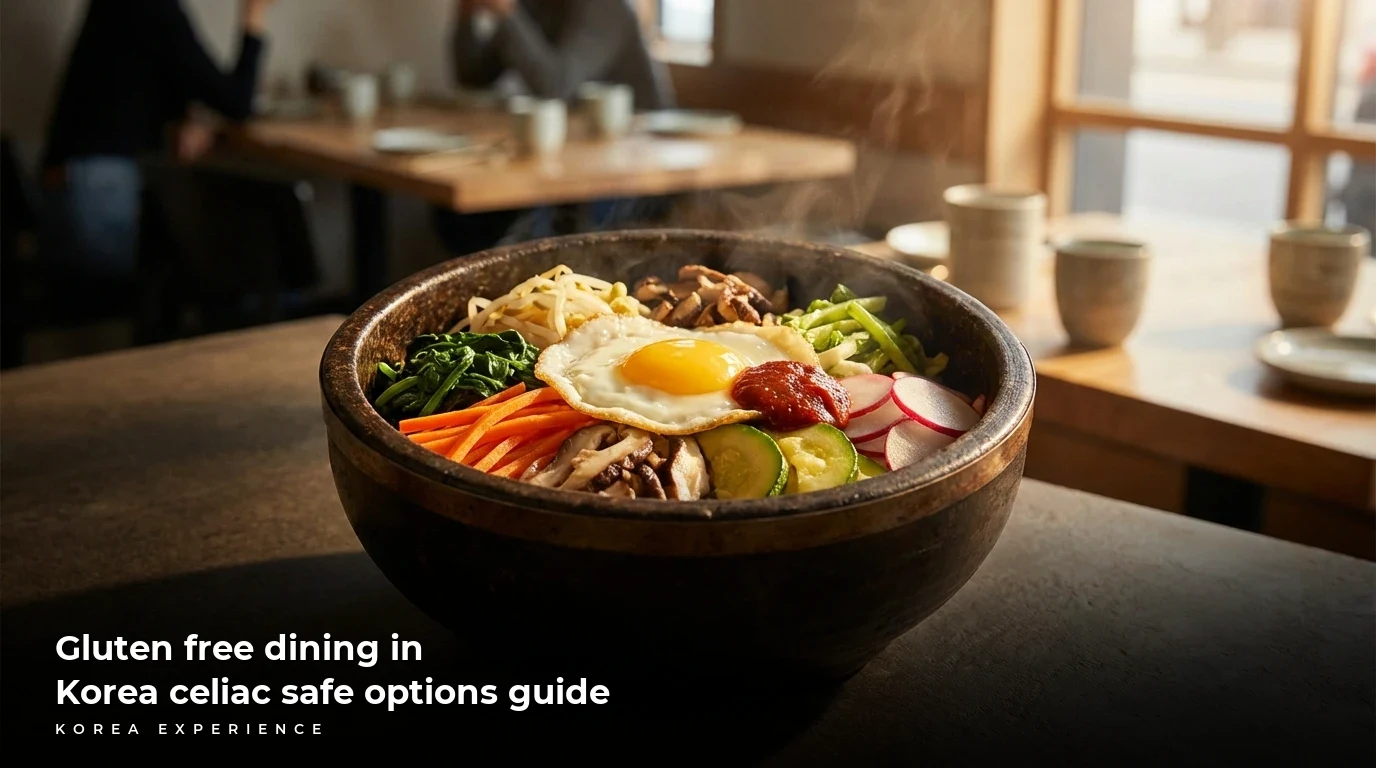
If you walk into Gwangjang Market expecting to eat the famous dumplings or the knife-cut noodles (Kalguksu) from the Netflix lady, you are going to have a bad time. Those are pure wheat. But if you go in with a plan, a translation card, and your own bottle of tamari, you can soak up the vibes and leave with a full stomach. For a broader look at dining out, check our Gluten free dining in Korea celiac safe options guide.
Why Is Wheat Everywhere?
You might be wondering, "Korea is an Asian country, don't they eat rice? Why is there so much wheat?"
Great question. It actually goes back to the 1960s. After the Korean War, South Korea was struggling with food shortages, specifically rice. The government launched campaigns to encourage people to eat less rice and more flour, which was being imported cheaply. They even had "flour-only days" where restaurants were banned from selling rice dishes at lunch! This forced culinary innovation. Traditional dishes were adapted to include wheat noodles, wheat dumplings, and wheat-thickened sauces.
The Rice Shortage
Post-war government pushed wheat flour consumption to save rice, embedding wheat into traditional recipes.
The Well-being Trend
Korea started caring about health foods, introducing rice flour bakeries, though often mixed with wheat.
Netflix Street Food
Gwangjang Market exploded in popularity; English menus became common, but allergy labeling did not.
Gluten-Free Bakery Boom
Dedicated GF spots like Sunny Bread gained cult followings, raising general awareness in Seoul.
Allergen Labeling Law
Stricter rules for packaged foods, but traditional market stalls remain largely unregulated for cross-contamination.
Current State
Tourist-heavy markets now have Papago-ready vendors, but cross-contamination remains the biggest hurdle.
Market-by-Market Breakdown
Not all markets are created equal when it comes to safety. Here is how the major spots stack up.
Gwangjang Market (The Big One)
This is the one you see on Netflix. It is loud, crowded, and aggressive.
- The Move: Head straight to the central intersection. You will see mountains of yellow pancakes. That’s Bindaetteok. Watch them grind the beans in the stone mill. If you see them adding a white powder from a bag, run. That’s flour. If it’s just the bean sludge, you’re good.
- The Trap: The Mayak Gimbap (addictive seaweed rolls). Everyone says "it's just rice and veg!" But the pickled radish inside often has wheat-based preservatives, and the dipping sauce is soy-based. Skip it unless you are feeling lucky.
- The Win: Yukhoe Alley. There is a tiny alleyway off the main drag filled with tanks of octopus and raw beef shops. This is arguably the safest meal in the market because it’s not cooked on a shared griddle. For high-demand spots like Buchon Yukhoe, you might need to know how to book ahead—check our CatchTable Global: Book Michelin Restaurants in Korea (2026) guide.
Myeongdong (The Tourist Trap)
Okay, locals hate Myeongdong, but for a GF traveler, it’s actually kind of great. Why? Because the street food here is designed for Instagram, which means lots of whole ingredients grilled in front of you.
- The Move: Grilled Lobster with Cheese. It’s expensive (around $15), but it’s usually just lobster, butter, and mozzarella. Scallops are also a safe bet.
- The Trap: Hotteok (sweet pancakes) and Egg Bread (Gyeran-ppang). These smell like heaven, like vanilla and sugar. They are 100% wheat batter. Do not touch.
- The Win: Tornado Potato. It’s a potato on a stick. Just ask for salt only, no cheese powder or onion powder (which often have anti-caking agents with gluten).
Namdaemun (The Old School)
This is where you go for clothes and kitchenware, but the food is very old-school.
- The Move: Galchi Jorim (Braised Hairtail Fish) is famous here, BUT it’s in a spicy red sauce. Risky. Instead, look for the grilled fish alleys. If you get a plain grilled mackerel and salt it yourself, you are golden.
- The Trap: The Hotbar (fish cake on a stick). It looks like a sausage. It is a sponge made of fish and flour. Avoid.
| Feature | Gwangjang Market | Myeongdong Street Food | Mangwon Market |
|---|---|---|---|
| Cost | Budget / Moderate (₩5k-15k) | Expensive (₩10k-25k) | Local / Cheap (₩3k-10k) |
| Gluten Risk | High (Soy sauce everywhere) | Medium (More grilled items) | High (Deep fried snacks) |
| Crowd Level | Insane (Shoulder-to-shoulder) | High (Evening peak) | Moderate (Local vibe) |
| Best GF Bet | Sunhee's Bindaetteok | Grilled Lobster / Scallops | Roasted Chicken / Fruit |
| English Spoken | Low to Medium | High | Low |
| 2026 Vibe | Netflix Fame = Long Lines | Instagram Fame = Visuals | Hipster Fame = Local Life |
Pros and Cons of Market Dining
Pros
- ✓The Atmosphere: There is nothing like the energy of a Korean market. Sitting on a heated bench in winter with steam rising around you is a core memory.
- ✓Freshness: The seafood markets have food that was swimming ten minutes ago. Fresh grilled fish or sashimi is naturally GF and safer than processed stuff.
- ✓Cost Effective: Compared to trendy GF bakeries in Gangnam where a scone is $8, you can get a massive mung bean pancake for $4.
Cons
- ✗The Gochujang Heartbreak: You will see delicious-looking spicy rice cakes (Tteokbokki) bubbling in red sauce, and you simply cannot have them.
- ✗Cross-Contamination Anxiety: Even if a dish is GF ingredients-wise, it is often cooked on the same griddle as a wheat pancake. You have to be vigilant.
- ✗Language Barrier: Trying to explain Celiac disease to a busy grandmother who has been making dumplings for 40 years is tough.
Step-by-Step Survival Guide
To survive the markets, you need a strategy. This isn't just about what you eat, but how you order it. For help with translation apps, see our guide on Ordering Food at Korean Traditional Markets Using Papago (2026).
📖 The No-Gluten Market Raid Strategy
Step 1: Pre-Game Prep (The Kit)
Do not walk in blind. Pack your Safety Kit: A printed GF Translation Card, Travel Tamari (Soy Sauce), Papago App (offline mode), and Wet Wipes.
Step 2: Scouting the Stall
Walk the market first. Look for separation. You want the stall that only sells Mung Bean Pancakes, not the one that sells Pancakes AND Wheat Dumplings on the same griddle.
Step 3: The Order & The Ask
Approach during a lull. Smile, bow, and present your card. Say "No Soy Sauce" (Ganjang Bbae-Juseyo) and immediately pull out your own sauce to show them you are prepared.
Step 4: The Safe Zone Eating
Find a spot away from the crowds to eat so you aren't bumped into someone holding a gluten-filled corn dog. If eating raw beef, mix it yourself.
Everyone thinks Makgeolli (Rice Wine) is safe because it's 'Rice' wine. It's not! 90% of commercial Makgeolli uses a fermentation starter called 'Nuruk' that is made from wheat. If you want to drink at the market, stick to Soju (look for the Fresh brand) or ask for 'premium' Makgeolli brands that specify rice nuruk, but honestly, at a street stall? Just drink Soju.
For more on drinking culture, read our Mastering the Pour: The Ultimate 2026 Guide to Korean Drinking Etiquette.
Safe Havens & Pricing
If you need specific destinations that are safer than the average stall, here are three vetted locations.
1. Sunhee's Bindaetteok (Gwangjang Market)
- Type: Market Stall / Restaurant
- Highlights: Famous Mung Bean Pancake, High turnover (fresh), Cheap.
- Insider Tip: Go inside the sit-down area to avoid the chaotic street crush; order the "Nokdu-jeon" (Mung bean pancake) and insist on no Wanja (meatball) to keep it safer.
2. Buchon Yukhoe (Gwangjang Market)
- Type: Michelin Bib Gourmand Restaurant
- Highlights: Michelin quality raw beef, Live octopus, Fast service.
- Insider Tip: Order the "Yukhoe-tang-tang-i" (Beef + Octopus). Tell them NO SAUCE on the beef; ask for salt and sesame oil on the side for dipping.
3. Sunny Bread (Seongsu-dong)
- Type: Bakery / Cafe
- Highlights: 100% Gluten Free facility, Cakes, Burgers.
- Insider Tip: This is your sanctuary. If you had a hard time at the market, come here to eat a safe burger and cake to restore your sanity.
Price Table: What to Expect
| Option | Price | Category | Description |
|---|---|---|---|
| Sunhee's Mung Bean Pancake | ₩5,000 ($3.75) | Budget | Huge, crispy, greasy, filling pancake. Market staple. |
| Buchon Yukhoe Plate | ₩19,000 ($14.25) | Mid | High-quality raw beef, Michelin recognized, very protein heavy. |
| Grilled Lobster with Cheese | ₩20,000 ($15.00) | Luxury | Myeongdong street food price. Expensive but tasty and generally wheat-free. |
| Shine Muscat Grapes | ₩10,000 ($7.50) | Mid | A cup/bunch of high-end fruit. Safe, sweet, expensive. |
| Sunny Bread GF Burger | ₩16,000 ($12.00) | Mid | Dedicated GF burger in a cafe setting (not market, but necessary backup). |
Warnings and Tips
The "Healthy" Trap You will see signs that say "Well-being" or "Rice Flour" (Ssal-garu). Do not trust them blindly. In Korea, "Rice Bread" often means "Wheat bread with 10% rice flour added for texture." Unless it says "100% Rice" or "No Milgaru" (No wheat), assume it is a hybrid.
The Barley Tea Betrayal You sit down at a restaurant, and they pour you a glass of water. It’s brown. It tastes nutty. STOP. That is Boricha (Barley Tea). It is the standard drinking water in many traditional spots. It contains gluten. Ask for "Saeng-su" (Plain water).
Convenience Store Backup If you strike out at the market and you're starving, duck into a CU or GS25. Look for "Hanjuku" eggs (soft boiled seasoned eggs) or sweet potatoes. They are almost always safe. For a full breakdown of what to buy, check our GS25 vs. CU: The Ultimate 2026 Guide.
No Korean Phone/ARC? Here's What To Do
If you need to make a reservation at a high-end GF-friendly restaurant nearby or order delivery because the market was a bust:
- Use the "Shuttle" App: It's the only food delivery app in Korea that is fully English and accepts foreign credit cards without a Korean phone number verification.
- Concierge Power: If you are at a hotel, have the concierge write down your dietary needs in Korean on the hotel stationary. It looks official and chefs respect it more than a scribbled note.
FAQ
❓ Frequently Asked Questions
Have more questions?Contact us →
Conclusion
Eating GF in Korea is playing on hard mode, but it’s a game you can win. Your first 24 hours should look like this: Land at Incheon, hit a convenience store for "Hanjuku" eggs, stock up on GF muffins at Sunny Bread, and then head to Gwangjang Market for a Sunhee's pancake and Soju.
You are going to see a lot of food you can't have. It’s okay to be bummed about the dumplings. But when you bite into that crispy, savory mung bean pancake or wrap a piece of fresh grilled pork belly in a sesame leaf, you'll realize you aren't missing out on the flavor of Korea. You're just taking the scenic, safer route. Eat well, stay safe, and don't forget your Tamari!
Sources
- Visit Korea (Official Tourism) - Information on Gwangjang Market vendors and locations.
- Celiac.com - Detailed guide on ingredients to avoid and Celiac safety in Korea.
- Michelin Guide - Verification of Buchon Yukhoe's status and menu offerings.
- Legal Nomads - Expert advice on Korean translation cards and hidden gluten in sauces.
- Kimchimari (Korean Food Expert) - Ingredient breakdown of Bindaetteok proving traditional recipes are GF but warning about modern fillers.
About the Author
Korea Experience Team
Written by the Korea Experience editorial team - experts in Korean medical tourism, travel, and culture with years of research and firsthand experience.
Explore more in Food & Dining
Korean BBQ, street food, Michelin restaurants, and regional specialties — your ultimate guide to eating well in Korea.
Browse All Food & Dining ArticlesContinue Reading
Explore more articles you might find interesting
Discover why market vendors give free food. Learn how to navigate 24000 stalls in 2026 using WOWPASS and experience the 16 percent sales boom firsthand.
Discover Seoul's top 8 traditional markets. From Gwangjang's ₩5,000 noodles to Namdaemun's 10,000+ shops, get the ultimate 2026 shopping guide.
So, you want to dive into the sizzling world of Gwangjang or Namdaemun without the lost in translation panic?
The ultimate 2026 guide to Seoul traditional markets. Discover prices, hidden stalls, and expert tips for Gwangjang, Noryangjin, and local favorites.
Discover the ultimate guide to gluten free dining in Korea with celiac safe options, restaurant recommendations, and essential travel tips for 2026.
The ultimate 2026 guide for navigating South Korea with celiac disease. Discover safe dishes, restaurant recommendations, and essential travel tips.