Baemin Without an ARC in 2026: Pay at Door & Alternatives
Navigating Baemin without an ARC in 2026 is simpler than you think. Discover reliable pay-at-door methods and effective alternatives for food delivery in Korea.
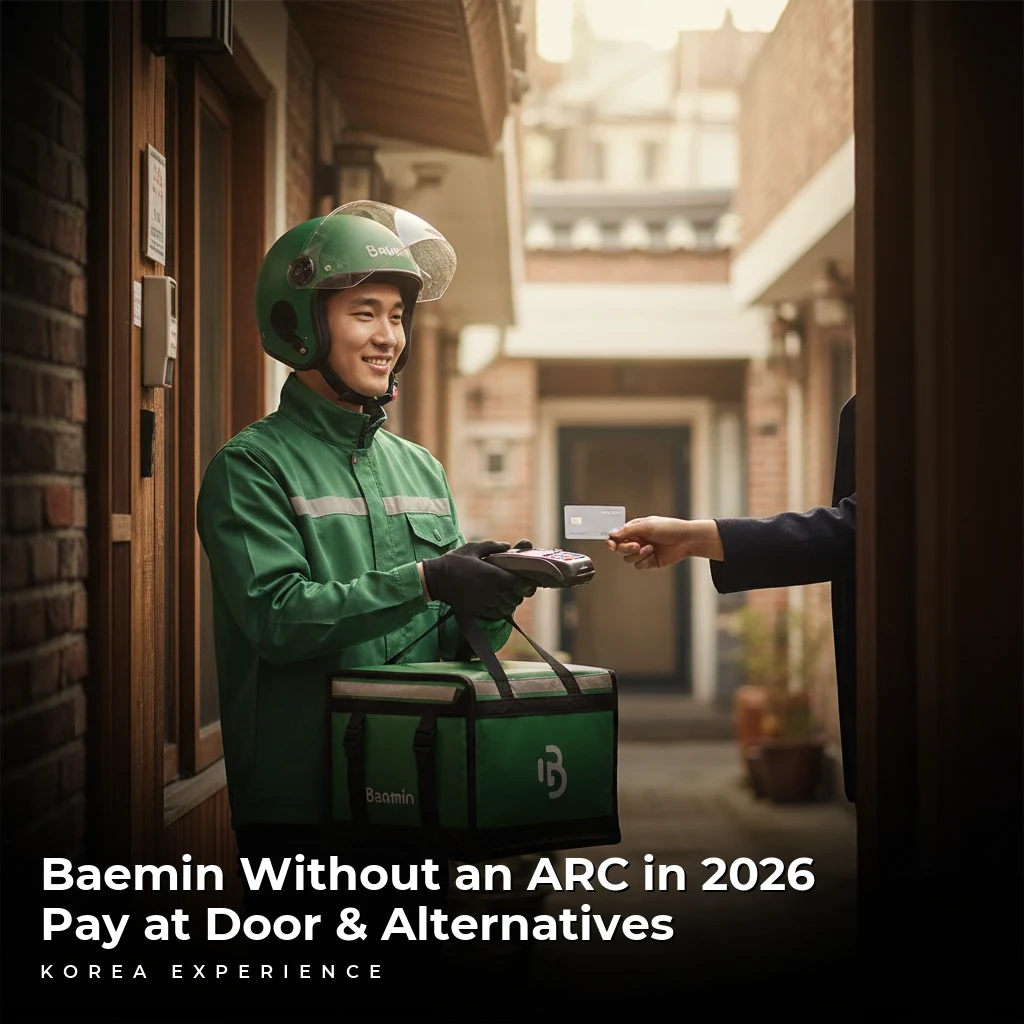
Welcome to Korea, a country celebrated for its vibrant culture, cutting-edge technology, and, of course, its phenomenal food scene. For many international visitors and short-term residents, experiencing Korean cuisine often means diving into the world of food delivery apps. Baemin, or Baedal Minjok, stands as the undisputed giant in this arena, boasting over 85% market share in 2025. However, the convenience it offers often comes with a significant hurdle for those without an Alien Registration Card (ARC) – the required local verification and payment methods. As we look to 2026, the challenge persists, but so do the innovative solutions. This comprehensive guide will illuminate the best strategies for enjoying Korea's culinary delights without an ARC, focusing on reliable pay-at-the-door methods and effective Baemin alternatives.
Key Takeaways
- 1Baemin's core functionality often requires a local phone number and bank account linked to an ARC, limiting direct use for short-term visitors.
- 2Pay-at-the-door options for food delivery are still available, primarily through English-friendly alternative apps like Shuttle Delivery, which processes foreign cards with ease.
- 3Leveraging local assistance (friends, hotel concierge) and exploring direct restaurant orders remain highly effective ARC-free strategies for food access.
The Baemin Challenge: Why an ARC Matters for Food Delivery in Korea
At first glance, Baemin appears to be the perfect gateway to Korean food. Its extensive network connects users to hundreds of thousands of restaurants, from traditional Korean eateries to international chains. In 2025, Baemin processed an average of 30 million orders monthly, a testament to its widespread adoption. However, for foreigners without an ARC, the process quickly hits a snag.
The primary issue stems from user verification and payment processing. To fully utilize Baemin, you typically need:
- A Korean phone number: Essential for account registration and order confirmation.
- A Korean bank account or credit card: Required for most in-app payments. Foreign credit cards are rarely accepted directly within the app's payment system for non-verified accounts.
- An Alien Registration Card (ARC): Crucial for verifying your identity with the mobile carrier for your Korean phone number, and often a prerequisite for opening a bank account.
Without these, the sophisticated system designed for long-term residents becomes a digital fortress. This means that simply downloading the app won't grant you access to ordering, even if you planned to pay cash at the door.
📋 Korean Delivery Market Insights (2025-2026)
This predicament is frustrating, especially when jetlagged and craving a late-night jjajangmyeon. The good news is that living in Korea without an ARC doesn't mean you're doomed to instant noodles. There are plenty of clever ways to navigate the culinary landscape.
ARC-Free Solutions: Pay-at-the-Door Methods and Workarounds
While direct Baemin use is largely out of reach without an ARC, the concept of "pay at the door" (현장결제 - hyeonjang gyeolje) is not. It just requires a slightly different approach or an alternative platform.
1. The Direct Restaurant Approach: Calling for Delivery
Many traditional Korean restaurants still operate on a direct order system, especially smaller, local establishments. This method bypasses apps entirely.
Direct Ordering Potential
Many local restaurants (especially Chinese, chicken, or traditional Korean spots) still maintain their own delivery staff and systems, often accepting direct phone orders and cash payment.
How it Works:
- Find Restaurants: Walk around your neighborhood or use Naver Maps/Kakao Maps to find nearby restaurants. Look for places with "배달" (baedal - delivery) signs.
- Call and Order: This is the trickiest part as it requires basic Korean. You'll need to clearly state your order and address.
- Sample Phrase: "안녕하세요. 배달 주문하고 싶어요. [메뉴 이름] 하나 주세요. 주소는 [주소]입니다. 현금 결제 가능해요?" (Hello. I'd like to order for delivery. One [menu item], please. The address is [address]. Is cash payment possible?)
- Confirm Payment: Always confirm "현금 결제" (hyeon-geum gyeol-je - cash payment) or "카드 결제" (ka-deu gyeol-je - card payment) upon delivery. Many small businesses prefer cash for direct orders.
- Wait for Delivery: Delivery times can vary from 20 to 60 minutes depending on the restaurant and time of day.
Pros and Cons of Direct Restaurant Orders
- ✓Authentic local experience
- ✓Bypasses all app hurdles
- ✓Direct interaction with local businesses
- ✓Often allows cash payment
- ✗Requires basic Korean language skills
- ✗Limited menu choices compared to apps
- ✗No English support
- ✗Can be difficult to find specific restaurants without local knowledge
Data Point: A typical direct delivery order from a local jjajangmyeon place might cost around ₩8,000-₩12,000 (approx. $6-9 USD) for a single dish, with no additional delivery fee if you're within a 1-2 km radius.
"When calling a local restaurant, keep it simple. If you struggle with Korean, try saying your address and the food item clearly. Sometimes, they'll understand 'cash payment' even if you just say 'hyun-geum.' Google Translate's conversation mode can be a lifesaver for small interactions."
2. Leveraging Local Assistance: The Buddy System
This is arguably the most reliable "Baemin without ARC" method: having a local friend, colleague, or even your guesthouse host order for you.
How it Works:
- Find a Helper: This could be a new acquaintance, a language exchange partner, or a trusted local contact. Many guesthouses offer this as a complimentary service.
- Communicate Your Order: Share screenshots of your desired food from Baemin (or any other app) or a clear list. Be specific about any dietary needs.
- Payment: Your helper will typically pay using their Korean card/account in the app. You then reimburse them in cash immediately upon delivery or via bank transfer if you have a local account (unlikely without an ARC).
- Delivery Coordination: Ensure your helper provides your exact address and any specific instructions (e.g., "delivery person, please call upon arrival").
Data Point: Most guesthouses or hostels offering this service might charge a small convenience fee, usually around ₩2,000-₩5,000 (approx. $1.50-$4 USD) per order, on top of the food cost and delivery fee (which typically ranges from ₩2,000-₩6,000 depending on distance and time).
Always Offer to Pay Extra
If a friend helps you, always insist on covering the full cost of the food, delivery fee, and offer an extra coffee or treat as a thank you. This goodwill goes a long way in fostering relationships.
3. ARC-Free Alternatives with Foreign Card Support (and Pay-at-Door Options)
This is where the real solutions lie for independent ordering without an ARC. While Baemin itself is tricky, other platforms cater specifically to international users.
A. Shuttle Delivery: The Foreigner-Friendly Champion
Shuttle Delivery (셔틀 딜리버리) is hands down the most recommended food delivery app for foreigners in Korea, especially for those without an ARC. It's designed with international users in mind.
Shuttle Delivery: Fully ARC-Free
Shuttle Delivery accepts foreign credit cards directly within the app and offers cash-on-delivery (COD) or card-on-delivery options. No Korean phone number or ARC is strictly required for ordering.
Key Features of Shuttle Delivery:
- English Language Support: The entire app, customer service, and most restaurant menus are in English.
- Foreign Card Acceptance: Seamlessly process international Visa, Mastercard, AMEX directly in the app.
- Cash/Card on Delivery: This is your primary pay-at-the-door method. Select "Cash" or "Card" at checkout.
- Wider Coverage: While initially focused on Itaewon and expat-heavy areas, Shuttle's coverage has expanded significantly across major cities by 2026, including parts of Gangnam, Hongdae, Busan, and Jeju.
📖 How to Order with Shuttle Delivery (ARC-Free)
Step 1: Download the App
Search 'Shuttle Delivery' on Google Play or Apple App Store and download. It’s free.
Step 2: Sign Up & Set Location
Register with your email or a foreign phone number. Enter your delivery address. The app often uses GPS to pinpoint your location.
Step 3: Browse & Select Food
Explore restaurants, filtering by cuisine, rating, or delivery fee. Most menus have English descriptions and photos.
Step 4: Choose Payment Method
At checkout, select 'Cash on Delivery' or 'Card on Delivery'. You can also pre-pay with a foreign credit card.
Step 5: Confirm Order & Track
Review your order and confirm. You'll receive updates on preparation and delivery status. Estimated delivery times are typically 30-70 minutes.
Data Point: Shuttle Delivery's average delivery fee hovers between ₩3,000-₩7,000 (approx. $2.50-$5.50 USD), similar to local apps, but sometimes slightly higher for longer distances or peak hours. Total cost for a meal for one typically ranges from ₩20,000-₩35,000 ($15-$28 USD) including delivery.
📊 Shuttle Delivery Growth & Reach (2025)
B. Coupang Eats: A Partial Solution (with caveats)
Coupang Eats (쿠팡이츠) is another major player, part of the Coupang ecosystem. While it primarily targets local users, it can be a partial solution for foreigners without an ARC under specific circumstances, mainly related to account creation.
The Challenge: Like Baemin, Coupang Eats prefers Korean phone numbers and local payment methods. Foreign card acceptance is limited and often fails if your account isn't fully verified.
Potential Workaround (Not Guaranteed ARC-Free): If you manage to acquire a prepaid Korean SIM card (which usually doesn't require an ARC for purchase, only passport verification), you might be able to register for a basic Coupang account (which includes Eats). However, linking a foreign credit card to this account often remains problematic, and the "pay at the door" option is often greyed out for unverified accounts.
"I tried Coupang Eats with a prepaid SIM. While I could register, paying with my foreign credit card was hit-or-miss. Sometimes it worked, sometimes it didn't, especially for smaller, local restaurants. I found Shuttle Delivery much more reliable for foreign card payments."
Data Point: In 2025, Coupang Eats captured approximately 13% of the food delivery market. Delivery fees are comparable to Baemin, usually ₩2,000-₩5,000, with dynamic pricing sometimes pushing it to ₩7,000+ during peak demand.
C. Yogiyo: Generally Not ARC-Friendly
Yogiyo (요기요) is the third major delivery app. Unfortunately, it shares many of the same verification and payment hurdles as Baemin. It is not recommended for users without a Korean phone number, bank account, and ARC for reliable service.
Food Delivery App Comparison for Non-ARC Users (2026)
| Feature | Baemin | Shuttle Delivery | Coupang Eats | Yogiyo |
|---|---|---|---|---|
| English Support | Limited (via Papago) | Excellent | Good | Limited (via Papago) |
| Foreign Card Acceptance | No | Yes (in-app/on-delivery) | Limited/Unreliable | No |
| Cash on Delivery | Yes (with verified local account) | Yes | Limited/Unreliable | Yes (with verified local account) |
| ARC Requirement | High | None | High (for full functionality) | High |
| Ease of Use (Non-ARC) | Very Difficult | Very Easy | Difficult | Very Difficult |
4. Hotel/Guesthouse Concierge Services
For those staying in hotels or higher-end guesthouses, the concierge or front desk staff can be your best friends for food delivery.
How it Works:
- Request Assistance: Simply ask the front desk to order food for you. They are accustomed to these requests.
- Menu Selection: You might pick from a physical menu they provide, or you can show them pictures from Baemin/Coupang Eats/Shuttle.
- Payment: You'll typically pay the hotel directly, either in cash or by adding it to your room bill. They then handle the payment to the delivery driver.
💵 Concierge Ordering: Convenience vs. Cost
Food + Delivery Fee (avg.)
Data Point: A concierge service might add a ₩3,000-₩10,000 (approx. $2.50-$8 USD) service charge on top of the food and delivery costs, but it offers unparalleled ease and peace of mind.
Grand Hyatt Seoul(그랜드 하얏트 서울)
Beyond Food Delivery: Groceries and Essentials (ARC-Free)
While food delivery is often the immediate concern, accessing groceries and other essentials without an ARC also presents similar challenges.
1. In-Person Shopping: The Most Reliable
For groceries, the most straightforward ARC-free method is always in-person shopping.
- Large Supermarkets: Chains like Lotte Mart, E-Mart, and Homeplus are foreigner-friendly. They accept international credit cards and cash. You can find almost anything here.
- Data Point: A typical week's worth of groceries for one person at a major supermarket might cost ₩50,000-₩80,000 (approx. $40-$65 USD) in 2026.
- Convenience Stores: GS25, CU, 7-Eleven, and E-Mart24 are ubiquitous. They accept cash and foreign cards. Perfect for quick snacks, drinks, and daily necessities.
- Data Point: There are over 50,000 convenience stores nationwide as of early 2026, meaning you're rarely more than a 2-minute walk from one.
- Traditional Markets: While requiring some Korean, markets offer fresh produce, meats, and street food. Cash is often preferred.
2. Online Grocery (Requires Workarounds)
Most major online grocery delivery services (Coupang Fresh, Market Kurly, SSG.com) are tied to Korean payment methods and often require ARC-verified accounts.
- Workaround: Similar to food delivery, the most effective method is to have a local friend order for you and reimburse them. Some hotels may also facilitate grocery orders.
- Prepaid Korean SIM: If you have a prepaid Korean SIM, you might be able to register for basic Coupang, which can then give you access to Coupang Fresh. However, payment with foreign cards can still be an issue.
Online Grocery Caution
While tempting, attempting to use major Korean online grocery apps without proper local verification (ARC, Korean phone, local card) is usually a frustrating experience leading to failed payments or account blocks.
Essential Tips for a Seamless ARC-Free Experience in Korea
To maximize your enjoyment and minimize hassle, keep these tips in mind.
1. Get a Prepaid Korean SIM Card
This is paramount. Even if it doesn't solve all your Baemin problems, a local number allows you to:
- Make direct calls to restaurants.
- Receive calls from delivery drivers (crucial for smooth deliveries).
- Use local mapping apps (Naver Maps/Kakao Maps) more effectively.
- Register for foreigner-friendly apps like Shuttle Delivery without issues.
Getting a Prepaid SIM Card (ARC-Free)
Research Providers
Look into KT, SKT, LG U+ (or MVNOs like Chingu Mobile, Korea SIM). Check plans for data/calls.
Purchase SIM Card
Head to the telecom counters at Incheon (ICN) or Gimpo (GMP) airports. You'll need your passport.
Immediate Use
Most prepaid SIMs activate within minutes. Test calls and data right away.
Stay Connected
Top up your balance at convenience stores or online if needed. Many plans offer fixed duration packages.
Data Point: A typical prepaid SIM card with unlimited data for 30 days costs around ₩35,000-₩60,000 (approx. $28-$48 USD) in 2026, depending on the provider and data allowance.
2. Keep Cash Handy
Even in a tech-forward society like Korea, cash is king for certain transactions, especially small businesses and pay-at-the-door deliveries. Always carry a good amount of Korean Won.
Data Point: Aim to carry at least ₩50,000-₩100,000 (approx. $40-$80 USD) in cash for daily expenses, including potential delivery orders. ATMs are widely available, accepting international cards (look for 'Global ATM' signs).
3. Learn Basic Korean Phrases (Especially for Directions)
While English is more prevalent in major tourist areas, knowing a few key phrases for ordering and giving directions can be incredibly helpful.
- 주소는 [address]입니다 (ju-so-neun [address] im-ni-da): The address is [address].
- 여기예요 (yeo-gi-ye-yo): It's here.
- 감사합니다 (gam-sa-ham-ni-da): Thank you.
- 현금 결제 (hyeon-geum gyeol-je): Cash payment.
- 카드 결제 (ka-deu gyeol-je): Card payment.
"Before a trip, I write down my accommodation's address in Korean on a small card. When ordering directly or using a helper, I can just point to it. It saves a lot of pronunciation errors and ensures accuracy."
4. Understand Delivery Etiquette
- Punctuality: Be ready when the delivery is expected. Drivers are on tight schedules.
- Greeting: A simple "안녕하세요" (Annyeonghaseyo - Hello) and "감사합니다" (Gamsahamnida - Thank you) go a long way.
- Payment: Have exact change or your card ready. Drivers carry mobile card terminals.
- Returning Containers: For some traditional Korean food (especially jjajangmyeon or jjamppong), the food comes in reusable ceramic bowls. Drivers will often return later to collect them. If you're leaving soon, clarify this with the restaurant or your helper.
Future Outlook: What to Expect in 2026 and Beyond
As Korea continues to attract a global audience, the demand for foreigner-friendly services is growing. While Baemin and other local apps are deeply integrated into the domestic ecosystem, there's increasing pressure for broader international accessibility.
- Increasing English Support: Expect more restaurants on local apps to offer English menus, and possibly in-app translation features.
- Payment Gateway Evolution: The integration of more international payment gateways (like PayPal or Apple Pay with foreign cards) might become more common, though deep integration requiring ARC verification will likely remain for core services.
- Niche Platforms: The success of Shuttle Delivery indicates a strong market for dedicated foreigner-friendly services, suggesting more players might emerge.
- Government Initiatives: Korea is actively promoting tourism and may push for more inclusive digital services, though legislative changes can be slow.
Despite these potential improvements, the Alien Registration Card will likely remain a foundational requirement for full participation in many Korean digital services due to identity verification laws. Thus, the strategies outlined here for ARC-free living in 2026 will likely remain highly relevant for years to come.
Conclusion
Navigating the bustling world of Korean food delivery without an Alien Registration Card might seem daunting at first, but with the right knowledge and tools, it's entirely manageable. While direct use of giants like Baemin remains a challenge, excellent alternatives like Shuttle Delivery offer seamless English support and foreign card acceptance, including convenient pay-at-the-door options. Coupled with the timeless methods of direct restaurant calls, leveraging local connections, and utilizing hotel concierge services, you're well-equipped to savor every bite of Korea's incredible culinary landscape. So, go forth, explore, and enjoy the delicious journey!
❓ Frequently Asked Questions
Have more questions?Contact us →
About the Author
Korea Experience Team
Written by the Korea Experience editorial team - experts in Korean medical tourism, travel, and culture with years of research and firsthand experience.
Explore more in Living in Korea
Everything expats and long-term visitors need to know — from visa requirements and housing to banking, healthcare, and daily life tips.
Browse All Living in Korea ArticlesContinue Reading
Explore more articles you might find interesting

Discover the best Kakao T alternatives for tourists. Learn how to use Uber, TADA, and street hailing hacks without a Korean SIM card.
Master Korean food delivery apps in 2026. From Coupang Eats to Baemin, learn how to order like a local with our complete English guide.
The ultimate 2026 guide for navigating South Korea with celiac disease. Discover safe dishes, restaurant recommendations, and essential travel tips.

With 36.1 percent of households living alone in 2026 Seoul solo dining is booming. Discover the best spots and apps to enjoy Korean BBQ without a local ID.
Discover how to book 2,000+ top Korean restaurants using CatchTable Global in 2026. Bypass local phone rules, pay deposits, and avoid the new 40% no-show fee.

Get a local 010 number for 35,000 KRW to access reservations and delivery apps while navigating the mandatory 2026 facial recognition laws.