Best Korea SIM Cards for Long-Term Travelers Beyond Airport Rentals
Discover the best Korea SIM cards for long-term stays. Compare MVNOs, postpaid plans, and verification steps to save money and stay connected.
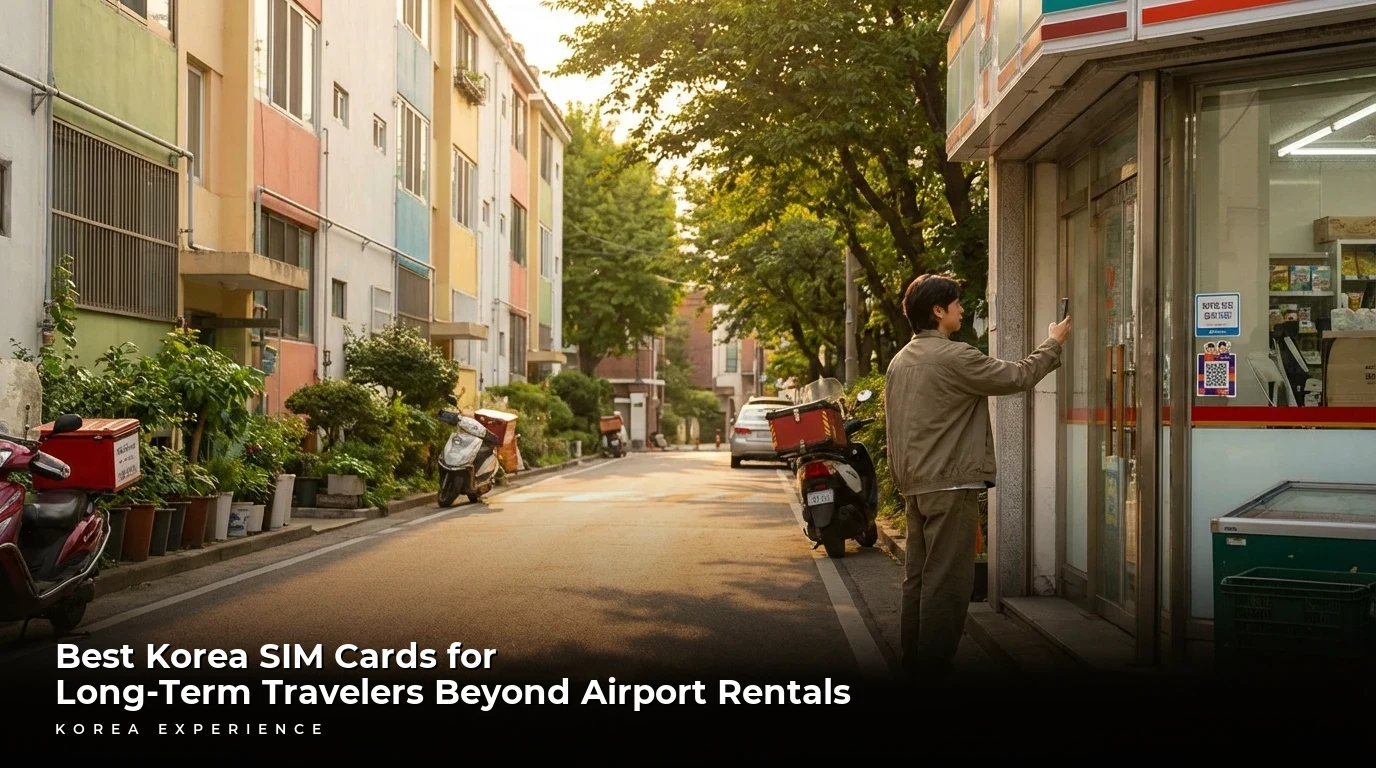
Landing at Incheon International Airport usually triggers a familiar ritual: rushing to the nearest roaming kiosk to secure connectivity. For tourists visiting for a week, these prepaid airport SIMs are convenient, albeit pricey. However, for digital nomads, exchange students, and expats planning to stay in South Korea for three months or longer, rely exclusively on airport rentals is a financial misstep.
In 2026, the South Korean telecommunications landscape has evolved significantly. While major carriers like SKT, KT, and LG U+ dominate the infrastructure, a wave of MVNOs (Mobile Virtual Network Operators) now offers plans that are 40% to 70% cheaper than standard tourist options. More importantly, understanding the difference between a simple data connection and a "verified" phone number is crucial for long-term survival in Korea's digital ecosystem.
Key Takeaways
- 1Airport SIMs cost approx ₩66,000 per month, while local MVNOs average ₩15,000.
- 2You need an Alien Registration Card (ARC) to upgrade to a verified identity plan.
- 3Most prepaid tourist SIMs expire strictly after 90 days of usage.
The Cost of Convenience: Why You Should Skip the Airport Kiosk
If you are staying in Korea for more than 30 days, the airport SIM is a budget-killer. The average unlimited data plan at Incheon Airport costs approximately ₩66,000 to ₩71,500 ($50-$55 USD) for a 30-day extension. Over a 6-month semester or work contract, this amounts to over ₩400,000 ($300 USD).
Conversely, getting a local SIM card in the city can drop your monthly expense to roughly ₩15,000 to ₩35,000 ($11-$26 USD) depending on your data tier. This is not just about saving money; it is about functionality. Most airport SIMs are "traveler status" SIMs. They provide data and sometimes a number for receiving calls, but they cannot be used for online identity verification, a critical system in Korea known as Bonin-injeung.
📊 Cost Efficiency Analysis
Without verification, you cannot sign up for food delivery apps like Baedal Minjok, book tickets on Interpark, or even secure a reservation at popular restaurants using CatchTable.
Understanding the "Alteul Phone" (MVNO) Revolution
In Korea, budget-friendly plans are referred to as "Alteul Phones" (Frugal Phones). These MVNOs lease network space from the "Big Three" (SKT, KT, LG U+) and resell it at a fraction of the cost. The network quality is identical—you get the same 99.9% LTE/5G coverage across the peninsula—but you forfeit membership perks like movie theater discounts.
For a long-term traveler, these perks are negligible compared to the cash savings. Currently, there are over 20 active MVNOs in Korea.
Network Speeds
Don't worry about speed. South Korea boasts average 5G download speeds exceeding 896 Mbps. Even throttled "unlimited" data on budget plans usually runs at 3 Mbps to 5 Mbps, which is sufficient for 1080p YouTube streaming.
Phase 1: Pre-ARC Options (First 1-5 Weeks)
When you first arrive, you likely won't have your Residence Card (formerly Alien Registration Card or ARC). Processing an ARC at the immigration office currently takes 3 to 6 weeks depending on the district. During this limbo period, you need a prepaid SIM that accepts a passport but allows for an extension or conversion later.
Top Providers for Foreigners (Passport Accepted)
While mainstream Korean shops may turn you away without an ARC, specific providers cater to the expat community.
1. Woori Mobile Woori Mobile has established itself as a leader for expats. They offer English, Chinese, and Vietnamese support. Their key advantage is flexibility; you can start a plan with your passport and switch it to your ARC later without changing your phone number.
2. Chingu Mobile Another favorite among students, Chingu Mobile offers extremely competitive rates. They often have plans involving a 4-month prepay contract that drops the monthly effective rate to as low as ₩10,000 ($7.50 USD).
3. The Pay / PPS Found in many foreign marts in districts like Ansan or Itaewon, these are simple pay-as-you-go options. However, their customer service is generally less comprehensive than Woori or Chingu.
Pre-ARC SIM Provider Comparison
| Feature | Woori Mobile | Chingu Mobile | Airport Roaming |
|---|---|---|---|
| Monthly Cost (Avg) | 0,000 | 5,000 | 6,000 |
| Keep Number After ARC | ✅ | ✅ | Rarely |
| English Support | Fluent | Fluent | Basic |
| Contract Required | No | Min 3-4 months | No |
Where to Go?
If you are in Seoul, visiting a physical branch is often easier than navigating a Korean website.
Woori Mobile Jonggak Branch(Woori Mobile)
Phase 2: The "Identity Verification" Upgrade (Post-ARC)
Once your ARC is issued, the game changes. You officially exist in the Korean system. You must now "authenticate" your phone number. This links your phone number to your ARC number.
The Identity Verification Journey
Arrival & Prepaid SIM
Get a passport-based SIM from a provider like Woori Mobile.
Apply for ARC
Visit immigration. Processing takes 3-5 weeks.
Receive ARC
Collect your physical residence card.
Authenticate SIM
Return to your provider to link your ARC to your number.
Why is this critical? Without this link, you cannot open a full Korean bank account, sign up for Coupang (Korea's Amazon), or use T-Money Go for express buses.
Many travelers forget to update their carrier after getting their ARC. If you don't update it, your phone service might suddenly stop after 90 days because passport-based accounts have a hard legal time limit. Always visit your provider within 3 days of receiving your card.
Postpaid Plans: The Long-Term Solution
Once you have your ARC and a Korean bank account (or a credit card), you can switch to a postpaid plan. This is where the real savings happen. You are no longer "top-up" dependent; the bill is automatically deducted from your account.
Best Postpaid MVNOs in 2026
If you are comfortable navigating basic Korean apps or have a Korean friend to help, consider these digital-first providers:
- Liiv M (KB Kookmin Bank): Offers excellent discounts if you bank with KB. Plans with 11GB of data + daily 2GB + 3Mbps throttling often cost around ₩24,000 ($18 USD).
- Toss Mobile: Integrated into the Toss finance app. Extremely user-friendly UI. Prices are slightly higher but offer great flexibility.
- KT M Mobile: One of the largest MVNOs. Reliable and offers self-activation if you have your ARC and a general purpose digital certificate (Gongdong Injeungseo).
💵 Postpaid Plan Comparison (Post-ARC)
Includes membership perks, full speed
Same data amount, no perks
Contract Durations and Penalties
Unlike the 24-month contracts common in the US or Europe, many Korean MVNO SIM-only plans are contract-free (Musyakjeong). You can cancel anytime without a penalty. However, major carriers (SKT, KT, LG) often require a 12 or 24-month commitment to get a 25% monthly fee discount.
Warning: If you leave Korea before your contract ends, cancellation fees can be steep, often calculated based on the discounts you received. For stays under 2 years, a contract-free MVNO plan is safer.
Data Usage Realities in Korea
How much data do you actually need? Seoul is one of the most connected cities on earth.
- Public Wi-Fi: Available on all subways (look for Public WiFi Secure), buses, and cafes.
- Commute usage: Streaming Netflix for a 1-hour commute consumes approx 1GB to 3GB depending on quality.
- Navigation: Naver Map uses minimal data, about 20MB per hour.
📋 Data Consumption Quick Facts
If you rely on public Wi-Fi, you can survive on a 7GB to 10GB monthly plan, which can cost as little as ₩12,000 ($9 USD) on an MVNO.
How to Get Your SIM: A Step-by-Step Guide
The process of getting a SIM card outside the airport can be intimidating due to language barriers. Here is the streamlined process for securing a connection at a provider like Woori or Chingu.
📖 How to Secure a Long-Term SIM
Step 1: Prepare Documents
You need your Passport and cash (or foreign card, though some smaller shops prefer cash). Bringing your entry slip is helpful.
Step 2: Visit the Store
Go to a foreigner-friendly branch (e.g., Woori Mobile in Sinchon or Jonggak).
Step 3: Choose a Plan
Ask for a 'Prepaid SIM' (Seon-bul). Select a data tier. 15GB+ is recommended for heavy map users.
Step 4: Activation
The staff will insert the SIM. You may need to restart your phone 2-3 times to catch the signal.
Step 5: Set Up ARC Alert
Set a reminder to return to the shop once your Alien Registration Card arrives to switch to a 'Verified' status.
Technical Considerations: Bands and Compatability
Before you fly, you must ensure your phone works in Korea. South Korea uses specific LTE and 5G bands.
- Primary LTE Bands: Band 3 (1800MHz), Band 8 (900MHz), Band 1 (2100MHz), Band 5 (850MHz), Band 7 (2600MHz).
- VoLTE: Voice over LTE is standard. 2G and 3G networks have been largely shut down or repurposed. If your phone is very old (pre-2020 budget models), it might struggle with calls even if data works.
The Shutter Sound
Be aware that phones purchased in Korea are legally required to make a loud shutter sound when taking photos, even in silent mode. This does not apply to foreign phones brought into Korea, but your SIM card will not change this behavior on your personal device.
eSIM vs. Physical SIM for Long Stays
The rise of eSIMs (Embedded SIMs) offers a compelling alternative. Providers like Airalo or Holafly are popular, but they are generally data-only roaming products.
Local Physical SIM vs. Travel eSIM
- ✓Comes with a Korean phone number (010)
- ✓Allows for Identity Verification (ARC linked)
- ✓Significantly cheaper per GB
- ✗Requires visiting a store or shipping
- ✗Physical swap required if no dual-SIM slot
Recommendation: Use a cheap travel eSIM (1GB-3GB) for your first 2 days to navigate from the airport to your accommodation. Then, go physically to a store to get a real SIM number. Do not rely on travel eSIMs for 6 months; the cost is exorbitant, and the lack of a phone number will isolate you from Korean services.
Final Thoughts: Smart Connectivity
Navigating Korea's mobile market requires a shift in mindset from "tourist convenience" to "resident utility." While the ₩66,000 airport SIM is an easy fix, it is a temporary patch that bleeds money and limits functionality.
By choosing an expat-friendly MVNO like Woori Mobile or Chingu Mobile, and eventually upgrading to a verified plan with your ARC, you unlock the full Korean digital experience while saving upwards of ₩300,000 per semester. That is enough for 20 bowls of authentic Bibimbap or a round-trip KTX ticket to Busan.
❓ Frequently Asked Questions
Have more questions?Contact us →
About the Author
Korea Experience Team
Written by the Korea Experience editorial team - experts in Korean medical tourism, travel, and culture with years of research and firsthand experience.
Explore more in Living in Korea
Everything expats and long-term visitors need to know — from visa requirements and housing to banking, healthcare, and daily life tips.
Browse All Living in Korea ArticlesContinue Reading
Explore more articles you might find interesting
Don't let a rejected foreign credit card ruin your Korean adventure.

The ultimate guide to finding meaningful volunteer work in Seoul for 2026. Discover animal shelters, soup kitchens, and language exchange programs.
Navigating Baemin without an ARC in 2026 is simpler than you think. Discover reliable pay-at-door methods and effective alternatives for food delivery in Korea.
Master the art of the Korean visa run in 2026. Comprehensive guide on routes, costs, immigration risks, and re-entry tips for long-term travelers.
The short answer? Korean kiosks reject foreign cards because of 3D Secure authentication failures, IC chip mismatches, and midnight maintenance windows.
Compare Hikorea online applications versus immigration office visits for Korean visa renewals. Find costs, documents, and expert tips for 2026.