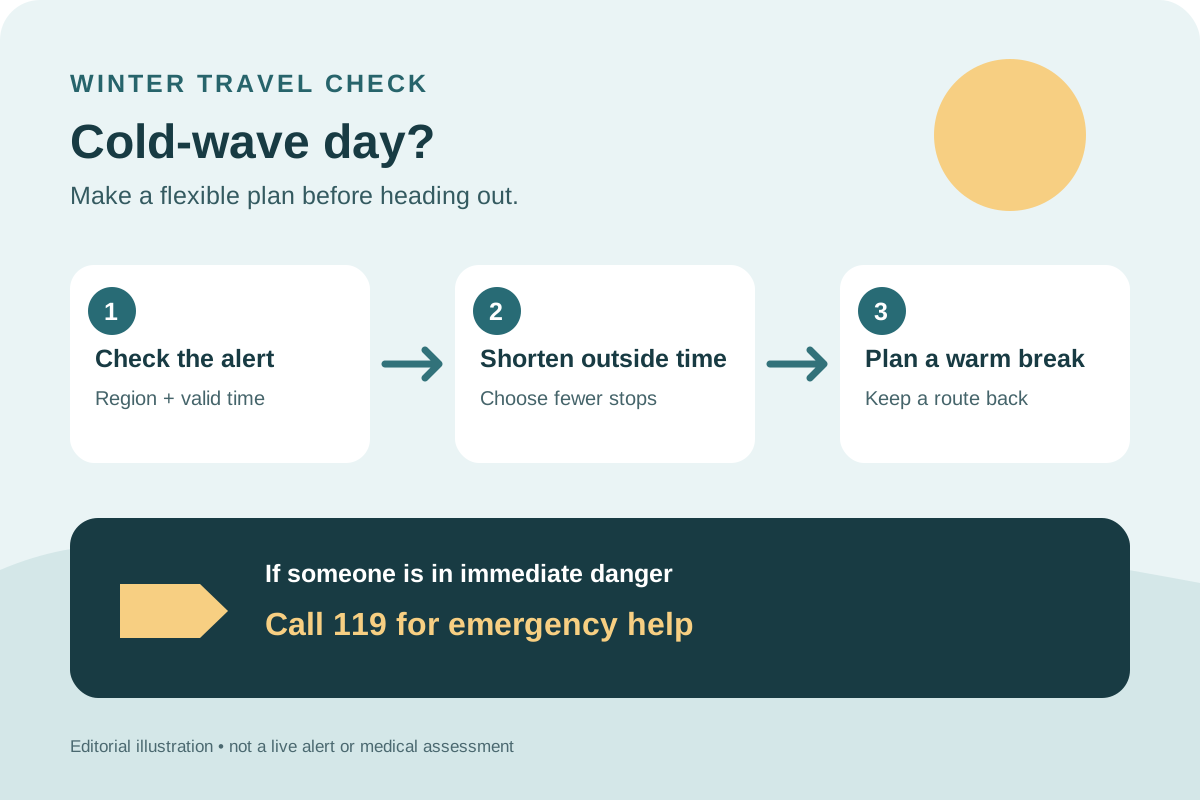
If Korea's weather service issues a cold-wave alert for your area, treat it as a reason to review the day—not as a live assessment of every street. Check the alert's location and timing, shorten long outdoor blocks when needed, and keep an easy route back to warmth.
Make the decision before leaving
- Open the Korea Meteorological Administration's current severe-weather page. Check whether a cold-wave alert covers the city or region you will visit and when it is valid. Forecasts and alerts change; this guide is not a live warning service.
- Recheck your actual outdoor plan: how long you will be exposed, whether the route has indoor stops, and how you will get back if you feel unwell.
- Replace a long exposed walk with shorter connected stops, a museum or another confirmed indoor visit. Check that the venue is open and that the return transport works for your date.
- Dress in adjustable warm layers, cover exposed skin and use footwear suited to the conditions. Keep your phone charged and tell a companion if you split up or change the route.
The KMA advises limiting strenuous or prolonged outdoor activity during cold waves and taking periodic warm breaks. Its cold-wave action guide also says to use public transport where possible and tell someone your destination and expected timing. These are general preparedness steps; your own health and tolerance vary.
Know when a normal itinerary should stop
| What you notice | Next step |
|---|---|
| You are cold, tired or uncomfortable and can still make decisions normally | Stop the outdoor block, move to a warm public place, reassess and shorten the route. |
| You feel increasingly unwell, confused, unusually exhausted or have trouble speaking clearly | Do not continue sightseeing alone. Ask someone nearby for help and seek urgent medical attention. |
| Someone is unresponsive or in immediate danger | Call 119 for emergency medical or rescue help. Give your location and follow the operator's instructions. |
These are not diagnostic criteria. The KMA lists severe chills, memory or orientation problems, unclear speech and marked fatigue among signs that need urgent attention. For a medical emergency, use emergency services rather than relying on a travel article.
Keep the day flexible
Before setting out, save the Korean name or address of your accommodation and identify a warm indoor stop along the route. If weather changes, ask venue staff or your accommodation to help with directions. For non-emergency travel interpretation or visitor information, see the 1330 Korea Travel Hotline guide; for emergency contact choices, read 1330 vs. 119.
If snow or ice is also forecast, use the separate snow-advisory travel checklist. For what to bring on a normal winter trip, see the winter packing checklist. Those guides address different decisions; none replaces current alerts or local instructions.
Illustration note: The cover is an original editorial decision diagram, not a weather map, live alert or medical assessment.
Sources checked 15 November 2026. Check the KMA and local service notices again on the day of travel.