Korean drinking etiquette pouring and toasting guide 2026
Master Korean drinking etiquette pouring and toasting rules. Learn the essential customs, from the two-hand pour to the senior turn.
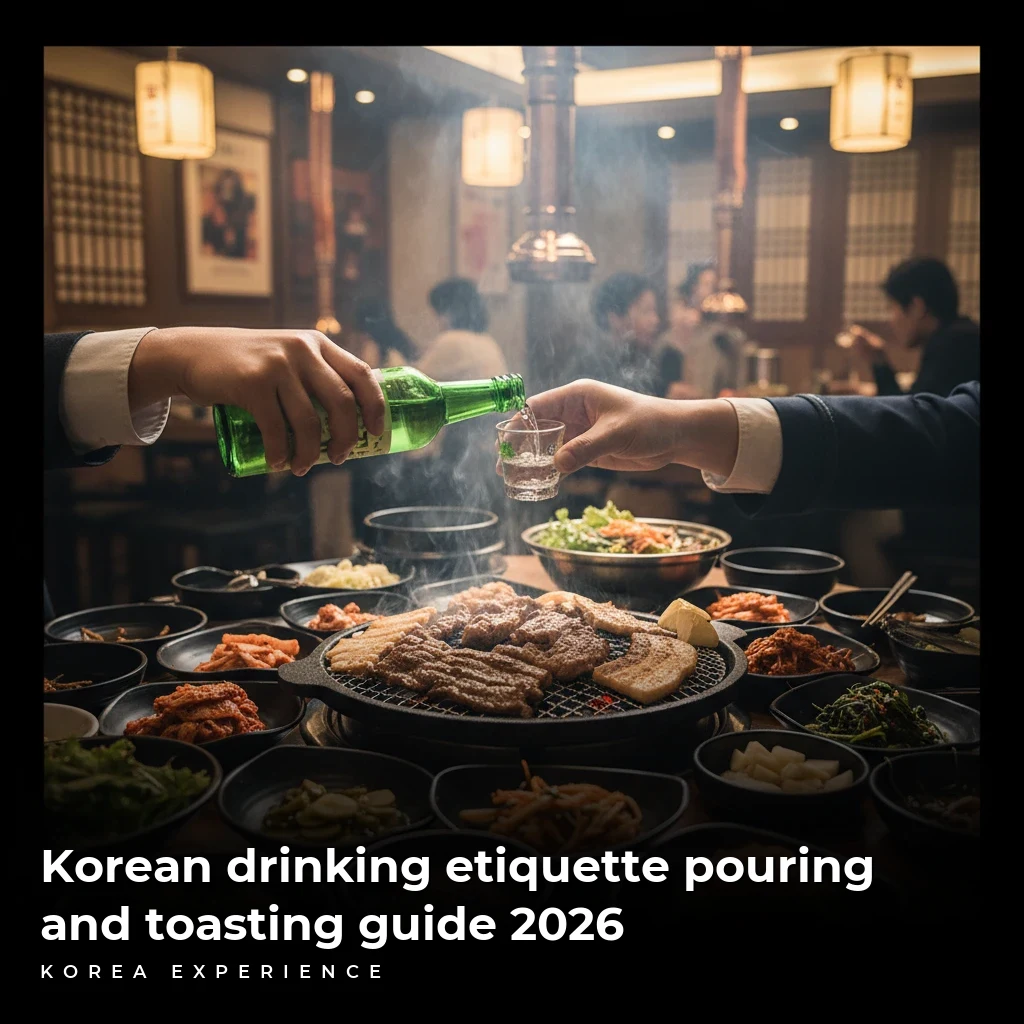
Understanding Korean drinking etiquette pouring and toasting customs is the fastest way to bridge the cultural gap and earn respect in South Korea. Alcohol acts as the primary social lubricant in Korean society, breaking down hierarchical stiffness and fostering deeper bonds between colleagues and friends.
Learn more in our comprehensive guide to Korean drinking culture Soju Makgeolli and pocha guide.
Related reading: Mastering Korean drinking games rules and fun for travelers.
Related reading: Korean Drinking Snacks Anju Pairing Guide for Travelers.
Learn more in our comprehensive guide to Table etiquette in Korea why you should not pick up your ....
Whether you are attending a formal business dinner (hoesik) in Gangnam or a casual gathering in Hongdae, the rules of the table are precise. Getting them right demonstrates high cultural intelligence, while getting them wrong can create awkward social friction. This guide covers every nuance of the experience, ensuring you navigate Seoul's nightlife with the confidence of a local.
Key Takeaways
- 1Never pour your own drink; always wait for someone else to fill your glass
- 2Use two hands when pouring for or receiving from an elder or superior
- 3Turn your head away from seniors when taking a sip as a sign of respect
The Philosophy of Korean Drinking Culture
In South Korea, drinking is rarely a solitary activity; it is a communal event designed to build relationships. The concept of "Jeong"—a deep feeling of attachment and bond—is often cultivated over shared bottles of Soju and beer.
The volume of alcohol consumed is significant. According to recent health data projections for 2025-2026, South Korea remains one of the highest consumers of hard liquor in the world, with the average adult consuming roughly 50 to 80 bottles of Soju annually. This isn't just about intoxication; it is about the shared experience.
The Hierarchy Factor
Korean society is built on Confucian hierarchy based on age and status. Drinking etiquette is the physical manifestation of this hierarchy. If you are the youngest (maknae) or the subordinate, you have the most responsibilities at the table.
When you sit down at a Korean BBQ restaurant, typically sized around 30 to 50 square meters for neighborhood spots, you aren't just eating; you are participating in a ritual. The spacing of the tables, often less than 1 meter apart, forces intimacy and collective conversation.
The Art of Pouring: Rules and Techniques
The most fundamental rule of Korean drinking etiquette is never fill your own glass. This practice, known as "jachak," is considered bad luck and socially isolating. It implies that your dining partner is not paying attention to your needs. Instead, you must remain vigilant of others' glass levels.
When to Pour
You should offer to refill a glass when it is roughly 10% to 20% full. Unlike in some Western cultures where "topping up" a half-full glass is common, in Korea, it is traditional to wait until the glass is nearly empty before refilling. A standard Soju glass holds approximately 50ml of liquid. Because a standard bottle of Soju is 360ml, it contains exactly 7.2 glasses. This "odd number" design is often jokingly cited as a marketing trick to ensure you must order a second bottle to fill the last glass evenly.
📖 How to Pour Correctly
Step 1: Assess the Hierarchy
Identify the senior members at the table. You must serve them first.
Step 2: Hold the Bottle
Hold the bottle with your right hand. Place your left hand under your right elbow or wrist to support your arm.
Step 3: The Pour
Pour gently to avoid splashing. Fill the glass to about 80-90% capacity.
Step 4: Return the Bottle
Place the bottle back on the table, not directly in front of someone's plate.
The Two-Hand Rule
The use of two hands is the clearest indicator of respect. If you are pouring for someone older or higher in rank, your right hand holds the bottle while your left hand lightly supports your right forearm or wrist. This gesture originates from historical times when flowing sleeves of the Hanbok (traditional dress) needed to be held back to prevent them from dipping into food. Today, it signifies that you are dedicating your full attention and body to the act of serving.
Conversely, if a senior pours for you, you must lift your glass to receive it. Do not leave your glass on the table. Hold the glass with your right hand and support the bottom of the glass with your left palm.
Toasting and Drinking: "Gunbae"
Once the glasses are filled, a toast usually follows. The Korean word for "Cheers" is "Gunbae," which literally translates to "dry glass." While you aren't always expected to finish the whole glass in one shot (one-shotting), the initial toast often involves a hearty sip or emptying the glass depending on the group's energy.
"Watch the height of your glass during a toast. If you are clinking glasses with a boss or an elder, ensure the rim of your glass hits the body of their glass—lower than their rim. Clinking higher than a senior is seen as arrogant."
The Head Turn
This is the most distinct aspect of Korean drinking etiquette. When you take your sip in the presence of an elder or superior, you must turn your upper body and head slightly away from them (usually to the side). You then cover the mouth and glass with your left hand while drinking. This creates a screen, as showing your teeth or the act of consuming alcohol directly in front of a superior is considered impolite.
If you are at a round table with seniors on both sides, turn away from the highest-ranking person. If the senior says, "You don't have to turn," (often said to foreigners to make them comfortable), you can then face forward, but maintaining the gesture shows great manners.
What You Will Be Drinking: The Big Three
While craft cocktails and wine are growing in popularity in districts like Hannam-dong and Cheongdam-dong, the trifecta of Korean alcohol remains Soju, Maekju (Beer), and Makgeolli.
Soju: The National Spirit
Soju is a clear, distilled liquor traditionally made from rice, but now often produced from sweet potatoes or tapioca. It has a neutral taste, similar to vodka but sweeter and with a lower viscosity.
- ABV: Typically 16% to 20%.
- Price: Very affordable. In a convenience store, a bottle costs roughly 1,800 to ₩2,000 ($1.35 - $1.50 USD).
- Serving: Always served chilled and neat in small shot glasses.
Maekju (Beer)
Korean beers like Cass, Terra, and Kelly are light lagers designed to cut through spicy and greasy food. They are rarely drunk for their complex flavor profile but rather for their refreshing quality.
- ABV: Usually around 4.5%.
- Volume: Served in 500ml bottles or 500cc draft pours.
💵 Alcohol Price Comparison (2026)
Upscale Gangnam venues
Itaewon/Seongsu breweries
Somaek: The Golden Ratio
Somaek is a portmanteau of Soju and Maekju. It is a boilermaker bomb where a shot of Soju is dropped into a glass of beer.
- The Ratio: The "Golden Ratio" is debated, but generally, it is 3 parts Soju to 7 parts Beer.
- The Spoon Trick: To mix it, Koreans often jam a chopstick or spoon into the glass and hit it with another chopstick, causing a vibration that foams the beer instantly.
The Social Flow: Rounds (Cha)
A night out in Korea is rarely confined to a single location. It is a journey through multiple "rounds," known as Cha.
A Typical Friday Night Timeline
1-Cha (Dinner)
Korean BBQ or Sashimi. Heavy food and Soju. Duration: 90-120 mins.
2-Cha (Pub)
Fried chicken (Chimaek) or dried snacks. Beer and Somaek. Duration: 60-90 mins.
3-Cha (Karaoke)
Noraebang. Singing, fruit platters, and cans of beer. Duration: 60 mins.
Moving between venues changes the atmosphere. 1-Cha is for talking and eating. 2-Cha is for loosening up. 3-Cha is for bonding through entertainment. Statistics show that in major entertainment districts like Hongdae or Itaewon, foot traffic peaks between 10:00 PM and 1:00 AM as groups migrate between rounds.
The distance between these venues is usually short. In dense neighborhoods, you will walk less than 200 meters (about a 3-minute walk) to get from a BBQ spot to a secondary pub.
Declining a Drink and Non-Drinkers
This is a common concern for travelers. Historically, refusing a drink from a superior was rude. However, culture is shifting. In 2026, health awareness and workplace harassment laws have made it acceptable to decline, though it requires tact.
How to Refuse Politely
Do not just say "No." If you cannot drink for medical or religious reasons, state this clearly at the beginning of the meal. Even if you aren't drinking alcohol, you should still receive the glass (accept the pour) and let it sit on the table. Refusing the pour itself breaks the flow of the ritual.
If you want to stop drinking later in the night, simply leave your glass half-full. Remember the rule: glasses are only refilled when empty. If you don't drain it, it won't be refilled.
For those who do drink, pacing is vital. A standard night out can last 4 to 6 hours. Eating distinct "Anju" (food specifically for drinking) is the key to survival. Anju is not an afterthought; it is mandatory.
The Aftermath: Hangovers and Cures
Korean culture has an entire industry dedicated to "Haejang," or hangover relief. The market for hangover cures—drinks, pills, and jellies sold at convenience stores—is massive.
📊 Hangover Cure Market
If you wake up foggy after a night of Soju, look for "Haejangguk" (Hangover Soup). These soups are rich, spicy, and full of electrolytes.
Cheongjinok(청진옥)
A bowl of Haejangguk typically costs between 10,000 and ₩14,000 ($7.50 - $10.50 USD). It is usually eaten between 7:00 AM and 10:00 AM by office workers recovering before the workday begins.
Paying the Bill
The concept of "Dutch Pay" (splitting the bill) is becoming more common among the younger generation (Gen Z), but in formal or hierarchical settings, it is still rare.
Usually, the oldest person or the inviter pays for the entire round (1-Cha). If you move to 2-Cha, a subordinate or younger friend might offer to pay to show gratitude, though the senior often picks that up too.
Payment Etiquette
- ✓Seniors usually pay for everything (free for juniors)
- ✓Reduces time spent calculating individual shares
- ✓Builds long-term reciprocity
- ✗Can feel awkward if you want to contribute
- ✗Expectation to stay as long as the payer stays
- ✗Expensive if you become the senior
If you are traveling with friends of similar age, "N-bbang" (splitting N ways) is perfectly acceptable. Most restaurants allow you to pay separately at the register, or one person pays and others transfer money via KakaoPay immediately.
Common Drinking Games
To break the ice, especially among university students or younger colleagues, drinking games are inevitable. They are fast-paced, rhythmic, and involve chanting.
📋 Game Essentials
- Titanic: A shot glass is floated in a beer glass. Players take turns pouring small amounts of Soju into the floating shot glass. Whoever sinks it drinks the whole mixture (Somaek).
- The Bottle Cap: Twist the wire tail of the Soju cap until it is tight. Flick it with your finger. Pass the cap around. Whoever flicks the tail off makes everyone else drink—or the person to their left/right drinks, depending on house rules.
Practical Tips for Travelers
When navigating the nightlife, safety and logistics are important. Public transport in Seoul is excellent but stops running around midnight to 1:00 AM.
- Subways: Most lines stop around 12:30 AM on weekdays and slightly earlier on weekends.
- Taxis: After 11:00 PM, finding a taxi can be difficult in areas like Gangnam or Itaewon.
- KakaoTaxi: It is highly recommended to download the Kakao T app. You can link foreign credit cards.
- Surcharges: There is a late-night taxi surcharge of 20% to 40% between 10:00 PM and 4:00 AM. A ride that normally costs ₩15,000 might cost ₩20,000 during these hours.
Transport Options After Midnight
| Mode | Availability | Cost (10km) | Convenience |
|---|---|---|---|
| Taxi (Street Hail) | Low | ₩15,000+ | Medium |
| Kakao T Blue | High | ₩18,000+ | High |
| Night Bus (N-Bus) | Medium | ₩2,150 | Low |
Understanding these logistics prevents the panic of being stranded after a fun night of cultural immersion.
Conclusion
Korean drinking etiquette is about more than just rules; it is a language of respect. By pouring with two hands, turning your head, and engaging in the communal spirit of the rounds, you are showing your hosts that you value their culture. It transforms a simple dinner into a memorable connection.
So, the next time you hear "Gunbae!" raise your glass (with two hands if necessary), look at your companions, and enjoy the warm camaraderie that defines a night out in Korea.
❓ Frequently Asked Questions
Have more questions?Contact us →
About the Author
Korea Experience Team
Written by the Korea Experience editorial team - experts in Korean medical tourism, travel, and culture with years of research and firsthand experience.
Explore more in Food & Dining
Korean BBQ, street food, Michelin restaurants, and regional specialties — your ultimate guide to eating well in Korea.
Browse All Food & Dining ArticlesContinue Reading
Explore more articles you might find interesting
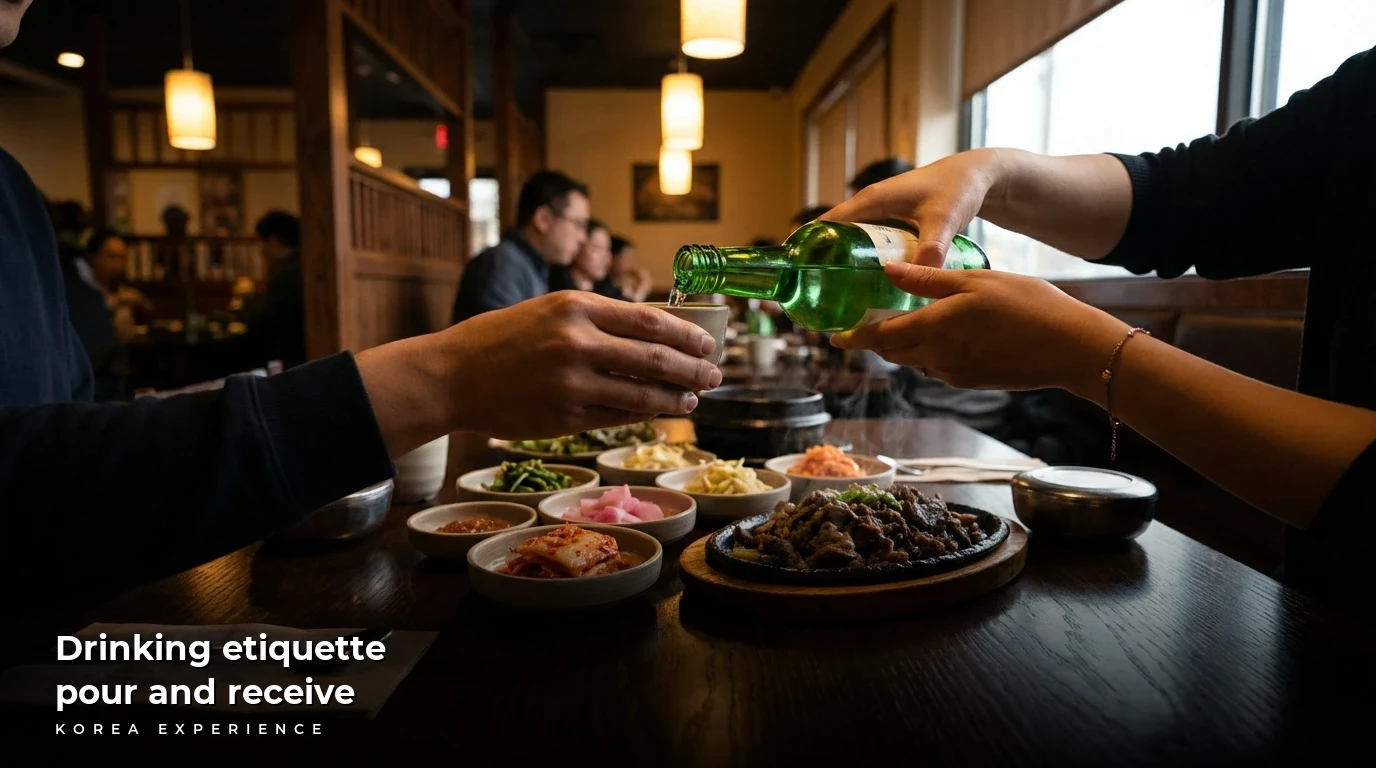
Master the two-hand tuck and polite turn. Learn why soju costs 7,000 KRW in 2026 and how to avoid the 50% refill rule mistake in this essential guide.
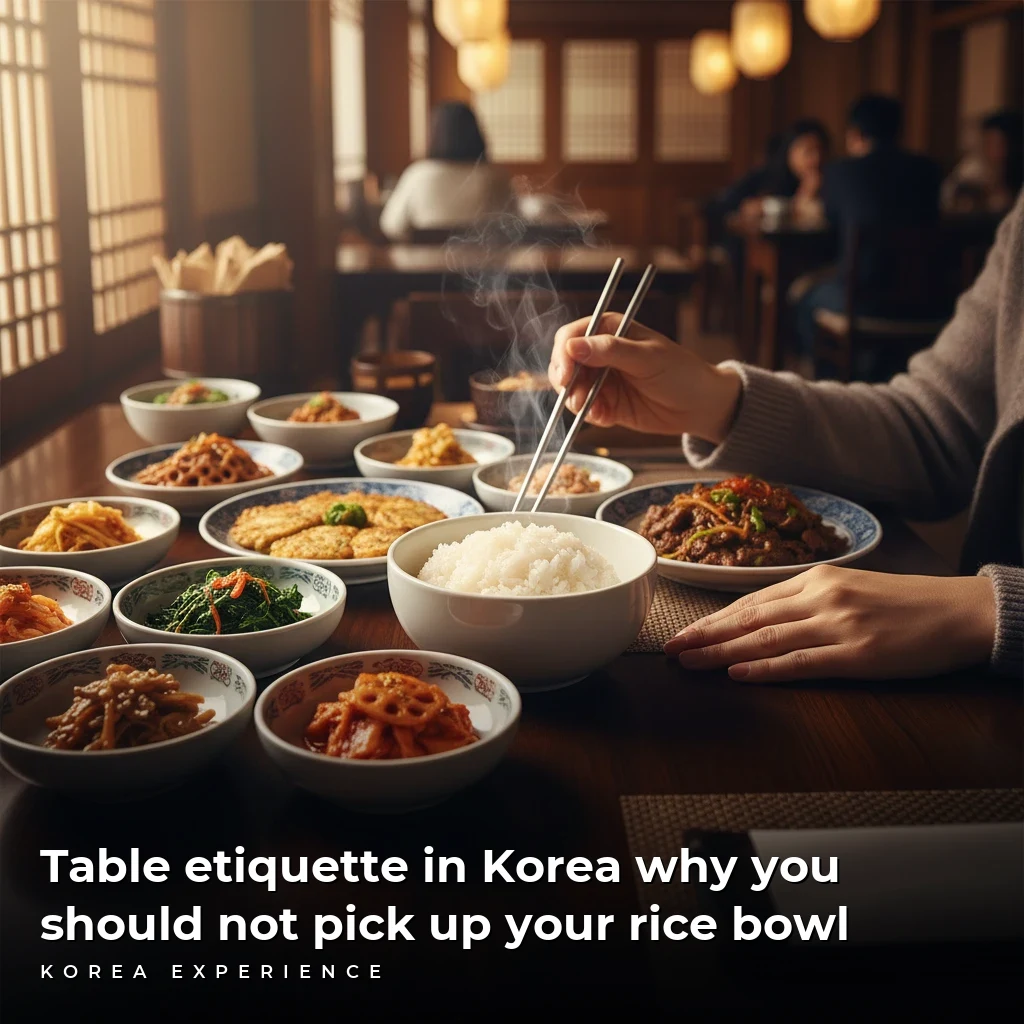
Master Korean dining rules and learn why lifting your rice bowl is a cultural taboo. Essential guide for travelers in 2026.
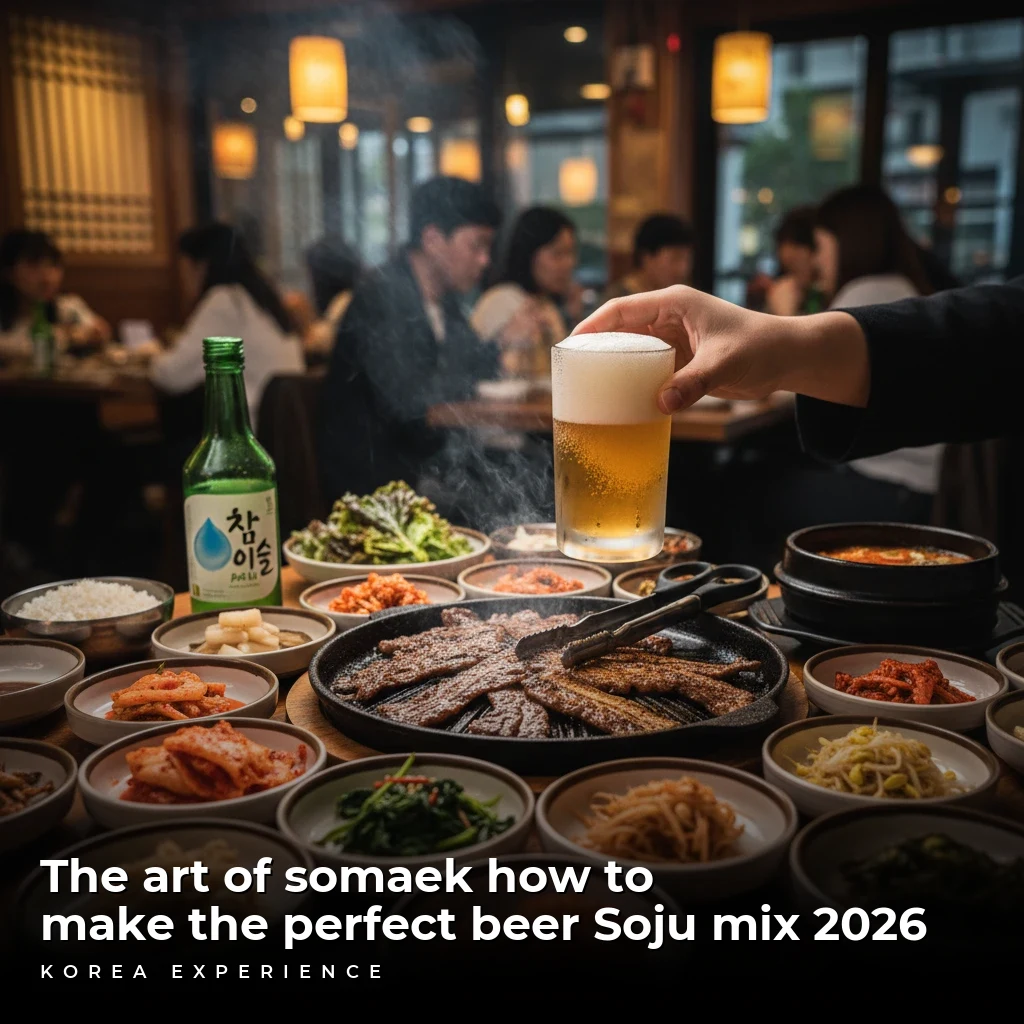
Master the art of Somaek with our 2026 guide to the perfect Korean beer and soju mix. Discover the golden ratio, best brands, and essential drinking etiquette.
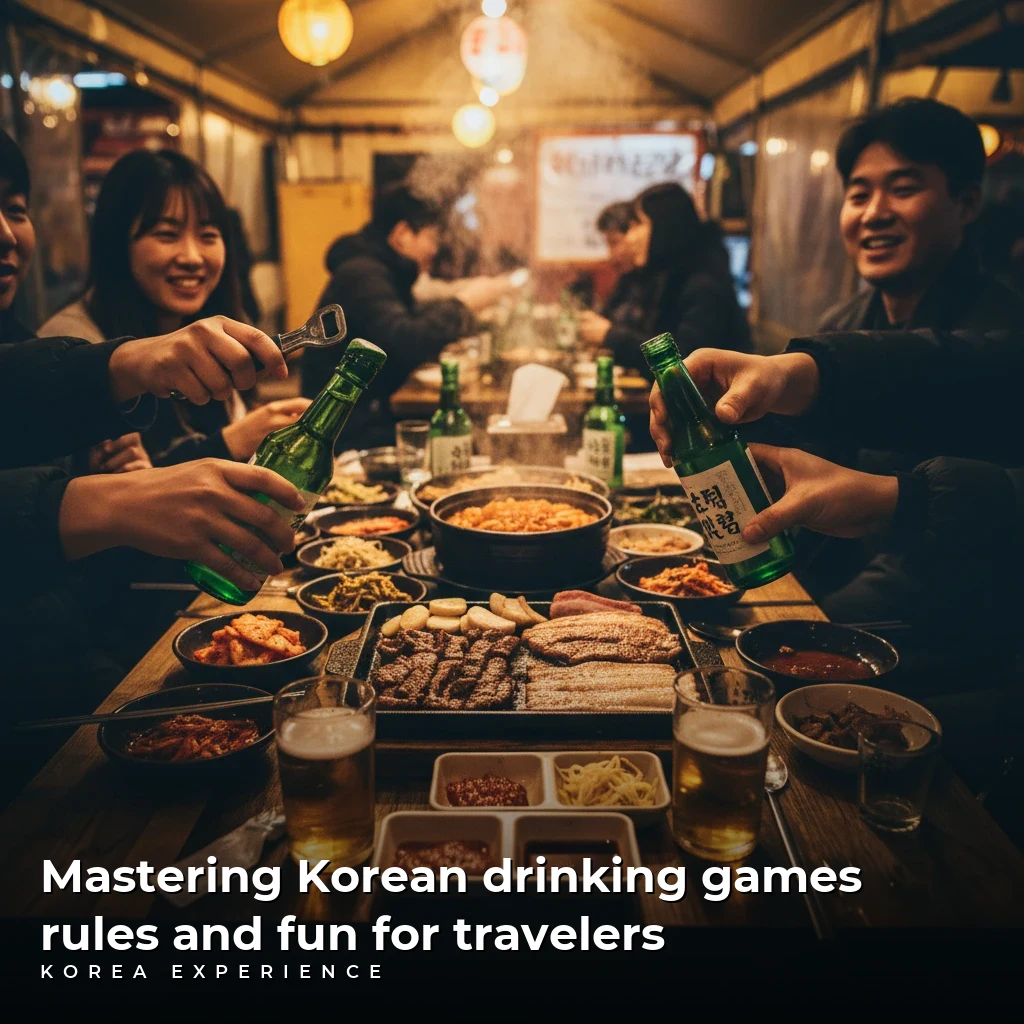
The ultimate guide to Korean drinking games rules, etiquette, and culture. Learn how to play Titanic, Soju Cap, and more like a local expert.
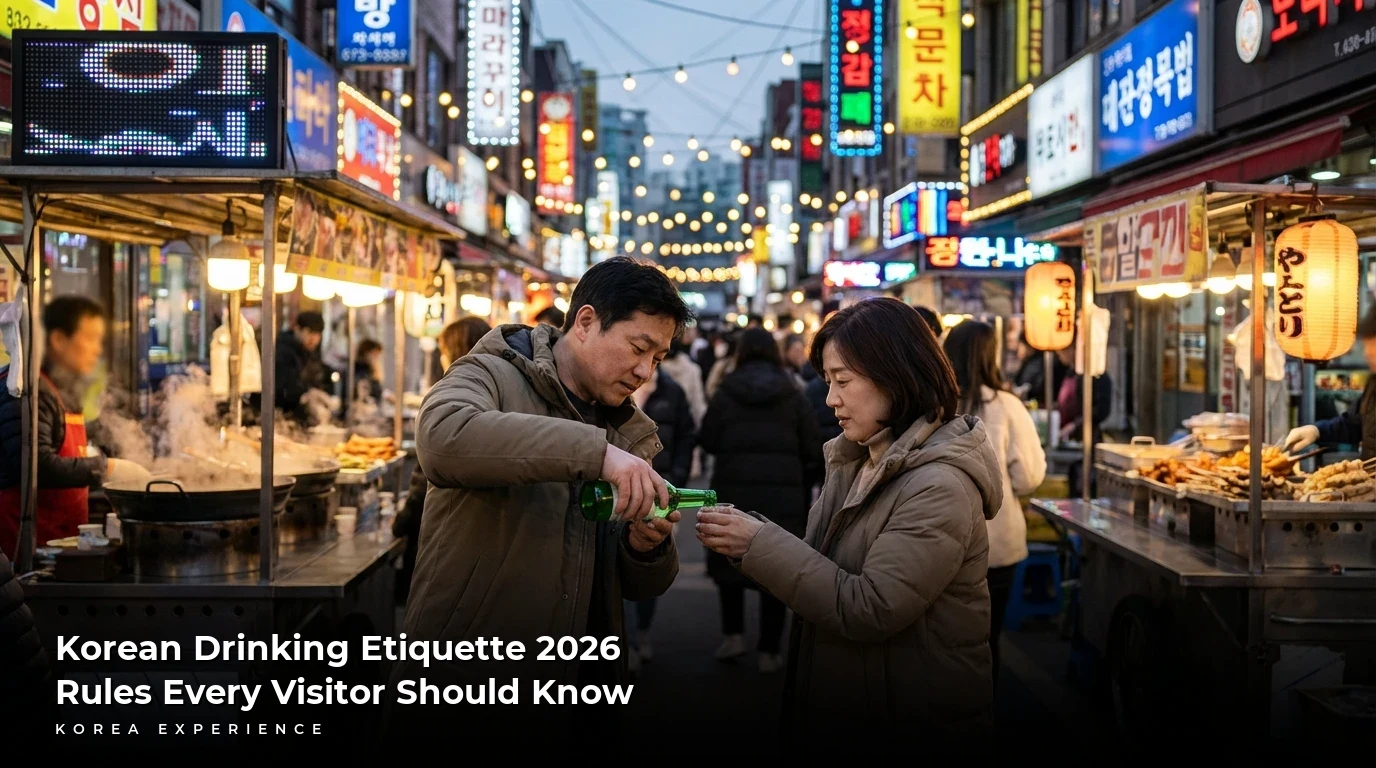
The short answer? Always use two hands when pouring or receiving a drink and never, ever fill your own glass—it's the fastest way to signal you're a tourist.
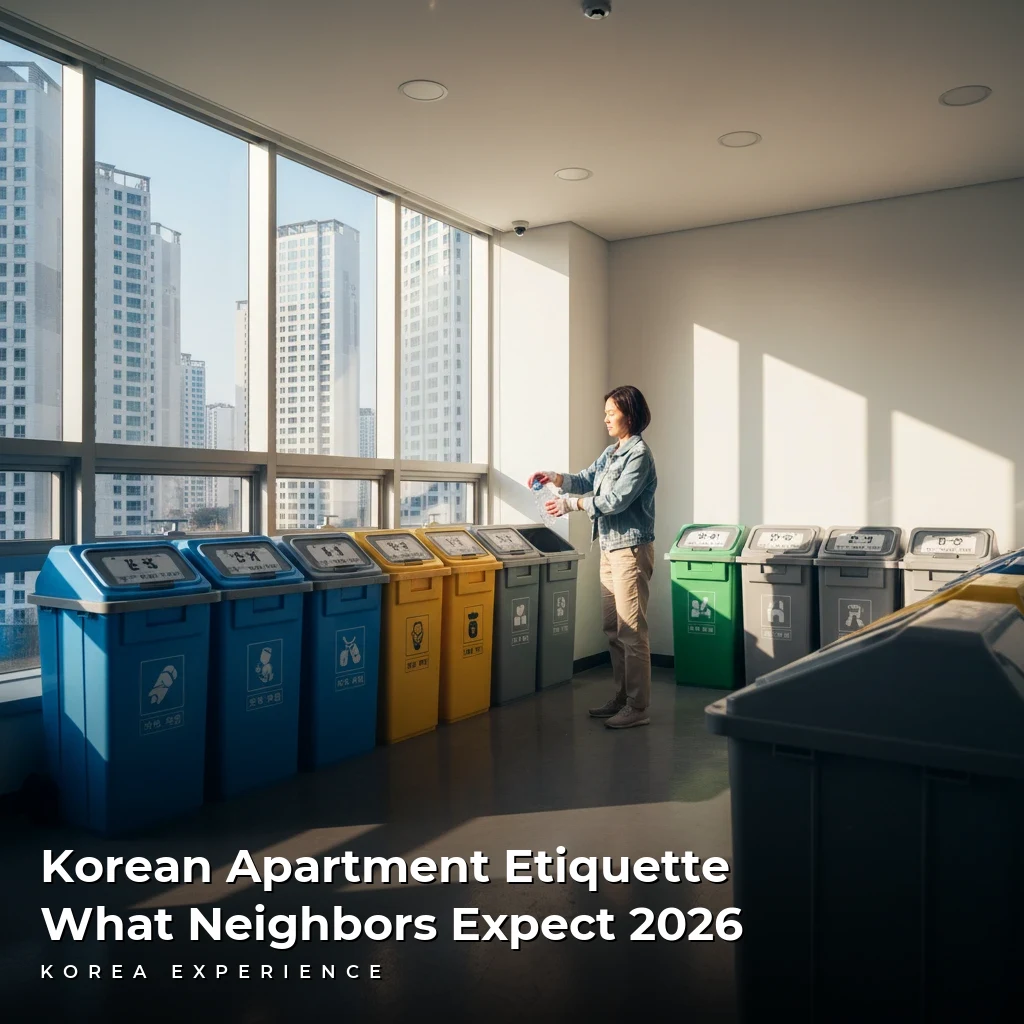
Master Korean apartment etiquette in 2026. From strict recycling rules to noise control, learn how to be the perfect neighbor in Korea.