Mastering Korean drinking games rules and fun for travelers
The ultimate guide to Korean drinking games rules, etiquette, and culture. Learn how to play Titanic, Soju Cap, and more like a local expert.
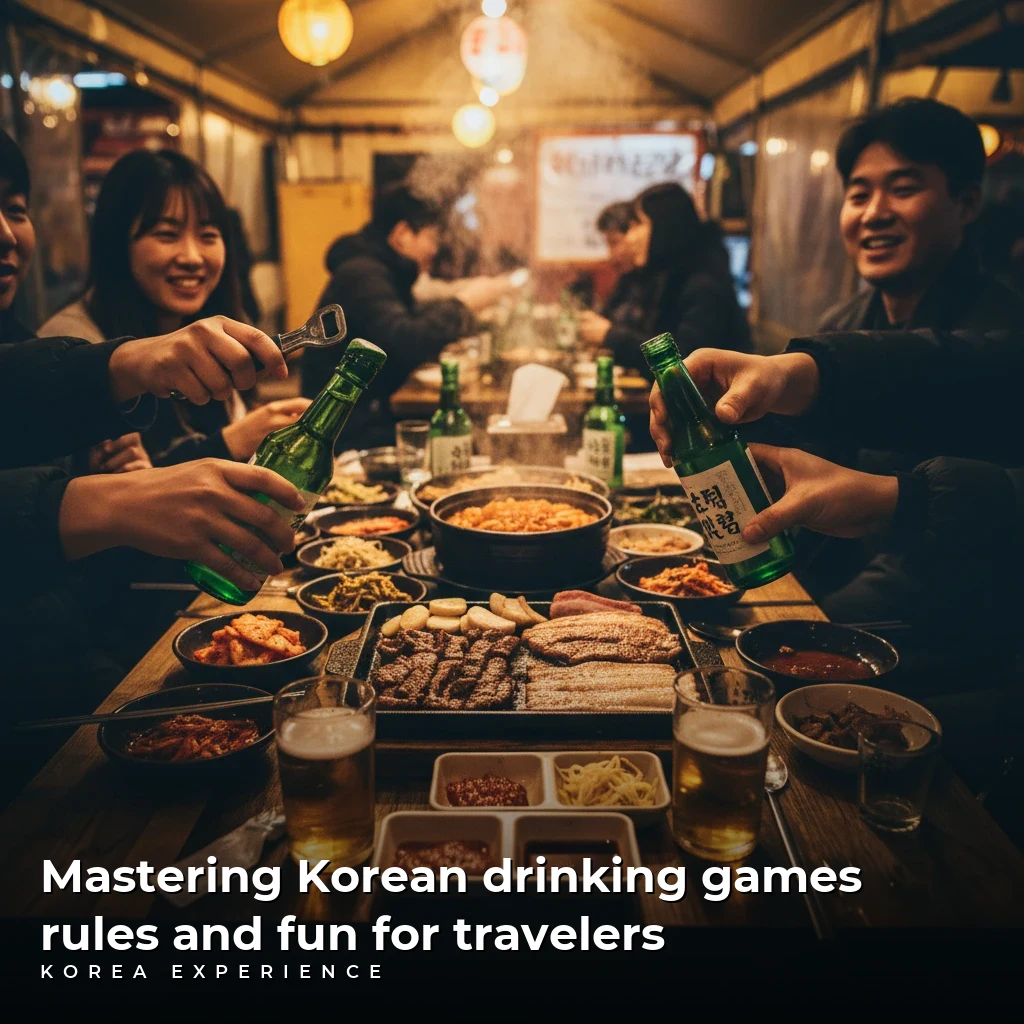
Understanding the nightlife in Seoul goes far beyond knowing which club to visit in Gangnam or which craft beer pub is trending in Itaewon. The true heartbeat of Korean social socialization is found around a round metal table, laden with green bottles, where the atmosphere is electric with chanting and laughter. If you want to truly integrate into the local culture, mastering Korean drinking games rules and fun etiquette is not just a party trick—it is an essential travel skill.
South Korea consistently ranks among the top nations globally for alcohol consumption per capita, with the average adult consuming roughly 53 bottles of Soju annually. However, drinking here is rarely a solitary act. It is a communal bonding experience known as hoesik (company dinners) or general gatherings among friends. The games serve a specific purpose: they break the ice, dismantle social hierarchies, and accelerate the bonding process.
Related reading: Korean Drinking Snacks Anju Pairing Guide for Travelers.
Whether you are a solo traveler looking to make friends at a guesthouse or an expat navigating your first office dinner, this guide will transform you from a confused observer into the life of the party.
Learn more in our comprehensive guide to Korean drinking culture Soju Makgeolli and pocha guide.
Key Takeaways
- 1Korean drinking games are fast-paced icebreakers essential for social bonding in Korea
- 2Soju contains roughly 16-20% ABV, so pacing yourself during games is critical for survival
- 3Always receive drinks with two hands to show respect to elders or new acquaintances
The Foundation: Essential Etiquette Before You Play
Before diving into the chaotic fun of the games, you must understand the rigid structure that supports Korean drinking culture. Unlike Western drinking cultures where individual autonomy is key, Korean drinking is collective.
Learn more in our comprehensive guide to Korean drinking etiquette pouring and toasting guide.
The most critical rule involves pouring. You should never pour your own drink. This is considered bad luck. Instead, you must scan the table. If you see a companion’s glass is empty (or less than 20% full), offer to refill it. When someone pours for you, hold your glass with both hands—or support your right wrist with your left hand—as a sign of respect. This applies even if the pourer is younger than you, though the strictness relaxes with close friends.
You might also enjoy our article about Makgeolli Bars Traditional Rice Wine Culture Guide for Tr....
The Empty Glass Rule
Never leave a glass completely empty unless you want a refill immediately. In Korea, an empty glass is an invitation to pour. If you need a break, leave about 15-20% of the alcohol in your glass.
When clinking glasses for a toast (Geonbae), look at the seniority of the group. If you are clinking with someone older or of higher status, ensure the rim of your glass hits below the rim of their glass. It is a subtle physical manifestation of humility that will earn you immense respect from locals.
📋 Drinking Culture Stats
The Arsenal: Know Your Beverages
To play Korean drinking games effectively, you must know what you are consuming. The penalties in these games are swift, and the volume of liquid consumed can add up dangerously fast.
Soju: The National Spirit
Soju is the fuel of Korean nightlife. It is a clear, distilled spirit usually made from rice, wheat, or barley, though tapioca and sweet potato are also common. A standard green bottle contains 360ml of liquid. While the classic "Fresh" soju sits around 16.9% ABV, fruit-flavored variations (Grapefruit, Green Grape, Plum) are popular among younger crowds and travelers. These usually have a slightly lower alcohol content (13-14%) but contain significantly more sugar, often leading to brutal hangovers.
Somaek: The Golden Ratio
Somaek is a portmanteau of Soju and Maekju (Beer). It is a boilermaker style drink but mixed with precision. The golden ratio is often debated, but a standard mix is 3 parts Soju to 7 parts Beer. Special "Somaek glasses" with marked lines are available in many restaurants to help you mix the perfect ratio.
💵 Alcohol Price Index (2026)
Standard green bottle retail price
Top 5 Korean Drinking Games Rules
Now that you have the beverage and etiquette handled, it is time for the main event. These games are designed to be played quickly, with rounds often lasting less than 2 minutes.
1. The Soju Cap Game (Flick the Tail)
This is usually the very first game played when a new bottle of Soju is opened.
The Setup: When you twist the metal cap off a Soju bottle, a thin strip of metal wire usually remains attached to the cap, forming a "tail." Do not break this off. Twist the wire so it stands straight up.
The Rules: The person holding the cap passes it around the circle. Each player gets one chance to flick the wire tail with their finger. The objective is to be the person who physically breaks the tail off the cap.
The Penalty: The person who successfully flicks the tail off is the winner (and usually safe). Everyone else at the table must drink. Alternatively, in some variations, the person to the immediate left or right of the winner must drink.
"To win the Cap Game, don't flick it as hard as you can. Aim for the base where the wire connects to the cap. A sharp, precise strike is better than brute force. If you see the wire is turning white at the stress point, it's about to break!"
2. Titanic ( The Submarine)
This is a game of tension and physics, perfect for playing while chatting. It requires steady hands and nerves of steel.
The Setup: Fill a clear beer glass about 60-70% full with beer. Carefully place an empty Soju shot glass inside the beer glass so it floats on top. It should look like a boat on the ocean.
The Rules: Players take turns pouring a small amount of Soju into the floating shot glass. You can pour as much or as little as you want—even a single drop counts. The surface tension will keep the shot glass afloat longer than you expect.
The End Game: Eventually, the shot glass will become too heavy. The player who pours the drop that causes the shot glass to sink to the bottom of the beer glass loses.
The Penalty: The loser must drink the entire mixture—the glass of beer with the submerged shot of Soju (a potent Somaek).
📖 How to Win at Titanic
Step 1: Analyze the Float
Check how high the shot glass is sitting. If it's bobbing significantly, it's getting heavy.
Step 2: The Drip Technique
Instead of pouring, let the Soju drip down the side of the bottle neck for maximum control.
Step 3: Surface Tension
Remember that the liquid can actually dome slightly above the rim before sinking. Use this to trap the next player.
3. Baskin Robbins 31
Named after the ice cream chain (popular in Korea), this is a simple counting game that requires zero props, making it perfect for loud bars or picnics at the Han River.
The Rules: Players sit in a circle. The goal is to avoid saying the number "31." Players take turns counting up from 1. On your turn, you can say one, two, or three numbers in succession.
- Player A: "1"
- Player B: "2, 3"
- Player C: "4, 5, 6"
The Strategy: The counting continues sequentially. The player who is forced to say the number "31" loses and must drink.
Strategy Insight: This is a mathematically solvable game. If you can control the count to land on 26 or 30, you can force the outcome. However, under the influence of alcohol, doing mental math becomes significantly harder.
4. The Image Game (Sense Game)
This game reveals what your friends really think of you. It acts as a voting system.
The Rules: One person (the "IT" person) proposes a descriptive statement. For example: "Who is the most likely to get lost on the subway?" or "Who has the best fashion sense?" On the count of three, everyone points at the person they think fits the description best.
The Penalty: The person with the most fingers pointing at them must drink. If you receive the most votes, you can sometimes defend yourself or tell a story, but usually, the democracy of the table rules supreme.
5. Up and Down
Often played immediately after the Soju Cap game using the number inside the cap.
The Setup: Inside a Soju cap, there is a number printed (usually between 1 and 50). The person who opened the bottle looks at the number and keeps it secret.
The Rules: Players take turns guessing the number. If Player A guesses "25" and the real number is 42, the host says "Up." If Player B guesses "45," the host says "Down."
The Twist: The range narrows quickly. The person who correctly guesses the number might be the winner, but in many variations, the person who guesses correctly makes everyone else drink, or the person who guesses correctly becomes the "target" for the next round. A common variation is that the person who guesses correctly is safe, but the people immediately to their left and right must drink.
Game Intensity Comparison
| Game | Skill Level | Luck Factor | Drunkenness Risk |
|---|---|---|---|
| Soju Cap | High | Low | Medium |
| Titanic | High | Medium | High (Somaek) |
| Baskin Robbins 31 | Medium | Low | Low |
| Up & Down | Low | High | Medium |
The Culture of Penalties: "Mashimyeon!"
In Western games, if you lose, you drink. In Korea, if you lose, the whole table sings to you while you drink. This peer pressure is lighthearted but effective in keeping the pace of the evening brisk.
The most common song you will hear when someone loses is the "Mashimyeon" song. It translates roughly to: "Drink, drink, drink! The alcohol is going in! Straight in! Straight in! When will you stop? Until the glass is empty!"
Hearing this chant increases the energy of the room (often exceeding 85 decibels in busy districts like Itaewon or Hongdae). It is impossible to sip your penalty drink slowly when 4-5 people are rhythmically chanting for you to finish.
Where to Play: Selecting Your Venue
Not every restaurant is appropriate for boisterous drinking games. A fine dining establishment or a quiet café is not the place. You need to find venues that cater to noise and high energy.
The Pocha (Pochamacha)
Originally street tents, modern Pochas are indoor bars that replicate the street vibe. They serve cheap snacks (Anju) like stirred-fried pork, egg rolls, and fish cake soup. This is the #1 spot for drinking games.
The Hof (Hopeu)
These are German-influenced beer halls that serve fried chicken and beer. While games are played here, the vibe is slightly more focused on eating chicken. However, after 9:00 PM, they often transition into rowdy drinking dens.
The University Towns
Areas near universities (Hongdae, Sinchon, Konkuk University) are the epicenter of game culture. Prices here are lower, with Soju often priced at ₩4,500 rather than the ₩6,000 you might find in Gangnam.
Kodachaya(코다차야)
Survival Guide: Dealing with the Hangover
If you play these games correctly, you will likely wake up the next day needing help. Thankfully, Korea has a sophisticated "hangover cure" industry worth over $200 million annually.
The Pharmacy Cure
Visit any convenience store (CU, GS25, 7-Eleven) or pharmacy (Yakguk). Look for small bottles in the refrigerated section. Brands like "Condition," "Dawn 808," and "Morning Care" are staples. They typically cost between ₩4,500 and ₩6,000. They contain raisin tree extracts or turmeric to aid liver function.
The Food Cure (Haejang-guk)
Haejang-guk literally translates to "hangover soup." It is a genre of hearty, spicy soups meant to sweat out the toxins. The most popular is Ppyeo-haejang-guk (pork bone soup), usually priced around ₩10,000.
Hangover Strategy: Meds vs. Food
- ✓Drinks: Fast acting (30 mins)
- ✓Drinks: Portable
- ✓Food: Replenishes electrolytes
- ✓Food: Culturally satisfying
- ✗Drinks: Taste can be bitter
- ✗Drinks: Expensive (₩5000+)
- ✗Food: Requires sitting at restaurant
- ✗Food: Spiciness can upset sensitive stomachs
Safety and Getting Home
Seoul is incredibly safe, with violent crime rates among the lowest in the OECD. However, overindulgence leads to vulnerability.
The subway system in Seoul typically stops running between 12:00 AM and 1:00 AM, depending on the line and the day of the week (weekends sometimes have extended hours, but do not rely on it). If you are playing games until 2:00 AM, you are committed to a taxi.
KakaoT is the essential app for hailing rides. Uber works in Korea (often calling local taxis), but KakaoT is faster. Nighttime surcharges for taxis apply from 10:00 PM to 4:00 AM. The base rate can jump by 20% to 40% depending on the hour, with the peak surcharge usually hitting between 11:00 PM and 2:00 AM.
📊 Transport Safety Stats
Practical Tips for International Travelers
If you are invited to a drinking session, here is how to navigate the social pressure.
- The Black Knight: If you simply cannot drink anymore but lose a game, you can ask for a "Black Knight" (Heuk-gisa). This is someone who drinks your penalty for you. However, this incurs a debt. Usually, the Black Knight gets to make a wish that you must grant (within reason, like buying ice cream later or singing a song).
- Non-Alcoholic Options: It is increasingly acceptable to substitute water or soda if you cannot drink alcohol for health or religious reasons, especially among younger generations (Gen Z). However, you must state this clearly at the start of the night.
- Toasting: The word for cheers is Geonbae (Empty Glass) or Jjan (the sound of glasses clinking).
The Typical Korean Night Out
1st Round (Il-cha)
Dinner with Soju. Moderate drinking.
2nd Round (I-cha)
Move to a Pocha or Hof. High energy games begin.
3rd Round (Sam-cha)
Karaoke (Noraebang) or Club. Singing and dancing.
Conclusion
Korean drinking games are more than just a way to consume alcohol; they are a rapid-fire mechanism for building friendship and shared memories. The rules may seem complex at first, but the spirit is simple: participate, laugh at your mistakes, and respect those around you.
Whether you are flicking a wire tail off a green bottle cap or anxiously watching a shot glass float in beer, you are participating in a ritual that millions of Koreans enjoy every weekend. So, practice your counting, steady your hands for Titanic, and get ready to shout Geonbae!
❓ Frequently Asked Questions
Have more questions?Contact us →
About the Author
Korea Experience Team
Written by the Korea Experience editorial team - experts in Korean medical tourism, travel, and culture with years of research and firsthand experience.
Explore more in Food & Dining
Korean BBQ, street food, Michelin restaurants, and regional specialties — your ultimate guide to eating well in Korea.
Browse All Food & Dining ArticlesContinue Reading
Explore more articles you might find interesting
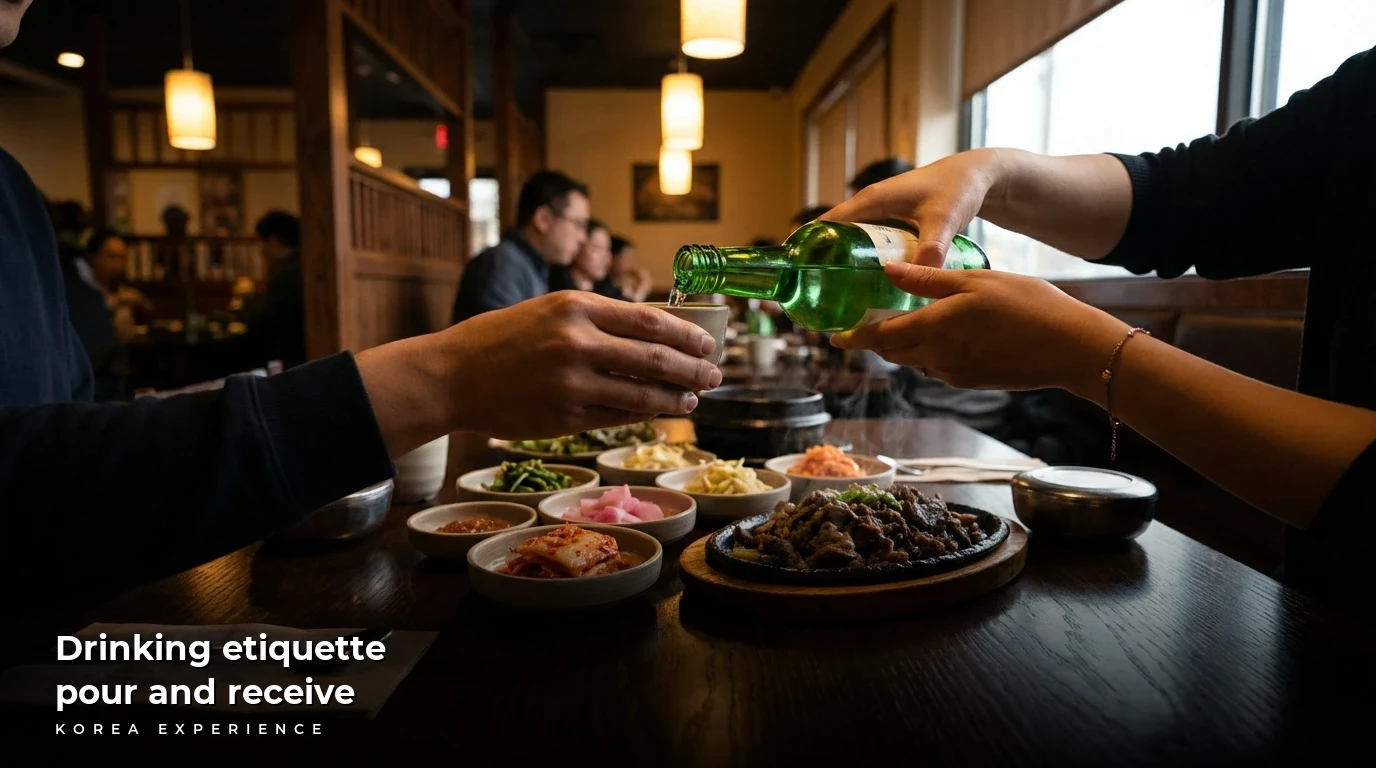
Master the two-hand tuck and polite turn. Learn why soju costs 7,000 KRW in 2026 and how to avoid the 50% refill rule mistake in this essential guide.
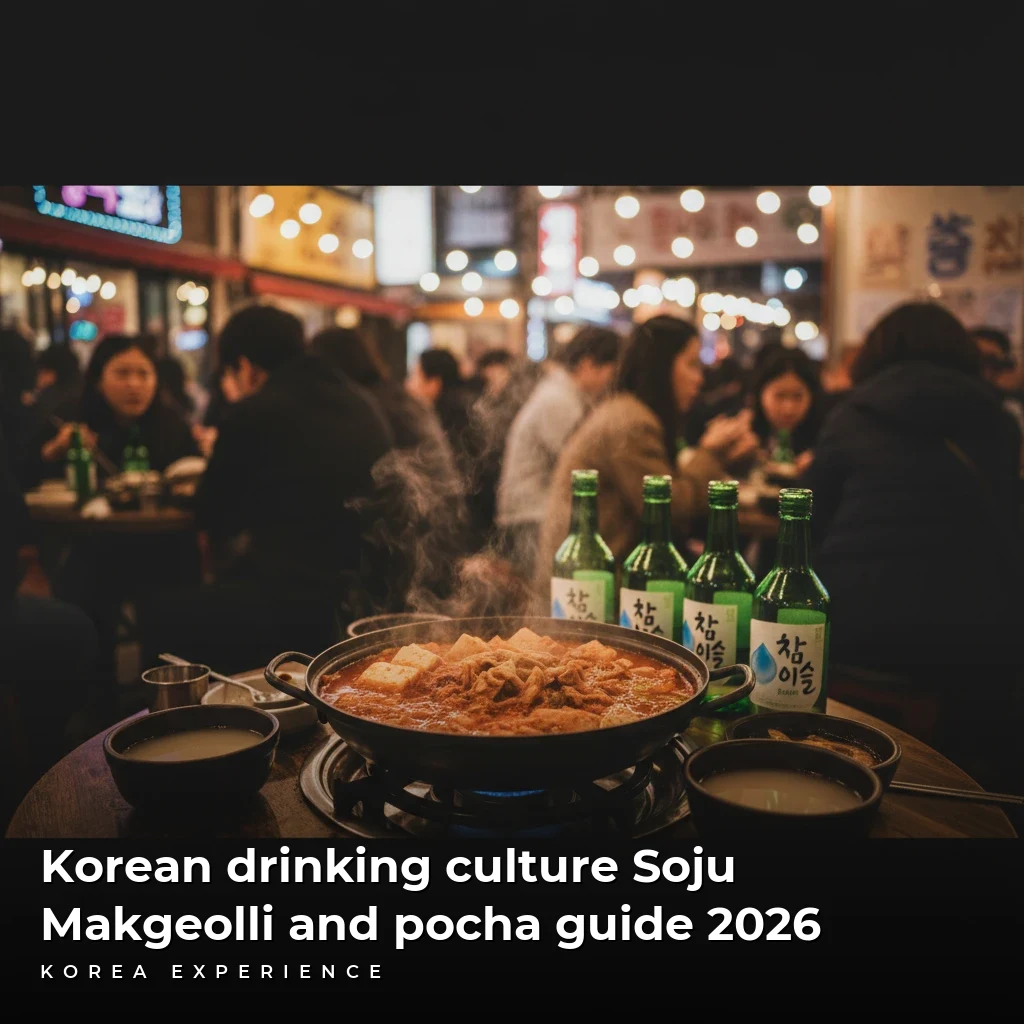
The ultimate 2026 guide to Korean drinking culture. Discover top Soju brands, best Makgeolli bars, and how to navigate Seoul Pocha streets like a local.
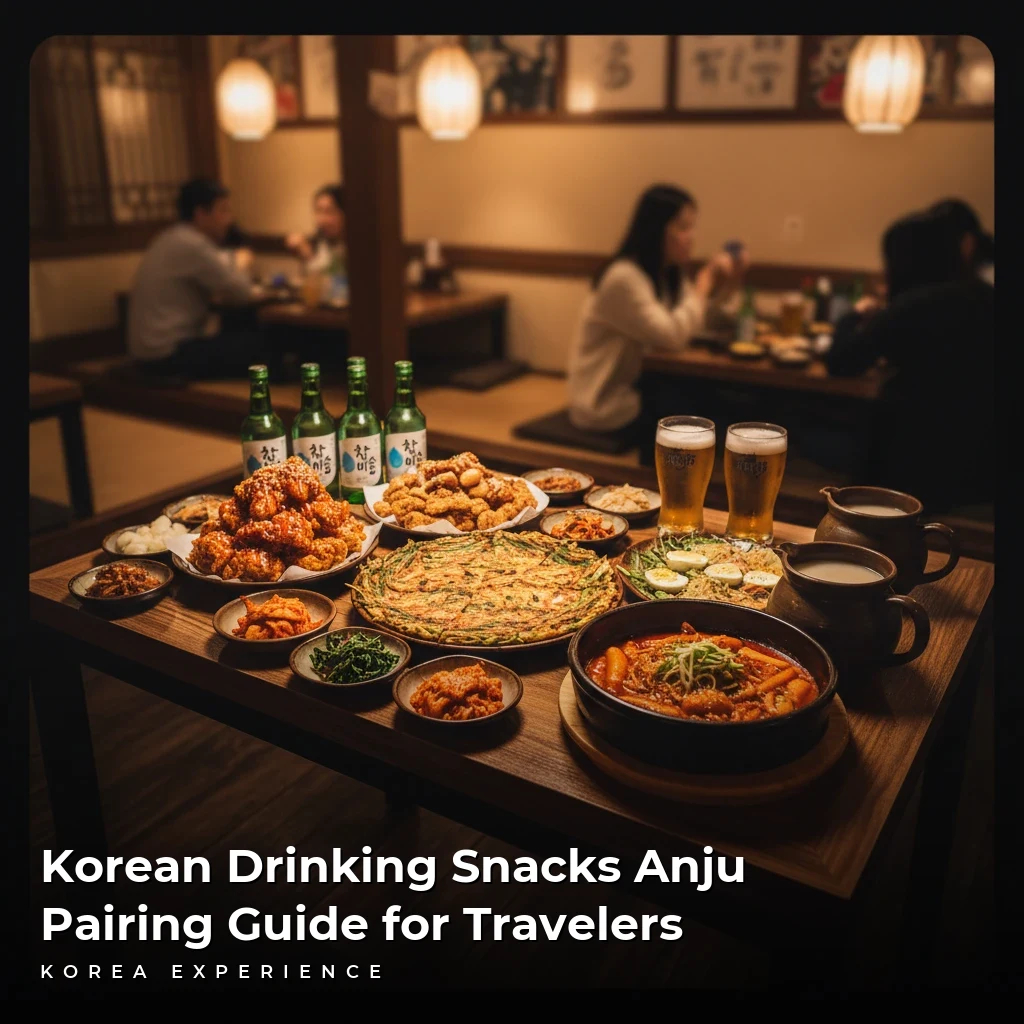
Master the art of Korean Anju pairings with our expert guide to Soju, Makgeolli, and Beer snacks for the ultimate local dining experience
Master the 2026 Korean trash system to avoid 100,000 KRW fines. Learn bag prices, sorting rules, and how to recycle 60% of waste like a local.
The ultimate 2026 guide to Korean fan culture. Master lightsticks, music show applications, birthday cafes, and ticketing warfare like a local expert.
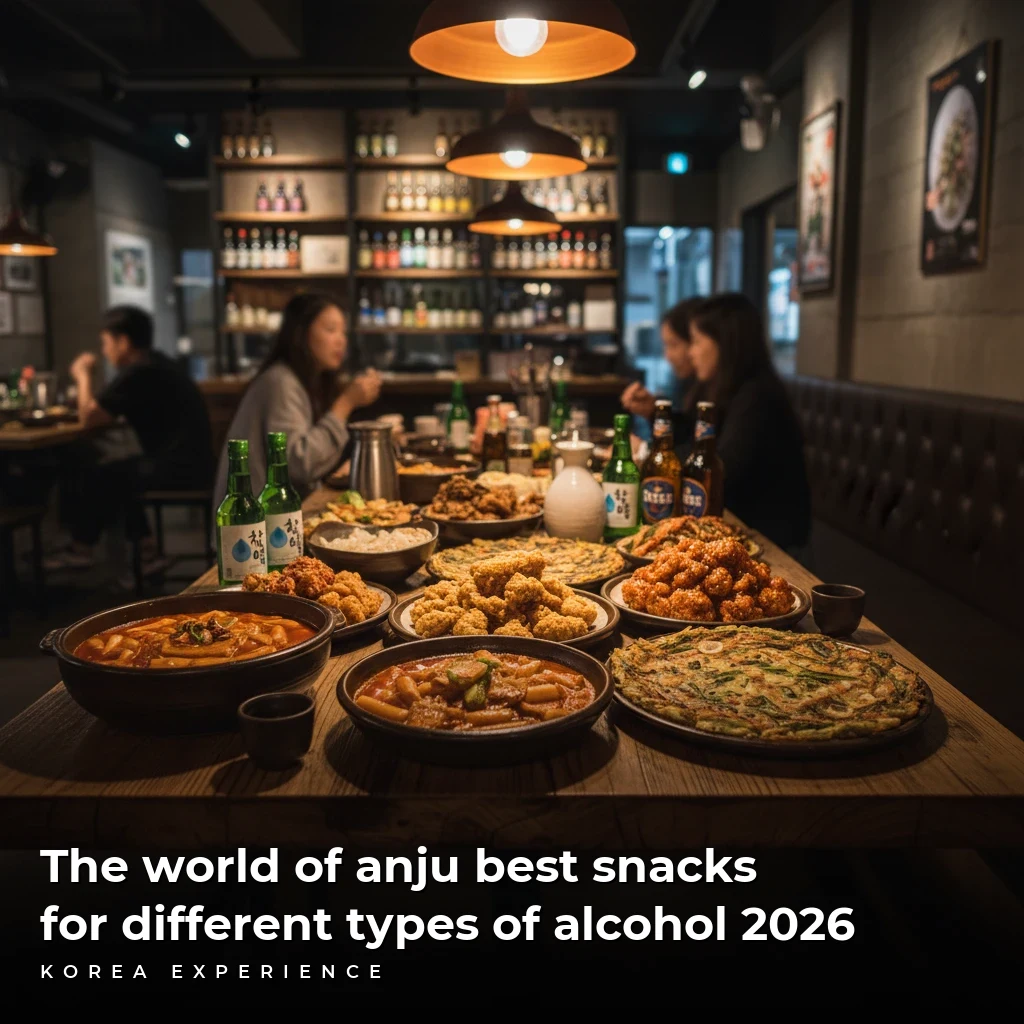
Discover the ultimate guide to Korean Anju culture in 2026. Learn how to pair Soju, Beer, and Makgeolli with the perfect snacks for an authentic experience.