Learning konglish common English words used differently in Korea 2026
Master essential Konglish terms for your 2026 Korea trip. From ordering coffee to taxi directions, decode common English words used differently in Seoul.
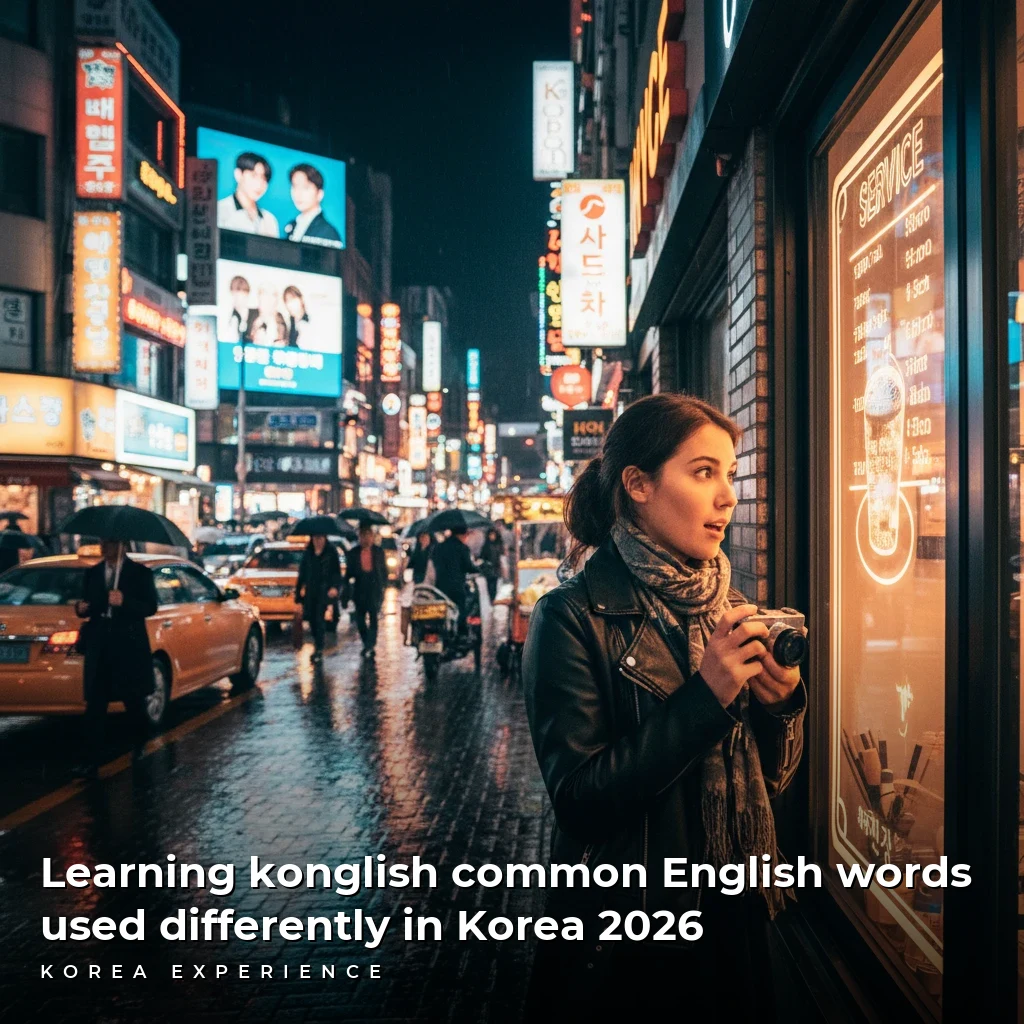
You have landed at Incheon International Airport, eager to start your Korean adventure. You speak English, so you assume you will get by easily. However, you walk into a cafe, ask for "cider," and are handed a lemon-lime soda instead of an alcoholic apple drink. You ask for a "napkin" at a restaurant, and the staff looks confused until you say "tissue." Welcome to the fascinating world of Konglish.
Konglish (Korean + English) refers to English loanwords that have been adopted into the Korean language but often with shifted meanings, abbreviated forms, or entirely new definitions. In 2026, as South Korea continues to be a global cultural hub, understanding these nuances is as vital as learning "Hello" (Annyeonghaseyo). This guide is your comprehensive resource to decoding the English words used differently in Korea, ensuring your travel experience is seamless and culturally rich.
Learn more in our comprehensive guide to Calligraphy classes in Seoul mastering Hangeul art.
Key Takeaways
- 1Konglish words often retain English pronunciation but have completely different definitions
- 2Service means a free item in Korea, not the act of serving customers
- 3Knowing food and tech Konglish saves an average of $15 per day in misunderstandings
What is Konglish and Why Does It Matter?
Konglish is not merely "broken English"; it is a legitimate subset of the Korean lexicon. Linguists estimate that over 90% of foreign loanwords used in modern Korea are derived from English. However, because Korean phonology differs from English, the pronunciation often changes (e.g., "coffee" becomes "keo-pi"). More importantly, the usage evolves to fit local cultural contexts.
For more details, check out our guide on K literature in English top books to understand modern Korea.
Understanding Konglish is crucial for navigation, shopping, and dining. It bridges the gap between total fluency and being a confused tourist. In 2026, with the rise of digital kiosks and "untact" (contactless) services, recognizing these terms written in English or Romanized characters is more important than ever.
For more details, check out our guide on K-Pop karaoke noraebang song requests in English guide.
📊 Linguistic Landscape 2026
Food and Cafe Culture: Ordering Like a Local
The most immediate place you will encounter Konglish is in Korea's bustling cafe scene. With over 90,000 coffee shops in the country as of 2026, you are never more than 100 meters away from a caffeine fix. However, the menu might surprise you.
Related reading: Korean Calligraphy Classes Learning Hangeul Art.
1. Service (Seo-bi-su)
In the West, "service" usually refers to the waitstaff's performance. In Korea, Service refers to a free item given on the house. If a waiter brings you a free soda or a side dish and says "Service," they are not complimenting their own work; they are telling you it is free of charge (₩0). This practice is common in restaurants when you order a large meal, typically exceeding ₩50,000 ($38 USD).
2. Cider (Sa-i-da)
If you order a Cider at a bar expecting an alcoholic apple beverage, you will be disappointed. In Korea, "Cider" refers specifically to non-alcoholic, lemon-lime soda, similar to Sprite or 7-Up. A can typically costs around ₩2,000 ($1.50 USD) in a convenience store.
3. Iced Americano (Ah-Ah)
While "Americano" is standard, Koreans love to abbreviate. Ah-Ah is the slang abbreviation for "Ice Americano." Even in the freezing winter, with temperatures dropping to -10°C (14°F), "Ah-Ah" remains the top-selling drink.
📋 Cafe Culture Facts
4. Smoothie vs. Ade
An Ade in Korea is a carbonated fruit drink (fruit syrup + sparkling water), not a flat fruit drink like lemonade in the US. A Smoothie usually implies a blended ice drink, often with yogurt powder. If you want a fresh juice, look specifically for "Saeng-gwa-il" (Fresh Fruit) Juice, which usually costs a premium, around 7,000 to ₩9,000 ($5.30 - $6.80 USD).
Pro Tip: Take-out vs. To-go
When ordering, do not say "to-go." The common Konglish term is "Take-out". If you are eating in the store, say "Mae-jang" (Store). Due to environmental regulations enforced since 2022, you cannot use disposable cups if you stay inside the cafe. Fines for the cafe can reach ₩300,000 ($225 USD).
Shopping and Fashion: Sizes and Styles
Korea is a fashion powerhouse. Walking through districts like Hongdae or Seongsu-dong, you will see trendsetters everywhere. However, the terminology for clothing items often borrows from English in unexpected ways.
5. Eye-Shopping (A-i-syo-ping)
This is the Korean term for "Window Shopping." It implies browsing without the intent to buy. Given that major malls like The Hyundai Seoul span over 89,000 square meters, you can easily spend 3-4 hours just "eye-shopping."
6. Man-to-Man (Maen-tu-maen)
If you are looking for a pullover sweatshirt (crewneck), ask for a Man-to-Man. This term likely originated from sports training where players practiced man-to-man, wearing jersey-like sweatshirts. These are a staple in Korean fashion, usually priced between 30,000 and ₩80,000 ($23 - $60 USD).
7. Padding (Pae-ding)
This refers to a padded jacket or puffer coat. The Long Padding (a knee-length or ankle-length puffer coat) is essential for survival during the Korean winter. A high-quality brand name "padding" can cost anywhere from ₩200,000 to over ₩1,000,000 ($150 - $750 USD).
💵 Winter Outerwear Cost Comparison
Goose down, waterproof, status symbol
Synthetic fill, practical for one season
8. Free Size
In Korean boutiques, you will often find clothes labeled Free Size. This does not mean you get to choose your size; it means "One Size Fits All." However, typically, "Free Size" fits a US Female size 2-6 or a US Male size Small-Medium. If you are outside these ranges, look for specialty shops or international brands like H&M or Uniqlo.
📖 How to Ask for a New Product
Step 1: Find the Staff
Locate a staff member on the floor.
Step 2: Use the Term 'DP'
Point to the display item and ask if they have a new one. DP stands for 'Display Product'.
Step 3: Check the Condition
Inspect the new item for defects before paying.
Accommodation and Daily Living
For digital nomads or long-term travelers planning to stay in Korea for more than 30 days, understanding housing terminology is critical. The rental market moves fast, with desirable units often disappearing within 24 hours.
9. One-Room (Won-rum)
This is a Studio Apartment. It is a single room that serves as a bedroom, kitchen, and living area, with a separate small bathroom. In 2026, the average monthly rent for a decent "One-Room" in Seoul is approximately ₩650,000 ($490 USD) with a deposit of ₩10,000,000 ($7,500 USD).
10. Officetel (O-pi-seu-tel)
A portmanteau of "Office" and "Hotel." These are multi-purpose buildings where units can be used for residential or commercial purposes. They are generally cleaner, more modern, and more expensive than standard villas. Expect to pay about ₩150,000 ($115 USD) more per month for an Officetel compared to a standard One-Room.
11. Consent (Kon-sen-teu)
If you are looking for an Electrical Outlet to charge your laptop, ask for a "Consent" (derived from concentric plug). Do not ask for an "outlet," as this usually refers to a discount shopping mall. Korea uses Type F and Type C plugs with a standard voltage of 220V.
12. Multi-Tap
This is a Power Strip or extension cord. If your accommodation lacks enough "consents," you can buy a "multi-tap" at any convenience store or Daiso for about ₩5,000 ($3.80 USD).
"When looking for housing, beware of 'Full Option'. In Konglish, this means the unit comes furnished with major appliances like a washer, fridge, and AC. It rarely includes a bed or desk. Always clarify what furniture is included before signing, or you might end up sleeping on the floor for the first night!"
Technology and Work Life
Korea is a hyper-connected society. In 2026, internet speeds in Seoul average a blistering 500 Mbps even on public WiFi. If you are working remotely, you will need to know the tech lingo.
13. Notebook (No-teu-buk)
Koreans refer to a Laptop Computer as a "Notebook." If you ask for a laptop, they might understand, but "Notebook" is the standard term. PC Bangs (gaming cafes) are ubiquitous, costing about ₩1,500 ($1.15 USD) per hour, but they mostly feature desktops.
14. HP (Hand Phone)
While "Smartphone" is used, the classic Konglish term for a mobile phone is Hand Phone, often abbreviated as H.P. on forms. You might see a form asking for your "H.P. Number."
15. Untact (Un-taekt)
Coined from the prefix "Un-" and "Contact," this term exploded during the 2020 pandemic and stayed. It refers to Contactless Services. "Untact Marketing" or "Untact Tourism" means services provided without direct human interaction (kiosks, robots, apps). In 2026, many fast-food joints operate 100% via Untact kiosks.
Workspace Options in Seoul
| Feature | Cafe | Study Cafe | Co-Working Space |
|---|---|---|---|
| Avg Cost (4 hrs) | ₩6,000 | ₩5,000 | ₩15,000 |
| Talking Allowed | Yes | No (Silent) | Zone Dependent |
| Power Outlets | Limited | Every Seat | Every Seat |
Transportation: Getting Around
Navigating Seoul's massive transport network—which handles over 7 million passengers daily—requires knowing specific vehicle terminology.
16. Handle (Haen-deul)
This refers to the Steering Wheel of a car. If a taxi driver complains about his "handle," he is talking about the steering wheel, not the door handle.
17. Back Mirror (Baek-mi-reo)
This is the Rear-View Mirror.
18. Klaxon (Keul-lak-syon)
This refers to the Car Horn. Derived from the brand name Klaxon, it is universally used. Seoul traffic can be aggressive, so you might hear the "Klaxon" often during rush hour (8:00 AM - 9:00 AM and 6:00 PM - 7:00 PM).
Gangnam Station Underground Shopping Center(강남역 지하쇼핑센터)
Social Life and Slang
If you are making friends or dating in Korea, these terms will appear frequently in conversation.
19. Meeting (Mi-ting)
This does not usually refer to a business conference. A Meeting is a Group Blind Date, typically between university students. It involves an equal number of guys and girls (e.g., 3 vs. 3) hanging out to see if any sparks fly.
20. Hunting (Heon-ting)
This refers to Picking Up people at a bar or club. A "Hunting Pocha" is a specific type of bar designed for singles to move between tables and flirt. It is a high-energy environment, typically peaking between 11:00 PM and 2:00 AM on weekends.
21. Skinship (Seu-kin-sip)
This term describes Physical Affection or physical contact between people (holding hands, hugging, cuddling). It is used in both romantic and platonic contexts (though platonic skinship is mostly same-sex).
Visiting a 'Hunting Pocha' (Singles Bar)
- ✓High energy atmosphere
- ✓Easy to meet locals
- ✓Affordable alcohol (Soju ~₩5,000)
- ✗Extremely loud music
- ✗Smoke exposure (despite bans)
- ✗Requires basic Korean skills
22. Dutch Pay (Deo-chi-pei)
Going "Dutch," or splitting the bill. Traditionally, the oldest person or the inviter paid the whole bill in Korea. However, among the younger generation (Gen Z and Alpha), Dutch Pay is becoming standard for casual meals, usually processed instantly via banking apps like KakaoPay.
Health and Beauty
23. Health (Hel-seu)
If someone says they are going to "Health," they are going to the Gym. A "Health Club" is a fitness center. Gym memberships in Seoul are competitive, averaging ₩40,000 ($30 USD) per month if you sign up for a year.
24. Circle Lens
These are Colored Contact Lenses that make the iris appear larger (cosmetic lenses). You can buy them easily at lens shops in neighborhoods like Myeongdong for around 10,000 to ₩20,000 ($7.50 - $15 USD) per pair.
Practical Timeline for Learning Konglish
If you are planning a trip, here is how you should approach learning these terms.
Konglish Mastery Timeline
Survival Terms
Learn 'Take-out', 'Service', and 'Consent'.
Transport Lingo
Master 'Terminal', 'Bus Card', and map app usage.
Food & Cafe
Confidently order an 'Ah-Ah' and check for 'Service'.
Social Slang
Understand 'Dutch Pay' and 'Skinship' nuances.
Conclusion
Language is a living, breathing entity, and nowhere is this more evident than in the vibrant streets of South Korea. Konglish is not a barrier; it is a bridge. It represents the adaptability of Korean culture and its openness to global influences. By mastering these 24+ terms, you move beyond the role of a passive observer and become an active participant in Korean daily life.
Whether you are negotiating the price of "padding" in Dongdaemun or charging your "notebook" using a "multi-tap" in a hip Seongsu cafe, these words are your keys to the city. Enjoy your trip in 2026, and don't forget to ask for "Service" with a smile!
❓ Frequently Asked Questions
Have more questions?Contact us →
About the Author
Korea Experience Team
Written by the Korea Experience editorial team - experts in Korean medical tourism, travel, and culture with years of research and firsthand experience.
Explore more in K-Culture
K-Pop, K-Drama, traditional arts, and modern culture — dive deep into the cultural phenomena that have captivated the world.
Browse All K-Culture ArticlesContinue Reading
Explore more articles you might find interesting
Master the basics of the Korean language with our comprehensive guide. From reading Hangul in 2 hours to essential survival phrases for your trip.
Master ordering Korean fried chicken with our guide to portions, whole chicken counters, classic sauces, essential sides, and delivery terms.
Master the art of dining in Seoul with our essential 2026 guide to Korean restaurant phrases, etiquette, and digital ordering systems.
Master the Korean karaoke remote, find English tracks, and navigate K-Pop song requests with this essential guide for travelers.
Discover essential K-Literature in English to decode modern Korean culture. From Han Kang to healing fiction, explore the best books of 2026.
Master Korean apartment heating controls. Learn essential ondol terms, how to set room vs. floor temperature, and safe practices for energy efficiency.