SMILE Pro vs. LASIK in Seoul 2026: Cost, Recovery & Results
SMILE Pro is the new gold standard for vision correction in Seoul, offering faster recovery and fewer side effects than traditional LASIK.
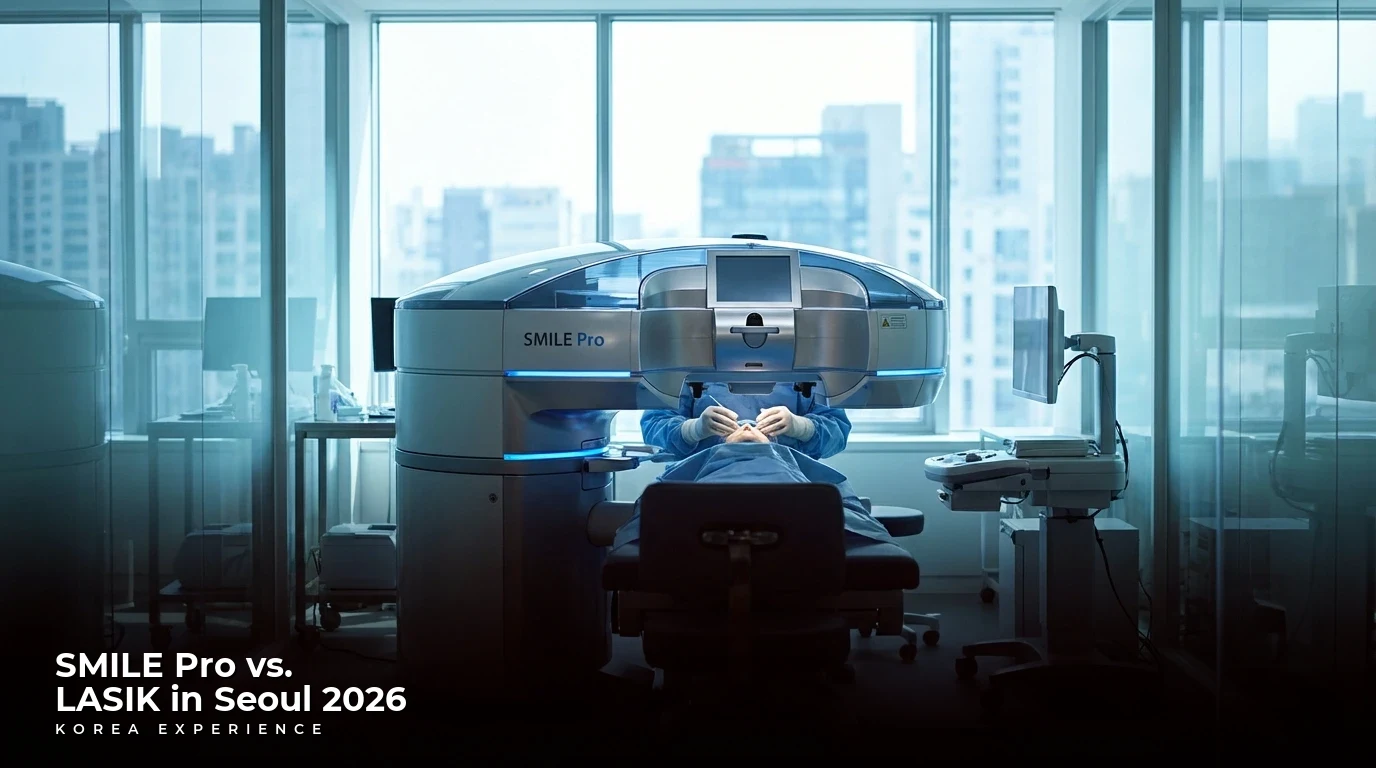
The short answer: If you're under 35, have moderate myopia (around -4.00 to -6.00), and can afford the extra ₩1,000,000 total cost, SMILE Pro is objectively superior—with 25% faster recovery and a drastically lower risk of chronic dry eyes. If you're over 40 or have mild prescriptions under -3.00, traditional LASIK is still incredibly effective and will save you enough money to fund an entire week-long recovery vacation in Jeju.
For the technology deep-dive, read our guide to SMILE Pro eye surgery as a 2026 tech upgrade from LASIK. Looking for a clinic? Browse our list of best surgery clinics for foreigners in Seoul.
Want the full picture? See our complete LASIK and LASEK eye surgery guide for Korea.
Key Takeaways
- 1The short answer: If you're under 35, have moderate myopia (around -4.00 to -6.00), and can afford the extra ₩1,000,000 total cost, SMILE Pro is objectively superior—with 25% faster recovery and a drastically lower risk of chronic dry eyes. If you're over 40 or have mild prescriptions under -3.00, traditional LASIK is still incredibly effective and will save you enough money to fund an entire week-long recovery vacation in Jeju.
- 2Here's the deal on the money: SMILE Pro costs about ₩2,500,000 to ₩3,000,000 for both eyes in Seoul's top clinics. Traditional LASIK is ₩1,500,000 to ₩2,000,000. That's a ₩1,000,000 premium (about $700 USD). As of January 1, 2026, the Korean government ended VAT refunds on medical tourism procedures, so what you see is what you pay—no more surprise tax savings at the airport.
- 3Actionable advice: Don't book based on 'Instagram discount codes' or 'foreigner specials.' Seoul's ophthalmology market is highly competitive, and some clinics push SMILE Pro aggressively because it has higher profit margins. Instead, get a comprehensive pre-op consultation at 2-3 clinics (often free), compare your exact corneal thickness and prescription data, and only then decide if the premium is medically justified for your specific case.
📋 SMILE Pro vs LASIK 2026
Vision Correction Evolution in Korea
SMILE Introduction
Carl Zeiss introduces ReLEx SMILE technology to Korea, offering a flapless alternative to LASIK.
Korean Market Boom
Seoul becomes a global hub for SMILE procedures, with clinics reporting 40% of patients from overseas.
SMILE Pro Launch
Zeiss releases SMILE Pro with CentraLign tracking, cutting procedure time from 30 seconds to 10 seconds per eye.
FDA Approval (US)
SMILE Pro receives FDA approval in the United States, validating safety for Western markets.
Korean Adoption Peak
Over 60% of Seoul's premium vision clinics upgrade to SMILE Pro machines.
VAT Refund Ends
South Korea eliminates VAT refunds for medical tourism, affecting procedure costs for foreign patients.
SMILE Pro vs Traditional LASIK
| Feature | SMILE Pro | Traditional LASIK | PRK (Surface) |
|---|---|---|---|
| Cost (Both Eyes) | ₩2.5M - ₩3M | ₩1.5M - ₩2M | ₩1M - ₩1.5M |
| Procedure Time | 10 sec per eye | 30 sec per eye | 5-10 min per eye |
| Recovery Time | 3-5 Days | 5-7 Days | 2-4 Weeks |
| Flap Created? | No (Keyhole only) | Yes (Large) | No |
| Dry Eye Risk | Very Low | Moderate | High (Short-term) |
| Night Vision Issues | Minimal | Occasional | Rare |
| Best For | Moderate myopia, active lifestyle | Mild-moderate myopia, cost-conscious | Thin corneas, high prescriptions |
| 2026 Status | Latest tech, premium pricing | Proven, widely available | Specialized, longer wait |
| Reversibility | No (Tissue removed) | No (Tissue removed) | No (Tissue removed) |
SMILE Pro Technology
- ✓Faster Procedure: The entire lenticule extraction takes about 10 seconds per eye, compared to 30+ seconds for LASIK. Less time under the laser means less anxiety and more precision.
- ✓Minimal Dry Eye: Because there's no large flap cut, SMILE Pro preserves more corneal nerves. Clinical data shows about 75% fewer reports of chronic dry eye syndrome compared to LASIK.
- ✓Active Lifestyle Friendly: No flap means no risk of flap dislocation. You can safely return to contact sports, swimming, and high-impact activities within weeks instead of months.
- ✗High Cost Premium: You're paying roughly ₩1,000,000 more for SMILE Pro. For many patients with simple prescriptions, that premium doesn't translate to a noticeably better outcome.
- ✗Limited Correction Range: SMILE Pro works best for myopia between -1.00 and -10.00. If you have significant astigmatism (over -3.00) or mixed prescriptions, LASIK might still be more effective.
- ✗Newer = Less Long-term Data: While SMILE has been around since 2011, SMILE Pro only launched in 2022. We don't have 20-year outcome studies yet, whereas LASIK has decades of follow-up data.
📖 How to Get Vision Correction in Seoul as a Medical Tourist
Step 1: Research and Shortlist Clinics
Focus on clinics with international patient departments and English-speaking staff. Top names include B&VIIT Eye Center, Dream Eye Center, and Gangnam Eyemedi.
Step 2: Book Pre-Op Consultations
Schedule consultations at 2-3 clinics. Most offer free or low-cost initial assessments that include corneal topography, pupil size measurement, and prescription verification.
Step 3: Compare Your Medical Data
After consultations, you'll have detailed reports. Compare your corneal thickness (must be >450 μm for SMILE), pupil size (large pupils may have more night glare), and exact prescription.
Step 4: Schedule and Prepare
Once you've chosen a clinic and procedure, you'll typically schedule the surgery for 2-3 days after your final consultation. Stop wearing contact lenses for at least 3 days before (7 days for hard lenses).
Step 5: Post-Op Care and Follow-up
You'll have check-ups at 1 day, 1 week, and sometimes 1 month post-op. Many clinics offer online follow-up consultations if you've already returned home.
In my practice, I've seen the marketing push patients toward SMILE Pro even when LASIK would give them an identical visual outcome at half the cost. The truth is: SMILE Pro's advantages are most pronounced in patients with moderate to high myopia (-4.00 to -8.00) and large pupils. If you're a -2.00 with small pupils, you're likely paying for brand prestige, not medical necessity.
Pro Tip: 'Trial Run' Your Vision
Before committing to either procedure, ask your clinic if they offer a 'Contact Lens Trial.' They'll give you lenses that simulate your post-surgery vision for a week. This helps you decide if the correction level they're planning is actually what you want.
Warning: Beware of 'Package Deal' Pressure
Some clinics offer suspiciously cheap 'foreigner packages' that bundle SMILE Pro with hotel stays and sightseeing. Often, these deals use older SMILE equipment (not Pro) or pressure you into add-ons like 'corneal strengthening' that aren't medically necessary for most patients.
No Korean Phone/ARC? Here's What To Do
Most major vision correction clinics in Seoul have dedicated 'International Patient' coordinators who handle everything via email or WhatsApp. You don't need a Korean phone number or ARC to book appointments or receive care. However, for post-op prescription medications, you'll need to use your passport at the pharmacy (not your ARC). Make sure to bring enough cash or a credit card, as some smaller pharmacies near clinics still prefer cash for foreign patients.
❓ Frequently Asked Questions
Have more questions?Contact us →
The SMILE Pro Revolution
So, you've been wearing glasses or contacts for years, and you've finally decided that 2026 is the year you fix your vision permanently. You've probably heard about LASIK—it's been around forever, and it's basically the "iPhone" of vision correction. But then you start seeing ads for "SMILE Pro," and suddenly everyone's saying it's the new superior option.
Here's the reality: SMILE Pro is legitimately an evolution in refractive surgery, but it's not a magic bullet. The core question you need to answer is: "Is the ₩1,000,000 premium worth it for my specific eyes?" And honestly, the answer depends on your prescription, your corneal anatomy, and your lifestyle.
Let me break down the science without the marketing fluff. Traditional LASIK involves creating a large corneal flap (about 20mm), lifting it, reshaping the underlying tissue with a laser, and then repositioning the flap. SMILE Pro, on the other hand, uses a femtosecond laser to create a tiny "lenticule" (a lens-shaped piece of tissue) inside your cornea through a 2-4mm incision. The surgeon then extracts that lenticule, which changes your corneal shape and corrects your vision.
Sources
- Carl Zeiss Meditec Official - SMILE Pro technology specifications
- Korean Society of Refractive Surgery - Clinical data and standards
- B&VIIT Eye Center - Leading SMILE Pro clinic in Seoul
- American Academy of Ophthalmology - LASIK vs SMILE comparative studies
- Korea Ministry of Health - 2026 medical tourism VAT policy changes
About the Author
Korea Experience Team
Written by the Korea Experience editorial team - experts in Korean medical tourism, travel, and culture with years of research and firsthand experience.
⚠️ Medical Disclaimer
The information provided on this website is for general informational purposes only and does not constitute medical advice. Always consult with qualified healthcare professionals before making any medical decisions.
Explore more in Medical Tourism
World-class medical procedures at competitive prices. From plastic surgery and dermatology to dental care and health checkups — your complete guide to medical tourism in Korea.
Browse All Medical Tourism ArticlesContinue Reading
Explore more articles you might find interesting
Compare Ultherapy, Thermage, and Shurink costs and results. Discover why Seoul offers treatments at 30-50% less than global rates with our 2026 guide.
Discover SMILE Pro eye surgery in Korea, the 2026 tech upgrade from traditional LASIK. Learn its benefits, process, and why Korea is your top destination.
Considering LASIK or LASEK eye surgery in Korea? Discover world-class clinics, advanced technology, costs, and a step-by-step guide for your vision correction journey.
A complete guide to hair transplant costs in Korea for 2026, featuring price comparisons, top methods like FUE and DHI, and realistic recovery timelines.
Get same-day dental implants in Seoul for 1000000 to 1800000 KRW in 2026. Enjoy a 95 percent success rate and save thousands compared to US or UK prices.
Compare Motiva Ergonomix at $7,200 against Sebbin Integrity at $5,400 in Seoul. Learn why the 2026 VAT refund end costs you 10 percent more.