Visa run strategies leaving and re entering south Korea guide
Master the art of the Korean visa run in 2026. Comprehensive guide on routes, costs, immigration risks, and re-entry tips for long-term travelers.
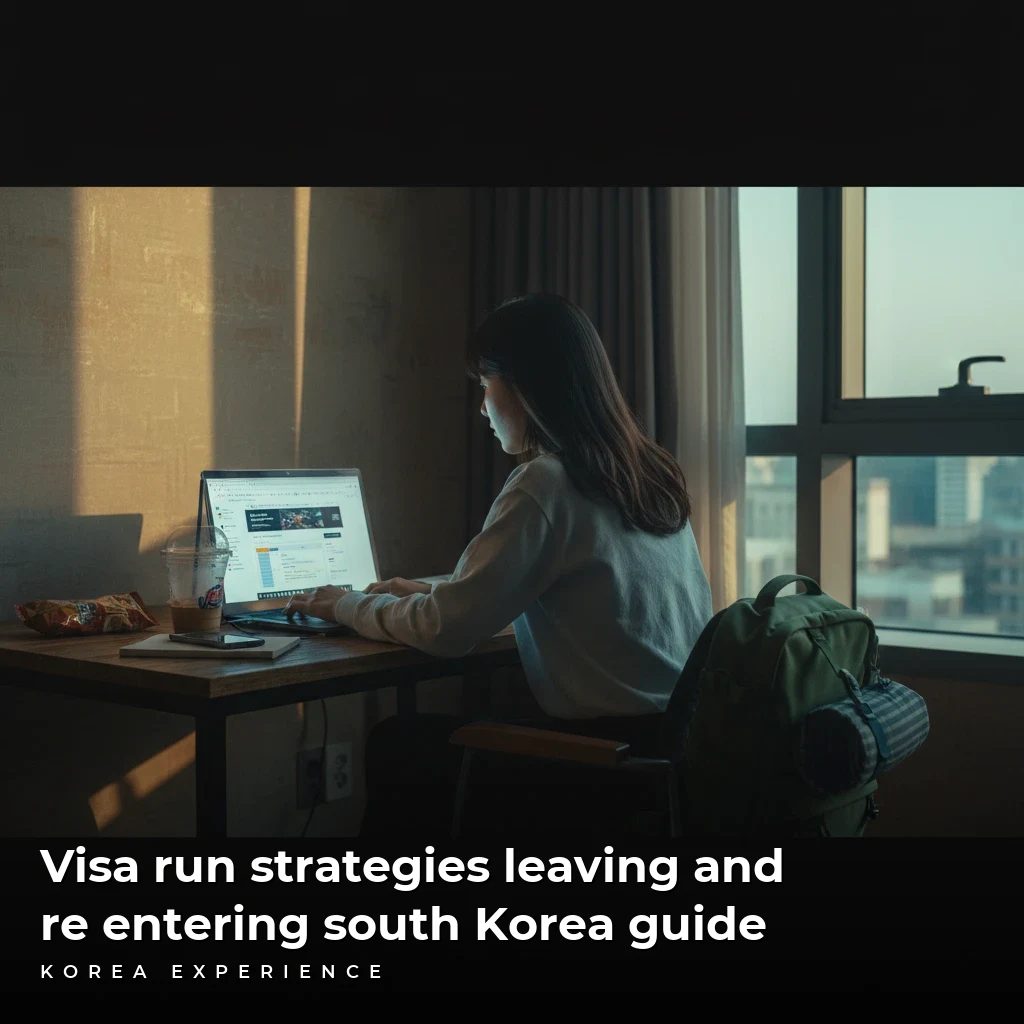
For many international residents, digital nomads, and long-term travelers in South Korea, the "visa run" is an inevitable ritual. Whether you are resetting a tourist waiver or transitioning between visa types, leaving and re-entering the country requires precision, preparation, and a clear understanding of immigration policies. In 2026, border control measures have become more sophisticated, making the "wing it" approach risky. A successful visa run is no longer just about buying a cheap ticket; it is a strategic operation involving timing, documentation, and demeanor.
Learn more in our comprehensive guide to Visa extension online vs in person methods in south Korea.
Learn more in our comprehensive guide to Changing visa status while in Korea guide for expats.
For more details, check out our guide on D 10 Job Seeker Visa After Graduation in 2026 Guide.
For more details, check out our guide on D 10 Job Seeker Visa Korea 2026 Complete Application Guide.
The concept is simple in theory: depart South Korea, enter a third country, and return to receive a new period of stay. However, with the Korea Electronic Travel Authorization (K-ETA) system fully integrated and scrutiny on "perpetual tourists" increasing, travelers must navigate this process with care. This guide covers the most efficient routes, cost breakdowns, and critical strategies to ensure your re-entry is smooth and successful.
Key Takeaways
- 1The Busan-Fukuoka ferry remains the most cost-effective route, averaging $110 round trip.
- 2Immigration officers now flag passports with more than 3 consecutive tourist resets.
- 3Always carry proof of onward travel departing Korea within 90 days of your re-entry.
Understanding the Landscape: The Rules in 2026
Before booking a ticket, it is vital to understand the legal framework. Most Western passport holders (US, UK, Canada, EU, Australia) are granted a 90-day visa-free entry. However, this is intended for tourism. Utilizing this mechanism to live in Korea strictly technically violates the spirit of the law, even if it is not explicitly illegal to re-enter.
As of February 2026, Korean Immigration Service (KIS) data indicates that repeat entrants—those entering more than four times in a 12-month period without a long-term visa—face a secondary questioning rate of approximately 18%. This is a significant increase from the 5% estimated in previous years. The standard fine for overstaying even by a single day starts at ₩100,000 (approx. $75 USD), and it escalates rapidly, potentially leading to entry bans.
Strict Warning: The K-ETA Factor
If your nationality requires a K-ETA (Korea Electronic Travel Authorization), ensure it is still valid. While K-ETAs are generally valid for three years, if you have renewed your passport since your last entry, your K-ETA is void. You must apply for a new one at least 72 hours before your return flight or ferry. The application fee is roughly ₩10,000.
The Classic Route: Busan to Fukuoka by Ferry
For those located in the southern half of the peninsula, or those willing to take the KTX train to Busan, the ferry to Fukuoka, Japan, is the undisputed king of visa runs. It is fast, affordable, and historically less scrutinized than airport entries.
The journey connects the Busan International Ferry Terminal to Hakata Port in Fukuoka. The high-speed hydrofoil, primarily operated by the "Queen Beetle" or similar vessels, covers the 213-kilometer (132-mile) distance in strictly 3 hours and 40 minutes.
The Logistics of the Ferry Run
The ferry terminal is located a short 10-minute walk from Busan Station. Most runs are executed as same-day returns or overnight stays. A typical economy class round-trip ticket costs between ₩130,000 and ₩180,000 depending on the season. Port taxes add approximately ₩25,000 to the total.
The Same-Day Fukuoka Sprint
Check-in at Busan Port
Arrive 90 minutes early. Counters close sharply 60 mins prior.
Depart Busan
3.5 hour journey across the Korea Strait.
Arrive Hakata
Clear Japanese immigration (usually 20-30 mins).
Lunch & Supplies
Grab ramen and duty-free goods near the port.
Check-in for Return
Back to the terminal for the return leg.
Arrive Busan
Re-enter Korea with a fresh stamp.
Cost Analysis: Ferry vs. Flight
Is the ferry worth the trek to Busan if you live in Seoul? The KTX from Seoul to Busan costs roughly ₩59,800 one-way and takes about 2.5 hours. This brings the total transport time to nearly 7 hours one way.
💵 Visa Run Cost Comparison (From Seoul)
Includes KTX + Ferry + Port Taxes. Total travel time: 14+ hours.
If you take the ferry, be aware of the weather. The Korea Strait is rough. If wave heights exceed 2.5 meters, hydrofoils are cancelled instantly. Always check the marine forecast 48 hours in advance. February brings strong winds, leading to a cancellation rate of about 15%.
The Air Strategy: Best Airports for Quick Turnarounds
If you prefer flying, or are based in Seoul/Gyeonggi-do, Incheon International Airport (ICN) and Gimpo International Airport (GMP) are your hubs. The goal is to minimize flight time to maximize your turnaround speed.
Top Destination: Osaka (Kansai International Airport)
Osaka is a favorite because of the high frequency of flights. LCCs (Low-Cost Carriers) like Jeju Air, T'way, and Peach Aviation run dozens of flights daily.
- Flight Time: 1 hour 40 minutes.
- Average Cost: 250,000 - ₩400,000 round trip.
- Immigration Speed: Kansai is efficient, averaging 35 minutes for processing.
Secondary Destination: Taipei (Taoyuan International Airport)
For those needing a break from Japan or wanting to reset their Japanese tourist clock as well, Taipei is the best alternative.
- Flight Time: 2 hours 30 minutes.
- Average Cost: 350,000 - ₩500,000.
- Note: Taiwan offers 90-day visa-free entry to most Western nations, similar to Korea.
📊 2026 Flight Statistics
The Re-Entry: Preparing for Immigration
This is the most critical phase. Leaving is easy; getting back in is where the anxiety lies. Korean immigration officers have broad discretion. They are looking for illegal workers and people living in Korea without proper tax residency.
When you approach the immigration desk at Incheon or Busan Port, the officer sees your entire entry history on their screen. If they see "Entry: Nov 2025, Exit: Feb 2026, Entry: Feb 2026," it raises a red flag. This pattern suggests you are living in Korea, not touring.
Essential Documentation Checklist
Never approach the desk empty-handed. Have the following accessible on your phone or printed:
- Proof of Onward Travel: You must have a ticket leaving Korea within the 90-day window you are about to be granted. A "dummy ticket" is risky; book a refundable ticket or a cheap ferry ticket to Japan for a date 89 days later.
- Proof of Accommodation: A hotel booking or the address of the friend you are staying with. If staying with a friend, have their phone number ready.
- Proof of Funds: While rarely asked for, having a banking app ready to show a balance of at least ₩1,000,000 ($750 USD) proves you can support yourself.
📋 Re-Entry Risk Factors
The Interview Strategy
If questioned, keep your answers short, truthful, and consistent.
- Officer: "Why are you returning so soon?"
- You: "I am continuing my tourism. I went to Japan for the weekend and now I am visiting Seoul and Seoraksan National Park."
- Officer: "How do you support yourself?"
- You: "I have savings from my previous job in [Home Country]." (Do not mention remote work or freelancing while in Korea, as digital nomad visas are a separate category).
Dress to Impress
Appearance matters. Do not look like a backpacker running out of funds. Business casual or neat travel attire subconsciously signals financial stability to immigration officers. Avoid wearing flip-flops or tank tops at the border control.
Making the Most of the Trip: Where to Go
Since you have to leave, you might as well enjoy the mini-vacation. If you are doing the Fukuoka run, the area around Hakata Port and Tenjin station is excellent for a few hours of exploration.
Ichiran Ramen Main Office(Ichiran Ramen)
If you choose the Osaka route, the Dotonbori district is approximately 50 minutes by train (Nankai Line) from Kansai Airport. The round trip train ticket costs about 1,860 JPY (approx. ₩16,000).
Pros and Cons of Different Strategies
Choosing between a "Same-Day Turnaround" and a "Weekend Trip" impacts your stress levels and your wallet.
Same-Day vs. Weekend Trip
- ✓Lowest possible accommodation cost (Zero).
- ✓Minimal packing required.
- ✓Quickest return to routine in Korea.
- ✗Extremely exhausting (12+ hour day).
- ✗Higher risk if transport is delayed.
- ✗Suspicious to immigration officers (looks purely like a visa run).
Advanced Tips for Long-Term Stayers
If you find yourself needing to do visa runs frequently, you should consider legitimate long-term visa options to avoid the stress and risk of denial.
- Digital Nomad Visa (Workcation Visa): Introduced recently, this allows remote workers with an income of over ₩85 million (approx $65,000 USD) per year to stay for up to two years.
- Language Student Visa (D-4): Enrolling in a Korean language program at a university provides a 6-month renewable visa. Tuition averages ₩1,600,000 per 10-week term.
- Point-Based Resident Visa (F-2-7): For highly skilled professionals.
📖 How to Prepare for Re-Entry Day
Step 1: Review Entry History
Count your days. Ensure you have not overstayed the 90-day limit by even one hour.
Step 2: Clean Your Phone
Delete messages discussing illegal work or teaching English without a visa.
Step 3: Print Documents
Physical copies of your return ticket and accommodation are faster than fumbling with a phone.
Detailed Route Comparison
To help you decide which third country to use for your run, here is a comparison of the most popular options available from Incheon (ICN) and Busan (PUS).
Visa Run Destination Comparison
| Feature | Fukuoka (Japan) | Osaka (Japan) | Taipei (Taiwan) |
|---|---|---|---|
| Avg Flight/Ferry Cost | $110 (Ferry) | $220 (Flight) | $280 (Flight) |
| Travel Time (One Way) | 3.5 hrs | 1.5 hrs | 2.5 hrs |
| Food Quality | High | Very High | High |
| Immigration Speed | Fast | Medium | Fast |
The "Q-Code" and Health Regulations
While pandemic-era restrictions have largely lifted, the Q-Code (Quarantine Information Pre-entry System) infrastructure remains. As of 2026, it is occasionally reactivated during flu seasons or regional outbreaks.
Always check the KCDA (Korea Disease Control and Prevention Agency) website 24 hours before return. If active, filling out the Q-Code online saves you roughly 20-30 minutes of queuing at Incheon Airport upon arrival. The system generates a QR code that allows you to breeze through the health quarantine checkpoint.
What Happens if You Get Denied?
It is the nightmare scenario. If the immigration officer decides you are not a genuine tourist, you will be denied entry.
- The Process: You will be taken to a holding room and interviewed.
- The Result: You will likely be put on the next flight back to your port of origin (e.g., sent back to Fukuoka or Osaka).
- The Cost: You are responsible for the cost of the ticket.
- Future Impact: A denial of entry stamp makes returning to Korea extremely difficult for at least 1-2 years and may flag you in other countries' systems.
The 'Honest Mistake' Plea
If you genuinely miscalculated your days and overstayed by one day, do not try to sneak past. Go to the immigration office at the airport before you try to leave. You will likely pay a fine and be allowed to leave, but you may face a temporary re-entry ban. Trying to leave without declaring it will result in a harsher ban.
Conclusion
The visa run is a rite of passage for many Korea enthusiasts, but in 2026, it requires professionalism. The days of casual, endless border hopping are fading as immigration systems become more digitized and interconnected. By treating the process with respect—preparing documents, dressing well, and adhering to the 90-day rules strictly—you can continue to enjoy life in the Land of the Morning Calm.
Remember, a visa run is a temporary solution. If you love Korea enough to live here, the ultimate strategy is to work towards a long-term residency visa. Until then, safe travels and may your stamps always be granted.
❓ Frequently Asked Questions
Have more questions?Contact us →
About the Author
Korea Experience Team
Written by the Korea Experience editorial team - experts in Korean medical tourism, travel, and culture with years of research and firsthand experience.
Explore more in Living in Korea
Everything expats and long-term visitors need to know — from visa requirements and housing to banking, healthcare, and daily life tips.
Browse All Living in Korea ArticlesContinue Reading
Explore more articles you might find interesting
A comprehensive guide to long-term stay options for retirees in South Korea, including investment visas, costs, and healthcare access.
Compare Hikorea online applications versus immigration office visits for Korean visa renewals. Find costs, documents, and expert tips for 2026.
A comprehensive guide to pensions, visas, healthcare, and housing for expats planning to retire in South Korea. Secure your future in the Land of Morning Calm.
Complete guide to the 2026 F-2 resident visa in South Korea. Learn points requirements, income thresholds, and application steps for long-term residency.
Complete guide to South Korea F-6 marriage visa requirements including income limits, language tests, and interview tips for 2026 applicants.
Discover the best Korea SIM cards for long-term stays. Compare MVNOs, postpaid plans, and verification steps to save money and stay connected.