Bringing prescription medications home from Korea: Customs rules 2026
A complete guide to taking prescription drugs out of Korea and through customs. Includes limits, documentation, and specific country rules for 2026.
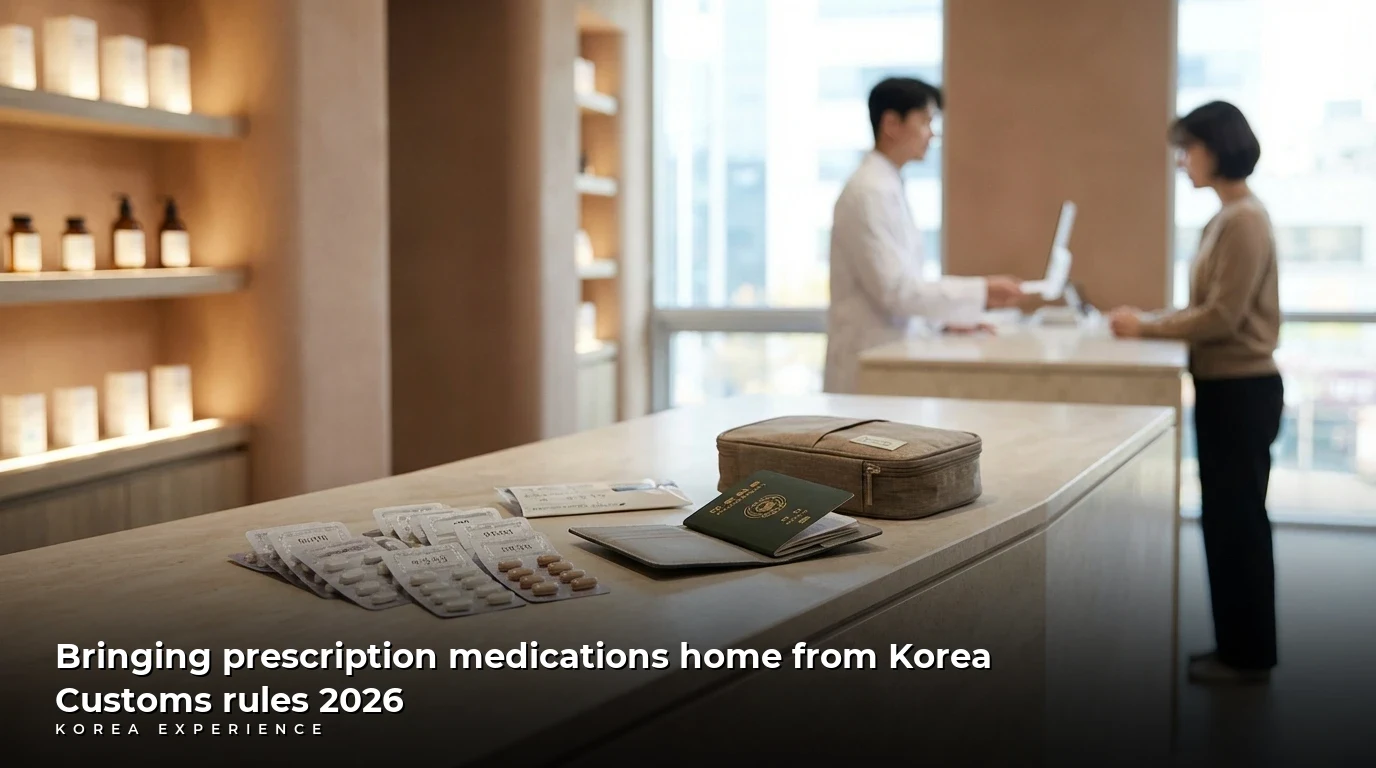
Travelers leaving South Korea after medical treatment, or expatriates returning home, often face a complex dilemma: how to legally transport prescription medications across international borders. Whether you are carrying painkillers following plastic surgery in Gangnam, a 3-month supply of dermatological medication, or managing a chronic condition, navigating the intersection of Korean exit laws and your home country's entry regulations is critical. Failing to prepare the correct documentation can result in confiscation of expensive medicines, heavy fines, or even detention at airport security.
The short answer: You can bring prescription medications home from Korea if they are for personal use, accompanied by an English-language prescription and doctor's note, and generally do not exceed a 90-day supply. However, strict restrictions apply to narcotics and psychotropic drugs (like strong painkillers or ADHD medication), which require specific customs declarations.
Key Takeaways
- 1Always keep medications in their original Korean packaging with the prescription label attached
- 2Request a 'Certificate of Treatment' and prescription in English from your doctor before leaving the clinic
- 3Liquid medications over 100ml in carry-on bags require a specific doctor's note for airport security
- 4Narcotics and psychotropic drugs (like Tramadol or Zolpidem) have strict 30-day limits for some destinations
- 5Australia and Japan have the strictest entry requirements for medications arriving from Korea
Understanding Korean Drug Classifications
Before you pack your bags, it is essential to understand how South Korea classifies the medication you are holding. What is considered an over-the-counter (OTC) headache cure in the United States might be a prescription-only drug in Korea, and vice versa. However, the most dangerous area for travelers involves drugs classified as Narcotics or Psychotropics.
In 2026, the Korean Ministry of Food and Drug Safety (MFDS) maintains a rigorous database of controlled substances. If you have undergone major surgery, such as double jaw surgery or body contouring, you may have been prescribed strong analgesics.
📋 Korean Drug Categories
General Prescription Drugs (Non-Controlled)
These include antibiotics (often prescribed after rhinoplasty or dental work), anti-inflammatories, blood pressure medication, and standard dermatological creams. These are generally the easiest to transport. Korean customs rarely stop travelers leaving with these, provided the quantity is reasonable (usually defined as less than 3 months' supply) and clearly for personal use.
Controlled Substances (Narcotics and Psychotropics)
This category trips up many travelers. It includes:
- Strong Painkillers: Opioids, Tramadol (often used for post-op recovery).
- Sleep Aids: Zolpidem (Stilnox), Benzodiazepines (Valium, Xanax).
- ADHD Medication: Methylphenidate (Concerta). Note: Amphetamine-based drugs like Adderall are illegal in Korea and cannot be prescribed, so you likely won't be taking them out unless you went through a rigorous approval process to bring them in.
If you are carrying these, you must be meticulous. While Korean exit customs checks are generally less invasive than entry checks, carrying a bag full of loose psychotropic pills without documentation is a red flag that can lead to an investigation by the Incheon Airport Narcotics Investigation Team.
Warning: Loose Pills
Never transfer prescription pills into generic travel organizers or Ziploc bags when flying internationally. Customs officers need to see the original bottle or blister pack with the drug name and dosage clearly printed. If you have loose pills, they may be tested for narcotics, causing significant delays.
Essential Documentation for Departing Korea
The success of bringing your medication home depends entirely on the "paper trail" you create before you head to Incheon International Airport. Do not assume your home country's customs agents can read Hangul (Korean). You must obtain English-language documentation while still at the clinic.
If you have visited one of the best plastic surgery clinics for foreigners in Seoul, they are likely accustomed to this request. However, smaller local clinics may need specific instructions.
📖 How to Secure English Medical Documentation
Step 1: Request at Consultation
Tell your doctor immediately that you are traveling abroad and need documents in English.
Step 2: Get the Certificate
Ask for a 'Certificate of Treatment' (So-gyeon-seo). This summarizes your diagnosis and why the meds are necessary.
Step 3: Verify Details
Check that your passport name matches the name on the documents exactly. No nicknames.
Step 4: Receipts
Keep the detailed receipt (Yeong-su-jeung) which proves you purchased the meds legally in Korea.
The Cost of Documentation
While the prescription paper itself is often free or nominal, the "Medical Certificate" or "Doctor's Note" usually incurs a fee in Korea. It is not covered by National Health Insurance for travel purposes.
💵 Documentation Costs (2026 Estimates)
Detailed doctor's note for Customs/TSA
Basic list of meds (often in Korean only)
Navigating Incheon Airport (ICN) Security
Departing from Incheon Airport is generally efficient, but carrying medications adds a layer of complexity to the security screening process.
Carry-On vs. Checked Luggage
The golden rule of travel is to keep essential medication in your carry-on luggage. If your checked bag is lost or delayed, you do not want to be without your post-surgery antibiotics or pain management.
However, the Liquid Rule (LAGs - Liquids, Aerosols, and Gels) applies strictly at Incheon.
- Solid Pills: No limit in carry-on, but must be screened.
- Liquids (Syrups, Ointments, Pumpkin Juice): If the individual container is over 100ml, it is generally banned from carry-on unless it is a prescription medication.
- The Exception: You can bring liquid medication >100ml if you present the doctor's note to the security officer. They may ask to open the bottle for testing.
"Many plastic surgery patients try to bring boxes of 'Pumpkin Juice' (for swelling) in their carry-on. Security will throw this away if it exceeds 100ml packets totaling 1 liter. Put the pumpkin juice in your checked bag; keep your antibiotics and painkillers in your backpack."
Country-Specific Entry Rules: Bringing Meds Home
This is the most critical section. Leaving Korea is the easy part; entering your home country is where travelers often face fines. Below is a breakdown of the rules for the most common destinations for travelers leaving Korea in 2026.
1. United States (FDA & CBP Rules)
The United States allows travelers to return with medication for personal use, generally defined as a 90-day supply.
- Requirements: You must declare all medications on your customs form if asked (though the specific question often relates to "commercial merchandise," you should verbally declare controlled substances).
- Controlled Substances: If you are bringing back Tramadol or Zolpidem prescribed in Korea, the medication must be in its original container. You must possess a valid prescription or doctor's note in English.
- Prohibited Items: Even with a prescription, you cannot bring "illegal" narcotics into the US, but most standard post-op meds prescribed in Korea are FDA-approved equivalents.
2. Canada (CBSA Rules)
Canada has similar rules to the US but focuses heavily on the "Single Course of Treatment" or a 90-day supply, whichever is less.
- The "Visitor" Exemption: This applies mostly to visitors to Canada, but returning residents are also permitted a 90-day supply of prescription drugs.
- Over-the-Counter: Canada is strict about "health products." If you bought bulk Korean herbal supplements or diet pills (often containing ephedrine or similar), these may be scrutinized.
3. Australia (TGA Rules)
Australia has some of the strictest biosecurity and drug importation laws in the world.
- Declaration: You MUST check "Yes" on the Incoming Passenger Card regarding "Medicine, steroids, illegal pornography, firearms, weapons or illicit drugs." Do not be afraid of checking "Yes"—it simply prompts a conversation. If you check "No" and are caught with prescription painkillers, you face an on-the-spot fine of over AUD 3,000 (approx. 2.7M ₩).
- Quantity: Maximum 3-month supply.
- Documentation: An English letter from your Korean doctor is mandatory for anything controlled.
📊 Australia Border Stats
4. United Kingdom & EU
The UK and EU nations generally allow for a 3-month supply for personal use.
- Schengen Area: If you are transiting through a Schengen country to get to the UK, be aware that strict rules regarding psychotropic drugs apply. You generally need a specific certificate for carrying narcotics across Schengen borders, though direct transit passengers are often exempt from detailed checks unless leaving the secure area.
- UK Specifically: Controlled drugs (like strong opioids) usually require you to carry a letter from the prescribing doctor containing your name, travel dates, and a list of the medication.
5. Singapore
Singapore strictly regulates drugs. Many common painkillers or sleeping pills in Korea contain ingredients that are controlled in Singapore.
- Pre-Approval: For certain "psychotropic" medications, you may need to apply for approval from the Health Sciences Authority (HSA) before you fly back to Singapore, even if you are a resident.
- Check the List: Check the HSA website for specific ingredients like Pseudoephedrine (common in Korean cold meds) or Codeine.
Entry Limits by Country
| Feature | USA | Australia | UK/EU |
|---|---|---|---|
| Max Supply | 90 Days | 3 Months | 3 Months |
| Declare Required? | If Controlled | ALWAYS | If Controlled |
| English Note | Recommended | Mandatory | Mandatory |
Handling "Medical Tourism" Specifics
If you visited Korea specifically for medical procedures, your medication "kit" likely looks different from a standard tourist's.
Post-Plastic Surgery Kits
Clinics often provide a recovery bag containing:
- Antibiotics: Usually a 7-14 day course. (Low risk).
- Painkillers: Tylenol (Acetaminophen) or NSAIDs. (Low risk).
- Strong Painkillers: Tramadol (Medium risk - requires documentation).
- Deswelling Medicine: Often herbal or enzyme-based. (Low risk, but looks suspicious if loose powder/liquid).
- Ointments: Antibiotic creams. (Subject to liquid rules).
For those who have visited best dermatology clinics in Seoul for foreigners, you might have prescription acne medication (Isotretinoin) or steroid creams. Isotretinoin is not a narcotic, but because it is a potent teratogen, some countries monitor its importation. Always keep the prescription box.
Herbal Medicines (Hanbang)
If you visited a traditional Korean medicine clinic, you might have pouches of dark liquid herbal medicine (Hanyak).
- The Risk: Customs officers in Western countries (especially Australia and New Zealand) view these as "Plant Products" or "Soil/Organic Material" risks.
- The Solution: Ask the clinic for an English ingredients list. Ensure the pouches are commercially sealed (vacuum packed). Declare them as "Traditional Medicine" to Agriculture/Biosecurity officers.
What if you run out or lose medication abroad?
It is a common nightmare: you are halfway through your flight or transit and realize you left your meds in the hotel in Seoul. Or, you arrive home and realize you need a refill of a specific Korean medication that isn't available domestically.
Can a Korean clinic mail me medication? Generally, NO.
Mailing prescription drugs internationally is illegal in almost all circumstances for individuals.
- Korean Law: Korean pharmacists cannot dispense medication without the patient being present (or a designated proxy with strict paperwork). They certainly cannot mail it abroad.
- Receiving Country Law: Customs will almost certainly seize mailed prescription drugs unless the sender is a registered pharmaceutical manufacturer and the receiver has an import license.
Mailing vs. Carrying Meds
- ✓Carrying: You have immediate access
- ✓Carrying: You can explain to customs officers
- ✓Carrying: Legal personal allowance
- ✗Mailing: High risk of seizure
- ✗Mailing: Illegal in most jurisdictions
- ✗Mailing: Medication may degrade in transit
If you need a refill, you must take your English prescription (from the Korean doctor) to a doctor in your home country. They cannot "fill" the Korean prescription directly, but they can use it as evidence to write you a new domestic prescription for a local equivalent.
Special Categories: ADHD and Psychotropics
This deserves a specific focus because the laws are so severe.
ADHD Medication: South Korea is extremely strict about amphetamines. If you are a resident leaving Korea and returning to a country where Adderall is legal (like the US), you are fine once you land. However, if you were prescribed Concerta (Methylphenidate) in Korea—which is the standard treatment there—you must have the paperwork.
- Concerta is a controlled substance.
- Limit: Usually 30 days supply for many jurisdictions, though US/UK allow up to 90.
Sleeping Pills (Zolpidem/Stilnox): Often prescribed for jet lag or post-op recovery.
- This is a highly controlled psychotropic in Korea.
- Do not carry more than what is prescribed for the journey and immediate recovery. Carrying 500 pills of Zolpidem "for later" will look like drug trafficking.
Practical Timeline: From Clinic to Home
To ensure a smooth journey, follow this timeline.
Medication Transport Timeline
Review Meds
Calculate exactly how much you need. Throw away empty boxes but keep labels.
Get Paperwork
Collect English certificate and prescription copies.
Organize Carry-On
Place meds in a clear plastic bag within your carry-on. Keep liquids >100ml separate with the note.
Screening
Remove the medication bag if asked. Have documents in hand.
Customs Declaration
If you have narcotics or large quantities, go to the 'Goods to Declare' channel.
Airport Resources
If you forgot to buy basic OTC meds (like motion sickness pills or mild painkillers) before getting to the airport, or if you need to buy a mask, pharmacies are available.
World Top Pharmacy(월드탑약국)
FAQ: Common Questions about Traveling with Meds
❓ Frequently Asked Questions
Have more questions?Contact us →
Final Thoughts
Bringing prescription medications home from Korea is a manageable process if you treat it with the seriousness it deserves. The key takeaway is transparency. Never try to hide medication. Having the correct English documentation converts a potentially stressful interrogation by customs officers into a 30-second glance at a piece of paper.
For more information on planning your medical trip efficiently, consider reading our guide on booking medical consultations in Korea. If you are looking for post-procedure recovery accommodation, check out our insights on Airbnb vs Recovery Hotels.
Safe travels, and may your recovery be smooth and complication-free.
Disclaimer: This article is for informational purposes only and does not constitute legal or medical advice. Customs regulations change frequently. Always consult the official customs website of your destination country and the Korean Ministry of Food and Drug Safety before traveling.
About the Author
Korea Experience Team
Written by the Korea Experience editorial team - experts in Korean medical tourism, travel, and culture with years of research and firsthand experience.
⚠️ Medical Disclaimer
The information provided on this website is for general informational purposes only and does not constitute medical advice. Always consult with qualified healthcare professionals before making any medical decisions.
Explore more in Medical Tourism
World-class medical procedures at competitive prices. From plastic surgery and dermatology to dental care and health checkups — your complete guide to medical tourism in Korea.
Browse All Medical Tourism ArticlesContinue Reading
Explore more articles you might find interesting
Send K-Beauty and souvenirs home safely. Compare EMS vs. Surface rates, learn 2026 customs limits for US/EU, and save up to 40% on shipping fees.
Complete 2026 guide to renting a car in Korea. Learn IDP rules, Naver Map navigation, costs starting at ₩60,000/day, and specific driving laws.
Complete guide to working in Korea on D-2 and D-4 visas. Learn hourly limits, permit applications, and strict regulations for 2026 student employment.
Complete guide to obtaining a C-3-3 or G-1-10 medical visa for Korea. Includes 2026 financial requirements, agency lists, and processing times.
A complete guide to insurance reimbursement for medical tourism in Korea. Learn about coverage limits, VAT refunds, and claim success rates in 2026.
A comprehensive guide to English-speaking medical facilities in Seoul. Includes wait times, 2026 pricing, insurance details, and the top 15 clinics for expats.