Choosing between large hospitals vs boutique clinics in Korea 2026
A complete guide comparing the Big 5 university hospitals against Gangnam boutique clinics, covering safety, costs, and 2026 medical tourism trends.
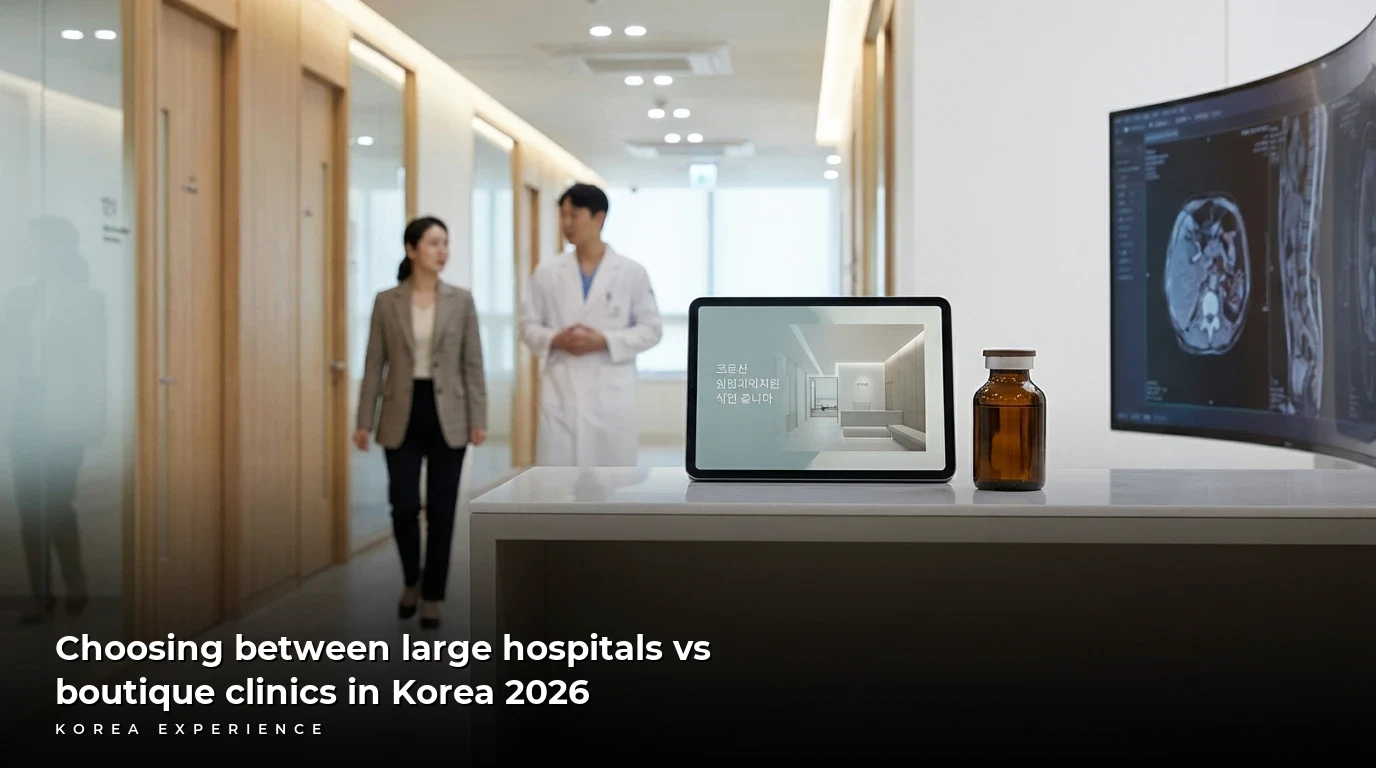
Deciding where to undergo a medical procedure in South Korea is the single most critical choice a medical tourist will make. The market is generally divided into two distinct tiers: the massive, multidisciplinary General University Hospitals (often referred to as the "Big 5") and the specialized, agile private institutions known as "Boutique Clinics." Your choice depends entirely on the complexity of your procedure, your budget, and your need for personalized aesthetic customization versus strict medical infrastructure.
The short answer: For complex, high-risk surgeries or those requiring general anesthesia with underlying health conditions, choose a Large University Hospital for their onsite ICUs and emergency infrastructure. For aesthetic refinements, dermatology, and standard plastic surgery where specific stylistic results and VIP service are the priority, a specialized Boutique Clinic is the superior choice in 2026.
Key Takeaways
- 1Large hospitals prioritize safety protocols and have 24/7 onsite anesthesiologists and ICUs
- 2Boutique clinics offer 30-40% faster scheduling and highly personalized aesthetic styling
- 3University hospitals charge 15-20% more for administrative fees but offer integrated care
The Landscape of Korean Medical Tourism in 2026
South Korea's medical infrastructure is world-class, boasting the highest number of hospital beds per capita among OECD nations (approximately 12.8 beds per 1,000 population as of recent 2025 data). However, for the international patient, the landscape can be confusing.
In districts like Gangnam-gu and Seocho-gu, you will find over 500 specialized clinics within a 5-kilometer radius. These range from single-doctor practices to 15-story "factory" style plastic surgery centers. Conversely, the "Big 5" hospitals—Asan Medical Center, Samsung Medical Center, Seoul National University Hospital, Severance Hospital, and Seoul St. Mary’s Hospital—operate like small cities, handling over 10,000 outpatients daily.
The decision matrix involves balancing three key factors: Safety Infrastructure, Aesthetic Specialization, and Patient Experience.
📋 Market Overview
Large University Hospitals: The Safety Fortresses
The "Big 5" hospitals in Korea represent the pinnacle of medical technology and safety. These institutions are JCI (Joint Commission International) accredited and are essentially "tertiary" hospitals. This means they are designed to handle the most complex medical cases, from organ transplants to advanced cancer treatments.
When it comes to plastic surgery or medical tourism procedures, these hospitals offer a distinct advantage: Comprehensive Risk Management.
Infrastructure and Emergency Preparedness
The primary reason to choose a large hospital is the presence of a fully staffed Intensive Care Unit (ICU) and 24-hour emergency medicine specialists. In a boutique clinic, if a complication arises during surgery (such as malignant hyperthermia or severe bleeding), the patient must be transferred by ambulance to a large hospital. In Seoul traffic, this transfer can take 20 to 45 minutes—a critical delay.
At a place like Asan Medical Center or Samsung Medical Center, the emergency response time is measured in seconds, not minutes. They have blood banks, multidisciplinary teams (cardiologists, pulmonologists), and advanced life support systems onsite.
The "Conservative" Aesthetic
It is widely understood in the Korean medical community that university hospitals tend to be more conservative in their aesthetic results. Their primary goal is functionality and safety. If you are looking for a dramatic "dolly" look or a high-bridge rhinoplasty that pushes the limits of your skin's elasticity, a university professor may refuse the surgery.
Who Should Choose Large Hospitals?
We strongly recommend large university hospitals for patients over 50, those with high BMI, existing heart conditions, diabetes, or those undergoing high-risk contouring surgeries (like double jaw surgery) where airway management is critical.
Cost and Process
Large hospitals are generally more expensive due to higher overhead. You can expect base surgery fees to be roughly 15% to 25% higher than average boutique clinics. Furthermore, there is often a "Special Treatment Designation Fee" for choosing a specific head professor, which can add ₩50,000 to ₩100,000 per consultation.
For more details on booking these appointments, check our guide on booking medical consultations in Korea.
Boutique Clinics: The Specialists of Gangnam
Boutique clinics are the driving force behind the "K-Beauty" phenomenon. These are private practices usually owned by a "Representative Director" (the head doctor). They focus intensely on specific areas—eyes, nose, anti-aging, or body contouring.
The Specialization Advantage
In a large hospital, a plastic surgeon might perform reconstructive burn surgery on Monday and a facelift on Tuesday. In a specialized boutique clinic, a doctor might perform only upper blepharoplasty (eyelid surgery) all day, every day, for 10 years. This hyper-specialization leads to incredible technical proficiency and an acute awareness of current aesthetic trends.
For example, current trends in 2026 favor a "natural-flashy" look (a blend of natural harmony with slightly distinct features). Boutique doctors are often the ones setting these trends on social media platforms.
Service and Customization
Boutique clinics operate with a service mindset closer to a luxury hotel than a hospital. The "Cinderella treatment" is common here.
- Speed: You can often land in Incheon at 4:00 PM and have a consultation at 6:00 PM.
- Language: Most top-tier boutiques employ full-time English, Chinese, Japanese, and Thai coordinators who stay with you throughout the process.
- Concierge: Many provide airport pick-up (approx. value ₩100,000) and deswelling treatments as part of the package.
The "Shadow Doctor" Concern
A historical criticism of some mid-to-large private clinics (not necessarily small boutiques) was the use of "shadow doctors" or ghost surgery—where a famous doctor consults, but a junior doctor operates while the patient is under anesthesia.
However, stricter laws enforced since late 2023 mandate CCTV recording inside operating rooms. In 2026, reputable boutique clinics openly market their adherence to this law, often allowing guardians to watch a livestream of the surgery from a waiting room.
Verification Checklist
Always ask: "Is there CCTV in the operating room?" and "Can I view the footage if requested?" Legally, medical institutions in Korea performing surgeries under general anesthesia must store this footage for at least 30 days.
If you are looking for specific clinic recommendations, see our list of best plastic surgery clinics for foreigners in Seoul.
Comparative Analysis: The Data Points
To help you visualize the differences, we've broken down the key metrics. Note that prices are estimates based on 2026 averages for foreign patients (who often pay slightly different rates due to agency fees or VAT refund structures).
University Hospital vs. Boutique Clinic
| Feature | University Hospital | Boutique Clinic |
|---|---|---|
| Anesthesiologist | On-site 24/7 Team | Visiting or Single On-staff |
| Emergency ICU | Yes (Full Scale) | Rare (Transfer required) |
| Consultation Wait | 2-4 Weeks | 1-3 Days |
| Surgery Style | Conservative/Natural | Trendy/Dramatic |
| Video Consultation | Difficult/Rare | Standard Practice |
| Recovery Stay | Strict Hospital Ward | Send home same-day |
Price Comparison (2026 Estimates)
Cost is a major factor. Below is a comparison for a standard Rhinoplasty (Nose Job) and Full Face Facelift. Note that boutique prices fluctuate heavily based on promotions and seasons.
💵 Procedure Cost Comparison (₩)
Includes admission & general anesthesia fees
Outpatient procedure, local sedation
The Anesthesia Debate: "Sleep" vs. "General"
One of the most profound differences lies in anesthesia. Large hospitals almost exclusively use General Anesthesia (GA) with intubation for major surgeries. This secures the airway completely but requires a longer recovery time (grogginess for 12-24 hours).
Boutique clinics often prefer Deep Sedation (Sleep Anesthesia) using Propofol or Ketamine for procedures like rhinoplasty or breast augmentation.
- Pros of Sedation: Faster recovery, less nausea, lower cost (saves approx. ₩1,000,000 in anesthesia fees).
- Cons of Sedation: The airway is not fully secured by a machine. If the patient stops breathing, the doctor must intervene immediately. This is why the presence of a dedicated anesthesiologist in a boutique clinic is the single most important safety question you can ask.
Process Timeline: What to Expect
The patient journey differs significantly between these two types of institutions. If you choose a large hospital, expect bureaucracy. If you choose a boutique, expect agility but potential sales pressure.
The Patient Journey Comparison
Booking
Hospital: Submit medical records 4 weeks prior. Clinic: WhatsApp chat 1 week prior.
Consultation
Hospital: 15-min strict slot with Professor. Clinic: 1-hour detailed design session.
Admission
Hospital: Admit 6am, discharge next day. Clinic: Arrive 9am, discharge 5pm.
Follow-up
Hospital: 1 check-up after 7 days. Clinic: Daily deswelling care & stitch removal.
Where to Stay During Recovery
Because boutique clinics usually discharge patients immediately after surgery (even for major procedures), your accommodation choice becomes an extension of the hospital. Most patients stay in Gangnam (Sinsa, Nonhyeon, or Yeoksam stations).
Large hospitals will keep you as an inpatient for 1-3 days for monitoring. After discharge, you generally need less intensive nursing care.
For a detailed breakdown of accommodation options, read our analysis on Airbnb vs recovery hotels for medical tourists.
The "Factory" Clinic Warning
Between the boutique clinics and the university hospitals lies a third category: the "Factory" clinic. These are massive private clinics that occupy entire buildings in Gangnam. They market aggressively to foreigners.
While they offer competitive pricing (often 20-30% lower than boutiques), they suffer from high staff turnover and "assembly line" surgery.
- Red Flag: If you meet a consultant for 45 minutes but the doctor only comes in for 3 minutes to draw lines on your face.
- Red Flag: If the clinic performs over 30 surgeries a day but only has 2 visible anesthesiologists.
The best boutique clinics in 2026 are 'owner-operated.' Look for clinics where the name of the clinic is the name of the doctor, or where there is only one representative surgeon per department. This ensures accountability. If something goes wrong, the owner's reputation is on the line.
Specialized Departments Breakdown
Dermatology
For skin treatments, the gap between hospitals and clinics is widest.
- University Hospitals: Treat severe skin diseases (psoriasis, melanoma, severe eczema). They do not prioritize cosmetic lasers.
- Boutique Clinics: Equipped with the latest 2026 lasers (Titanium lifting, Ulthera, Thermage FLX). They focus on texture, brightness, and anti-aging. For foreigners, a boutique dermatology clinic is almost always the better choice. Check our guide on best dermatology clinics in Seoul for specific names.
Orthopedics & Spine
- University Hospitals: Essential for spinal fusion or complex disc replacements.
- Specialized Spine Hospitals (Wooridul, Jaseng): A hybrid model. They are large specialized hospitals (not boutiques) that focus solely on spine/joints. These are excellent alternatives to general university hospitals for orthopedic issues.
Medical Visas and Tax Refunds
Regardless of your choice, legitimate medical institutions in Korea allow you to claim a VAT refund.
- VAT Refund: You can get back roughly 7-9% of the surgery cost at the airport.
- Certificate: Both large hospitals and certified boutique clinics can issue the "Certificate of Medical Treatment" required for this refund.
- Visa: If your stay exceeds 90 days for recovery, you need a Medical Visa (G-1). University hospitals have dedicated International Healthcare Centers (IHC) that process this paperwork efficiently. Boutique clinics often outsource this to agencies.
📊 Safety Statistics 2026
Making Your Decision: A Step-by-Step Guide
If you are still undecided, follow this decision tree.
📖 How to Choose the Right Facility
Step 1: Assess Risk Level
Is the surgery invasive (bone cutting)? If yes, do you have underlying health issues? If YES -> University Hospital.
Step 2: Define Aesthetic Goal
Do you want a specific celebrity nose or a dramatic change? If YES -> Boutique Clinic.
Step 3: Check Credentials
Ensure the surgeon is a 'Board Certified Plastic Surgeon' (Seong-hyeong-oe-gwa), not just a general practitioner doing cosmetic work.
Step 4: Verify Anesthesia
For boutique clinics, confirm the anesthesiologist stays in the room during the entire procedure.
Pros and Cons Summary
To wrap up, here is a balanced look at both options.
University Hospitals vs. Boutique Clinics
- ✓Hospitals: Highest safety standards and ICU availability
- ✓Hospitals: Accountability and transparent billing
- ✓Clinics: Highly personalized aesthetic designs
- ✓Clinics: VIP service, English fluency, and speed
- ✗Hospitals: Conservative results (less dramatic change)
- ✗Hospitals: Impersonal process and long wait times
- ✗Clinics: Varying safety standards (must verify individually)
- ✗Clinics: Higher risk of 'upselling' unnecessary procedures
Conclusion
In 2026, the line between large hospitals and boutique clinics is becoming clearer. The large hospitals are solidifying their role as guardians of safety and reconstructive complexity, while boutique clinics are evolving into hyper-specialized aesthetic ateliers.
If you are a healthy individual seeking cosmetic enhancement (rhinoplasty, lifting, blepharoplasty) or dermatology, a reputable, board-certified boutique clinic is likely your best option. The level of service, customization, and aesthetic capability is unmatched globally.
However, if you are undergoing facial bone contouring (Double Jaw) and have any respiratory issues, or if you require body contouring with large volume liposuction (over 5000cc), the safety net of a University Hospital or a hospital-grade specialized center provides peace of mind that is worth the extra cost and conservative approach.
For those planning their trip, remember that where you recover is just as important as where you operate. Don't forget to look into best Korean healing foods for surgery recovery to speed up your healing process.
❓ Frequently Asked Questions
Have more questions?Contact us →
About the Author
Korea Experience Team
Written by the Korea Experience editorial team - experts in Korean medical tourism, travel, and culture with years of research and firsthand experience.
⚠️ Medical Disclaimer
The information provided on this website is for general informational purposes only and does not constitute medical advice. Always consult with qualified healthcare professionals before making any medical decisions.
Explore more in Medical Tourism
World-class medical procedures at competitive prices. From plastic surgery and dermatology to dental care and health checkups — your complete guide to medical tourism in Korea.
Browse All Medical Tourism ArticlesContinue Reading
Explore more articles you might find interesting
Discover how Korea's 2026 hybrid medical protocols combine AI diagnostics with ancient Hanbang treatments to solve chronic pain, saving patients over 60%.
A complete guide to taking prescription drugs out of Korea and through customs. Includes limits, documentation, and specific country rules for 2026.
A comprehensive guide to navigating Korea's advanced recovery landscape, from traditional kiln saunas to modern cryotherapy clinics.
Discover premier breast reduction surgery in Korea for international patients. Learn about top clinics, costs, recovery tips, and essential travel info for 2026
Find the best medical compression garments in Seoul for post-surgery recovery. Detailed guide on locations, prices, and sizing in Gangnam and beyond.
A comprehensive guide comparing teardrop vs round implants in Korean plastic surgery, analyzing costs, 2026 trends, and the rise of Motiva Ergonomix.