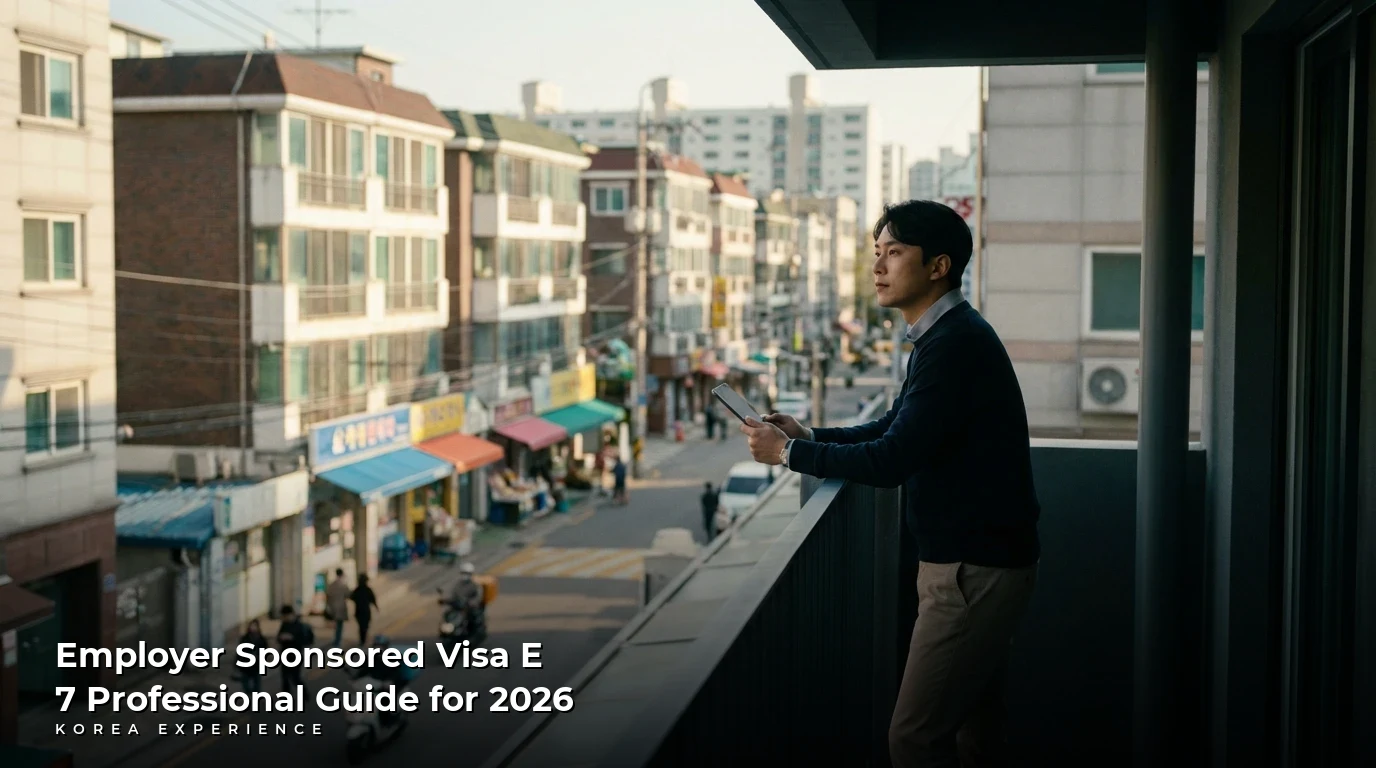
Korea E-7 Professional Visa: Your Work Permit Guide
Unlock professional opportunities in Korea with the E-7 visa. This guide covers eligibility, application, and crucial tips for expats.
Introduction: Your Gateway to Professional Life in South Korea
South Korea, a nation at the forefront of innovation, culture, and economic dynamism, continues to attract ambitious professionals from around the globe. Its vibrant cities, cutting-edge industries, and rich cultural heritage offer an unparalleled experience for those seeking international career growth. However, navigating the complexities of Korean immigration and securing the right to work can often seem daunting. For skilled foreign professionals, the Employer-Sponsored Visa E-7 Professional, often simply referred to as the E-7 visa, stands as the primary pathway to establishing a career in this captivating country.
This comprehensive guide is meticulously crafted for international travelers and expats who aspire to build a professional life in Korea. We understand the challenges and uncertainties that come with relocating and securing employment abroad. That's why we've designed this post to demystify the E-7 visa process, providing you with clear, actionable information from eligibility requirements to application procedures, and crucial tips for success. By the end of this article, you will have a thorough understanding of what it takes to obtain and maintain your E-7 Professional Visa, enabling you to confidently pursue your career aspirations in the Land of the Morning Calm.
Understanding the E-7 Professional Visa: Your Key to Working in Korea
The E-7 visa, formally known as the "Specific Activities" (E-7) visa, is a cornerstone of Korea's immigration policy for attracting foreign talent. Unlike general work permits, the E-7 is specifically designed for professionals with specialized skills, knowledge, or experience that are deemed beneficial or necessary for Korean industries. It's an employer-sponsored visa E-7 professional category, meaning a Korean company must offer you a job and be willing to sponsor your visa application.
This visa category is incredibly broad, encompassing over 80 specific sub-categories under three main umbrellas: professional (specialized) jobs, quasi-professional (semi-skilled) jobs, and skilled (general) jobs. However, for most international professionals, the focus will be on the "professional" sub-categories, which include fields like IT, research and development, engineering, design, and certain types of foreign language instruction (distinct from the E-2 English teaching visa).
The Korean government utilizes the E-7 visa to fill gaps in its labor market, introduce advanced technologies, and foster international collaboration. Therefore, proving that your skills and experience are specialized and directly contribute to your prospective employer's business and the broader Korean economy is paramount. It's not merely about having a job offer; it's about demonstrating a unique value proposition that aligns with Korea's industrial needs.
Key Characteristics of the E-7 Visa
- Employer Sponsorship: A Korean company must formally sponsor your visa, confirming your employment.
- Specialized Professions: Primarily for individuals with professional skills or expertise not readily available in the local labor market.
- Renewable: Initially granted for a period, typically one to three years, and can be renewed if employment continues.
- Pathway to Residency: Can serve as a stepping stone towards long-term residency visas like the F-2-7 (Resident) or F-5 (Permanent Resident) visas.
- Family Sponsorship: E-7 visa holders can usually invite their immediate family members (spouse and minor children) to Korea under an F-3 (Dependent Family) visa.
E-7 Visa Categories: A Brief Overview
While the full list is extensive, here are some common professional sub-categories for the E-7 visa that might be relevant to our target audience:
| Category | Description | Example Roles |
|---|---|---|
| E-7-1: Professional Jobs | High-level specialists with advanced degrees or significant experience in specific fields. | IT Developer, Software Engineer, R&D Researcher, Designer |
| E-7-2: Quasi-Professional | Mid-level professionals, often requiring specific licenses or technical skills. | Tour Guide (foreign language), Medical Coordinator |
| E-7-3: Skilled Jobs | Workers in fields requiring specific vocational training or experience, often in manufacturing or agriculture. | Welder, Shipbuilder (though often requires prior D-2/D-4) |
For most readers aiming for a professional career in Korea, the E-7-1 category will be the most pertinent. It targets individuals who can bring significant value through their specialized knowledge and expertise, directly contributing to Korea's advanced industries and global competitiveness.
Eligibility Unpacked: Who Qualifies for an E-7 Professional Visa?
Securing an Employer-Sponsored Visa E-7 Professional hinges on meeting stringent eligibility criteria, not just for the applicant but also for the sponsoring employer. Understanding these requirements is the first critical step toward a successful application.
Applicant Requirements
The Korea Immigration Service meticulously assesses each applicant's qualifications to ensure they align with the needs of the Korean labor market and the specific E-7 sub-category.
- Education and Experience:
- General Rule: A bachelor's degree or higher in a relevant field, coupled with at least one year of professional experience directly related to the prospective job in Korea.
- Alternative Qualifications: In some cases, a diploma (associate's degree) with five or more years of relevant experience, or a high school diploma with ten or more years of relevant experience, may be accepted, especially for technical or highly skilled trades.
- No Experience Required: Graduates from Korean universities (bachelor's or higher) or those with a master's degree (or higher) from an overseas university in a field directly related to the E-7 category might be exempt from the one-year experience requirement for certain roles. This is a significant advantage for international students who study in Korea.
- Job Relevance: The job offer in Korea must be directly related to your academic background and professional experience. Immigration officials will scrutinize this connection to prevent general labor roles from being misrepresented as specialized professions.
- Minimum Salary: You must be offered a salary that meets or exceeds the minimum wage requirements for E-7 visa holders, which is typically above the national minimum wage and often tied to the Gross National Income (GNI) per capita. As of recent policies, this often means your annual salary must be at least 80% of the previous year's GNI per capita in Korea, or higher depending on the specific E-7 category. This figure changes annually, so it's crucial to check the latest guidelines from the Korea Immigration Service.
- No Criminal Record: Applicants must have a clean criminal record. A criminal record certificate from your home country (and any country you've resided in for a significant period) is a standard requirement.
- Health Check: While not always required upfront for all E-7 categories, immigration authorities reserve the right to request a medical examination if deemed necessary.
Employer Requirements
The sponsoring Korean company also bears significant responsibilities and must meet specific criteria to be eligible to hire foreign professionals on an E-7 visa.
- Business Registration and Stability: The company must be a legally registered entity in Korea, demonstrating stable operations and financial solvency.
- Necessity of Foreign Hire: The employer must convincingly demonstrate why a Korean national cannot fill the position and why the foreign professional's specific skills and experience are indispensable. This often involves providing evidence of efforts to recruit locally or explaining the unique expertise the foreign applicant brings.
- Compliance with Labor Laws: The company must adhere to all Korean labor laws, including providing a compliant employment contract, fair working conditions, and meeting the minimum salary requirements for E-7 visa holders.
- Quota System: Some E-7 categories might be subject to quotas, limiting the number of foreign employees a company can sponsor. This is more common in manufacturing or less specialized sectors but is worth being aware of.
Meeting both sets of criteria is essential. A robust application requires strong documentation from both the applicant and the employer, presenting a clear and compelling case to the Korea Immigration Service.
Navigating the E-7 Application Process: A Step-by-Step Guide
The application for an Employer-Sponsored Visa E-7 Professional can be a detailed process, requiring meticulous preparation and adherence to specific procedures. While the exact steps and required documents can vary slightly based on your country of origin and the specific E-7 sub-category, the general outline remains consistent.
Step 1: Secure a Job Offer and Employment Contract
This is the foundational step. Before you can even consider applying for an E-7 visa, you must have a confirmed job offer from a Korean company. The company will then provide you with a formal employment contract. Ensure this contract clearly outlines your role, responsibilities, salary, working hours, and the duration of employment. It must comply with Korean labor laws and meet the minimum salary requirements for the E-7 visa.
Step 2: Gather Required Documents
Both you (the applicant) and your sponsoring employer will need to compile an extensive set of documents. This is often the most time-consuming part of the process. All foreign-issued documents usually need to be apostilled or notarized by the Korean embassy/consulate in your home country and translated into Korean (or English, if the original is not English).
Applicant's Required Documents:
- Passport: Valid for at least six months beyond your intended stay.
- Visa Application Form: Duly completed and signed.
- Photo: Passport-sized, color photo taken within the last six months.
- Original Degree/Diploma Certificates: From your highest educational attainment.
- Academic Transcripts: From your relevant degree programs.
- Curriculum Vitae (CV)/Resume: Detailing your professional experience.
- Certificates of Employment/Career Certificates: From previous employers, verifying your work experience, job titles, and duration of employment.
- Criminal Record Certificate: Issued by a relevant authority in your home country (and potentially other countries of long-term residence), usually within three to six months of application. This often needs to be apostilled.
- Health Check/Medical Certificate: If specifically requested.
- Proof of Residence in Korea: If you are already in Korea (e.g., lease agreement, dormitory certificate).
Employer's Required Documents:
- Invitation Letter/Sponsorship Letter: From the Korean company, explaining the purpose of your employment and the company's commitment to your sponsorship.
- Employment Contract: Original and copies, signed by both parties.
- Business Registration Certificate (사업자등록증 - Saeopja Deungrokjeung): Of the sponsoring company.
- Company Financial Documents: Such as tax payment certificates (납세증명서 - Napse Jeungmyeongseo), financial statements, or balance sheets to prove financial stability.
- Explanation of Necessity (활용계획서 - Hwalyong Gyehoekseo): A detailed document explaining why the company needs to hire a foreign national, outlining your specific role, how your skills are unique, and why a Korean national could not fill the position. This is a critical document.
- Copy of Representative's ID: Identity card of the company's legal representative.
- Office Lease Agreement: Proof of the company's operational address.
- Job Description: Detailed outline of your duties and responsibilities.
Comparison Table: Key Documents for E-7 Visa
| Document Type | Applicant Responsibility | Employer Responsibility |
|---|---|---|
| Personal ID | Passport, Visa Application Form, Photo | N/A |
| Qualifications | Degree/Diploma, Transcripts, CV, Career Certs | N/A |
| Background Checks | Criminal Record Certificate, Health Check | N/A |
| Job Offer Proof | Employment Contract (signed copy) | Invitation/Sponsorship Letter, Original Employment Contract |
| Company Details | N/A | Business Registration, Financials, Representative's ID, Office Lease |
| Justification | N/A | Explanation of Necessity, Detailed Job Description |
Step 3: Application Submission
The application can be submitted in two primary ways:
- Outside Korea (Consulate/Embassy): If you are outside Korea, your employer will typically submit the necessary documents to the Korea Immigration Service in Korea to apply for a "Visa Issuance Confirmation Number" (사증발급인정서 - Sajingbalgeup Injeungseo). Once issued, this number is sent to you, and you take it to the nearest Korean embassy or consulate in your home country (or country of residence) to get the actual E-7 visa sticker in your passport.
- Inside Korea (Change of Status): If you are already in Korea on a different valid visa (e.g., D-2 Student Visa, D-10 Job Seeker Visa, or even a short-term visa if eligible for change of status), your employer can apply for a "Change of Status of Sojourn" (체류자격 변경 - Charyu Jagyeok Byeongyeong) directly at a local Korea Immigration Service office. You will need to attend the appointment with your employer's representative.
Step 4: Processing and Approval
Processing times for E-7 visas can vary significantly, ranging from a few weeks to several months, depending on the volume of applications, the complexity of your case, and the specific immigration office. It is crucial to apply well in advance of your intended start date or current visa expiration. During this period, the Korea Immigration Service may request additional documents or an interview.
Step 5: Receive Your Visa and Alien Registration Card (ARC)
Once your application is approved:
- Outside Korea: You will receive your E-7 visa sticker in your passport from the embassy/consulate. Upon arrival in Korea, you must apply for your Alien Registration Card (ARC) at a local Korea Immigration Service office within 90 days of entry.
- Inside Korea: You will be notified of the approval and instructed on how to collect your ARC. The ARC is your primary identification document in Korea, enabling you to open bank accounts, sign leases, and access various services.
Practical Tip: Always make multiple copies of all your documents. Keep a digital backup as well. Consider engaging a professional immigration consultant or lawyer, especially if your case is complex or you are unsure about any part of the process.
Key Challenges and Practical Tips for E-7 Success
While the E-7 visa opens doors to professional opportunities, applicants often face specific challenges. Being aware of these and preparing adequately can significantly increase your chances of success.
Common Challenges
- Proving "Specialized" Need: This is arguably the biggest hurdle. The Korea Immigration Service is strict about ensuring that the position cannot be filled by a qualified Korean national. Your employer must craft a compelling "Explanation of Necessity" that highlights your unique skills, international experience, or specialized knowledge that is critical to their business. Generic job descriptions will likely be rejected.
- Matching E-7 Categories: Your proposed job title and responsibilities must precisely fit one of the many E-7 sub-categories. Misalignment can lead to rejection. For instance, being a "marketing manager" with general duties might be harder to prove as "specialized" than a "digital marketing specialist for international markets" with specific language and platform expertise.
- Minimum Salary Compliance: The minimum salary requirement for E-7 holders can be higher than what some entry-level or junior professional roles might offer. Your employer must meet this threshold, which is typically calculated as a percentage of Korea's GNI per capita. Ensure your offer meets or exceeds this.
- Document Verification: Immigration officials rigorously verify all submitted documents. Discrepancies, incomplete information, or fraudulent documents will lead to immediate rejection and potentially blacklisting from future visa applications.
- Language Barrier: While not a direct visa requirement for all E-7 categories, a lack of Korean language proficiency can hinder communication with immigration officers or in preparing documents, especially if your employer has limited experience with foreign hires.
Practical Tips and Insider Knowledge
- Start Early and Be Thorough: The E-7 application is not a last-minute endeavor. Begin gathering documents and preparing well in advance. Double-check every form and document for accuracy and completeness. Missing a single piece of information can delay your application significantly.
- Leverage Your Network and Resources:
- Job Search Platforms: Utilize major Korean job search platforms like Job Korea, Saramin, and Incruit, filtering for "foreigner" or "global" positions. LinkedIn is also increasingly popular for professional roles.
- Government-Supported Agencies: KOTRA (Korea Trade-Investment Promotion Agency) and various regional job centers (e.g., Global Talent Link) sometimes assist foreign professionals in finding jobs and understanding visa requirements.
- University Career Centers: If you are a graduate of a Korean university, their career centers often have resources and networks specifically for international students transitioning into the workforce.
- Prepare a Strong "Explanation of Necessity": Work closely with your employer to craft a persuasive statement. Focus on:
- Your unique skill set or educational background.
- How your role contributes to the company's global strategy, technology advancement, or specific market expansion.
- Any specific foreign language capabilities you possess that are vital for the role.
- Why a local hire would not be suitable.
- Consider Professional Assistance: For complex cases or if your employer is new to sponsoring foreign workers, hiring a reputable immigration lawyer or licensed administrative agent (행정사 - haengjeongsa) specializing in E-7 visas can be invaluable. They can review documents, advise on the best approach, and even submit the application on your behalf, significantly reducing the risk of errors.
- Understand Korean Workplace Culture: Beyond the visa, adapting to Korean workplace culture is crucial for long-term success. Hierarchy, respect for elders and superiors, and collective harmony are significant. Learning basic Korean phrases and demonstrating an effort to understand the culture will be highly appreciated.
- Maintain Communication with Your Employer: Keep an open line of communication with your sponsoring company throughout the visa process. They are your primary partner in this journey, and their active cooperation is essential.
- Be Prepared for Interviews: While not always mandatory, the Korea Immigration Service may call you or your employer for an interview to clarify details. Be ready to articulate your role, experience, and the necessity of your position clearly.
By proactively addressing these challenges and implementing these tips, you can streamline your E-7 visa application and increase your chances of a smooth transition to professional life in Korea.
Maintaining Your E-7 Status: Renewals, Changes, and Obligations
Obtaining your Employer-Sponsored Visa E-7 Professional is a significant achievement, but it's just the beginning. To ensure a seamless stay and continued professional opportunity in Korea, it's crucial to understand the requirements for maintaining your visa status, renewing it, and handling any changes to your employment or personal circumstances.
Visa Renewal Process
E-7 visas are typically issued for one to three years initially. Before your visa expires, you must apply for a renewal if you wish to continue working in Korea.
- Timing is Key: Apply for renewal at your local Korea Immigration Service office within four months (or at least two months) before your current visa expiration date. Do not wait until the last minute, as processing can take time.
- Required Documents for Renewal:
- Application form for extension of stay.
- Passport and Alien Registration Card (ARC).
- Proof of current employment (employment certificate from your company).
- Updated employment contract (if any changes).
- Company's business registration certificate.
- Company's tax payment certificates and financial statements to prove continued stability.
- Proof of residence in Korea (e.g., housing contract).
- A statement from the employer justifying the continued need for your specialized skills.
- Any other documents requested by the immigration office (e.g., proof of salary, social insurance contributions).
- Review of Status: During renewal, immigration authorities will review your compliance with the original visa conditions, including your salary, job duties, and the employer's continued need for your role. Consistent employment and adherence to labor laws are critical.
Changing Employers
If you decide to change jobs while on an E-7 visa, it's not a simple transfer; you effectively need to apply for a new E-7 visa with your new employer.
- Prior Approval: You must obtain permission from the Korea Immigration Service before starting work with a new company. Working for a new employer without authorization is a serious violation and can lead to fines, deportation, and future visa denials.
- New Application: The process is similar to your initial E-7 application, with the new employer submitting documents to sponsor your visa. All eligibility criteria (applicant's qualifications, employer's necessity, minimum salary) must be met again.
- Notification of Departure: Inform the immigration office when you leave your previous employer. This is an important part of maintaining your legal status.
- Transition Period: There is typically a grace period (e.g., 90 days) after leaving a job to find a new one and apply for a change of employer, but it's best to secure new employment before terminating your current role.
Family Sponsorship (F-3 Visa)
As an E-7 visa holder, you can generally sponsor your immediate family members (spouse and minor children under 19) to join you in Korea under an F-3 (Dependent Family) visa.
- Application Process: Family members apply for the F-3 visa at a Korean embassy or consulate in their home country, providing documents such as their passports, marriage/birth certificates, and proof of your E-7 status and financial capability to support them.
- Work Restrictions: F-3 visa holders are generally not permitted to work in Korea. If your spouse wishes to work, they would need to apply for their own separate work visa (e.g., E-7, E-2, etc.) or a points-based F-2-7 visa which allows limited work.
Obligations as an E-7 Visa Holder
To avoid penalties or issues with future visa applications, E-7 visa holders have several key obligations:
- Report Changes:
- Change of Address: You must report any change in your residential address to your local immigration office within 14 days.
- Change of Workplace/Employer: As mentioned, this requires a new visa application or permission.
- Change in Personal Information: Updates to passport information, marital status, etc., should also be reported.
- Adhere to Visa Conditions: Your E-7 visa is granted for a specific role and company. Engaging in activities outside your approved scope of work or working for an unauthorized employer is a violation.
- Compliance with Korean Laws: As a resident, you are subject to all Korean laws and regulations.
- Maintain Valid Documents: Always ensure your passport and ARC are valid.
By diligently adhering to these maintenance requirements and obligations, you can ensure a stable and legally compliant professional journey in South Korea, paving the way for potential long-term residency.
Beyond E-7: Pathways to Long-Term Residency in Korea
The Employer-Sponsored Visa E-7 Professional is an excellent stepping stone for career growth in Korea, but for many, it's also a crucial first step towards establishing a more permanent life in the country. Korea offers several pathways for E-7 holders to transition to longer-term residency visas, each with its own set of requirements.
Transitioning to an F-2-7 Resident Visa (Points-Based)
The F-2-7 visa is a highly sought-after residency visa that allows greater flexibility, including the ability to change employers more easily and for spouses to engage in limited work. It is a points-based system designed to attract and retain highly skilled foreign professionals.
Key Requirements:
- E-7 Status: You must generally have been on an E-7 visa for a certain period (e.g., 3 years), though some exceptions exist for high-income earners or graduates of Korean universities.
- Points System: Applicants are evaluated based on a points system that considers factors such as:
- Age: Younger applicants receive more points.
- Education: Higher degrees (Master's, Ph.D.) and degrees from Korean universities earn more points.
- Income: Higher annual income in Korea significantly boosts points.
- Korean Language Proficiency: TOPIK (Test of Proficiency in Korean) scores are crucial. Higher levels (e.g., Level 4 or higher) award substantial points.
- Social Contribution: Volunteer work or participation in specific government programs.
- Other Factors: Experience in specialized fields, recommendations from government agencies, etc.
- Minimum Points: You need to achieve a minimum score (typically 80 points out of 120 or 160, depending on the specific criteria in effect) to qualify.
- Annual Quotas: The F-2-7 visa may be subject to annual quotas, so competition can be high.
The F-2-7 visa is typically granted for three to five years and is renewable. It offers significant advantages for professionals looking to make Korea their long-term home.
Pathways to an F-5 Permanent Resident Visa
The F-5 visa represents true permanent residency in Korea, offering the most freedom and stability. It's a challenging visa to obtain, requiring a significant commitment to life in Korea. Several sub-categories of F-5 exist, and E-7 holders primarily pursue a few:
- F-5-1 (General Permanent Resident):
- Requirements: Typically requires continuous legal residency in Korea for at least five years, demonstrating financial stability (e.g., meeting a certain income threshold, often twice the GNI per capita), and passing a Korean language and culture test or completing the Korea Immigration and Integration Program (KIIP). You must also maintain good conduct (no serious criminal record).
- E-7 Pathway: If you maintain your E-7 status for five consecutive years, you can often apply for the F-5-1, provided you meet the financial and integration requirements.
- F-5-11 (Permanent Resident for Highly Skilled Professionals):
- Requirements: This category is specifically for professionals with advanced degrees (Master's or Ph.D.) and high annual income (often three times the GNI per capita or more). It might allow for a shorter residency period (e.g., 3 years) before applying for permanent residency. Strong Korean language skills are also typically expected.
- E-7 Pathway: E-7 holders who meet these high-income and academic criteria can potentially fast-track their permanent residency application.
Comparison Table: Residency Pathways from E-7
| Feature | E-7 Professional Visa (Work Permit) | F-2-7 Resident Visa (Points-Based) | F-5 Permanent Resident Visa |
|---|---|---|---|
| Primary Purpose | Specialized work in a specific role/company | Long-term residency for skilled professionals | Permanent residency with full rights |
| Duration | 1-3 years (renewable) | 3-5 years (renewable) | Indefinite |
| Employer Change | Requires new visa application/permission | Generally easier, often just notification | No restrictions |
| Spouse Work | F-3 dependent, generally no work | Limited work allowed without separate visa | No restrictions |
| Eligibility | Job offer + specialized skills/education | E-7 holder (usually 3+ years), points system (income, language, age, education) | E-7/F-2-7 holder (5+ years), high income, language, integration |
| Flexibility | Tied to specific employer/role | Significant flexibility, stepping stone to F-5 | Highest flexibility and rights |
Internal Linking Opportunities:
- Cost of Living in Korea: Understanding your salary's purchasing power is crucial for long-term planning.
- Korean Healthcare System: All residents on long-term visas are covered.
- Finding a Job in Korea: Strategies for landing that initial E-7 sponsoring role.
- Korean Culture and Etiquette: Essential for integration into society and the workplace.
Transitioning from an E-7 visa to an F-2-7 or F-5 visa requires meticulous planning, consistent adherence to regulations, and a demonstrable commitment to life in Korea. It's a journey that rewards patience and strategic career development.
Conclusion: Your Professional Journey in Korea Awaits
Securing an Employer-Sponsored Visa E-7 Professional is more than just obtaining a work permit; it's unlocking a world of professional growth, cultural immersion, and personal development in one of Asia's most dynamic nations. From the bustling streets of Seoul to the innovative hubs across the country, Korea offers unparalleled opportunities for skilled international talent.
Throughout this comprehensive guide, we've walked you through the intricate details of the E-7 visa process: understanding its purpose, decoding the eligibility requirements for both you and your sponsoring employer, and navigating the step-by-step application journey. We've also highlighted common challenges, provided insider tips for success, and outlined the crucial aspects of maintaining your visa status, including renewals and the exciting pathways to long-term residency in Korea.
Actionable Takeaways for Aspiring E-7 Professionals:
- Prioritize Job Search: Your E-7 journey begins with securing a legitimate job offer from a Korean company willing to sponsor you. Focus on roles that genuinely require your specialized skills.
- Document Meticulously: The application is document-heavy. Start gathering all necessary certificates, transcripts, and proofs of experience early, ensuring they are accurate, translated, and authenticated as required.
- Understand Your Value: Work with your employer to clearly articulate why your unique skills and experience are indispensable for the role and for Korea's economy. This "Explanation of Necessity" is critical.
- Stay Informed: Immigration policies can change. Regularly check the official Korea Immigration Service website or consult with a reputable immigration professional for the latest guidelines.
- Embrace the Culture: While not a visa requirement, showing an interest in learning Korean and understanding Korean workplace culture will significantly enhance your experience and integration.
Your dream of building a professional career in South Korea is within reach. With diligent preparation, a clear understanding of the E-7 Professional Visa requirements, and a proactive approach, you can successfully navigate the immigration process and embark on an enriching and rewarding journey in this remarkable country. Korea awaits your talent and contributions.
About the Author
Korea Experience Team
Written by the Korea Experience editorial team - experts in Korean medical tourism, travel, and culture with years of research and firsthand experience.
⚠️ Medical Disclaimer
The information provided on this website is for general informational purposes only and does not constitute medical advice. Always consult with qualified healthcare professionals before making any medical decisions.
Continue Reading
Explore more articles you might find interesting
Unlock the path to becoming a Korean citizen. This detailed guide covers eligibility, step-by-step applications, required documents, tests, and invaluable tips for expats.
Navigating moving companies in Korea can be complex. This guide covers international and local movers, costs, services, and essential tips for expats.
Navigating your Korea visa extension? Discover the comprehensive guide to both online and in-person methods, ensuring a smooth process.