Exploring Korea Independent Bookstores Dongne Chaekbang 2026
Discover the charm of Dongne Chaekbang in 2026. A complete guide to independent bookstores in Korea, from Seoul hidden gems to coastal bookstays.
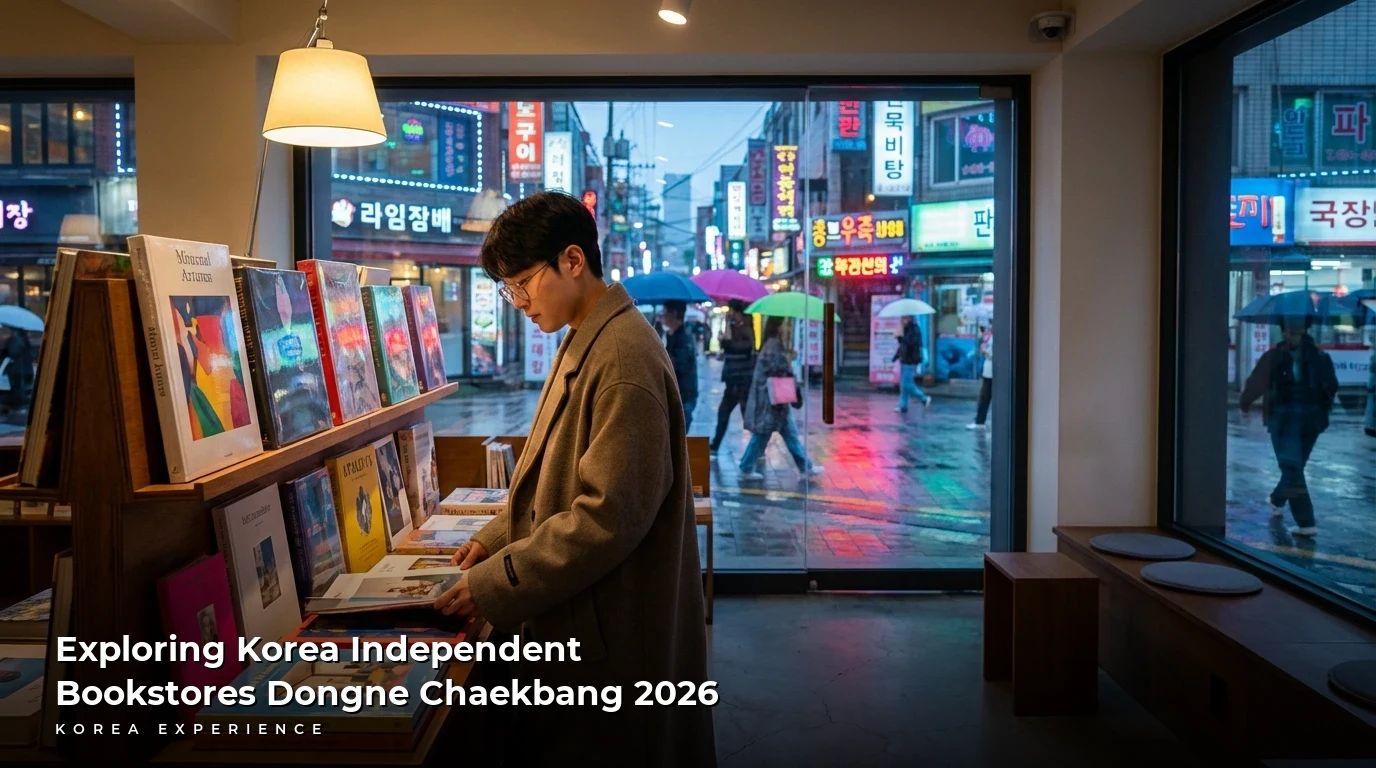
The landscape of travel in South Korea has shifted dramatically over the last few years. While the neon lights of Myeongdong and the futuristic architecture of Dongdaemun still draw crowds, a quieter, more intimate trend has taken hold of the cultural narrative in 2026: the resurgence of the Dongne Chaekbang (neighborhood bookstore). These are not merely retail spaces for purchasing paperbacks; they are curated cultural salons, community hubs, and sanctuaries of silence in a bustling digital society.
For the international traveler, exploring these independent bookstores offers a unique lens into the contemporary Korean psyche. It is an exploration of taste, design, and the slow-living movement that is currently counterbalancing the nation's "bali-bali" (hurry-hurry) culture. In 2026, there are over 850 registered independent bookstores across the peninsula, a 15% increase from 2024, proving that print is far from dead—it has simply evolved.
Key Takeaways
- 1Dongne Chaekbang are curated independent bookstores focusing on specific themes like art, poetry, or mystery.
- 2Most shops require a drink purchase (approx. ₩6,000) if you plan to sit and read for extended periods.
- 3The 'Bookstay' trend allows travelers to sleep inside bookstores, with prices averaging ₩120,000 per night.
The Evolution of the Korean Bookstore
Unlike the massive Kyobo orypo bookstore chains which stock hundreds of thousands of titles, a Dongne Chaekbang relies on the owner's personal taste—the Chwihyang. In 2026, this curation is the primary selling point. You are not just buying a book; you are buying the bookseller's perspective on the world.
The economics of these spaces have also shifted. To survive the digital age, 70% of these shops now operate as hybrid spaces: cafe-bookstores, bar-bookstores, or exhibition spaces. The average price of a curated independent book in 2026 ranges between ₩15,000 and ₩22,000, slightly higher than mass-market retailers, but the premium supports the ecosystem.
📊 Indie Bookstore Growth 2026
Seochon and Bukchon: History Between the Pages
If you are beginning your journey in Seoul, the neighborhoods of Seochon and Bukchon offer the perfect blend of traditional Hanok architecture and literary culture. Located just west of Gyeongbokgung Palace, Seochon has historically been home to artists and writers.
Related reading: Independent cinema guide art house theaters in Seoul.
Boan Books (Boan Yeogwan)
Perhaps the most iconic stop is Boan Books. Originally an inn (Yeogwan) that opened in 1942, it hosted famous poets like Seo Jeong-ju. Today, it stands as a multi-complex cultural space. The bookstore is located on the second floor, connected by a glass bridge to the old inn structure.
The walk from Gyeongbokgung Station (Exit 3) takes approximately 10 minutes. The space offers a stunning view of the palace walls. The curation here leans heavily towards art, humanities, and independent magazines.
Boan Books(Boan Chaekbang)
The History of Dae-o Bookstore
Just a 5-minute walk (350 meters) from Boan Books lies Dae-o Bookstore. While it no longer sells new books, it is the oldest bookstore in Seoul, preserved as a cafe. It became globally famous after RM from BTS visited. In 2026, the entrance fee (which includes a drink) is ₩7,000. It remains a pilgrimage site for K-Pop fans and history buffs alike.
Many tourists miss the 'Tongui-dong Security Inn' exhibition space right next to Boan Books. It is usually free to enter and showcases experimental Korean art. It takes only 15 minutes to tour and adds deep context to the area.
Mapo-gu: The Hipster's Library
Crossing the Han River or moving west to Mapo-gu (Hongdae, Yeonnam-dong, Mangwon-dong), the vibe shifts from historical to hyper-modern and indie. Mapo-gu has the highest density of independent bookstores in the country, with over 80 shops within a 5-kilometer radius.
GAGA77PAGE
Located in the trendy Sangsu-dong area, GAGA77PAGE is a sanctuary for independent publishing. Here you will find "zines"—small circulation, self-published works that cover niche topics ranging from depression diaries to manuals on growing moss. The store is approximately 400 meters from Sangsu Station.
They frequently host "Book Talks" and small concerts. The average cost of a zine here is quite affordable, usually between ₩8,000 and ₩12,000, making it a great place to buy unique souvenirs.
📋 Mapo Book Walk Stats
Thanks Books
In the heart of Hongdae, Thanks Books has been a staple for over a decade. It curates books that match the vibrant, design-centric energy of the neighborhood. The selection changes monthly. It is a 7-minute walk from Hapjeong Station. The interior is warm and yellow-toned, designed to make you stay.
Pro Tip: The Monthly Curation
Look for the 'Staff Picks' table near the entrance. In 2026, Thanks Books provides small English summary cards for their top 5 picks of the month, helping non-Korean speakers understand the context of the titles.
Specialty Bookstores: Niche Interests
The true charm of the Dongne Chaekbang movement in 2026 is hyper-specialization. Generalist stores are rare; instead, owners dive deep into specific genres.
Mystery Union
Located in the Sinchon area, roughly 10 minutes from the university district, this shop sells only mystery novels. The wooden interior resembles a detective's office. They stock over 1,600 titles strictly in the mystery/thriller genre. While most are in Korean, they have a dedicated "Global Mystery" section with English translations of Korean hits.
Your Mind
A pioneer in the art book scene, Your Mind is located in a beautiful vintage house in Yeonhui-dong. It is slightly harder to reach by subway (20 minutes walk from Hongik Univ. Station), so taking a taxi (approx. ₩6,000 from the station) is recommended. They specialize in photography books and illustration distinct to Korean creators.
Specialty Bookstore Comparison
| Feature | Your Mind (Art) | Mystery Union (Genre) | Wit N Cynical (Poetry) |
|---|---|---|---|
| English Books | ✅ | Limited | Rare |
| Merchandise | Extensive | Basic | Books only |
| Atmosphere | Bright/Gallery | Cozy/Dark | Modern/Clean |
The Bookstay: Sleeping with Stories
One of the most immersive trends to mature by 2026 is the "Bookstay." This concept combines a guesthouse with a bookstore, allowing travelers to read all night long after the shop closes to the public.
Motive behind the Bookstay
The primary appeal is solitude. In a city of 10 million people, finding a private space to disconnect is a luxury. Bookstays usually limit occupancy to a small number of guests (often just 1 to 4 people), ensuring quiet.
Costs and Logistics
A typical Bookstay in 2026 costs between ₩100,000 and ₩180,000 per night. This usually includes a private room, breakfast, and unlimited access to the library lounge. Check-in is typically late (after 4:00 PM) and check-out is early (before 11:00 AM) to accommodate regular store hours.
💵 Cost Analysis: Hotel vs. Bookstay
Bed, TV, standard amenities
Bed, Curated Library, Breakfast
📖 How to Book a Bookstay
Step 1: Identify Venue
Search Naver Maps for 'Bookstay' or 'Chaekbang Stay'. Top options include 'Soseol' in Seoul or 'Bookstay Itda' in Gangwon.
Step 2: Check Availability
Most bookstays use Instagram DM or Naver Booking. They rarely appear on Agoda or Booking.com.
Step 3: Send Inquiry
Send a DM in simple English or translated Korean: 'Hello, I want to reserve for [Date]. Is it available?'
Beyond Seoul: Busan's Coastal Libraries
Busan, Korea's second-largest city, offers a different flavor of book culture. The pace is slower, and the views often include the ocean. The KTX train from Seoul to Busan takes about 2 hours and 30 minutes and costs ₩59,800 one way.
Bosu-dong Book Street
This is a living museum. Formed during the Korean War by refugees selling books to survive, it is a narrow alley lined with stacks of used books. In 2026, it remains a gritty, authentic contrast to the polished shops of Seoul. You can find vintage English paperbacks here for as low as ₩3,000.
Eternal Journey (Ananti Cove)
On the other end of the spectrum is Eternal Journey in the Ananti Cove resort area (Gijang-gun). It is a massive 500-pyeong (approx. 1,650 sq meters) complex. It is distinct because it arranges books by theme and color rather than the Dewey Decimal System. It is a 20-minute taxi ride from Haeundae Beach, costing around ₩15,000.
Seoul vs. Busan Book Hunting
- ✓Seoul: Higher density of shops
- ✓Seoul: More English titles available
- ✓Busan: Scenic ocean views
- ✓Busan: Cheaper vintage finds
- ✗Seoul: More crowded
- ✗Seoul: Higher drink prices
- ✗Busan: Shops are spread far apart
- ✗Busan: Less English service
Practical Guide for International Visitors
Visiting these spaces requires a subtle understanding of Korean etiquette, especially in 2026 where "quiet zones" are strictly enforced.
The "No WiFi" Movement
Many Dongne Chaekbang in 2026 have removed WiFi access and power outlets. The goal is to discourage "Digital Nomads" from occupying a seat for 4 hours with a laptop while only buying one coffee. These spaces are for reading, not working.
Buying Books as a Souvenir
Even if you cannot read Korean, these books make excellent souvenirs. The cover design in Korea is world-class.
- Picture Books: Korean illustration is globally renowned. Look for books by Baek Heena or Suzy Lee.
- Poetry: Small, palm-sized poetry books are a trend. They cost around ₩10,000 and are light to pack.
Photography Etiquette
In Korea, smartphone cameras make a mandatory shutter sound. In a silent bookstore, this is very disruptive. Always ask "Sajin jikeodo doeyo?" (May I take a photo?) before snapping. Many shops only allow photos of the interior, not the book contents.
Shipping Books Home
If you buy too many books, you can use the Korea Post service.
- Service: EMS (Express Mail Service).
- Cost: Approximately ₩35,000 for 2kg to North America or Europe.
- Time: 3 to 5 business days.
- Most post offices have a self-packing station with boxes (approx. ₩1,000 per box) and tape provided.
The Ideal Bookstore Day Trip (Seoul)
Start at Gyeongbokgung
Walk through the palace to enter Seochon.
Boan Books
Browse the collection and view the exhibition.
Lunch in Seochon
Try Samgyetang (Ginseng Chicken Soup), approx ₩20,000.
Move to Yeonnam-dong
Take a taxi (20 mins) to the indie hub.
Coffee & Reading
Settle into a quiet cafe-bookstore for 2 hours.
Conclusion
Exploring independent bookstores in Korea in 2026 is about slowing down. It is an invitation to step out of the frantic tourist algorithm and into a space of contemplation. Whether you are browsing art books in a Hanok in Bukchon, hunting for vintage paperbacks in the alleys of Busan, or sleeping surrounded by stories in a Bookstay, you are engaging with the culture on a deeper, more personal level.
These spaces prove that in one of the most technologically advanced nations on earth, the tactile, analog experience of reading is more cherished than ever.
❓ Frequently Asked Questions
Have more questions?Contact us →
About the Author
Korea Experience Team
Written by the Korea Experience editorial team - experts in Korean medical tourism, travel, and culture with years of research and firsthand experience.
Explore more in K-Culture
K-Pop, K-Drama, traditional arts, and modern culture — dive deep into the cultural phenomena that have captivated the world.
Browse All K-Culture ArticlesContinue Reading
Explore more articles you might find interesting
A deep dive into Korean fortune telling culture in Sinsa-dong, comparing traditional Saju with modern Tarot including prices and English options.
Master the art of K Pop photocard collecting in 2026 with our guide to global markets, trading etiquette, and exclusive Seoul shopping spots.
A complete guide to Seoul e-sports culture in 2026. Visit LoL Park, T1 Base Camp, and experience high-end PC Bangs with RTX 50-series rigs.
Discover the top celebrity owned cafes and restaurants in Seoul for 2026. From K-Pop idol cafes to actor owned dining, get verified locations and prices.
Discover the evolution of Hallyu 4.0 in 2026. From AI-driven K-Pop experiences to the Digital Nomad Visa, here is the future of Korean culture travel.
Discover the best calligraphy classes in Seoul for 2026. Learn Hangeul art, costs, studio reviews, and essential tips for travelers.