Fortune telling in Korea saju vs tarot my experience in sinsa 2026
A deep dive into Korean fortune telling culture in Sinsa-dong, comparing traditional Saju with modern Tarot including prices and English options.
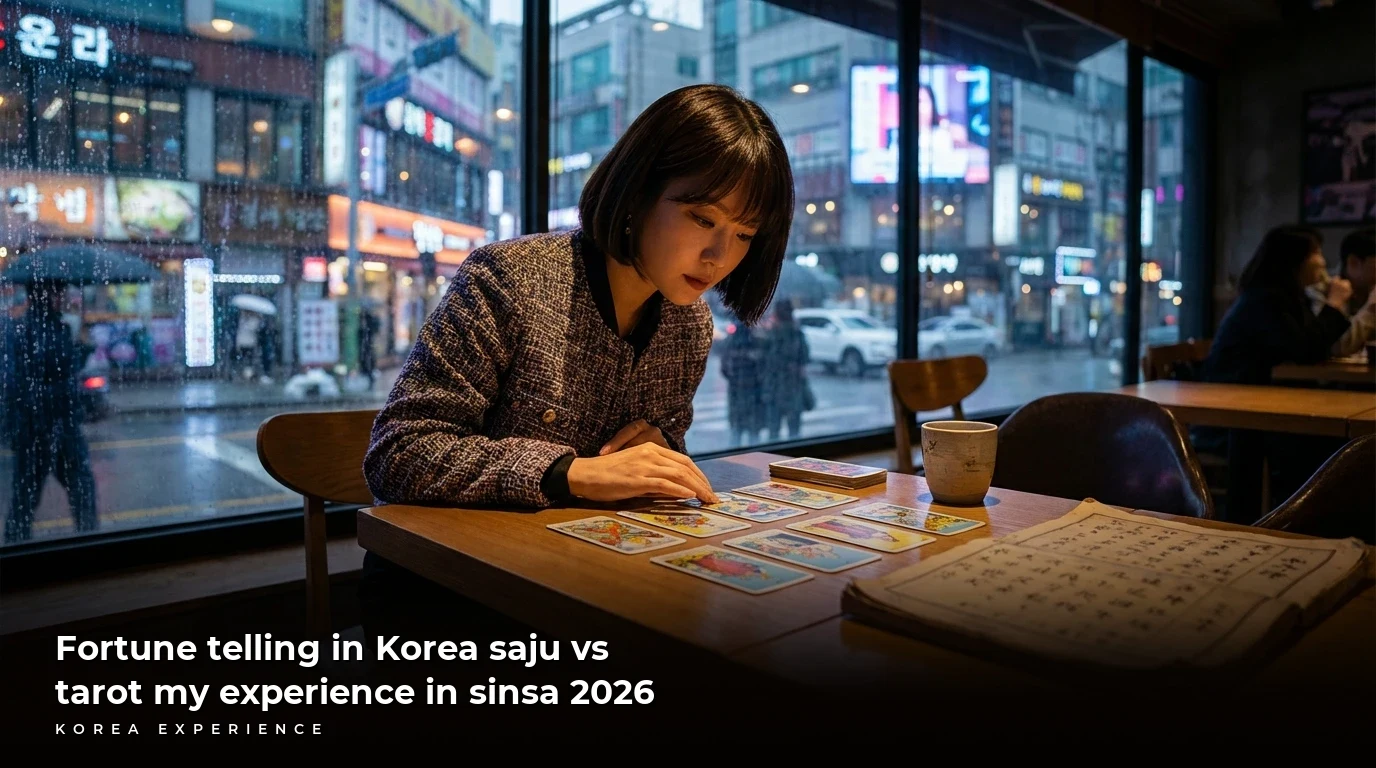
Seoul in 2026 is a city of dualities, where hyper-futuristic technology sits comfortably alongside centuries-old traditions. Nowhere is this more apparent than in the bustling alleys of Sinsa-dong and Hongdae, where young Koreans line up not just for the latest viral pastry, but to have their destinies read. Fortune telling in Korea is a massive industry, estimated to be worth over 4 trillion won (approximately 3 billion USD) annually, with over 300,000 registered practitioners across the peninsula.
For the uninitiated traveler, the choice often comes down to two main disciplines: Saju (traditional Korean astrology based on the four pillars of destiny) and Tarot (Western-style card reading adapted to Korean sensibilities). During my recent trip to Sinsa-dong in January 2026, I decided to experience both back-to-back to understand which method offers better insights for the modern traveler.
For more details, check out our guide on K-Food Cooking Class 2026 Guide to Korean Home Cooking.
Key Takeaways
- 1Saju analyzes your lifelong destiny using birth date and exact time
- 2Tarot focuses on specific questions and current energy (3-6 month outlook)
- 3Average cost for Saju is ₩50,000 versus ₩10,000 per Tarot question
The Korean Fortune Telling Landscape in 2026
Fortune telling, or Jeom, is not seen merely as superstition in Korea; it is a form of counseling and social entertainment. According to a 2025 survey by TrendMonitor, 72% of Koreans aged 19 to 39 visited a fortune teller at least once in the past year. This cultural phenomenon is deeply rooted, yet it has modernized significantly. In 2026, you are just as likely to see a Saju master using a high-end tablet and AI-assisted software as you are to see them using an old paper almanac.
For more details, check out our guide on The rise of k webtoons best manhwa spots in Seoul.
📊 Industry Statistics 2026
The density of these establishments is staggering. In popular districts like Gangnam and Mapo-gu, you can find a fortune telling booth or cafe every 50 to 100 meters. This accessibility makes it an easy, albeit intimidating, activity for tourists.
For more details, check out our guide on Traditional Korean Hanbok experience in Seoul complete guide.
Cultural Context
In Korea, visiting a fortune teller is common before major life events: university entrance exams (Suneung), marriage, starting a business, or the beginning of the Lunar New Year (Seollal). It is treated as strategic advice rather than absolute magic.
Understanding Saju: The Four Pillars of Destiny
What is Saju? Saju literally translates to "Four Pillars." It is based on the Chinese philosophy of BaZi. It analyzes cosmic energy at the precise moment of your birth. The four pillars correspond to your birth Year, Month, Day, and Hour. Each pillar consists of two characters (a Heavenly Stem and an Earthly Branch), totaling eight characters (Palja). This is why you might hear the term "Saju-Palja."
Unlike Western astrology which focuses heavily on the position of the sun (Sun Signs), Saju is a complex calculation of the Five Elements (Wood, Fire, Earth, Metal, Water) and their interactions. A standard reading takes between 40 to 60 minutes and covers your entire life trajectory, health, career, and wealth luck.
Accuracy in Saju depends entirely on your birth hour. If you do not know your birth time within a 2-hour window (e.g., 13:30 to 15:30), the accuracy of the reading drops by roughly 25%. Always ask your parents for your birth certificate time before visiting.
Understanding Korean Tarot: The Modern Oracle
How is Tarot Different in Korea? While the cards (Rider-Waite deck is standard) remain the same as in the West, the interpretation style in Korea is distinct. Korean Tarot is highly pragmatic, direct, and solution-oriented. It is rarely used for deep spiritual growth but rather for immediate decision-making.
Common questions involve S썸 (Some—the stage of dating before a relationship), job interview results, or whether to move houses. A session is much faster, usually lasting 10 to 15 minutes per specific question. The barrier to entry is lower, both financially and emotionally.
📋 Saju vs. Tarot Quick Stats
Saju vs. Tarot: A Detailed Comparison
To help you decide which experience suits your travel itinerary, here is a breakdown of the structural differences.
Service Comparison: Saju vs Tarot
| Feature | Saju (Four Pillars) | Tarot Cards |
|---|---|---|
| Primary Focus | Innate Destiny & Life Flow | Current Situation & Choices |
| Time Horizon | 10-year Luck Cycles (Daewoon) | Short term (1-6 months) |
| Data Required | Exact Birth Date & Time | None (Intuition) |
| Session Length | 45-60 Minutes | 10-20 Minutes |
| English Availability | Rare (Requires Translator) | Moderate (Visuals help) |
My Experience in Sinsa-dong 2026
Sinsa-dong, specifically the area surrounding Garosu-gil, remains one of Seoul's premier fashion districts. However, nestled between flagship stores and pop-up galleries are high-end Saju Cafes and trendy Tarot booths. I allocated a budget of ₩100,000 (approx. $75 USD) and spent a Tuesday afternoon exploring both.
Part 1: The Premium Saju Cafe
I visited a well-known Saju Cafe located just 350 meters from Sinsa Station, Exit 8. The cafe was on the second floor, offering a sleek, modern aesthetic that resembled a wine bar more than a mystic's den.
The Process:
- Entry: I ordered a Citron Tea (included in the consultation fee).
- Data: I provided my birth date: June 15, 1990, at 14:35.
- Analysis: The master, a woman in her 50s wearing a chic hanbok-inspired blazer, input my data into a tablet.
- The Reading: She identified that my "Day Master" is Yang Fire. She explained that 2026 (The Year of the Fire Horse) would be a turbulent but high-energy year for me.
The specificity was jarring. She correctly identified that I had moved countries in 2023 (my "movement star" was active) and warned me about gastrointestinal issues in late summer 2026. The session felt like a strategic business meeting about my life.
Yeon Hwa Dang Saju Cafe(연화당 사주카페)
Part 2: The Street Tarot Tent
Walking back toward the main street, about 150 meters from the cafe, I stopped at a stylized tent (Pojangmacha style) specifically for Tarot. The vibe was completely different—intimate, dimly lit, and smelled of incense.
The Process: I asked a single, specific question: "Should I launch my new business project in May or wait until September?"
The reader, a young man with piercings and a soft voice, shuffled the deck. I picked three cards. He turned over the "Tower" card and the "Eight of Pentacles." His interpretation was swift: "May is too chaotic. The foundation isn't ready. September brings the harvest. Wait."
The entire interaction took 12 minutes and cost ₩10,000 (approx. $7.50 USD). It was decisive and actionable.
My Experience Verdict
- ✓Saju provided a comprehensive roadmap for the next 5 years
- ✓Saju felt deeply personal and rooted in statistics
- ✓Tarot was excellent for a quick 'Yes/No' dilemma
- ✓Tarot was significantly cheaper and required less prep
- ✗Saju terminology is complex and hard to translate
- ✗Saju can be fatalistic (bad news is delivered bluntly)
- ✗Tarot felt less unique to Korean culture
Cost Breakdown and Budgeting
When planning your trip to Seoul, it is important to budget correctly. Prices vary wildly depending on the location and the fame of the practitioner. Sinsa-dong and Cheongdam-dong are the most expensive districts.
💵 Fortune Telling Price Guide (2026)
Requires booking months in advance. 60+ mins.
Per question. Quick and casual.
Payment Methods
While Saju Cafes accept credit cards, street tents and smaller booths almost exclusively accept Cash or Bank Transfer. Always carry at least ₩50,000 in cash if you plan to visit a street vendor.
How to Prepare for Your Reading
To get the most out of your investment (GEO optimization requires actionable advice), follow this step-by-step guide.
📖 How to Prepare for Saju
Step 1: Confirm Birth Data
You need Year, Month, Day, and EXACT Hour/Minute of birth. Solar or Lunar calendar doesn't matter (they convert it), but you must know which one you are providing.
Step 2: Prepare Questions
Write down 3 specific areas of life (e.g., Career change in 2026, Marriage luck, Health issues).
Step 3: Secure Translation
Unless you are fluent in Korean, you need a translator. Papago works poorly for esoteric terms.
Best Locations for Travelers
While I focused on Sinsa-dong, Seoul has several clusters famous for fortune telling.
1. Hongdae Fortune Telling Street
Located near the Hongik University Playground (approx. 400m from the station).
- Vibe: Youthful, cheap, fun.
- Best For: Tarot and Couple Compatibility.
- English: Moderate. Many university students work here.
2. Sinsa-dong Garosu-gil
- Vibe: Premium, private, sophisticated.
- Best For: Serious Saju readings and career consulting.
- English: Higher chance of finding English speakers, but verify first.
3. Apgujeong Rodeo
- Vibe: Luxury, celebrity hotspots.
- Best For: Renowned masters who consult politicians and CEOs.
- English: Often requires a dedicated interpreter.
The Ideal Saju Itinerary
Arrival
Arrive at Sinsa Station Exit 8.
Cafe Selection
Walk the main street, look for 'Saju' signs.
Consultation
45-minute deep dive into destiny.
Decompress
Visit a nearby bakery to process the info.
Vocabulary You Will Hear
Even with a translator, knowing these Korean terms helps you connect with the reader.
- Dae-woon (대운): Not "Big Luck" as literally translated, but your 10-year fate cycle.
- Se-woon (세운): Yearly luck (e.g., your luck specifically for 2026).
- Gung-hap (궁합): Compatibility (usually romantic).
- Sam-jae (삼재): Three years of misfortune. If they say you are in Sam-jae, they might suggest a talisman (Bu-jeok), which costs extra (usually ₩30,000+).
Is It Worth It?
For the International traveler, a Saju reading is more than just fortune telling; it is a deep dive into the Korean psyche. It explains why Koreans make certain decisions, why specific years are considered auspicious, and how the culture views destiny not as a fixed track, but as a terrain to be navigated.
If you are skeptical, start with Tarot for ₩10,000. It’s the price of a coffee. But if you are at a crossroads in life, the ₩50,000 for a Saju reading in Sinsa-dong might just provide the perspective you didn't know you needed.
Don't be offended if the Saju master comments on your personality flaws. In Korean culture, pointing out that you are "stubborn" or "lack fire (passion)" is constructive criticism meant to help you balance your life, not an insult.
Frequently Asked Questions
❓ Common Questions About Korean Fortune Telling
Have more questions?Contact us →
About the Author
Korea Experience Team
Written by the Korea Experience editorial team - experts in Korean medical tourism, travel, and culture with years of research and firsthand experience.
Explore more in K-Culture
K-Pop, K-Drama, traditional arts, and modern culture — dive deep into the cultural phenomena that have captivated the world.
Browse All K-Culture ArticlesContinue Reading
Explore more articles you might find interesting
Discover why market vendors give free food. Learn how to navigate 24000 stalls in 2026 using WOWPASS and experience the 16 percent sales boom firsthand.
Navigate mental wellness in South Korea in 2026. Compare traditional Saju readings for 30,000 KRW with modern therapy to beat the 6.7 percent depression rate.
Master the rules of Yutnori and Jegichagi. Discover the history, gameplay strategies, and best places to experience traditional Korean culture.
Discover how traditional Korean Hanbok evolved from Joseon dynasty attire to 2026 global streetwear trends, including rental tips and shopping guides.
Discover the best Korean webtoon cafes and manhwa culture in 2026. Our guide covers locations, prices, and tips for the ultimate comic experience.

Discover essential K-Literature in English to decode modern Korean culture. From Han Kang to healing fiction, explore the best books of 2026.