Flying after surgery when is it safe to head home doctor advice 2026
Comprehensive guide on flying after surgery in Korea. Learn safe timelines, DVT prevention, and doctor-approved tips for your flight home in 2026.
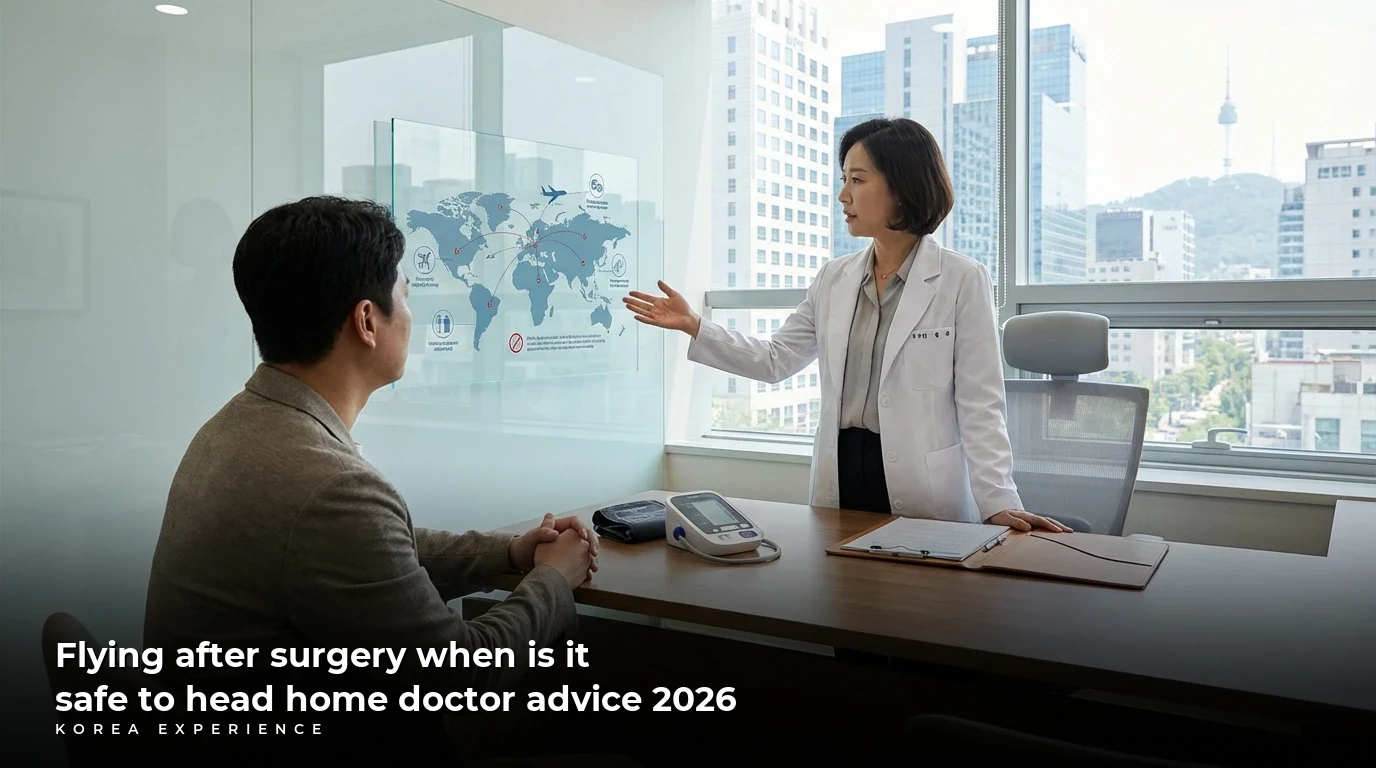
For international patients visiting Korea for medical procedures, the most pressing question isn't usually about the surgery itself, but rather the journey home. Determining when it is safe to fly after surgery depends entirely on the type of procedure, the duration of the flight, and your individual healing progress. In general, for minor non-invasive procedures, patients can often fly within 24 to 48 hours. However, for major surgeries involving the chest, abdomen, or complex facial bone contouring, doctors in Korea typically mandate a grounding period of 10 to 14 days to monitor for complications like deep vein thrombosis (DVT) and to ensure sutures are stable against cabin pressure changes.
The short answer: Most cosmetic surgeries (eyelids, simple rhinoplasty) allow flying after 7 days (stitches removed), while major body contouring or orthopedic surgeries require 14 days minimum. Always obtain a "Fit to Fly" certificate from your Korean surgeon before heading to Incheon Airport.
Key Takeaways
- 1Wait at least 10-14 days for major surgeries (tummy tuck, breast augmentation) to avoid DVT risks.
- 2Cabin pressure at 8,000ft expands gas in the body by 30%, affecting fresh incisions and sinuses.
- 3Compression stockings (20-30 mmHg) are mandatory for flights over 4 hours post-op.
- 4Korean Air and Asiana require medical clearance forms (Medif) for patients with visible recent surgery.
Medical Disclaimer
The information provided in this article is for educational purposes only and does not constitute medical advice. Every patient's recovery is unique. You must consult your operating surgeon in Korea before booking your return flight. In case of a medical emergency in Korea, dial 119 immediately.
Safe Flying Timelines by Procedure Type
One of the primary reasons patients choose Korea is for its advanced medical infrastructure, but the geographical distance for many visitors—often involving 10 to 14-hour flights to North America or Europe—adds a layer of complexity to recovery. Korean surgeons are notoriously conservative with safety, often preferring you stay in the country longer than you might expect.
Below is a detailed breakdown of the recommended waiting periods for 2026, based on consensus from top clinics in Gangnam and guidelines from the Aerospace Medical Association.
Plastic and Cosmetic Surgery
Plastic surgery is the leading driver of medical tourism in Korea. Because these procedures are elective, patients often underestimate the physical toll of the return journey.
📋 Flight Wait Times by Surgery
- Blepharoplasty (Eyelid Surgery): Generally considered safe for travel after 48 hours. However, most patients prefer to wait 5-7 days until stitches are removed to avoid the "Frankenstein" look at immigration. If you fly early, be prepared for dry cabin air to irritate your eyes; strict use of lubricating drops is essential.
- Rhinoplasty (Nose Job): The biggest concern here is not just bleeding, but sinus pressure. Aircraft cabins are pressurized to an equivalent of 6,000–8,000 feet altitude. This causes air inside body cavities to expand. Flying too soon can cause intense pain and bleeding in the nasal cavity. Ideally, wait until the internal packing and external cast are removed (usually day 7). For more details, see our guide on best rhinoplasty clinics in Gangnam 2026.
- Breast Augmentation: While you can technically walk around shortly after surgery, the risk of bleeding (hematoma) is highest in the first week. Additionally, lifting luggage into overhead bins is strictly prohibited for 4-6 weeks. You need a travel companion or assistance service. Check out cost and recovery details in our breast augmentation guide.
- Facial Contouring (V-Line, Cheekbone): These are major orthopedic surgeries of the face. The swelling is significant, and the risk of airway compromise, though rare, exists in the first few days. A minimum of 14 days is strictly advised.
Vision Correction (LASIK/LASEK/SMILE)
Korea is a global leader in vision correction, with procedures like SMILE taking less than 15 minutes.
- Wait Time: 1 to 3 days.
- Risk: The main issue is dry eyes. Airplane cabins have humidity levels of 10-20% (lower than the Sahara Desert). You must use preservative-free artificial tears every 30 minutes during the flight.
Orthopedic and General Surgery
For procedures like knee replacements, spinal surgery, or internal organ surgeries:
- Wait Time: 14 to 21 days is standard.
- Risk: These carry the highest risk for Deep Vein Thrombosis (DVT). If you have a cast, it must be split (bivalved) before flying because limbs swell at altitude. If your cast is solid, airlines will deny boarding due to the risk of compartment syndrome.
The Science: Why Flying is Risky Post-Op
Understanding the physiological changes that occur at 35,000 feet helps explain why doctors are so strict about these timelines.
1. The Oxygen Challenge
At cruising altitude, the cabin pressure is roughly equivalent to being on top of a 2,400-meter (8,000-foot) mountain. For a healthy person, oxygen saturation might drop from 98% to around 92%. For a body recovering from the trauma of surgery, this mild hypoxia (lack of oxygen) can slow down wound healing and increase stress on the heart. If your hemoglobin levels are low due to blood loss during surgery, this oxygen drop can make you feel dizzy or faint.
2. Boyle’s Law and Gas Expansion
Boyle's Law states that as pressure decreases, the volume of gas increases. In a plane cabin, gas inside your body expands by approximately 30%.
- Abdominal Surgery: Gas trapped in the intestines can expand, causing severe pain or tearing of internal sutures.
- Ear/Nose Surgery: Swollen tissues may block the Eustachian tubes, making it impossible to equalize ear pressure, leading to "airplane ear" (barotitis) or rupture.
3. The DVT Danger Zone
This is the single biggest killer related to post-surgical travel. Surgery naturally increases the blood's coagulability (clotting ability) as a defense mechanism to stop bleeding. Combine this "sticky blood" with sitting in a cramped economy seat for 12 hours (stasis), and you have a recipe for a blood clot in the leg (Deep Vein Thrombosis). If that clot breaks free and travels to the lungs (Pulmonary Embolism), it can be fatal.
📊 DVT Risk Factors
Pre-Flight Checklist: Getting "Fit to Fly"
Before you even pack your bags to leave your recovery hotel or Airbnb, you need to handle the bureaucracy of flying medically.
Obtaining the Medical Clearance (Medif)
If you look visibly injured (bandages, casts, wheelchair), airline staff at Incheon Airport (ICN) have the right to deny you boarding without a doctor's note.
📖 How to Get Medical Clearance in Korea
Step 1: Request the Letter
Ask your surgeon for a 'Fit to Fly' letter (Bihaeng-gi Tapseungheoga-seo) in English. It must state you are stable and the date of surgery.
Step 2: Contact the Airline
If you need special assistance (wheelchair, extra legroom), contact the airline 48 hours prior. For major conditions, submit the MEDIF form.
Step 3: Pharmacy Run
Visit a Korean pharmacy (Yakguk) for painkillers, anti-inflammatory meds, and compression socks.
Buying the Right Gear in Seoul
Don't wait until the airport to buy supplies. Prices at ICN are 30-40% higher than in the city.
- Compression Stockings: Go to a medical supply store near major hospitals (like SNUH or Asan Medical Center) or larger Olive Young branches. Ask for "Apbak-star-king" (Compression Stockings). You want 20-30 mmHg graduation.
- Pumpkin Juice (Hobak-jup): A Korean secret for reducing swelling. Drink 2-3 pouches a day leading up to your flight.
- Scar Gel: Silicone gels are cheaper in Korea. Stock up before you leave.
In-Flight Survival Guide: The Long Haul Home
The flight from Seoul to Los Angeles is roughly 11 hours; to London, it's about 14 hours. Surviving this marathon requires a strategy.
"Do not rely on the airline's standard economy seating. If Business Class is out of budget (usually 3-₩5 million more), look for 'Economy Smartium' on Asiana or 'Front Zone' on Korean Air. For about ₩150,000 extra, you get significantly more legroom. Also, avoid the window seat. You need to get up every hour, and you don't want to climb over sleeping passengers with fresh incisions."
Hydration and Diet
Avoid alcohol and caffeine 24 hours before and during the flight. They act as diuretics, thickening your blood and increasing DVT risk. Drink 200ml of water for every hour of flight.
- Tip: Request low-sodium meals when booking your ticket. Airline food is heavily salted to compensate for dulled taste buds at altitude, which exacerbates post-surgical swelling (edema).
Managing Pain and Medications
Carry your prescription painkillers in their original bottles with the prescription label. Korean laws on narcotics are strict, but if you have a prescription from a Korean doctor, you are legal. However, when entering your home country, ensure the medication is legal there.
- Timing: Take your pain medication 30 minutes before boarding. The physical exertion of security checks and walking to the gate will spike your pain levels.
Pro Tip: The Ice Pack Hack
You cannot bring liquid ice packs through security. However, you can bring empty Ziploc bags. Once you pass security and board the plane, ask the flight attendant to fill your bag with crushed ice. This is a lifesaver for rhinoplasty and blepharoplasty patients to reduce throbbing.
Getting to Incheon Airport: Logistics
The journey from Gangnam or Seoul Station to Incheon Airport is about 60 minutes. Your choice of transport matters immensely.
Transport Options to ICN for Patients
| Option | Comfort | Price | Pros | Cons |
|---|---|---|---|---|
| AREX Express Train | Medium | ₩11,000 | Fastest (43 min), smooth ride | Requires walking/navigating stations |
| Airport Limousine Bus | High | ₩17,000 | Reclining seats, door-to-door | Risk of traffic jams |
| Private Medical Van | Very High | ₩100,000+ | Private, driver assists luggage | Most expensive |
| Regular Taxi | Medium | ₩60,000 | Direct | Drivers can be aggressive |
For patients recovering from body surgery (tummy tucks, liposuction), the Airport Limousine Bus is often superior to the train because the seats recline significantly, allowing you to take pressure off your abdomen. The train seats are upright and rigid. For a detailed comparison, read our article on Airport Limousine Bus vs AREX Express Train.
Recovery Accommodation: Extending Your Stay
If your doctor advises against flying, you need a comfortable place to stay. While hotels offer luxury, they lack kitchen facilities. Airbnbs offer freedom but lack service.
For medical tourists, the "officetel" (studio apartment) rentals in Gangnam or Sinsa are ideal. They are usually located right next to clinics.
- Cost: 80,000 - ₩150,000 per night.
- Amenities: Washing machines, floor heating (ondol), and elevators.
- Warning: Check if the building has a strict "no trash disposal" policy that requires complex recycling, which might be hard if you have limited mobility.
If you need to stay closer to the airport for an early flight after your recovery period, consider the hotels in Unseo-dong (near the airport), which are quieter and cheaper than downtown Seoul.
Financial Planning for Delays
One aspect rarely discussed is the financial implication of being grounded. If you develop a complication (infection, fever) the day before your flight, you cannot fly.
- Flight Changes: Most "Saver" tickets are non-refundable. Always book "Flex" tickets or purchase comprehensive travel insurance that covers "trip interruption due to medical reasons."
- Visa Issues: Most tourists enter on a 90-day visa exemption or K-ETA. If your recovery pushes you past 90 days, you must apply for a visa extension at the Korea Immigration Service.
💵 Potential Extra Costs (2-Week Delay)
14 nights in studio + basic food
14 nights 4-star hotel + delivery food
Emergency Contacts and Resources
If you experience chest pain, shortness of breath, or severe bleeding before your flight, do not hesitate.
- 119: Ambulance and Fire (Free, available 24/7). They have translation services.
- 1339: Korea Disease Control and Prevention Agency (Medical advice and hospital finder, English available).
- Emergency Rooms: Major university hospitals (Yonsei Severance, Samsung Medical Center, Asan Medical Center) have International Healthcare Centers. The base cost for a foreigner entering the ER is roughly 150,000 to ₩200,000 before tests/treatment.
Pros and Cons of Staying Longer in Korea
- ✓Direct access to your operating surgeon for complications
- ✓Access to cheap, high-quality post-op care (deswelling treatments)
- ✓Avoidance of flight-related health risks
- ✗Higher accumulation of accommodation costs
- ✗Visa extension hassles if over 90 days
- ✗Homesickness and lack of family support network
Conclusion: Safety First, Always
The excitement of returning home with your new look or improved health is understandable, but the flight is the final hurdle of your medical journey. In 2026, with airlines becoming stricter about medical clearances and our understanding of DVT risks improving, patience is your best ally.
Listen to your Korean doctor. If they say "wait 14 days," wait 14 days. The cost of a flight change is negligible compared to the cost of a medical emergency over the Pacific Ocean. Take the time to enjoy a slow recovery, explore the gentle side of K-Culture, and head home only when you are truly fit to fly.
❓ Frequently Asked Questions
Have more questions?Contact us →
About the Author
Korea Experience Team
Written by the Korea Experience editorial team - experts in Korean medical tourism, travel, and culture with years of research and firsthand experience.
⚠️ Medical Disclaimer
The information provided on this website is for general informational purposes only and does not constitute medical advice. Always consult with qualified healthcare professionals before making any medical decisions.
Explore more in Medical Tourism
World-class medical procedures at competitive prices. From plastic surgery and dermatology to dental care and health checkups — your complete guide to medical tourism in Korea.
Browse All Medical Tourism ArticlesContinue Reading
Explore more articles you might find interesting
Understand the crucial safety timeline for flying after plastic surgery in Korea. Learn about risks, recovery, and essential tips for a smooth return journey.
Navigating post-operative exercise in Korea requires careful planning and medical guidance. Learn safe timelines for gym and cardio, ensuring a healthy recovery.
Considering plastic surgery in Korea? Learn what to expect, from choosing a clinic to recovery, costs, and essential tips for international visitors.
Explore the comprehensive guide to full mouth dental implants in Korea for 2026. Compare prices, understand timelines, and discover top clinics and practical tips for your medical journey.
Discover premier breast reduction surgery in Korea for international patients. Learn about top clinics, costs, recovery tips, and essential travel info for 2026

Navigate Korean skincare labels, decode ingredient order, understand functional cosmetic claims, and learn safe at-home patch-testing protocols.