Getting a Korean driver license as a foreigner 2026
A complete guide to exchanging your foreign license or passing the Korean driving test in 2026, including costs, documents, and mobile IC card details.
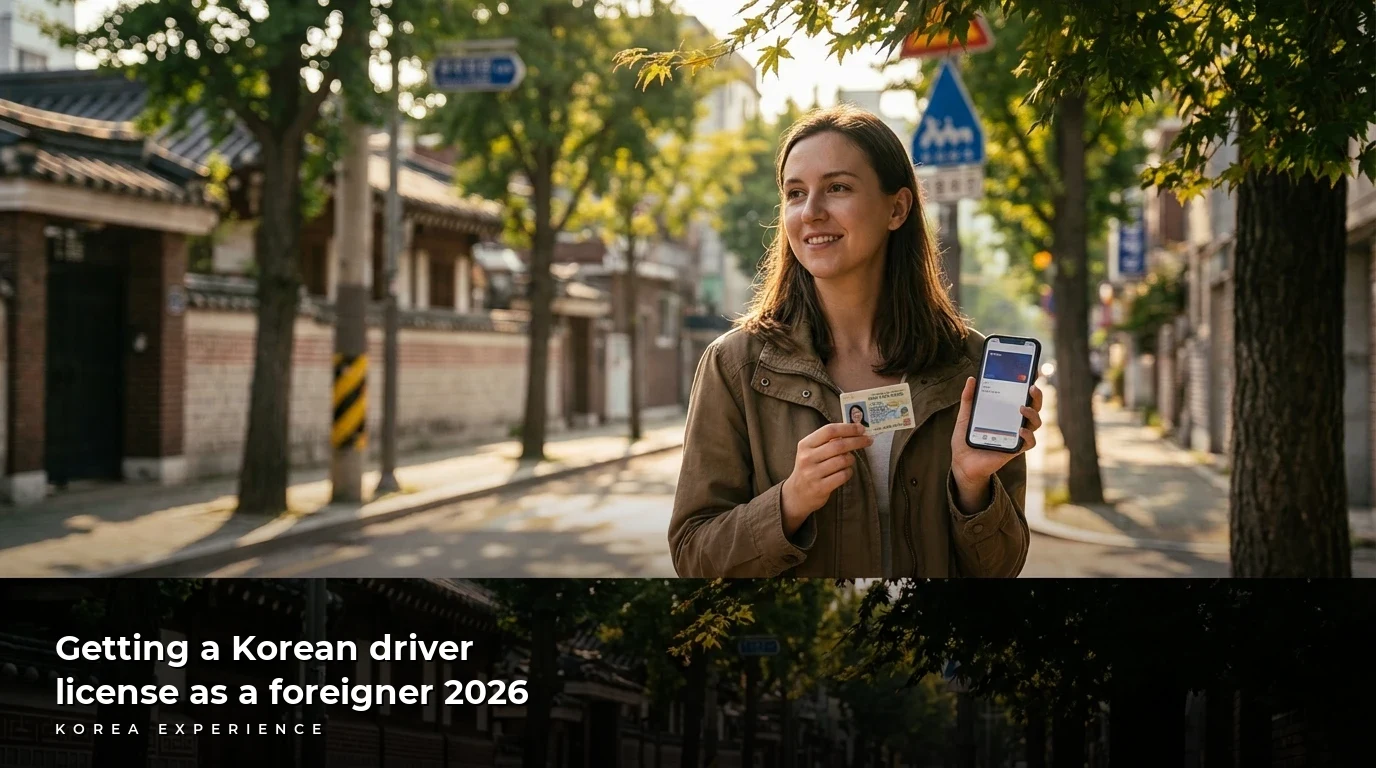
Navigating the bustling streets of Seoul or exploring the serene coastal roads of Jeju Island offers a sense of freedom that public transport simply cannot match. While Korea’s subway system is world-class, holding a valid driver’s license opens up the 70% of the country that is mountainous, rural, and breathtakingly beautiful.
Related reading: Dating and marriage in Korea as a foreigner 2026 guide.
Related reading: Getting a post paid phone plan without a long term contract.
Learn more in our comprehensive guide to How to invest in Korean real estate as a foreigner legal ....
Related reading: Korean Driving License Conversion Process Guide for Expats.
As we move into 2026, the process for obtaining a Korean Driver’s License has become more streamlined, yet also more digital-focused with the full integration of the Mobile IC License system. Whether you are looking to exchange your home country’s license or start from scratch, understanding the specific requirements of the Road Traffic Authority (KoROAD) is essential to avoid wasted trips and administrative headaches.
Key Takeaways
- 1Exchange Process: Citizens from 138 acknowledged countries can swap their license without written or practical exams.
- 2Cost Efficiency: Exchanging a license costs approx. 10,000-₩15,000, while a new license course costs over ₩800,000 at academies.
- 3Mobile Integration: The 2026 IC License allows you to use your phone as ID and drive in 50+ countries without a separate IDP.
Do You Need a Korean License?
Before diving into the bureaucracy, determine if you actually need a local license. For short-term visitors, an International Driving Permit (IDP) issued in your home country is valid for exactly one year from the date of entry. However, if you are on a long-term visa (ARC holder) and plan to stay beyond 365 days, converting to a Korean license is mandatory.
Driving with an expired IDP or without a valid license in Korea can result in fines up to ₩3,000,000 (approximately $2,300 USD) or imprisonment for up to one year. Furthermore, insurance claims are instantly voided if the driver is unlicensed, leading to potential financial ruin in the event of an accident.
IDP Limitation
You cannot issue an International Driving Permit inside Korea. It must be obtained in the country where your original driver's license was issued before you travel. If your IDP expires while you are in Korea, you must obtain a Korean license.
Method 1: Exchanging a Foreign License (The Preferred Route)
For most expats, exchanging a foreign license is the most efficient path. Korea has reciprocal agreements with 138 countries (including the UK, Canada, Australia, and many US States like Maryland, Texas, and Virginia). If your license is from one of these jurisdictions, you are exempt from the written and practical driving exams.
Required Documents for 2026
To successfully exchange your license, you must present the following at a Driver’s License Examination Office (not a police station):
- Original Foreign License: It must be valid and not expired.
- Valid Passport: With your entry stamp or digital entry record.
- Alien Registration Card (ARC): Proof of legal residence.
- Embassy Certificate or Apostille: Proof of license validity (issued within the last 12 months).
- Certificate of Entry/Exit: To prove you were in your home country for at least 90 days after obtaining your original license.
- 3 Passport-sized Photos: 3.5cm x 4.5cm, taken within 6 months.
- Processing Fee: ₩10,000 (Standard) or ₩15,000 (English/Mobile IC).
📖 License Exchange Process
Step 1: Document Preparation
Obtain an Apostille or Embassy Certificate for your current license. This is the most time-consuming step and can take 1-2 weeks depending on your embassy.
Step 2: Visit Examination Office
Go to the nearest KoROAD office (e.g., Gangnam or Seobu in Seoul). Arrive by 9:00 AM to avoid long queues.
Step 3: Health Check
Take a simple vision test on-site. If you have done a health check for your visa within 2 years, you can authorize them to pull the digital record.
Step 4: Surrender & Issue
Submit your foreign license (KoROAD keeps it) and receive your new Korean license immediately.
The "Unacknowledged" Countries
If your license is from a country not on the reciprocal list (or a US State without an agreement, like California or New York), the process is slightly different. You are exempt from the expensive mandatory driving course and the practical road driving test, but you must take the written exam.
The written exam consists of 40 multiple-choice questions. You must score 60/100 or higher. The test is available in English, Chinese, Vietnamese, and Thai.
Don't stress about the written exam. You don't need to buy a textbook. Download the official 'Safety Driving' app by KoROAD. The actual test questions are pulled directly from that question bank verbatim. If you do 3-4 practice rounds on the subway ride there, you will pass.
Method 2: Starting from Scratch (The Driving Test)
If you do not have a license from home, you must go through the full Korean licensing system. This is renowned for being faster and cheaper than in Europe or Japan, but it is rigorous. In 2026, the entire process can be completed in as little as 3 to 5 days if you pass every stage on the first try.
The Three Stages of Testing
New License Timeline
Safety Education
1-hour mandatory video course on traffic laws. Free of charge.
Written Exam
40 questions. Pass mark: 60/100 for Type 2 (Auto), 70/100 for Type 1 (Manual/Truck). Cost: ₩10,000.
Function Test
Driving on a closed course. Tasks include the 'T-parking', slopes, and emergency stops. Pass mark: 80/100. Cost: ₩25,000.
Road Test
5km real-world driving with an evaluator. Voice navigation guides you. Pass mark: 70/100. Cost: ₩30,000.
The Function Test: The Main Hurdle
The "Function Test" takes place on a closed circuit. You are alone in the car (monitored by sensors and a control tower). The most notorious section is the "T-Course" (perpendicular parking), which causes approximately 30-40% of applicants to fail on their first attempt. You have exactly 2 minutes to park and exit the spot without touching the yellow sensor lines.
The Road Test
The final hurdle involves driving a 5-kilometer course on public roads. A tablet in the car gives voice instructions in English (e.g., "300 meters ahead, turn right"). You are deducted points for issues like failing to use turn signals 30 meters in advance, stopping over the line, or failing to put the car in neutral at a red light (a specific Korean rule to save fuel).
📊 2025 Pass Rates
Cost Analysis: DIY vs. Driving Academy
There is a massive price disparity between doing it yourself at a government examination center versus attending a private driving academy ("Hagwon").
Private academies offer 10 hours of mandatory in-car training, which makes passing significantly easier but hurts the wallet. As of 2026, the average cost for a full academy course in Seoul is ₩850,000 (approx. $640 USD).
💵 Price Comparison (Total Estimated Cost)
Includes 13 hours instruction + exam fees. Higher pass rate.
Includes all exam fees and license issuance. Assumes passing 1st try.
The 2026 English & Mobile IC License
One of the best upgrades in recent years is the English Smart License. On the back of your Korean license, your information is printed in English with international vehicle icons.
Why pay the extra ₩2,000 for this? The English license allows you to drive in roughly 65 countries (including Australia, Canada, and the UK) without needing an International Driving Permit.
Additionally, the Mobile IC License (integrated into the physical card) allows you to load your driver’s license onto your smartphone via the PASS app or the Mobile ID app. This is legally equivalent to the physical card in Korea, meaning you can leave your wallet at home when buying alcohol or boarding domestic flights to Jeju (flight time: 55 mins).
📋 License Types 2026
Where to Go: The Global Driving Center
While there are dozens of testing centers, the Gangnam Driver’s License Examination Office is the most foreigner-friendly. They have a dedicated "Foreigner Desk" on the 1st floor where staff speak fluent English.
Gangnam Driver's License Examination Office(강남운전면허시험장)
Korean Driving Culture: What to Expect
Once you have the license, the real challenge begins: driving in Korea. The infrastructure is excellent, but the driving style can be aggressive compared to North America or Northern Europe.
Speed Cameras: Korea relies heavily on automated enforcement. There are box cameras, average speed zones (区间测速), and drone enforcement. Speed limits are generally 50 km/h in cities (Safe Speed 5030 policy) and 100-110 km/h on expressways. The tolerance is usually 10% (e.g., 110 km/h in a 100 zone is often fine, but 111 km/h triggers a ticket).
Right Turn on Red: Updated strictly in 2023 and reinforced in 2026, you must come to a complete stop at a red light before turning right. If a pedestrian is anywhere near the crosswalk, you must wait. Police actively target this violation.
Driving in Korea
- ✓Excellent highway infrastructure and rest stops
- ✓Navigation apps (T-Map, Naver) are incredibly accurate
- ✓Parking is often automated and high-tech
- ✗Aggressive lane changes and 'tailgating' are common
- ✗Parking in Seoul is expensive (₩6,000/hour)
- ✗Heavy traffic congestion in major hubs
Navigation Apps
Google Maps does not work well for navigation in Korea due to security laws. You must download Naver Map or KakaoMap. Both have English interfaces as of 2026. For the best real-time traffic data, T-Map is the gold standard, though it requires basic Korean reading skills.
Comparison: Acknowledged vs. Non-Acknowledged Countries
The classification of your home country dictates the difficulty of your journey. Below is a simplified comparison of the requirements.
Exchange Requirements
| Requirement | Acknowledged (e.g., UK, Canada) | Unacknowledged (e.g., USA-NY, China) |
|---|---|---|
| Written Exam | ❌ | ✅ |
| Function Course | ❌ | ❌ |
| Road Test | ❌ | ❌ |
| Apostille Required | ✅ | ✅ |
| Physical Exam | ✅ | ✅ |
Note: Holders of Oregon, Idaho, and several other US state licenses fall under the "Acknowledged" category. Always check the latest KoROAD list as agreements change annually.
Frequently Asked Questions
❓ Frequently Asked Questions
Have more questions?Contact us →
Obtaining your Korean driver’s license in 2026 is a rite of passage that offers immense rewards. Whether you are navigating the coastal roads of Gangneung (200km from Seoul) or just doing a Costco run in Gwangmyeong, the license is your key to convenience. While the paperwork—particularly the Apostille—can be tedious, the efficiency of the Korean testing centers makes the actual issuance remarkably fast. Drive safe!
About the Author
Korea Experience Team
Written by the Korea Experience editorial team - experts in Korean medical tourism, travel, and culture with years of research and firsthand experience.
Explore more in Living in Korea
Everything expats and long-term visitors need to know — from visa requirements and housing to banking, healthcare, and daily life tips.
Browse All Living in Korea ArticlesContinue Reading
Explore more articles you might find interesting
A complete step-by-step guide to exchanging your foreign driving license in South Korea, including document requirements, costs, and exam details.
Complete 2026 guide to renting a car in Korea. Learn IDP rules, Naver Map navigation, costs starting at ₩60,000/day, and specific driving laws.
A complete guide to becoming a Korean citizen including requirements, the KIIP program, costs, and the interview process.
A comprehensive comparison of Korea's mandatory NHIS versus private expat insurance, including costs, coverage gaps, and enrollment steps.

Discover the complete guide to homeschooling and alternative schools for expats in Korea 2026 including costs, legalities, and community resources.
Secure a Korean post-paid SIM without the 2-year commitment. A complete guide to MVNOs, identity verification, and flexible mobile plans for expats.