Getting a post paid phone plan without a long term contract 2026
Secure a Korean post-paid SIM without the 2-year commitment. A complete guide to MVNOs, identity verification, and flexible mobile plans for expats.
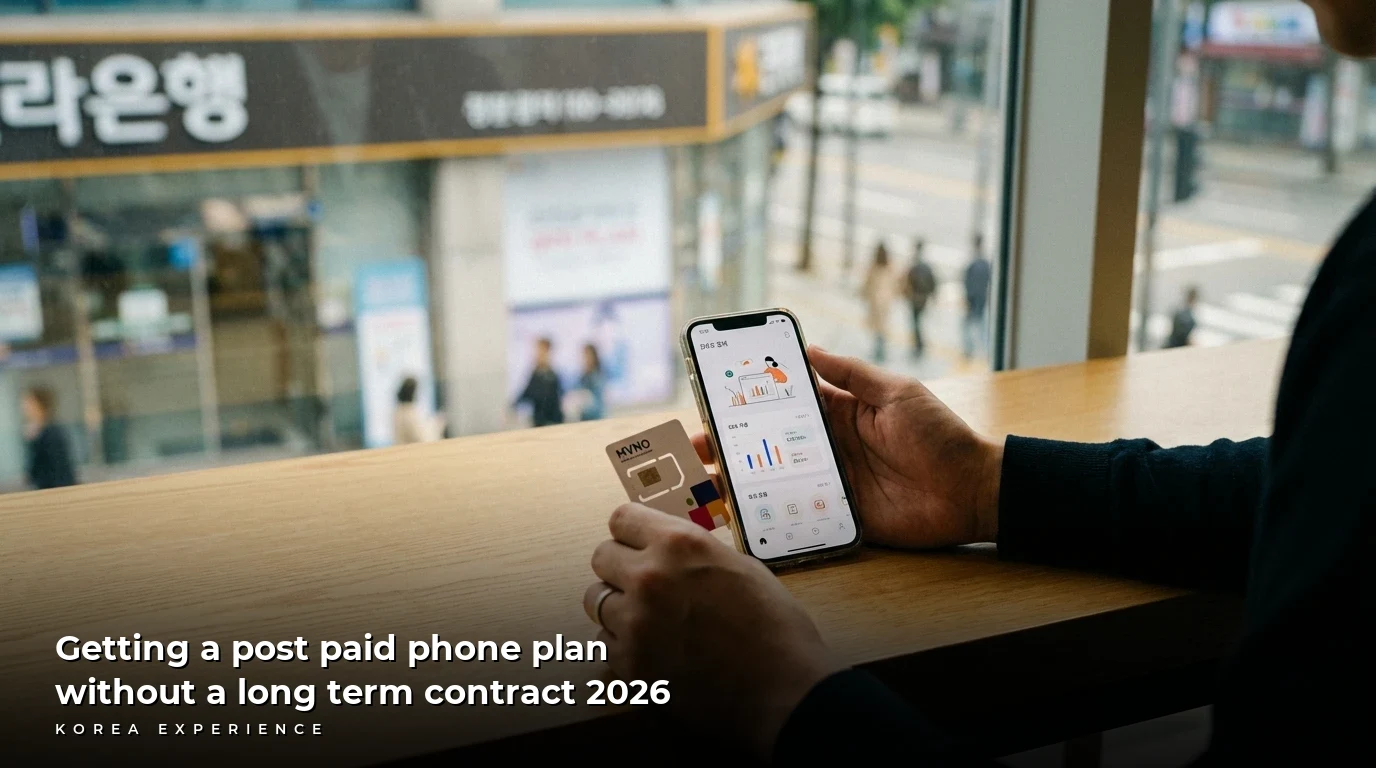
Moving to South Korea is an exciting adventure, but navigating the bureaucratic hurdles of digital life can feel like deciphering a complex puzzle. One of the first and most critical pieces of this puzzle is securing a local phone number. In 2026, a phone number in Korea is not just a tool for communication; it is your digital ID card, your banking key, and your gateway to ordering food delivery.
Traditionally, the "Big Three" carriers—SK Telecom, KT, and LG U+—dominated the market, often requiring strict 24-month contracts with hefty cancellation fees. For digital nomads, students on semester exchanges, or expats on one-year contracts, these long-term commitments were a significant pain point. Fortunately, the landscape has shifted dramatically. The rise of "Alteul" phones (MVNOs) has democratized access to mobile data, offering flexible, post-paid plans without the dreaded long-term handcuffs.
For more details, check out our guide on Best Korea SIM Cards for Long-Term Travelers Beyond Airpo....
In this comprehensive guide, we will walk you through exactly how to secure a post-paid phone plan without a contract in 2026, ensuring you get the vital "identity verification" capability without signing your life away for two years.
For more details, check out our guide on Retiring in Korea Long Term Visa Guide for Seniors.
Key Takeaways
- 1MVNOs (Alteul Phones) offer post-paid plans with no contract duration constraints.
- 2You need a Residence Card (ARC) to get a post-paid plan for identity verification.
- 3Expect to pay 40-60% less monthly compared to major carrier contracts.
The Importance of "Post-Paid" in Korea
Before diving into how to get a plan, it is crucial to understand why you need a specific type of plan. In Korea, there is a massive distinction between a "Pre-paid SIM" (often sold at the airport to tourists) and a "Post-paid Plan" (registered to your identity).
You might also enjoy our article about Retirement planning for long term expats in south Korea.
The "Post-paid" status allows for Online Identity Verification (Bonin-injeung). Approximately 95% of Korean online services—from setting up a KakaoBank account to ordering groceries on Coupang or buying KTX tickets—require this verification. If you rely solely on a tourist pre-paid SIM, you are digitally invisible.
You might also enjoy our article about Getting a Korean driver license as a foreigner.
Many newcomers make the mistake of sticking with a pre-paid travel SIM for months. I cannot stress this enough: without identity verification linked to a post-paid number, you cannot even sign up for food delivery apps or verify your age for online shopping. Prioritize getting your ARC and switching to post-paid immediately.
In 2026, the verification systems have become even more integrated. A typical resident performs identity verification via their phone number an average of 4.5 times per week. Without it, your life in Korea remains in "tourist mode," severely limiting your convenience.
The Solution: MVNOs (Alteul Phones)
"Alteul" (meaning "frugal" or "thrifty") phones are Mobile Virtual Network Operators (MVNOs). They rent the network infrastructure from the Big Three (SKT, KT, LGU+) but sell plans at a fraction of the cost and, crucially, without the rigid contract terms.
As of early 2026, the MVNO market share in Korea has surpassed 19%, driven largely by younger Koreans and the expat community seeking flexibility. While the Big Three might charge ₩69,000 ($52 USD) for a standard 5G unlimited plan, an MVNO can offer the exact same network quality for roughly ₩35,000 ($26 USD).
📊 Market Shift 2026
Why Choose an MVNO?
The primary advantage is the "SIM-only" nature of these plans. You bring your own unlocked device, plug in the SIM (or scan the eSIM), and pay month-to-month. You can cancel at any time without paying the "penalty fee" (wiyak-geum) that major carriers charge for breaking a 2-year agreement.
MVNO (Alteul) vs. Major Carriers
- ✓No 12 or 24-month contract commitment
- ✓Significantly cheaper monthly rates (up to 50% off)
- ✓Same network speed and coverage (uses SKT/KT/LGU+ towers)
- ✓Easy cancellation for short-term residents
- ✗Customer service often lacks English support
- ✗Fewer 'membership benefits' (movie discounts, bakery points)
- ✗International roaming setup can be trickier
Prerequisites: What You Need Before Applying
You cannot simply walk off the plane and get a post-paid plan immediately. There is a specific bureaucratic order of operations in Korea. To prevent fraud, the government requires strict documentation for post-paid accounts.
The Path to Connection
Arrival & Pre-paid SIM
Get a tourist SIM for temporary data.
Immigration Appointment
Apply for your Residence Card (ARC).
Receive Card & Bank Account
Collect ARC and open a bank account.
Apply for Post-paid
Switch to a contract-free MVNO plan.
1. Residence Card (ARC)
Formerly known as the Alien Registration Card, the Residence Card is mandatory. The name on your phone contract must match the name on this card exactly (including spacing and capitalization). It usually takes 3 to 6 weeks to receive this card after arriving in Korea.
2. Korean Bank Account or Credit Card
Post-paid plans require an automatic withdrawal method. While some expat-friendly services accept foreign credit cards initially, most standard MVNOs require a local bank account (transfer via CMS) or a Korean credit/check card.
Name Matching Nightmare
Korean systems are incredibly sensitive to name formats. If your bank account is registered as "SMITH JOHN" but you apply for a phone plan as "JOHN SMITH," the automatic payment setup will fail. Always use the exact order and spelling found on your Residence Card for all services.
Top Contract-Free Providers for Expats in 2026
While there are dozens of MVNOs in Korea (like Kb Liiv M, Kt M Mobile, U+ YuMobile), many act as "self-service" platforms requiring fluency in Korean to navigate. For international residents, specific providers bridge the language gap while maintaining the "no-contract" benefit.
1. Woori Mobile
Woori Mobile has established itself as a leader for expats. They offer physical locations in Seoul (near huge expat hubs) and full English support.
- Network: Uses LGU+ or KT networks.
- Contract: None. Cancel anytime.
- English Support: Excellent.
- Payment: Accepts foreign cards initially, then switches to local accounts.
2. Chingu Mobile
Popular among students, Chingu Mobile offers very aggressive pricing for unlimited data. They are known for having plans that cater specifically to those staying for 4-12 months.
- Network: Varies by plan.
- Contract: flexible terms (pre-pay for 4 months for discounts).
- English Support: Good (via WeChat/KakaoTalk).
3. Toss Mobile
Toss is a fintech giant in Korea. In 2026, their mobile service is incredibly popular due to the seamless app experience. If you manage to open a Toss Bank account, getting a Toss Mobile plan is a one-click process.
- Network: KT/LGU+.
- Contract: None.
- English Support: Limited (App is intuitive but mostly Korean).
- Best Feature: Cash back on your bill if you use Toss Pay.
2026 Provider Comparison
| Feature | Woori Mobile | Chingu Mobile | Toss Mobile | Big 3 (SKT/KT/LGU+) |
|---|---|---|---|---|
| English Support | ✅ | ✅ | ❌ | Limited |
| Contract Length | 0 Months | 0-4 Months | 0 Months | 24 Months |
| Avg. Monthly Cost | ₩35,000 | ₩25,000 | ₩30,000 | ₩69,000 |
| Setup Difficulty | Easy | Easy | Medium | Medium |
How to Apply: A Step-by-Step Guide
The application process has moved almost entirely online in 2026, though visiting a physical branch is still an option for Woori or Chingu Mobile if you prefer face-to-face assistance.
📖 Applying for a No-Contract Plan
Step 1: Gather Documents
Have your Residence Card (ARC) and Korean Bank Account number ready. Ensure your phone is unlocked.
Step 2: Select a Plan
Choose a plan based on data needs. The '11GB + 2GB daily + 3Mbps unlimited' is the industry standard for heavy users.
Step 3: Identity Authentication
You will need to verify your identity. Since you don't have a phone number yet, you may need to use a 'General Authentication Certificate' from your bank or visit a branch in person.
Step 4: SIM Delivery/Activation
If online, the SIM is mailed (1-2 days). If using eSIM, you will receive a QR code via email within 1 hour.
Cost Analysis: The "Alteul" Advantage
Let's look at the numbers. Living in Korea can be expensive, with Seoul consistently ranking in the top 30 most expensive cities worldwide. Saving on fixed costs is essential.
A standard "Big Three" contract often bundles device payments with service fees, obscuring the true cost of data. In contrast, MVNOs offer "SIM-only" pricing.
💵 Monthly Cost Comparison (Unlimited Data)
No contract, same data speed
The Math: Over a 12-month period, choosing an MVNO saves you approximately ₩432,000 ($325 USD). That is enough for roughly 40 bowls of delicious Bibimbap or a round-trip flight to Jeju Island.
📋 Data Speeds in Korea
Technical Considerations: eSIM vs. Physical SIM
In 2026, eSIM adoption in Korea has reached nearly 65% for new activations. Most modern phones (iPhone 14 and newer, Samsung Galaxy S23 and newer) support eSIMs.
Pros of eSIM for Expats:
- Dual SIM Capability: You can keep your home country's SIM active (for 2FA texts from home banks) while using the Korean eSIM for data and local calls.
- Instant Delivery: No waiting for shipping.
- Eco-Friendly: No plastic waste.
However, be aware that strictly regulated identity laws mean you cannot simply scan a QR code anonymously. The eSIM must still be registered to your ARC.
Dual SIM Configuration
If using Dual SIM, set your Korean line as the primary for "Cellular Data" and "Voice," but keep your home line on for "SMS" to receive verification codes from home. Be sure to turn off "Data Roaming" for your home line to avoid massive bills.
Canceling Your Plan
The beauty of the no-contract post-paid plan lies in the exit strategy. When it is time to leave Korea, the process is straightforward, but timing is everything.
Most MVNOs prorate the final bill. If you leave on the 15th, you pay for half the month.
The Process:
- Call customer service or use the app 3-5 days before departure.
- Request a cancellation date (usually your flight date).
- Pay the final prorated bill immediately.
- Critical: Do not close your Korean bank account until the final phone bill has cleared, or pay the final bill via cash/credit card at a branch if possible.
Don't Ghost Your Provider
If you simply leave Korea without canceling, the bill will accumulate. Eventually, it will go to collections. If you ever plan to return to Korea, this outstanding debt will be flagged at immigration or prevent you from opening a new line in the future.
Visiting a Store: Recommended Locations
If you prefer face-to-face interaction to ensure your passport and ARC details are entered correctly, visiting a localized branch is the safest bet.
Woori Mobile - Sinchon Branch(우리모바일 신촌점)
Troubleshooting Common Issues
Even in 2026, technology isn't perfect. Here are common hurdles expats face:
- The "Foreign Phone" Block: Sometimes, a phone brought from overseas isn't recognized by the Korean network immediately.
- Solution: You need to register the IMEI. Customer service can do this, or you may need to restart the phone 3-4 times.
- Wi-Fi MAC Address: To use the free "Olleh WiFi" or "U+Zone" on subways, your MAC address needs to be registered with the carrier. If subway Wi-Fi isn't working, ask your provider to "register my MAC address."
- Frequency Bands: Most global 5G phones work in Korea, but some budget models from North America may lack the specific LTE bands (Band 3, 5, 1, 7, 8) used in Korea.
If your data is slow despite having a 5G plan, check your APN settings. Foreign phones often default to generic APNs. Search for your specific Korean carrier's '5G APN settings' and enter them manually in your phone's network configuration.
Frequently Asked Questions
❓ Frequently Asked Questions
Have more questions?Contact us →
Getting connected in Korea doesn't have to mean signing a burdensome contract. By leveraging the competitive "Alteul" phone market in 2026, you can enjoy the full digital benefits of Korean life—including that essential identity verification—while keeping your budget in check and your commitment flexible. Welcome to the world of hyper-connectivity!
About the Author
Korea Experience Team
Written by the Korea Experience editorial team - experts in Korean medical tourism, travel, and culture with years of research and firsthand experience.
Explore more in Living in Korea
Everything expats and long-term visitors need to know — from visa requirements and housing to banking, healthcare, and daily life tips.
Browse All Living in Korea ArticlesContinue Reading
Explore more articles you might find interesting
Discover the best Korea SIM cards for long-term stays. Compare MVNOs, postpaid plans, and verification steps to save money and stay connected.

A comprehensive guide to pensions, visas, healthcare, and housing for expats planning to retire in South Korea. Secure your future in the Land of Morning Calm.

Complete guide to Korean SIM cards, eSIMs, and phone plans in 2026. Compare prices, speeds, and registration steps for travelers and expats.
Compare SKT, KT, and LG U Plus phone plans for travelers and expats in 2026 to find the best data speeds, coverage, and value.
Master the art of sending packages from Korea. A complete guide to EMS, box sizes, customs apps, and shipping costs for expats and travelers.
A complete guide to exchanging your foreign license or passing the Korean driving test in 2026, including costs, documents, and mobile IC card details.