Gym memberships in Korea pricing and contracts guide
A complete guide to navigating gym memberships in South Korea, covering pricing structures, hidden fees, contract terms, and fitness culture.
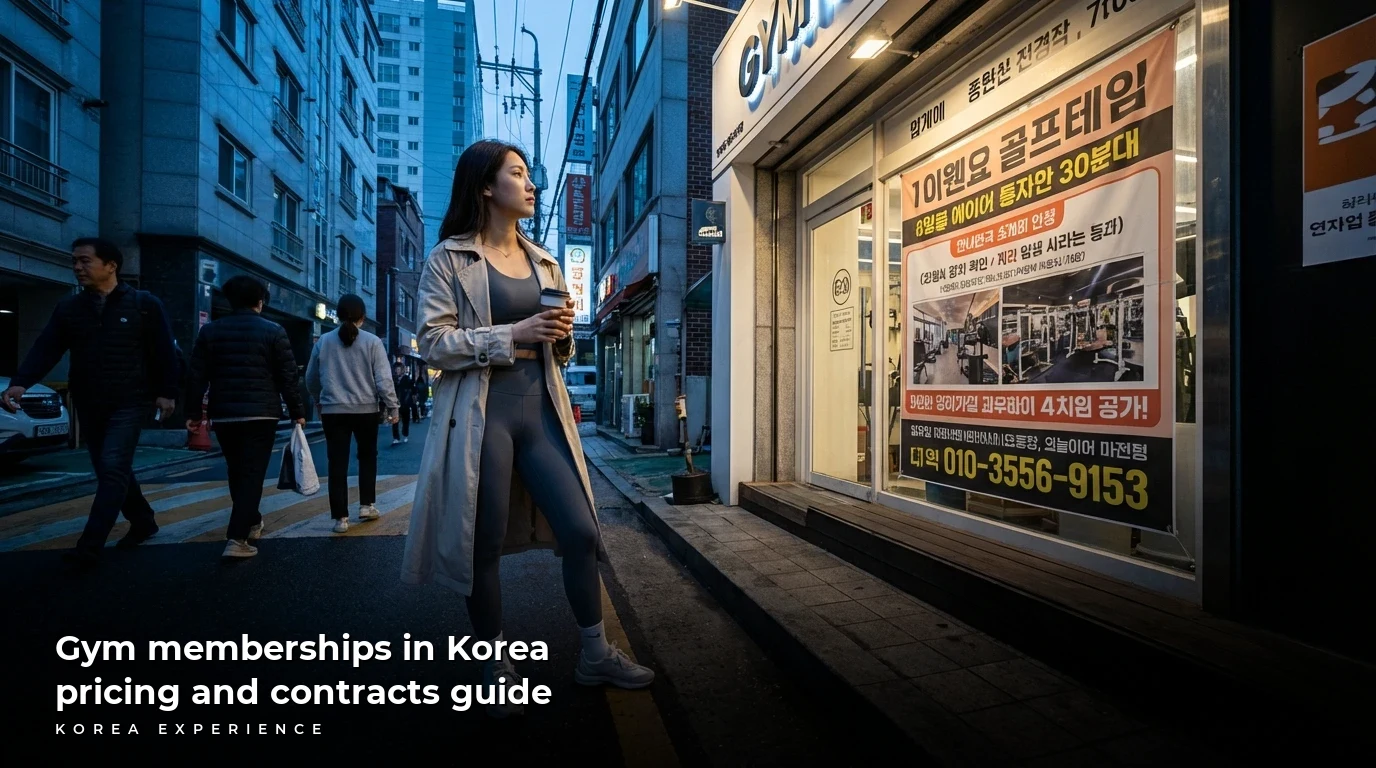
Staying fit while living in South Korea has become significantly easier—and arguably more intense—over the last decade. The country has seen an explosion in fitness culture, driven by the "Body Profile" trend where individuals train like athletes for months to take professional photoshoot pictures. For expats and travelers, this means you are rarely more than 500 meters away from a high-quality fitness center, especially in major hubs like Seoul, Busan, or Daegu.
However, navigating the administrative side of a Korean gym (often called a "Helseu-jang") can be daunting. The pricing structures are unique, the contracts are rigid, and the etiquette is specific. Whether you are looking for a luxury wellness club in Gangnam or a budget-friendly 24-hour chain, understanding the system will save you money and frustration.
Key Takeaways
- 1Long-term contracts offer 60-70% discounts compared to monthly rates
- 2Hidden fees for lockers and sportswear usually add $10-20 monthly
- 3Strict indoor shoe policies are enforced at 100% of Korean gyms
The Korean Fitness Landscape: An Overview
The fitness market in South Korea is dense and highly competitive. As of 2025, there are over 9,500 registered fitness centers across the country. For the consumer, this saturation is excellent because it drives prices down and forces gyms to maintain high-quality equipment.
Most gyms in Korea fall into three main categories:
- Large Commercial Chains: Examples include SpoAny and Goto Fitness. These are often 24/7, highly accessible, and offer mid-range pricing.
- Public Health Centers (Gu-min Centers): Government-subsidized facilities that are incredibly cheap but have limited hours and older equipment.
- Boutique & Luxury Gyms: High-end facilities often located in hotels or premium districts, offering saunas, golf ranges, and Pilates.
📊 Korea Fitness Market
When you first walk into a gym, do not expect the price listed on the website (if they even have one) to be the final offer. The Korean gym industry operates heavily on "Event Prices."
Related reading: Korean labor laws your rights as a foreign employee.
Decoding Gym Pricing: The "Event" Culture
In Western countries, a gym might have a flat monthly rate of $50. In Korea, the pricing model is designed almost exclusively to lock you into a long-term contract. It is common to see a banner advertising "₩30,000 per month," but this rate is only valid if you sign up for 12 months upfront.
If you ask for a single month, you might be quoted 90,000 to ₩120,000 (approximately $65 to $85 USD). However, if you commit to a year, that monthly breakdown drops drastically.
💵 Pricing Structure Comparison
Breakdown of ₩30,000 per month (paid upfront)
Payment Methods
Almost all gyms require the full contract amount to be paid upfront. Monthly direct debits are rare for independent gyms, though some large franchises are beginning to adopt subscription models. If you have a Korean credit card, you can often pay in "installments" (hal-bu) over 3 to 6 months interest-free, which eases the burden of the lump sum.
You might also enjoy our article about Buying a used car in Korea K Car vs Encar guide.
Never accept the first price offered. Gyms almost always have a 'manager discount' or a 'friend referral event' they can apply if you hesitate. Ask if there are any current promotions specifically for new members.
Hidden Costs: VAT, Lockers, and Sportswear
The advertised price is rarely the final price. When budgeting for your membership, you must account for the "service fees" that are standard across the industry.
- VAT (Value Added Tax): Prices are usually quoted without the 10% VAT. A ₩300,000 membership will actually cost you ₩330,000 at the terminal.
- Registration Fee: Some gyms charge a one-time joining fee ranging from 30,000 to ₩50,000.
- Locker Rental: Small lockers for your shoes and toiletries are rented monthly.
- Sportswear Rental: Most Korean gyms provide shorts and t-shirts (resembling generic hospital scrubs or PE uniforms) for a monthly fee. This is incredibly convenient as it reduces your laundry load.
📋 Additional Monthly Costs
If you opt for the 12-month contract, you can often negotiate to have the locker and sportswear fees waived. This is the easiest point of negotiation during the sales consultation.
Commercial Chains vs. Public Centers
Choosing the right type of facility depends on your budget and your schedule. The distance between your home and the gym is the number one factor for consistency, especially during the harsh Korean winter or humid summer.
Commercial Chains (SpoAny, Goto, Bodystar)
These are the most convenient options for expats. Brands like SpoAny have over 90 branches across Korea.
For more details, check out our guide on Credit cards in Korea which banks accept foreigners 2026 guide.
- Pros: Open 24/7 (usually), modern equipment, English-speaking staff are more likely.
- Cons: Can be extremely crowded during peak hours (7:00 PM – 9:00 PM).
- Average Cost: 350,000 – ₩450,000 per year.
Public Health Centers (Gu-min Centers)
Every district (Gu) in Seoul has a sports center.
- Pros: Very cheap (approx. 40,000 – ₩50,000/month with no long contract).
- Cons: Closed on 2nd and 4th Sundays, limited hours (usually close by 10 PM), older equipment, no English support.
- Average Cost: ₩50,000 per month.
Gym Type Comparison
| Feature | Commercial Chain | Public Center | Luxury Hotel Gym |
|---|---|---|---|
| Operating Hours | 24/7 (Common) | 06:00 - 22:00 | 06:00 - 23:00 |
| Avg Yearly Cost | ₩400,000 | ₩600,000 | ₩3,000,000+ |
| Crowd Level | High | Medium | Low |
| English Service | Hit or Miss | Unlikely | Likely |
Boutique and Specialized Fitness
CrossFit and F45 have a massive following in Korea. However, they are significantly more expensive than standard gyms.
- CrossFit: Expect to pay 200,000 – ₩300,000 per month.
- Pilates: extremely popular, with group classes averaging 20,000 – ₩30,000 per session.
SpoAny Gangnam Station(SpoAny Gangnam)
Personal Training (PT) Culture
You cannot discuss Korean gyms without mentioning Personal Training (PT). Sales pressure for PT can be intense. Upon signing up, you will often be offered 2 free "OT" (Orientation Training) sessions. Be aware: these are sales pitches. The trainer will measure your InBody (body composition), tell you your muscle mass is dangerously low or your posture is bad, and try to sell you a package.
PT packages are sold in blocks.
- 10 Sessions: Approx. 70,000 – ₩90,000 per session.
- 30 Sessions: Approx. 50,000 – ₩60,000 per session.
- Total Cost: A 30-session package usually costs around 1.5 million to ₩1.8 million ($1,100 – $1,300 USD).
The PT Hard Sell
If you are not interested in Personal Training, be firm but polite during your free orientation. A simple "I prefer to train alone" (Hon-ja ha-neun ge jo-a-yo) usually works. If you show hesitation, the sales pitch can last over 30 minutes.
How to Sign Up: A Step-by-Step Guide
Foreigners can easily sign up for gyms, but you need specific documentation. While some smaller neighborhood gyms might accept cash and a name, commercial chains require identification.
📖 Gym Registration Process
Step 1: Prepare Documents
Bring your Alien Registration Card (ARC) or Passport. If you have a Korean phone number, bring that too.
Step 2: Consultation
Sit with a manager to discuss pricing. This is where you negotiate the 'Service' (free locker/clothes).
Step 3: Sign Contract
Read the refund policy carefully (or translate it). Sign the digital or paper forms.
Step 4: Payment
Pay the lump sum via Credit Card or Bank Transfer. Cash is accepted but ask for a receipt.
Important Gym Etiquette
Korean social rules apply heavily inside the gym. Breaking these rules can lead to awkward confrontations or even membership termination.
For more details, check out our guide on D 10 Job Seeker Visa Korea 2026 Complete Application Guide.
1. The Indoor Shoe Rule
This is the most critical rule. You cannot wear the shoes you wore outside into the gym workout area. You must bring a clean pair of sneakers that have never touched the street. You will change into these in the locker room or entryway.
- Why? Korea has high dust levels and dirty streets; gyms pride themselves on clean floors.
- Consequence: Staff will stop you immediately if they see street dirt on your soles.
2. Sharing Equipment
In busy gyms, "working in" is less common than in the West. If someone is on a machine, they usually finish all their sets before moving. However, sitting on a machine while looking at your phone for 5 minutes is considered rude.
- Rest time: Keep it under 90 seconds during peak hours.
3. Greetings
When entering a smaller gym, it is polite to bow slightly or say hello to the staff at the desk. When leaving, a simple "Sugoha-syeoss-seumnida" (Thank you for your hard work) is standard.
Korean Gym Culture
- ✓High-tech equipment (often new)
- ✓Cleanliness is prioritized
- ✓Open late or 24/7
- ✓Sportswear provided
- ✗Sales pressure for PT
- ✗Strict refund policies
- ✗Peak hours are incredibly crowded
- ✗Music is often very loud K-Pop
Cancellation and Refunds: The Tricky Part
This is where 90% of consumer complaints arise. You might think that if you bought a 12-month pass for ₩360,000 and cancel after 1 month, you get ₩330,000 back. This is wrong.
The refund calculation works like this:
- Penalty: 10% of the total contract price is deducted as a penalty.
- Usage: The months you used are deducted, but NOT at the discounted rate you paid (30k/month). They are deducted at the "Standard Monthly Rate," which is arbitrarily set high (often 100k-150k/month).
Example Scenario:
- You paid ₩360,000 for 12 months.
- You cancel after 2 months.
- Penalty: ₩36,000.
- Usage: 2 months x ₩100,000 (Standard Rate) = ₩200,000.
- Refund: 360,000 - 36,000 - 200,000 = ₩124,000.
You lose over 60% of your money despite only using 16% of the time.
Cancellation Reality
Review Contract
Check the 'Standard Monthly Rate' listed in fine print.
Request Refund
Staff will calculate the penalty. Expect a much lower amount than anticipated.
Transfer Membership
It is often better to sell your remaining months to someone else ('Yang-do').
The Transfer Hack (Yang-do)
Instead of cancelling, use apps like "Karrot Market" (Dang-geun Market) to sell your remaining membership. You usually just pay a ₩50,000 transfer fee to the gym, and the new person takes over your contract. This minimizes your financial loss.
Short-Term Alternatives and Day Passes
For travelers or digital nomads staying less than 3 months, signing a contract is risky. Here are your best alternatives:
1. Day Passes (Il-il Gwon)
Most gyms offer day passes ranging from 15,000 to ₩25,000.
- Pro Tip: Search the gym on Naver Maps. Many offer a "First Visit Free" or highly discounted day pass coupon to attract new customers.
2. Booking Apps
Apps like Kyung-gwang-u or accessing gyms through Naver Booking can help you find classes or gym access without long commitments. While "ClassPass" isn't the dominant player, local equivalents exist for yoga and Pilates.
3. Hotel Gym Memberships
If budget is not an issue, major hotels (Shilla, Hyatt, Four Seasons) sell memberships. These grant access to pools and saunas.
- Cost: Deposit of 20M - ₩100M + Annual dues of 3M - ₩5M. This is strictly for long-term wealthy residents.
Finding a Gym: The Search Process
To find the best gym near you, do not use Google Maps. It is often outdated in Korea. You must use Naver Map or KakaoMap.
- Open Naver Map.
- Search for "헬스장" (Helseu-jang) or "Fitness".
- Look for the "Event" tab or photos of price banners.
- Check reviews for cleanliness and crowding.
Look for gyms located on the 2nd floor or higher. Basement gyms (common in older buildings) can smell musty during the humid summer monsoon season. Good ventilation is worth paying extra for.
Conclusion
Joining a gym in Korea is an excellent way to maintain a routine and even make local friends. The facilities are generally world-class, clean, and safe. The key to a positive experience lies in understanding the contract structure. Avoid the monthly payment trap by committing to 6 or 12 months if you plan to stay, but have an exit strategy (transferring the membership) if you need to leave early.
Always remember your indoor shoes, prepare for the PT sales pitch, and enjoy the high-energy atmosphere of Korea's fitness culture.
❓ Frequently Asked Questions
Have more questions?Contact us →
About the Author
Korea Experience Team
Written by the Korea Experience editorial team - experts in Korean medical tourism, travel, and culture with years of research and firsthand experience.
Explore more in Living in Korea
Everything expats and long-term visitors need to know — from visa requirements and housing to banking, healthcare, and daily life tips.
Browse All Living in Korea ArticlesContinue Reading
Explore more articles you might find interesting
A detailed guide to renting in South Korea, covering Jeonse vs Wolse, deposits, finding English-speaking agents, and navigating contracts safely.
Master the fast-paced Pali-Pali culture in South Korea's workplaces. Essential guide for expats & international professionals in 2026.

Essential guide to South Korean labor laws for expats in 2026 covering wages severance dismissal and contracts
A complete guide to securing remote work and navigating the digital nomad lifestyle in South Korea under the 2026 visa regulations.
A complete guide to surviving Korean bureaucracy, covering residence cards, digital certificates, banking, and tax settlements for expats.
A complete guide to changing your visa status within South Korea, covering requirements, HiKorea reservations, and D-10 to E-7 transitions.