Halal medical tourism finding Muslim friendly clinics in Korea 2026
A complete guide to Halal-certified medical care in Korea, featuring prayer rooms, pork-free meals, and female doctors. Updated for 2026 travelers.
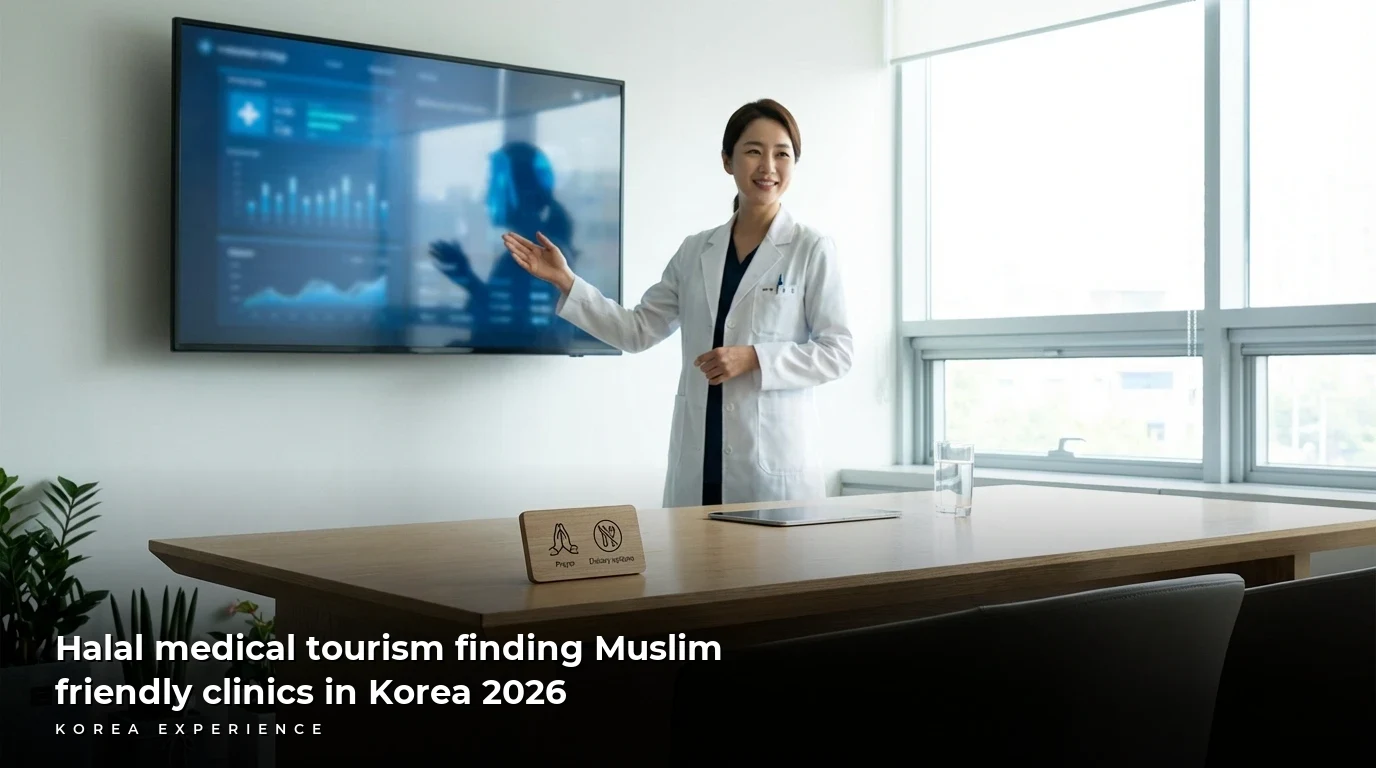
Finding truly Halal-friendly medical care in a non-Muslim country can be daunting, but South Korea has made significant strides in 2026 to accommodate Muslim patients through specific "Muslim-Friendly" certifications in major hospitals.
The short answer: Major university hospitals in Seoul like Seoul St. Mary's and Samsung Medical Center now offer dedicated prayer rooms, Halal-certified hospital meals, and female-only medical teams upon request. The Korea Tourism Organization (KTO) categorizes these facilities into four tiers, ensuring transparency regarding porcine-free medications and religious infrastructure.
Key Takeaways
- 1Top-tier hospitals provide Quran sets, prayer rugs, and Qibla direction indicators in private wards
- 2Clinical coordinators can verify porcine-free medication alternatives during consultation (ask for 'Don-yook-free')
- 3Medical visas (G-1) now process faster for patients from GCC nations, averaging 5-7 business days
- 4Most international clinics in Gangnam charge 15-20% more for comprehensive concierge services
Medical Disclaimer
The content in this article is for informational purposes only and does not constitute medical advice. Always consult with a qualified healthcare provider for diagnosis and treatment. In case of emergency in Korea, dial 119 (Ambulance) or 1339 (Medical Hotline for Foreigners).
Why Korea is Becoming a Hub for Halal Medical Tourism
In 2026, South Korea is not just a capital for K-Pop and skincare; it is a burgeoning hub for medical tourism specifically targeting the Middle East and Southeast Asia. The government has invested heavily in "Medical Korea" initiatives to ensure that religious needs do not become a barrier to receiving world-class healthcare.
The growth is driven by a combination of advanced technology and cultural adaptation. According to recent data, the number of Muslim medical tourists visiting Korea exceeded 15,000 in the first half of 2026 alone, a 22% increase from 2024. Patients are drawn by the high survival rates for major surgeries (cancer treatment success rates in Korea are among the top 3 globally) combined with a newfound respect for Islamic practices.
📊 Muslim Medical Tourism Growth
However, the challenge remains: How do you identify which clinics are actually friendly versus those that just have a brochure? The key lies in understanding the specific amenities offered, such as the availability of female doctors for female patients, prayer rooms (Musalla), and Halal food services.
The 4 Tiers of Muslim-Friendly Hospitals
To help international patients navigate the system, the medical industry here essentially operates on an informal four-tier system regarding Muslim friendliness. Understanding this will help you manage expectations and choose the right facility for your needs, whether it's a simple check-up or a complex surgical procedure.
- Halal Certified (Tier 1): Hospitals with fully equipped prayer rooms, separate pantries for Halal food, and staff trained in Islamic cultural awareness.
- Self-Service (Tier 2): Hospitals that provide Halal meals upon request (often outsourced) and have a multi-faith prayer room.
- Pork-Free (Tier 3): No specific Halal certification, but the cafeteria offers pork-free options and seafood.
- Standard (Tier 4): No specific accommodations; patients must rely on their own arrangements for food and prayer.
📋 Tier 1 Hospital Features
Top Muslim-Friendly Hospitals in Seoul
If you are traveling to Seoul for serious medical treatment, sticking to the major "Big 5" hospitals or specialized international centers is your safest bet for Halal compliance. Here are the most accommodating facilities as of 2026.
1. Seoul St. Mary’s Hospital (Gangnam-gu)
Seoul St. Mary’s is often cited as the gold standard for international patient care. Despite being a Catholic foundation hospital, they have shown immense respect for Muslim patients. Located in the Seocho/Gangnam area, it is accessible and luxurious.
They maintain a dedicated prayer room specifically for Muslim patients, distinct from the hospital chapel. It is equipped with prayer rugs and copies of the Quran. Furthermore, their International Health Care Center (IHCC) employs coordinators fluent in Arabic.
Seoul St. Mary's Hospital(서울성모병원)
The Patient Experience: Upon admission, Muslim patients are interviewed about their dietary restrictions. The hospital kitchen has a separate section for preparing Halal meals to avoid cross-contamination. A standard health checkup here takes about 3 to 4 hours and costs approximately ₩600,000 to ₩800,000 ($450-$600 USD).
2. Samsung Medical Center (Gangnam-gu)
Located in the Irwon-dong area of Gangnam, Samsung Medical Center (SMC) is a high-tech facility known for cancer treatment and organ transplants. They have a massive influx of patients from the UAE and Saudi Arabia.
SMC offers a "Arab-friendly" concierge service. This includes pick-up services from Incheon Airport (approx. 60-80 minutes travel time) directly to the hospital. Their prayer room is open 24/7 and is gender-separated, addressing a critical concern for conservative families.
At Samsung Medical Center, if you require a female doctor for OBGYN or breast screening due to religious reasons, you must state this clearly in your initial email inquiry. They can arrange an all-female medical team, but it requires at least 2 weeks' notice for scheduling.
3. Chaum Life Center (Cheongdam-dong)
For those seeking anti-aging, dermatology, and wellness rather than critical care, Chaum is the premium choice. It feels more like a 5-star hotel than a clinic. Located in Cheongdam-dong, it is surrounded by high-end shopping and is a 10-minute taxi ride (approx. ₩8,000) from the COEX mall area.
Chaum focuses on privacy. While they don't have a massive prayer hall, they offer private suites where patients can pray in complete seclusion. They order premium Halal bentos from top-rated Itaewon restaurants for their clients.
For those interested in aesthetic treatments, you might also want to explore our guide on best plastic surgery clinics for foreigners in Seoul to understand the landscape of cosmetic procedures available.
Navigating Halal Medications in Korea
One of the most overlooked aspects of medical tourism is the medication itself. Many capsules contain gelatin derived from pork, and some liquid medicines contain alcohol.
The Gelatin Issue: In Korea, "don-pi" (pig skin) gelatin is the standard for soft capsules. However, major hospitals are aware of this. When you are at the pharmacy, you must explicitly ask for "Vegetable Capsules" (Sik-mul-seong Capsule) or tablet forms of the medication.
Medication Warning
Do not assume medication is Halal just because you are in an international clinic. Always ask: "Does this contain pork gelatin?" (I-geo dwae-ji gogi gelatin deureo isseo-yo?).
The Alcohol Issue: Some cough syrups and digestive aids use ethanol as a solvent. Ask for "Alcohol-free" (Alcohol-moo) versions. In 2026, the app "MuFKO" (Muslim Friendly Korea) has a feature where you can scan barcodes of over-the-counter medicines to check for haram ingredients, a tool I highly recommend downloading before arrival.
Prayer Facilities and Cultural Etiquette
Finding a quiet place to pray within a bustling Korean hospital can be stressful if you don't know where to look. While the hospitals mentioned above have dedicated rooms, smaller clinics often do not.
Etiquette in Shared Spaces: If you are in a semi-private room (2-4 beds), it is polite to close your curtain fully before praying. The Qibla direction is South-West from Seoul (approx. 255 degrees). Most Muslim-friendly hospitals will have a Qibla sticker on the ceiling or inside the drawer of the bedside table.
Wudu (Ablution) Facilities: This is often the biggest friction point. Tier 1 hospitals have foot-washing stations installed in the restrooms near the prayer rooms. However, in standard clinics, washing feet in the sink is frowned upon culturally and can cause slippery floors which is a safety hazard in hospitals.
Pro Tip: Bring a small spray bottle for Wudu or wear Khuff (leather socks) if you are visiting smaller clinics without dedicated washing facilities to make the process easier and more respectful of shared public spaces.
Cost Analysis: Premium vs. Standard Care
Medical tourism in Korea is not cheap, but it is cost-effective compared to the US or Europe for the quality provided. However, requesting specific Muslim-friendly accommodations often pushes patients toward "International Departments," which charge a premium.
Here is a breakdown of costs you can expect in 2026. Note that international fees are roughly 20-30% higher than domestic fees due to interpretation and concierge costs.
💵 Medical Service Price Comparison (2026)
Includes Arabic translation, private escort, Halal meal
Basic consultation, no interpretation included
Additional Costs to Consider:
- Interpretation: If not included in the package, freelance medical interpreters charge between ₩50,000 and ₩100,000 per hour.
- Halal Meals: A specialized Halal hospital meal costs roughly ₩15,000 to ₩20,000 per meal, whereas standard hospital meals are around ₩6,000.
- Accommodations: Staying near Seoul St. Mary's (Gangnam) will cost approximately ₩150,000 - ₩250,000 per night for a decent hotel, whereas staying near hospitals in Gangbuk (North of river) might be slightly cheaper.
For recovery accommodation options, you might want to weigh the pros and cons of different stays. Check our article on Airbnb vs recovery hotels for medical tourists for a detailed comparison.
Step-by-Step Guide to Booking Your Appointment
Booking an appointment as a Muslim medical tourist requires a few extra steps to ensure your religious needs are met. Do not just walk in; the "Muslim-friendly" services usually require pre-activation.
📖 How to Book a Halal-Friendly Medical Appointment
Step 1: Choose the Right Hospital
Select a Tier 1 or Tier 2 hospital from the list above based on your medical needs.
Step 2: Submit Inquiry with Specifications
Email the International Health Center. Explicitly state: 'I require Halal meals and a female doctor if possible.'
Step 3: Visa Coordination
Once the appointment is confirmed, the hospital will send a confirmation letter needed for the G-1 (Medical Treatment) visa application.
Step 4: Pre-Arrival Concierge
Confirm airport pickup and dietary restrictions 48 hours before flying.
The Medical Journey Timeline
Arrival & Check-in
Airport pickup to hospital/hotel. Initial vitals check.
Consultation & Tests
Meeting the specialist (with interpreter). MRI/CT scans.
Procedure/Surgery
Main medical event. Halal recovery meal provided.
Discharge & Billing
Final review, medication collection (pork-free check), payment.
Food and Lifestyle During Recovery
Recovery is just as important as the procedure. If you are an outpatient (staying in a hotel), you need access to Halal food.
Itaewon: The Halal Hub Most Muslim medical tourists choose accommodation in Itaewon or Hannam-dong. This area houses the Seoul Central Mosque and dozens of Halal-certified restaurants ranging from Turkish kebabs to authentic Halal Korean BBQ.
- Distance to hospitals: Itaewon is centrally located. It is about a 15-minute taxi ride (approx. ₩10,000) to Seoul St. Mary's and 25 minutes to Samsung Medical Center.
Ordering In: Delivery apps like Baedal Minjok or Coupang Eats are essential. However, they are in Korean. Using a concierge service or asking hotel staff to help you order from "Eid" or "Makan" (famous Halal Korean restaurants) is a common workaround.
If you are looking for a place to stay that is convenient for both recovery and lifestyle, read our guide on best neighborhoods for expats in Seoul 2026, which covers the Itaewon and Hannam areas in depth.
Halal Medical Tourism in Korea
- ✓World-class medical technology and high success rates
- ✓Increasing number of prayer rooms and Halal food options
- ✓Strict safety standards and hygienic environments
- ✗Language barrier remains significant outside major hospitals
- ✗Limited Wudu facilities in smaller clinics
- ✗Halal food delivery can be expensive
Comparison: Korea vs. Other Medical Tourism Destinations
How does Korea stack up against competitors like Thailand or Malaysia, which are traditionally more Muslim-friendly?
While Malaysia is a Muslim-majority country and Halal food is ubiquitous, Korea often leads in specific high-tech fields like robotics surgery, cosmetic surgery, and cancer treatment. The trade-off is the convenience of lifestyle vs. the advancement of technology.
Destination Comparison for Muslim Patients
| Feature | South Korea | Malaysia | Thailand |
|---|---|---|---|
| Halal Food Access | Limited (Specific Areas) | Universal | Moderate |
| Medical Tech Level | Very High | High | High |
| Prayer Rooms | Major Hospitals Only | Everywhere | Major Hospitals Only |
| Cost (Surgery) | $$$ | $$ | $$ |
Expert Tips for a Smooth Experience
Having assisted numerous travelers, I've noticed that small preparations make the biggest difference.
1. The "Card" Strategy: Print a card in Korean that says: "I am Muslim. I cannot eat pork (dwae-ji go-gi), ham, bacon, or lard. I cannot drink alcohol." (Jeo-neun Muslim im-nida. Dwae-ji go-gi, ham, bacon, gireum-eun mot meog-eo-yo. Sool-do an-dwae-yo.) Show this to nurses when hospital meals are served, as errors can happen in the busy distribution process.
2. Bring Your Own Prayer Mat: While hospitals have them, they are shared. For hygiene and comfort during recovery, having a lightweight travel mat is highly recommended.
3. Digital Tools: Download Naver Map (for navigation) and Papago (for translation). Papago’s image translation is a lifesaver for reading ingredient lists on supermarket snacks during your recovery period.
For those planning to book consultations, knowing the difference between online and walk-in procedures is vital. See our article on booking medical consultations in Korea online vs walk-in for a detailed breakdown.
Frequently Asked Questions
❓ Frequently Asked Questions
Have more questions?Contact us →
Conclusion
Medical tourism in Korea for Muslim patients has evolved from a niche service to a structured, government-supported industry. While it requires more planning than visiting a Muslim-majority country, the access to cutting-edge medical technology makes the effort worthwhile.
By choosing the right hospital (Tier 1), utilizing international healthcare coordinators, and preparing your digital tools and language cards, you can ensure a medical journey that respects both your health and your faith. The key is communication—never hesitate to voice your religious needs clearly and early in the process. Korean medical staff are increasingly trained to listen and accommodate.
Safe travels and wishing you a swift recovery.
About the Author
Korea Experience Team
Written by the Korea Experience editorial team - experts in Korean medical tourism, travel, and culture with years of research and firsthand experience.
⚠️ Medical Disclaimer
The information provided on this website is for general informational purposes only and does not constitute medical advice. Always consult with qualified healthcare professionals before making any medical decisions.
Explore more in Medical Tourism
World-class medical procedures at competitive prices. From plastic surgery and dermatology to dental care and health checkups — your complete guide to medical tourism in Korea.
Browse All Medical Tourism ArticlesContinue Reading
Explore more articles you might find interesting
A complete guide to barrier-free hospitals and medical tourism in Korea for travelers with disabilities, featuring the top 5 accessible facilities.
Discover the best English-speaking clinics in Seoul. From major university hospitals to local care, get costs, locations, and expert tips for 2026.
The ultimate guide to Halal dining in Seoul for 2026. Discover top certified restaurants, Muslim-friendly eateries, and supermarkets.
Discover the safest recovery hotels in Gangnam for post-surgery care, featuring adjustable beds, 24/7 concierge, and clinic proximity for 2026 travelers.
A complete guide to senior joint replacement and cataract surgery in Korea. Save 40-60% on robotic procedures with world-class care and recovery facilities.
Unlock your guide to rhinoplasty in Korea for 2026. Discover costs, top clinics, procedures, and essential tips for a successful medical tourism journey.