Hair transplant FUE vs FUT method comparison and costs in Korea 2026
A detailed guide comparing FUE and FUT hair transplants in Seoul, including 2026 price data, recovery timelines, and success rates for medical tourists.
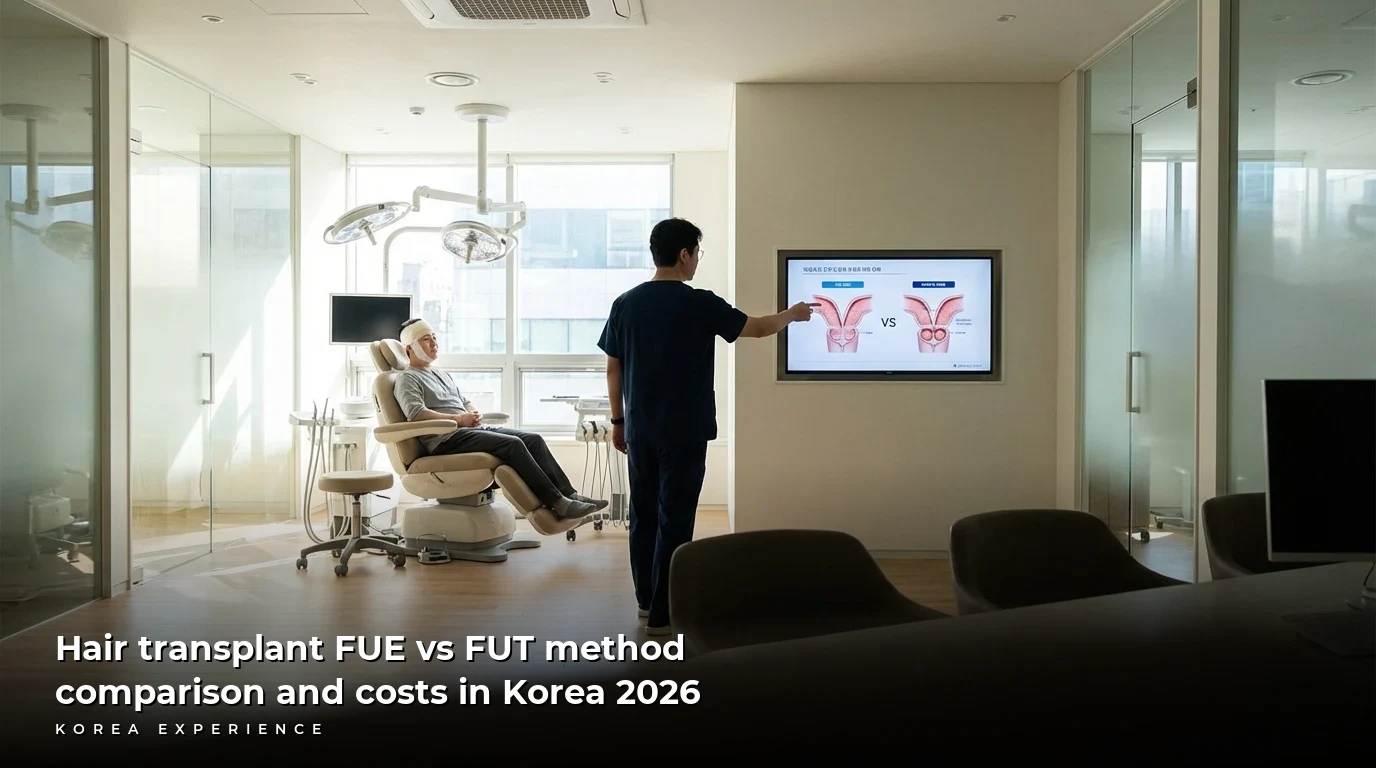
When deciding between a hair transplant in South Korea, the choice ultimately narrows down to two primary methods: Follicular Unit Extraction (FUE) and Follicular Unit Transplantation (FUT). The main difference lies in how the hair follicles are harvested from the donor area. In FUE, individual follicles are extracted one by one using a micro-punch tool, leaving tiny, dot-like scars that are virtually invisible. In FUT (often called the "strip method"), a linear strip of skin containing hair is removed from the back of the scalp, which allows for a higher number of grafts to be harvested in a single session but leaves a fine linear scar. For international patients visiting Seoul in 2026, FUE is the overwhelmingly popular choice due to the faster recovery time and lack of visible scarring, though FUT remains a viable, cost-effective option for those requiring extensive coverage (4,000+ grafts) who do not plan to wear short hairstyles.
The short answer: FUE is the modern standard in Korea, offering a scarless recovery and less post-op pain, typically costing 20-30% more than FUT. FUT is best reserved for patients needing maximum graft counts (over 4,000) on a lower budget who don't mind a linear scar.
Key Takeaways
- 1FUE accounts for over 85% of hair transplants for foreigners in Korea due to faster healing
- 2FUT is approximately ₩1.5 million ($1,100 USD) cheaper on average for a 3,000 graft session
- 3Recovery time for FUE is roughly 7-10 days, while FUT requires 14-21 days for full suture healing
Understanding the Mechanics: How Hair Transplants Work
To make an informed decision, you must understand that both methods share the same implantation phase; they only differ in the extraction phase. In both procedures, healthy hair follicles are moved from a "donor zone" (usually the back of the head, which is genetically resistant to balding) to the "recipient zone" (the thinning or bald area).
In South Korea, the technology used for implantation is world-class. Clinics often utilize slit techniques or implanter pens (like the Choi Implanter), which allow for high density—often achieving 40 to 60 grafts per square centimeter, compared to the global average of 30 to 40.
📊 Korean Transplant Statistics
The "Golden Zone" Concept
Korean surgeons are famous for their aesthetic approach to the hairline. They don't just fill in the bald spots; they redesign the face frame. The "Golden Zone" refers to the specific ratio of the forehead to the mid-face and lower face (often a 1:1:1 ratio). During your consultation, likely in the Gangnam or Apgujeong districts, the doctor will use laser leveling tools to measure your facial symmetry down to the millimeter.
Deep Dive: Follicular Unit Extraction (FUE)
FUE is currently the gold standard for medical tourism in Korea. It is a meticulous process where the surgeon (or a robotic arm) uses a micro-punch tool, typically ranging from 0.8mm to 1.0mm in diameter, to isolate and extract individual follicular units.
The Procedure Experience
An FUE session in Seoul typically starts at 9:00 AM and can last until 4:00 PM or 5:00 PM. You will be under local anesthesia, and many clinics offer "sleep sedation" for the initial injection phase to minimize discomfort. Because the grafts are taken individually, there is no need for stitches or sutures.
Non-Shaven FUE
Korea is a global leader in "Non-Shaven FUE." This advanced technique allows executives and celebrities to undergo the procedure without shaving their donor area. The surgeon carefully trims only the specific hairs to be extracted. Note that this method takes 2-3 hours longer and costs roughly 30-50% more than standard FUE.
Who is FUE Best For?
- Short Hair Wearers: If you plan to wear a fade or buzz cut, FUE is essential because the tiny dot scars are undetectable to the naked eye once healed.
- Active Lifestyles: Athletes or those with physically demanding jobs prefer FUE because there is no risk of a linear scar stretching during movement.
- Smaller Sessions: Ideal for hairline correction or crown filling (1,500 to 3,000 grafts).
For those interested in the logistical side of booking such a procedure, checking out our guide on booking medical consultations in Korea is highly recommended.
Deep Dive: Follicular Unit Transplantation (FUT)
FUT, or the Strip Method, is the traditional technique. While it sounds more invasive, it has specific advantages regarding graft quality and yield. The surgeon removes a strip of scalp tissue (usually 1.5cm wide and 15cm to 30cm long) from the back of the head. This strip is then dissected under microscopes into individual follicular units.
The "Linear Scar" Reality
The biggest drawback is the scar. Even with the best "trichophytic closure" techniques used by top Korean surgeons—which allow hair to grow through the scar tissue—a thin white line will remain. If you wear your hair longer than 2cm (grade 4 or above), this scar is completely hidden.
Who is FUT Best For?
- Advanced Hair Loss: Patients needing "Megasessions" (4,000 to 5,000+ grafts) often benefit from FUT because extracting that many grafts via FUE can over-harvest the donor area, making it look moth-eaten.
- Budget-Conscious Travelers: FUT is less labor-intensive for the surgeon during extraction, making it significantly cheaper.
- Long Hair Wearers: If you never plan to shave your head, the scar is a non-issue.
Method Comparison Summary
- ✓FUE: No linear scar, recover in 7 days
- ✓FUE: Less post-op pain/tightness
- ✓FUT: Higher graft yield in one session
- ✓FUT: Grafts spend less time outside body
- ✗FUE: More expensive, longer procedure time
- ✗FUE: Donor area must be shaved (usually)
- ✗FUT: Leaves a permanent linear scar
- ✗FUT: Longer recovery (14+ days for stitches)
Cost Analysis: Korea vs. The World (2026 Data)
One of the main drivers for medical tourism to Korea is the price-to-quality ratio. While Turkey is cheaper, Korea offers higher hygiene standards, advanced technology (like ARTAS robotics), and a more natural hairline design philosophy.
In 2026, the exchange rate hovers around 1,350 to ₩1,400 per 1 USD, making Korean procedures highly attractive.
💵 Estimated Cost for 3,000 Grafts (2026)
Approx $3,300 - $4,800 USD. Includes suture removal.
Note: Prices vary based on the clinic's reputation, the surgeon's experience, and whether you choose a "celebrity" doctor. Non-shaven FUE can easily exceed ₩12,000,000 ($8,800 USD).
For comparison, a 3,000-graft FUE surgery in the United States typically costs between $15,000 and $20,000 USD. Even after factoring in flights and a 10-day stay in a comfortable hotel, you save significant money. If you are budgeting for your trip, consider reading about the cost of living in Seoul to estimate your food and transport expenses.
The Pain and Recovery Timeline
Fear of pain is the number one barrier for many patients. In Korea, pain management is taken seriously.
Anesthesia
The only painful part of the procedure is the local anesthesia injection. It feels like a series of bee stings. This lasts about 2-3 minutes. After that, the scalp is numb. Korean clinics often use vibration devices to distract the nerves during injection to minimize pain.
Post-Op Pain
- FUE: Most patients report minimal pain. You might feel soreness similar to a sunburn or a helmet being too tight for 24-48 hours. OTC painkillers (Tylenol) are usually sufficient.
- FUT: The donor area will feel tight and sore for 5-7 days due to the stitches. Sleeping can be uncomfortable as you cannot put pressure on the back of the head.
Recovery Journey
Critical Phase
Swelling moves down to eyes. Spray saline every 2 hours.
Scab Removal
Scabs fall off. Donor area heals (FUE). Stitches removed (FUT).
Shock Loss
Transplanted hair sheds. This is normal. Do not panic.
Final Result
Full density and thickness achieved.
The "Ugly Duckling" Phase
Between weeks 3 and month 4, the transplanted hairs will shed. This is known as "shock loss." You may look balder than before the surgery. This is psychologically the hardest part of the process. If you are staying in Korea for an extended period, you might want to distract yourself. Perhaps explore some historic K-drama sets where you can walk gently and enjoy the scenery without strenuous activity.
Choosing the Right Clinic in Seoul
Seoul has over 400 plastic surgery and dermatology clinics concentrated in a 5-kilometer radius within Gangnam-gu. Not all specialized in hair.
"Many foreign patients make the mistake of going to a general plastic surgery clinic. You must choose a clinic that does ONLY hair transplants. Look for a surgeon who is a member of the KSHRS (Korean Society of Hair Restoration Surgery). Ask specifically: 'Does the doctor perform the extraction and implantation, or do technicians do it?' In top-tier Korean clinics, the doctor should be involved 100% of the time."
Location Spotlight: Apgujeong & Sinsa
The highest concentration of specialized hair clinics is near Apgujeong Station (Line 3) and Sinsa Station (Line 3).
Gangnam Medical District(강남 의료 특구)
Ghost Doctor Warning
While rare in reputable hair clinics, "ghost surgery" (where a nurse or junior doctor swaps in after anesthesia) is a concern in general plastic surgery. Ensure your clinic has CCTV in the operating room—it is now legally required in Korea for operating rooms to have cameras. Ask to see the footage if you are suspicious.
Recovery Logistics for Travelers
If you are flying to Korea for surgery, you need to plan your accommodation strategically.
Where to Stay
You should stay near the clinic for the first 3 days to attend follow-up washing services. Most clinics offer a free hair wash the day after surgery to teach you how to clean the grafts without dislodging them.
- Hotels: Better for hygiene and room service.
- Airbnb: Good for long stays, but ensure the host provides extra pillows (you must sleep elevated at 45 degrees for 3 nights).
Check our guide on Airbnb vs. Recovery Hotels to decide which option suits your post-op needs best.
Sightseeing Restrictions
You cannot sweat heavily for 14 days. This means:
- No saunas or jimjilbangs (Korean bathhouses) for 1 month.
- No spicy food (stimulates sweating) for 1 week.
- No heavy hiking.
- Light walking is encouraged to reduce swelling.
A perfect activity would be visiting bookstores where the environment is calm and temperature-controlled. See our guide to independent bookstores in Seoul.
Comparison: Technology & Tools
Korea is known for adopting technology early.
Slit vs. Implanter Pen (DHI)
- Slit Method: The surgeon makes tiny incisions with a blade, and technicians place the grafts with forceps. Common in US/Europe.
- Implanter Pen (Choi Pen): The graft is loaded into a needle-like device and injected directly into the scalp. This is the standard in Korea. It offers control over angle, depth, and direction, and reduces trauma to the scalp, leading to faster healing.
Implantation Techniques
| Feature | Forceps/Slits | Choi Implanter Pen |
|---|---|---|
| Handling of Graft | More manipulation | Minimal touch |
| Density | Standard (30-40/cm²) | High (50-60/cm²) |
| Bleeding | Moderate | Minimal |
| Procedure Time | Faster | Slower (More precise) |
Medical Tourism Tax Refund
One major financial benefit of doing your transplant in Korea is the VAT Refund. Procedures performed for cosmetic purposes (including hair transplants) are subject to a 10% Value Added Tax.
However, tourists are eligible for a refund of approximately 7-8% of the total surgery cost.
- Bring your Passport to the clinic.
- Ask for the "Tax Refund Receipt" (Slip) after payment.
- Scan the receipt at the kiosk at Incheon Airport (Gate 28) before you leave.
- If your surgery cost ₩8,000,000, you could get back around ₩600,000 ($450 USD)—enough to cover your flight!
📖 How to Claim Your Medical Tax Refund
Step 1: Get the Slip
Ensure the clinic gives you the official Tax Free Refund slip.
Step 2: Airport Kiosk
Go to the tax refund kiosks in the departure hall (before security) or airside (Gate 28).
Step 3: Cash or Card
Choose to receive the refund in cash (₩) or back to your credit card.
Conclusion
Choosing between FUE and FUT in Korea largely depends on your budget, hair loss severity, and hairstyle preference.
- Choose FUE if you want the most advanced, least invasive option and can afford the premium. This is the choice for 90% of international patients in Korea.
- Choose FUT if you need massive coverage (Norwood Scale 5-7) and are on a stricter budget.
Korea's medical infrastructure, combined with the "Implanter Pen" technique and tax refunds, makes it one of the top 3 destinations globally for hair restoration in 2026.
❓ Frequently Asked Questions
Have more questions?Contact us →
About the Author
Korea Experience Team
Written by the Korea Experience editorial team - experts in Korean medical tourism, travel, and culture with years of research and firsthand experience.
⚠️ Medical Disclaimer
The information provided on this website is for general informational purposes only and does not constitute medical advice. Always consult with qualified healthcare professionals before making any medical decisions.
Explore more in Medical Tourism
World-class medical procedures at competitive prices. From plastic surgery and dermatology to dental care and health checkups — your complete guide to medical tourism in Korea.
Browse All Medical Tourism ArticlesContinue Reading
Explore more articles you might find interesting
A complete guide to hair transplant costs in Korea for 2026, featuring price comparisons, top methods like FUE and DHI, and realistic recovery timelines.
A complete guide comparing PicoSure and Q-Switch lasers for tattoo removal in Korea, including costs, pain levels, and success rates for 2026.
Compare PRP and PDO thread lifts in Korea with costs, recovery times, and results. A detailed guide for medical tourists seeking natural rejuvenation.
A complete guide to revision nose surgery in Seoul including 2026 costs, recovery timelines, rib cartilage techniques.
Compare online booking vs walk-in for Korean clinics. Data on wait times (15 min vs 2 hours), deposit costs (₩50k-100k), and success rates for 2026.
A comprehensive guide comparing Korean Botox brands Botulax and Nabota against Allergan. Includes 2026 price data, efficacy rates, and safety profiles.