Korean Cult Recruitment 2026: How to Spot and Avoid Scams
Avoid the ₩50,000 ancestor ceremony scam. Learn to spot cult recruiters in Hongdae and Sinchon with our 2026 safety guide for expats and students.
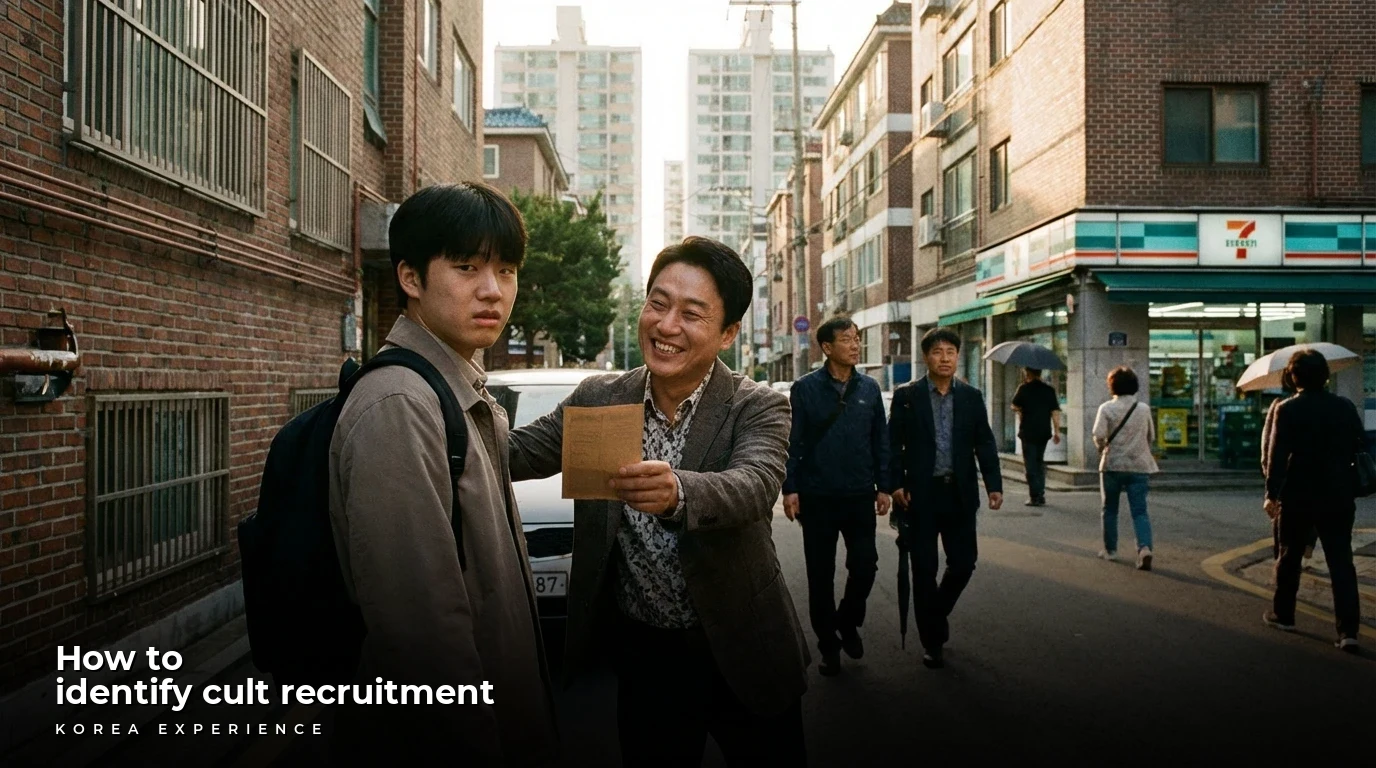
You just wanted to find the best tteokbokki in Hongdae or learn some Korean slang, but now you are being asked to fill out a "psychological survey" or talk about "God the Mother." If you spend any amount of time in major Korean cities, you will likely encounter this scenario.
Here is the ultimate, no-nonsense guide to spotting, dodging, and escaping cult recruiters in South Korea without losing your cool—or your cash.
Key Takeaways
- 1The short answer is simple. If a stranger approaches you on the street (especially in pairs) asking for directions, a survey, or commenting on your bright energy, it is almost certainly a recruitment attempt. Normal Koreans rarely approach foreigners cold just to chat.
- 2The most important number is ₩20,000 to ₩50,000. This is the ceremony fee the ancestor-worship groups (Daesun Jinrihoe) will pressure you to pay after dragging you to their temple, which is usually just a random apartment.
- 3Actionable advice: Do not be polite. The moment the conversation shifts to culture, ceremony, Bible study, or psychology test, give them the X arm signal, say No, and keep walking. If you give them your KakaoTalk ID, block them immediately.
📋 Quick Facts
Is Your New "Korean Bestie" Actually a Cult Recruiter?
Look, I know why you are here. You are in Seoul, maybe you just arrived, and some incredibly friendly locals just approached you on the street. They want to show you a "traditional ceremony," or they need help with a "university psychology project," or maybe they just asked if you know "God the Mother."
The short answer is: It is a cult. Or at the very least, a high-control group trying to recruit you.
Here is the deal: Normal Koreans are generally shy about approaching strangers—especially foreigners—due to language barriers. If two people (it is almost always two) approach you with perfect English, glowing smiles, and questions about your "energy" or "spiritual life," they are not trying to be your friend. They are trying to meet a recruitment quota.
If you go with them, one of two things will likely happen:
- The Short Con: You will be taken to a house, dressed in Hanbok, made to bow to a tablet, and then pressured to pay between ₩20,000 and ₩50,000 (or whatever you have in your wallet) for a "ceremony" to clear your ancestors' bad karma.
- The Long Con: You will be befriended, love-bombed, and slowly introduced to a "Bible study" that takes up 3-4 days a week for 6 months, eventually revealing itself as Shincheonji or a similar group.
Trust me on this one: Do not engage. Do not be polite. Just keep walking. For more on navigating social interactions, check out our guide on unwritten social rules in South Korea.
The Background Story: Why Korea?
So, how did South Korea, the land of K-Pop and Samsung, become a hotbed for these groups? It is a wild story that mixes history, shamanism, and modern anxiety.
See, Korea has a long history of what scholars call "New Religious Movements." After the Korean War, the country was devastated. People were desperate for hope, structure, and answers. This created a vacuum that charismatic leaders filled. Many of these groups blended Christianity with traditional Korean Shamanism and Confucianism. That is why you get groups talking about "Jesus" in one breath and "Ancestor Karma" in the next.
Fast forward to the economic boom. Korea developed fast. Like, whiplash fast. This created immense social pressure—competition for jobs, for universities, for status. It left a lot of young people feeling lonely and inadequate. Cults stepped in and said, "Hey, we have the answer. We have a community where you are special."
Then came the "Foreigner Boom." As more expats and tourists flooded into Korea, cults realized something: Foreigners are lonely, too. And crucially, foreigners don't watch the Korean 9 o'clock news. You guys don't know that Shincheonji caused a massive COVID-19 outbreak in 2020. You don't know about the JMS leader's prison sentence for sexual assault. To a tourist, a recruiter just looks like a friendly local wanting to practice English.
By 2024 and heading into 2026, these groups had to evolve. Everyone in Korea knows the "Do you know the Dao?" (Do-eul A-shim-ni-kka?) line. It became a meme. So, they pivoted. Now they are "culture guides," "mental health advocates," and "language partners." They moved from the streets to Tinder and HelloTalk. They became digital, slicker, and harder to spot.
Shincheonji Founded
Lee Man-hee establishes the Shincheonji Church of Jesus, which later becomes infamous for deceptive recruitment.
Sewol Ferry Tragedy
The tragedy exposes the deep links between the ferry owners and the Salvation Sect (Guwonpa), bringing cults into the national spotlight.
COVID-19 Patient 31
A massive COVID-19 outbreak in Daegu is traced to a Shincheonji super-spreader, leading to national outrage and exposure of their secretive tactics.
JMS Netflix Documentary
"In the Name of God: A Holy Betrayal" releases, exposing the sexual abuse and crimes of JMS leader Jung Myung-seok, sparking a new wave of vigilance.
God the Mother Resurgence
WMSCOG (World Mission Society Church of God) ramps up aggressive street recruitment targeting foreigners in university districts like Hongdae and Sinchon.
Digital Pivot
Recruiters shift heavily to language exchange apps (HelloTalk, Tinder, Bumble) and "Cultural Experience" front groups to bypass street skepticism.
Breaking Down Your Options: The Big Three
Okay, so you are on the street or swiping on an app. Who are you actually dealing with? Let’s break down the "Big Three" you will likely encounter.
Option A: The Ancestor Debt Collectors (Daesun Jinrihoe)
These are the ones who talk about "Energy" (Gi).
- The Pitch: "You look like you have a lot of worries," or "Your eyes are full of blessings, but your ancestors are blocking your path."
- The Goal: Fast cash. They want to take you now to a "study room" (usually a sketchy apartment).
- The Scenario: If you go, you will bow to a table of fruit, burn a paper with your name on it, and then... the awkward part. They ask for an envelope of cash. They might say, "It's for the fruit," or "It's for your ancestors' peace." If you don't pay, things get tense. They aren't usually violent, but they will block the door and guilt-trip you until you pay up just to escape. This bowing ritual is a twisted version of traditional etiquette; learn about proper bowing in our Korean prayer pose guide.
Option B: The Bible Puzzle Solvers (Shincheonji)
These guys are playing the long game.
- The Pitch: "We are doing a survey for our psychology class," or "I'm looking for people to join a casual book club/movie club."
- The Goal: Indoctrination.
- The Scenario: You meet for coffee. They are awesome. They listen to your problems. They validate you. Then, they introduce a "mentor" or a "counselor" who just happens to be amazing at interpreting dreams or the Bible. Before you know it, you are in a class learning that parables are secret codes and that a man named Lee Man-hee is the only one who can crack them. They will explicitly tell you, "Don't tell your friends or family, they won't understand." That is the biggest red flag in the universe.
Option C: The Mother Lovers (WMSCOG)
- The Pitch: "Did you know God has a wife?" or "Do you know God the Mother?"
- The Goal: Baptism and membership.
- The Scenario: They often carry iPads showing verses about "the Bride" in the Bible. They are very active on university campuses. They will try to get you to come to their church immediately for a baptism. They also run volunteer groups like ASEZ, which look like legit environmental clubs (cleaning up trash, etc.), but are actually recruitment fronts.
| Feature | Legit Language Exchange | Cult Recruitment | Ancestor Rite Scam |
|---|---|---|---|
| Initial Contact | Organized meetup or app match | Street approach (pairs) or survey | Street approach asking for directions/energy |
| Location | Public cafes, bars, centers | Cafes, then moves to Study Rooms | Moves to a private house/apartment |
| Topic | Hobbies, food, daily life | Psychology, MBTI, God the Mother | Spiritual energy, Ancestors, Rites |
| Cost | Coffee or entry fee (₩10k) | Free (initially), then requires time | Demands cash for ceremony (₩50k+) |
| Vibe | Casual, noisy, disorganized | Intense eye contact, overly friendly | Eerie, persistent, focused on luck |
| Best For | Making friends | AVOID AT ALL COSTS | AVOID AT ALL COSTS |
| 2026 Changes | More digital nomads | Using AI/Tech surveys as hooks | Targeting tourists with Hanbok experiences |
High-Risk Zones: Where Recruiters Lurk
While you can run into these groups anywhere, certain locations are notorious hotspots.
Location 1: Hongdae Exit 9 (Hongik Univ. Station)
- Type: Subway Station / Meeting Point
- Highlights: Street performers, endless crowds, cult recruiters.
- Insider Tip: Walk fast. Do not stop for anyone holding a clipboard near the KFC or the ABC Mart. This is ground zero for the "survey" tactic.
Location 2: Kyobo Bookstore (Gangnam Branch)
- Type: Bookstore
- Highlights: Huge book selection, stationary, cafe area.
- Insider Tip: Cult recruiters hang out in the self-help and religion sections pretending to look for books to strike up conversations. They often compliment your choice of book to start the "Love Bombing" process.
The Complete How-To: Spot and Ditch
So, how do you handle this like a pro? You need a game plan. Here is your step-by-step guide to not getting recruited.
Step 1: The Assessment
⏱️ 10 SecondsAs you are walking near a subway station (especially Hongdae Exit 9, Gangnam, or Sinchon), look at who is approaching you. Are there two of them? Are they holding a clipboard or an iPad? Do they have bright but slightly intense eyes and overly modest clothing? Did they beeline specifically for you, the foreigner? Pro Tip: If they start with "Excuse me, can I ask you a question?" in English, 99% of the time it is a pitch.
Step 2: The Hook Check
⏱️ 10 SecondsListen to their opening line. If it is "You look like you have a nice aura/bright energy" (Daesun Jinrihoe), "We are art students doing a project on color therapy/MBTI" (Shincheonji), or "Do you know about God the Mother?" (WMSCOG), initiate abort sequence immediately. Real university students do surveys, but they usually stay on campus.
Step 3: The Hard No
⏱️ 5 SecondsDo not apologize. Do not say "maybe later." Cult recruiters are trained to overcome polite objections. You need to be firm. Option A: Say "Dwae-sseo-yo" (I am done/No thanks) while holding your hand up like a stop sign. Option B: Don't even stop walking. Say "No time, sorry" and accelerate. Option C: Pretend you don't speak English OR Korean.
Step 4: The Escape
⏱️ VariableIf they follow you (and the Ancestors group often will), do not go to a less populated area. Duck into a convenience store (CU or GS25) or a franchised coffee shop (Starbucks). They will rarely follow you into a business. If you need to leave the area quickly, read our guide on hailing a Korean taxi.
The most dangerous thing about Korean cults isn't that they look scary—it's that they look like your new best friend. They use a tactic we call 'Love Bombing.' They will tell you that you're special, that you're smart, and that they've never met a foreigner who understands Korea like you do. That dopamine hit is the hook. If a stranger is more interested in your life than your own mother is within 5 minutes of meeting, run.
Pros and Cons of the "Trust Nobody" Approach
Pros
- ✓Safety First: You avoid being dragged to a remote location or a private apartment where you have no control over the situation.
- ✓Time Saver: These interactions can last hours. By spotting them early, you save your precious vacation or study time for actual fun.
- ✓Wallet Protection: You won't be guilt-tripped into withdrawing cash from an ATM to pay for a ceremony to cleanse your grandmother's bad karma.
Cons
- ✗Missed Connections: Very rarely, a genuine Korean student might actually want to practice English, and you might accidentally brush them off (though the odds are slim).
- ✗Cynicism: It feels crummy to assume everyone being nice to you has an ulterior motive, which can jade your experience of Korean hospitality.
- ✗Awkwardness: Walking away from someone mid-sentence feels rude if you come from a polite culture, but in this context, it is necessary survival skills.
The Stuff Nobody Tells You: Edge Cases
There are some weird edge cases that you need to know about because nobody really warns you until it's too late.
The "Fake Date"
This is the cruelest one. You match with a cute Korean guy or girl on Tinder. You go on a date. It's going great! Then, on the second or third date, they say, "Hey, my mentor is in town, I'd love for you to meet them." Or, "I have this really cool seminar I go to, want to come?"
- Reality Check: If a date invites a third wheel to your hangout, it's not a date. It's a recruitment session. This is a common tactic called "Flirty Fishing" (or the modern equivalent). It hurts, I know, but you need to cut ties.
The "Cultural Experience" Scam
You might see flyers for "Free Hanbok Experience" or "Tea Ceremony" that aren't in official tourist centers. You think, "Oh cool, free culture!"
- The Trap: It is a ceremony, but it's a religious one. They take you to a private home. You bow. Then they demand money for the food on the altar.
- The Solution: Only do cultural activities at official venues like palaces, the Seoul Global Cultural Center, or places listed on Klook/Trazy. For legitimate food reservations, use trusted apps; check our guide on CatchTable Global.
No Korean Phone/ARC? Here's What To Do
The Cost of Falling for It
To put things in perspective, here is a quick breakdown of what you risk versus legitimate options.
| Option | Price | Category | Description |
|---|---|---|---|
| Legit Language Exchange | ₩10,000 | Budget | Entry fee + 1 drink at a legit cafe like GSM. |
| Cult "Ceremony" Fee | ₩50,000+ | Luxury | The cash they demand you pay to "cleanse ancestors." |
| Cult "Bible Study" | Time | Mid | Costs you 6-8 months of your life, 3x a week. |
FAQ
❓ Frequently Asked Questions
Have more questions?Contact us →
Conclusion: Your Action Plan
Here is the bottom line: South Korea is an incredibly safe country. You can leave your laptop on a cafe table for an hour and nobody will steal it. But your time and your attention? Those are up for grabs.
For your first 24 hours in Korea:
- Download KakaoMap or Naver Map so you never have to ask a stranger for directions (and thus invite a recruiter conversation).
- Practice the "X" arm block in the mirror. Seriously.
- Be skeptical of aggressive friendliness. If someone is acting like your long-lost best friend within 30 seconds, put your shields up.
Don't let this scare you away from interacting with locals. Just remember: Real friends take time to make. Cult recruiters are in a hurry. Be smart, stay safe, and enjoy your time in Seoul!
Sources
- Gwangju News - "Topik Hoax" - Detailed account of the "free Korean tutoring" bait and switch tactic.
- Yonsei Annals - "The B.I.T.E Model" - Breakdown of recruitment on university campuses.
- Korea JoongAng Daily - "Modern Recruitment Methods" - Coverage of iPad surveys and "wellness apps."
- Creatrip - "Ancestor Ceremony Scam" - Common phrases used by recruiters.
- The Guardian - "Shincheonji International Tactics" - Analysis of psychological manipulation.
About the Author
Korea Experience Team
Written by the Korea Experience editorial team - experts in Korean medical tourism, travel, and culture with years of research and firsthand experience.
Explore more in Living in Korea
Everything expats and long-term visitors need to know — from visa requirements and housing to banking, healthcare, and daily life tips.
Browse All Living in Korea ArticlesContinue Reading
Explore more articles you might find interesting

So, you are in Seoul, your head is pounding from that 14-hour flight, or maybe you went a little too hard on the spicy tteokbokki—don't worry, I have got you.
If you're planning to hit more than three spots a day in Seoul, the Climate Card is your absolute best friend.
Save money in Seoul with the 2026 Climate Card. We analyze if the 62,000 KRW monthly pass beats T-Money for your 30-day stay based on 40 rides.
The short answer is yes, you can absolutely call a taxi without a local number by using apps like K.Ride or Uber (UT).
Wash and dry a full load for 10,000 KRW in under 75 minutes. A 2026 guide to using Korean coin laundromats, shoe washers, and cashless kiosks.
The short answer? Korea's recycling system is incredibly strict—you need to separate everything from food waste to clear PET bottles, and if you mess it up.