Korean Phone Plans Compared SK vs KT vs LG U Plus Guide
Compare SKT, KT, and LG U Plus phone plans for travelers and expats in 2026 to find the best data speeds, coverage, and value.
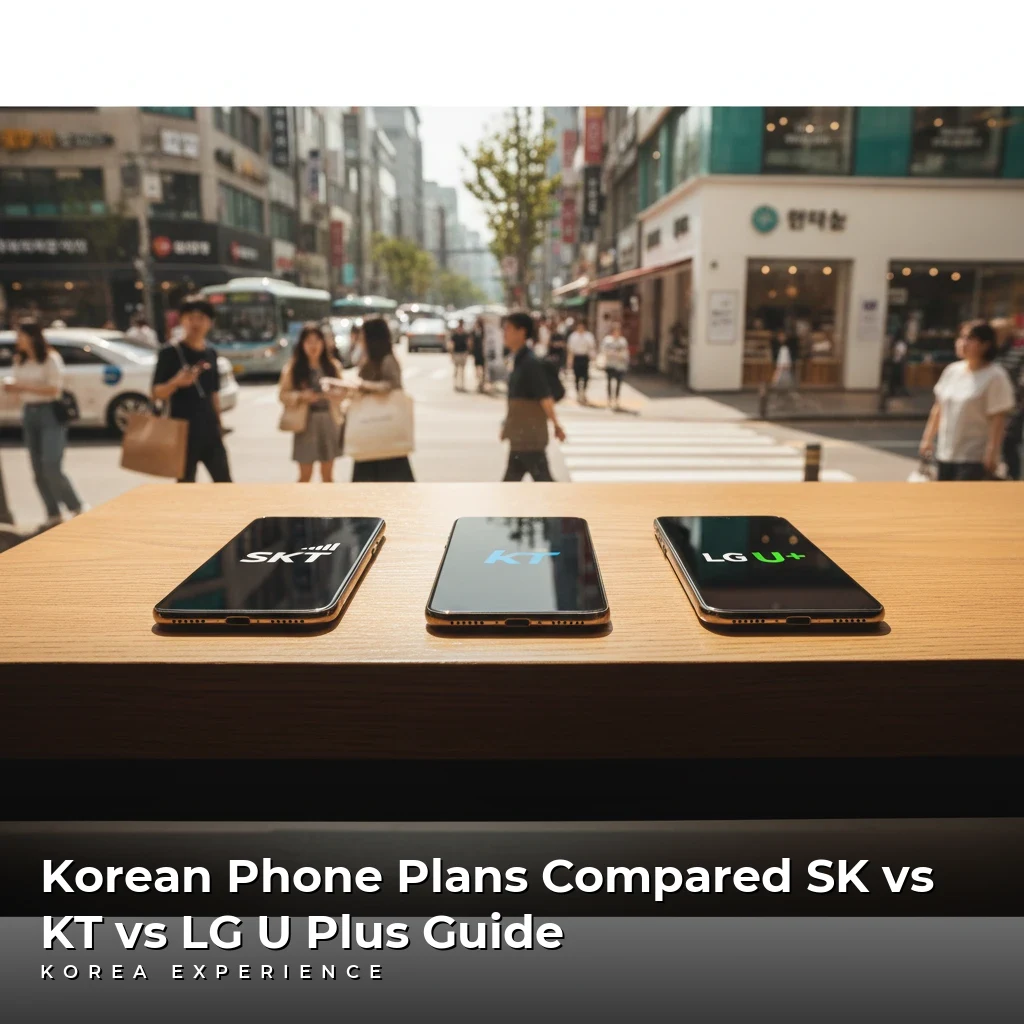
South Korea is globally renowned for possessing one of the world's most advanced telecommunications infrastructures. For international travelers and expatriates arriving in 2026, the prospect of navigating the mobile landscape can be both exciting and slightly overwhelming. With 5G coverage extending to over 96% of the population and average download speeds consistently exceeding 800 Mbps in major metropolitan areas, staying connected is seamless—once you choose the right provider.
The market is dominated by three major carriers, often referred to as the "Big Three": SK Telecom (SKT), KT (formerly Korea Telecom), and LG U Plus. Each offers distinct advantages depending on whether you are a short-term tourist needing a prepaid SIM or a long-term resident seeking a postpaid contract. Understanding the nuances between these carriers can save you significantly, potentially reducing your monthly telecommunications budget by 20% to 50%.
Key Takeaways
- 1SK Telecom leads in nationwide coverage and speed, ideal for rural travel
- 2KT offers the most extensive public Wi-Fi network with 100,000+ access points
- 3MVNOs (Budget Phones) use the same towers but cost 30-50% less than major carriers
The Big Three: An Overview of the Market
In South Korea, mobile connectivity is not just a utility; it is a lifestyle necessity. As of early 2026, there are over 75 million mobile subscriptions in a country of 51 million people, indicating a saturation rate of nearly 150%. The competition is fierce, which benefits the consumer through high-quality service and competitive perks.
SK Telecom (SKT)
SK Telecom is the market leader, commanding approximately 40% of the market share. They are traditionally viewed as the premium option. Historically, SKT has held the reputation for the best call quality and deepest coverage, particularly in mountainous regions and remote islands.
Related reading: Korea phone plans and sim cards for foreigners.
📊 SK Telecom Market Dominance
If your itinerary involves hiking effectively anywhere in the 70% of Korea that is mountainous, or visiting remote areas like Ulleungdo, SKT is often the safest bet. Their customer service is top-tier, though their plans can sometimes cost 5,000 to ₩10,000 more per month than competitors for similar tiers.
KT (Korea Telecom)
KT holds the second-largest market share, hovering around 24-25%. As a former state-owned enterprise, KT owns the most extensive landline and fiber optic infrastructure in the country. Their distinct advantage lies in their Wi-Fi network. KT subscribers gain free access to "KT WiFi" zones, which are ubiquitous in subways, cafes, and public landmarks.
For foreigners, KT is often the most accessible. Their "Global Stores" in areas like Gangnam, Hongdae, and Gwanghwamun specifically cater to English speakers, and their roaming centers at Incheon Airport are the largest.
Related reading: Getting a post paid phone plan without a long term contract.
LG U Plus
LG U Plus is the challenger brand with about 20% market share. To compete with the larger two, LG U Plus often aggressively prices their bundles. They are famous for integrating heavy data usage with lifestyle perks, such as free subscriptions to Netflix, YouTube Premium, or Disney+.
While their rural coverage was historically slightly behind SKT, the gap has narrowed significantly in the 5G era. For someone living in Seoul, Busan, or Daegu, the performance difference is negligible, often indistinguishable in daily use (latency usually stays under 25ms for all three).
Carrier Feature Comparison
| Feature | SK Telecom | KT | LG U Plus |
|---|---|---|---|
| Primary Strength | Coverage & Speed | Public Wi-Fi | Content Bundles |
| English Support | Good | Excellent | Good |
| Price Tier | Premium ($$$) | Standard ($$) | Value ($$) |
| Rural 5G | 98% Coverage | 95% Coverage | 92% Coverage |
Tourist vs. Resident: Identifying Your Needs
The most critical factor in choosing a plan is your visa status. The Korean mobile system is strictly bifurcated into "Prepaid" (for tourists) and "Postpaid" (for residents with an Alien Registration Card/Residence Card).
Short-Term Travelers (Prepaid)
If you are visiting for less than 90 days, you will rely on prepaid travel SIMs or eSIMs.
- Cost: Approximately 60,000 to ₩72,000 ($45-$55 USD) for 30 days of unlimited data.
- Limitations: These usually provide data only. Voice calls and SMS (crucial for reservations and delivery apps) often cost extra or require a specific "Voice + Data" SIM type.
- Convenience: Can be picked up instantly at the airport.
Identity Verification
Travel SIMs rarely allow you to perform "Self-Authentication" (Bon-in-injeung). This online identity verification is required for signing up for many Korean services like delivery apps (Baedal Minjuk), online banking, or buying concert tickets. You need a resident ARC and a postpaid plan for this.
Long-Term Residents (Postpaid)
If you have an Alien Registration Card (ARC) and a Korean bank account, you should switch to a postpaid plan immediately.
- Cost: Vary widely, from ₩30,000 to ₩90,000 monthly.
- Contract: Usually 12 or 24 months.
- Benefits: Full identity verification capabilities, cheaper rates per gigabyte, and device subsidies.
📖 How to Transition from Tourist to Resident Plan
Step 1: Obtain ARC
Wait for your physical Residence Card (approx. 3-4 weeks after arrival).
Step 2: Open Bank Account
Visit a local bank to set up an account for auto-withdrawal.
Step 3: Visit Carrier Store
Bring ARC, Bank Book, and Passport to an official SK, KT, or LG store.
Step 4: Port Number (Optional)
If you want to keep your prepaid number, ask for 'Beonho-idong' (Number Portability). This is sometimes possible if switching from the same carrier's prepaid service.
The Rise of Budget Phones (MVNOs)
For the savvy expat, the best plan might not be directly with the Big Three, but with an MVNO (Mobile Virtual Network Operator), known locally as "Alteul Phone" (Budget Phone).
These companies rent the network towers from SKT, KT, and LG U Plus. This means you get the exact same speed and coverage for a fraction of the price. The only trade-off is customer service (usually Korean only) and a lack of membership points (like discounts at bakeries or cinemas).
💵 Monthly Cost Comparison (Unlimited Data)
Includes membership perks + English support
Same speed, zero perks, limited support
I switched to a 'Woori Mobile' MVNO plan using the KT network three years ago. I pay ₩17,000 a month for 15GB of data plus unlimited throttled data (3Mbps) after that. It saves me over ₩600,000 a year compared to my old contract. If you have a Korean friend to help you sign up, this is the smartest financial move.
Buying at the Airport vs. The City
For travelers landing at Incheon International Airport (ICN), the convenience of airport kiosks is undeniable. However, pricing structures differ slightly.
Incheon Airport (Arrivals Hall)
Every major carrier has a roaming booth open 24/7 or from 06:00 to 22:00.
- Process: Hand over passport, pay, insert SIM.
- Wait Time: 10-20 minutes depending on queues.
- Price: Fixed tourist rates. Difficult to negotiate.
KT Roaming Center(KT Roaming Center)
City Stores
Official retail stores are found on almost every block in Seoul.
- Process: More paperwork involved.
- Benefit: Better for long-term contracts.
- Warning: Authorized retailers (resellers) often have aggressive sales tactics. Look for "Official Certified Dealer" stickers.
Data Speeds and Performance
South Korea consistently ranks in the top 5 globally for mobile internet speeds. As of 2026, the average mobile download speed across all carriers hovers around 450 Mbps to 1.2 Gbps depending on your 5G proximity.
- Subway Wi-Fi: The Seoul Metropolitan Subway offers free high-speed Wi-Fi (often 300+ Mbps) provided by the carriers. It is remarkably stable even when moving at 80km/h underground.
- Public Transport: KTX (High-speed trains) have improved Wi-Fi, but tunnels can still cause momentary drops. SKT generally handles tunnel handovers slightly better than competitors.
SK Telecom Pros and Cons
- ✓Highest average download speeds (1Gbps+)
- ✓Superior coverage in hiking trails and islands
- ✓T-Membership discounts (Bakeries, Pizza chains)
- ✗Most expensive monthly premiums
- ✗Stricter credit requirements for expats
- ✗Contract cancellation fees are high
How to Save Money: The 25% Discount Rule
If you are signing a contract (Postpaid) with SK, KT, or LG, you must know about the "Selective Contract Discount" (Seontaek Yakjeong).
By law, if you do not take a device subsidy (i.e., you bring your own unlocked phone), the carrier must offer you a 25% discount on your monthly service fee.
- Requirement: Commit to a 1-year or 2-year contract.
- Benefit: A ₩69,000 plan becomes ₩51,750.
- Action: Explicitly ask for the "25% discount" when signing up.
Pro Tip: Unlocking Your Phone
Before leaving your home country, ensure your phone is "Carrier Unlocked." If your phone is locked to Verizon, AT&T, or Softbank, a Korean SIM card will not work. Contact your home carrier at least 3 days before departure to process the unlock.
eSIM vs. Physical SIM
In 2026, eSIM usage in Korea has skyrocketed. All major carriers and most MVNOs now offer immediate eSIM activation via QR code.
- Pros: No need to physically swap cards; keep your home number active for 2FA texts; instant delivery via email.
- Cons: Your phone must be eSIM compatible (iPhone XS or newer, Galaxy S20 or newer).
- Recommendation: For short trips (under 10 days), eSIM is superior for convenience. For long-term residence, a physical SIM is sometimes easier to move between devices if your phone breaks.
eSIM Activation Process
Purchase Plan
Buy from Trazy, Klook, or Carrier Website
Receive QR Code
Receive voucher with QR code within 5 minutes
Scan & Install
Go to Settings > Cellular > Add eSIM
Activate
Turn on line upon landing in Korea
Cancellation and Departure
Leaving Korea requires closing your line properly to avoid accruing debt, which can affect future entry into the country.
- Contract End Date: Check your contract end date. Canceling even 1 day early can trigger a "Penalty Fee" (Winyeokgum), which is the repayment of all discounts you received.
- Return Rental Gear: If you rented a Wi-Fi egg or a phone, return it at the airport.
- Pay Final Bill: You cannot close a bank account if it's tied to a pending phone bill. Visit a carrier store at the airport to settle the pro-rated final bill in cash or card before flying out.
❓ Frequently Asked Questions
Have more questions?Contact us →
Final Verdict
Choosing between SKT, KT, and LG U Plus ultimately depends on your specific situation.
- Choose SKT if: You demand the absolute best performance, plan to travel to rural areas, or are a heavy user who values premium network stability.
- Choose KT if: You want the easiest English experience, plan to rely heavily on public Wi-Fi to save data, or are locating near a university where KT infrastructure is dominant.
- Choose LG U Plus if: You want to bundle entertainment subscriptions and are looking for competitive pricing on unlimited 5G data.
- Choose an MVNO (Budget Phone) if: You are a resident on a budget, have a Korean friend to help with setup, and don't care about membership perks.
Whichever you choose, you will be connecting to one of the world's most robust digital ecosystems. Welcome to the hyper-connected life in Korea.
About the Author
Korea Experience Team
Written by the Korea Experience editorial team - experts in Korean medical tourism, travel, and culture with years of research and firsthand experience.
Explore more in Living in Korea
Everything expats and long-term visitors need to know — from visa requirements and housing to banking, healthcare, and daily life tips.
Browse All Living in Korea ArticlesContinue Reading
Explore more articles you might find interesting

Complete guide to Korean SIM cards, eSIMs, and phone plans in 2026. Compare prices, speeds, and registration steps for travelers and expats.
Discover the best Korea SIM cards for long-term stays. Compare MVNOs, postpaid plans, and verification steps to save money and stay connected.
Secure a Korean post-paid SIM without the 2-year commitment. A complete guide to MVNOs, identity verification, and flexible mobile plans for expats.
Compare Coupang and Gmarket for online shopping in Korea. We analyze delivery speeds, English support, and payment methods for expats in 2026.
Compare Korea's best SIM and eSIM options for 2026. Data plans from ₩3,000/day, airport pickup details, and speed tests for KT, SKT, and LG U+.
Compare Seoul's top medical districts: Gangnam for value, Apgujeong for expertise, and Cheongdam for luxury. Find the right fit for your 2026 surgery.