Korean Post Office International Shipping Guide 2026
Master the art of sending packages from Korea. A complete guide to EMS, box sizes, customs apps, and shipping costs for expats and travelers.
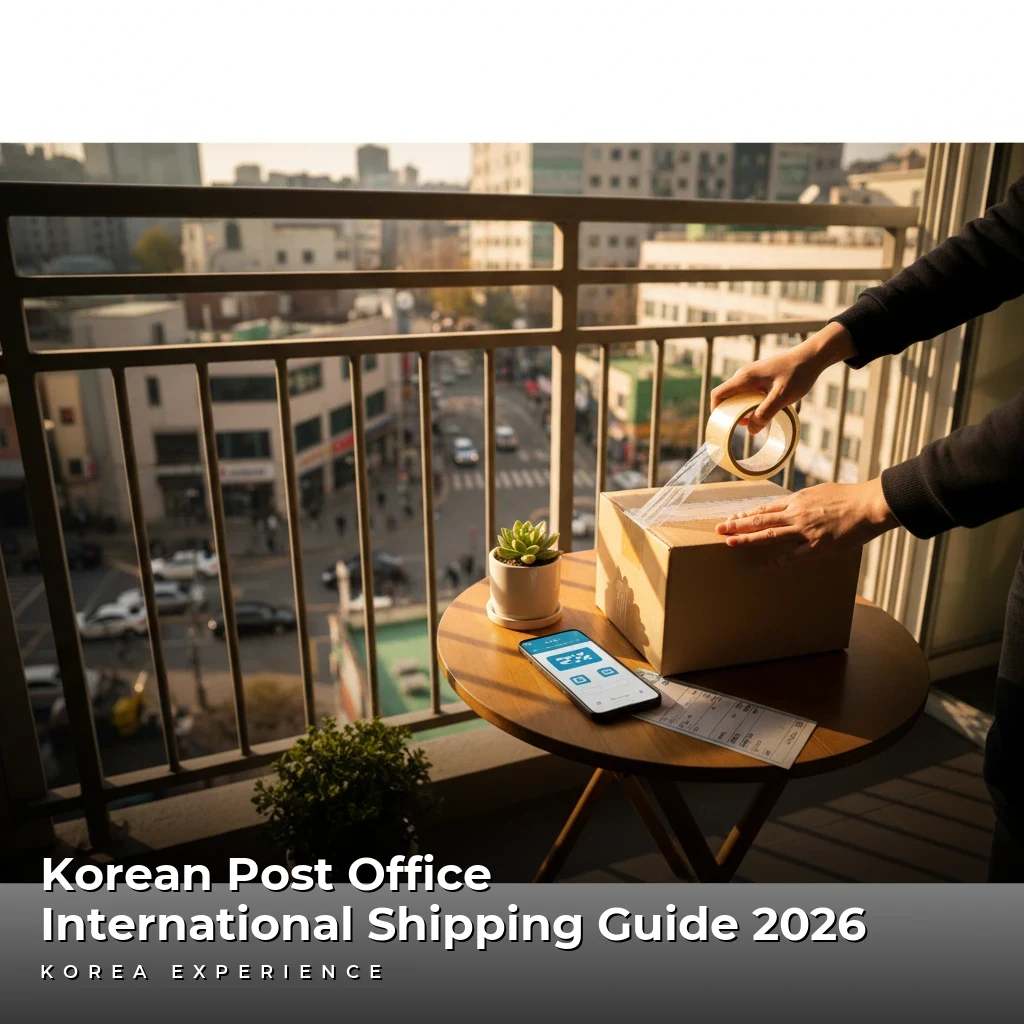
Navigating the Woocheguk (Korea Post) is a quintessential experience for anyone living in or visiting South Korea. Whether you are an expat moving home, a student sending winter clothes back, or a traveler whose suitcase is overflowing with skincare products and K-pop merchandise, the Korean postal system is widely regarded as one of the most efficient, affordable, and user-friendly services in the world.
However, recent changes to international customs regulations and the digitization of shipping forms can be daunting if you don't speak the language. With over 3,400 post offices operating across the peninsula, finding a branch is easy, but knowing exactly how to prepare your shipment is the key to a stress-free experience. This guide provides a comprehensive walkthrough of the entire process, ensuring your package arrives safely at its destination.
Related reading: Getting a post paid phone plan without a long term contract.
Key Takeaways
- 1EMS is the fastest option (3-5 days) but requires digital customs declaration via app
- 2Surface mail is 60-70% cheaper but takes 2-3 months to arrive
- 3Standard Post Office boxes come in 6 sizes; Size 5 is best for heavy items (max 30kg)
Understanding Your Shipping Options
Korea Post offers a tiered system for international shipping, balancing speed against cost. Choosing the right service depends entirely on your budget and urgency. The system is highly reliable, boasting a delivery success rate of over 98% for international parcels.
You might also enjoy our article about Korean work culture office etiquette for foreigners maste....
Korea Post Service Tiers
| Feature | EMS (Express) | K-Packet (Air) | Surface (Ship) |
|---|---|---|---|
| Speed | 3-5 Days | 10-14 Days | 60-90 Days |
| Tracking | Full / Real-time | Partial | Limited |
| Insurance | Included (up to a limit) | Optional | Optional |
| Max Weight | 30kg | 2kg | 20kg |
EMS (Express Mail Service)
EMS is the gold standard for international shipping from Korea. It is prioritized handling that links directly with the local postal service in your home country (e.g., USPS in the USA, Royal Mail in the UK).
Learn more in our comprehensive guide to Moving Companies in Korea.
- Speed: Very fast. Most packages to North America or Europe arrive within 4 to 6 business days.
- Cost: Premium. Sending a 5kg box to the United States costs approximately ₩115,000 ($85 USD).
- Reliability: Highest. Includes tracking and basic insurance.
International Parcel (Air)
This is standard airmail. It travels on airplanes but without the priority status of EMS.
Learn more in our comprehensive guide to Seoul International Schools Complete Guide for Expat Parents.
- Speed: Moderate. Expect 2 weeks on average.
- Cost: Mid-range. roughly 20-30% cheaper than EMS.
Surface Mail (Ship)
This is the budget option for sending heavy items where time is not a factor, such as moving boxes or winter coats in summer.
- Speed: Slow. It goes by cargo container ship. To North America, it takes 2 to 3 months. To Europe, it can take up to 4 months.
- Cost: Very Cheap. A 10kg box to the USA might cost only ₩45,000 ($33 USD), compared to over ₩200,000 for EMS.
Surface Mail Warning
Surface mail boxes are handled roughly during their months at sea. Use double-walled boxes and excessive tape. Do not ship electronics or fragile items via Surface mail as they are prone to damage from humidity and impact.
Box Sizes and Packing Materials
One of the best features of Korean post offices is the packing station. You do not need to bring your own box, tape, or scissors. Every branch has a self-service packing area equipped with tape, scissors, glue, and bubble wrap (though bubble wrap policies vary by branch).
You must purchase a standard Korea Post box. These are sturdy, standardized cardboard boxes available in six sizes. Using these boxes is highly recommended as they fit perfectly within the carrier's automated sorting dimensions.
📋 Standard Box Specs
Detailed Dimensions:
- Size 1: 22 + 19 + 9 = 50cm (Ideal for cosmetics, small souvenirs)
- Size 2: 27 + 18 + 15 = 60cm
- Size 3: 34 + 25 + 21 = 80cm (Good for shoes, books)
- Size 4: 41 + 31 + 28 = 100cm
- Size 5: 48 + 38 + 34 = 120cm (Most popular for moving; max weight usually 20-30kg)
- Size 6: 52 + 48 + 40 = 140cm (EMS only; often rejected for Surface mail due to size restrictions in some countries)
If you are using Surface (Ship) mail, avoid Box Size 6. While Korea Post sells it, the postal service in the receiving country (especially the US and Australia) sometimes rejects it for being too large for standard delivery trucks, leading to return fees. Stick to Size 5 for sea shipping to be safe.
The "Smart" Customs Declaration System
Gone are the days of handwriting carbon-copy forms. Due to stricter customs regulations in the EU, USA, and UK, you are now required to submit your shipping information digitally before or during your visit. This prevents errors and speeds up processing.
The EMS Smart Application (available on the Korea Post website or app) allows you to fill out the info in English and generates a QR code.
📖 How to Use the Korea Post Smart Service
Step 1: Download or Visit
Go to the Korea Post Internet Post Office website (epost.go.kr) or download the app. Select 'International Mail Smart Filing'.
Step 2: Sender & Receiver Info
Input your Korean address and phone number. Input the receiver's address exactly as it appears in their country.
Step 3: Item Declaration
List every item type. Be specific. Instead of 'Clothes', write 'Cotton Shirt'. You must input the quantity, weight (estimate is fine), and value in USD.
Step 4: Generate QR Code
Once finished, save the form. You will receive a QR code or a registration number.
Step 5: Scan at Post Office
When you arrive at the counter, show the QR code. The staff will scan it and print your label instantly.
By using the Smart Filing system, you typically receive a 5% to 10% discount on your shipping fees. This makes it not only mandatory for many destinations but also economically smart.
Prohibited and Restricted Items
Before you seal your box, you must ensure you are not shipping prohibited goods. South Korean airport security is extremely thorough. If your package contains a prohibited item, it will be opened, the item removed (and discarded), and the package resealed and sent, or returned to you entirely.
Strictly Prohibited:
- Lithium Batteries: This is the most common reason for rejection. No power banks, no loose batteries, and usually no electronics with built-in batteries unless specific rigorous standards are met (often easier to just carry these on the plane with you).
- Liquids with High Alcohol Content: Perfumes, nail polish remover, and diffusers are considered flammable/hazardous goods.
- Aerosols: Hairspray, mist sprays, shaving cream cans.
- Currency: Cash, checks, or gold.
Restricted (Country Dependent):
- Food: Dried food is usually fine. Fresh produce, meat products (including jerky), and dairy are often banned by the receiving country.
- Kimchi: You can send Kimchi, but it must be in a specialized can purchased at the post office or a specific airtight container to prevent fermentation explosions.
Lithium Battery Alert
Do not attempt to hide batteries in your luggage or packages. X-ray scanners detect them 100% of the time. If a battery is found, your shipment will be delayed by at least 1 week and you may be fined or required to retrieve the package personally.
Costs and Pricing Guide (2026 Estimates)
Shipping costs are calculated based on two factors: Actual Weight vs. Volumetric Weight (whichever is higher), and the Zone of the destination.
Korea Post divides the world into zones.
- Zone 1: Japan, China, Taiwan (Cheapest)
- Zone 2: Southeast Asia (Vietnam, Thailand, Hong Kong)
- Zone 3: North America (USA, Canada), Western Europe, Australia
- Zone 4: South America, Africa, Eastern Europe (Most Expensive)
Here is a comparative look at pricing for a typical 10kg (22 lbs) package sent to Zone 3 (USA/Europe).
💵 Cost Comparison: 10kg Package to Zone 3
Arrives in 60-90 days. Basic tracking.
For lighter items, the "Small Packet" options (under 2kg) are available:
- K-Packet (Air): ~₩30,000 for 1.5kg.
- Registered Small Packet: ~₩22,000 for 1.5kg.
📊 Inflation Note
Note that international fuel surcharges fluctuate weekly. The prices listed above are estimates including typical surcharges for 2026.
Visiting the Post Office: What to Expect
The operational hours for most Korea Post branches are strictly 09:00 to 18:00, Monday through Friday. They are closed on weekends and public holidays. Financial services at the post office usually close earlier, at 16:30, but postal services remain open until 6 PM.
The Seoul Main Post Office
If you are in Seoul and want the most foreigner-friendly experience, the Seoul Main Post Office (near Myeongdong) is the best option.
Seoul Central Post Office(서울중앙우체국)
The In-Store Process
- Enter and Pack: Head straight to the packing table. Buy your box at the counter first if you don't see them stacked out (at smaller branches).
- Pack Securely: Use the free bubble wrap. Tape the bottom of the box with the "H" method for strength.
- Get a Ticket: Look for the kiosk machine. Press the button for "Postal Service" (usually colored orange or red, distinct from Banking/Finance).
- Wait for Number: Watch the LED screen.
- Weigh and Pay: Place your box on the scale. Show your QR code from the app. Pay with cash or credit card (foreign Visa/Mastercards are accepted).
Shipping Journey
Drop-off
Package scanned at local branch
Incheon Logistics Center
Customs scanning and x-ray
Departure
Loaded onto flight (EMS) or container (Surface)
Destination Customs
Arrival in home country and customs clearance
Local Delivery
Handover to local post (e.g., USPS) for final mile
Korea Post vs. Private Couriers
Should you use Korea Post or a service like FedEx or DHL? For 90% of personal shipments, Korea Post is superior due to cost. However, private couriers have their place.
Korea Post vs. Private Couriers (DHL/FedEx)
- ✓Significantly cheaper (50% less)
- ✓Offices are everywhere
- ✓Easier customs process for personal items
- ✓Free packing materials provided
- ✗Slower than DHL Express
- ✗Stricter battery restrictions
- ✗Weight limit often capped at 30kg
- ✗Customer service harder to reach from abroad
Important Tips for a Smooth Experience
To ensure your package doesn't get stuck in the dreaded "Incheon Customs Hold," follow these practical tips.
- Be Descriptive: Never write just "Gifts" or "Personal Effects" on the customs form. Customs agents hate this. Write "Used Clothes," "Korean Snacks," or "Books."
- The 'Used' Trick: If you are sending your own clothes home, explicitly write "Used Personal Clothes" and set the value lower (e.g., $1-5 per item) to avoid being taxed on them as if they were new imports.
- Insurance: EMS comes with automatic insurance up to a certain value (usually around ₩70,000). If your items are valuable, ask for additional insurance (Bo-heom). It is very cheap (roughly ₩3,000 for ₩500,000 coverage).
Hangeul Helper
If you need help, show this to the staff: "I want to send this to the USA by EMS." "이것을 EMS로 미국에 보내고 싶어요." (I-geot-eul EMS-ro Mi-guk-e bo-nae-go sip-eo-yo)
Conclusion
Sending a package from Korea is a reliable and structured process. While the transition to digital customs forms adds a small step to the preparation, the efficiency of the Woocheguk remains unmatched. Whether you choose the lightning-fast EMS for your urgent documents or the slow-but-steady Surface mail for your winter wardrobe, you can trust that your items are in good hands.
Remember to pack securely, declare honestly, and double-check your battery situation. With this guide, you are ready to navigate the Korean postal system like a local.
❓ Frequently Asked Questions
Have more questions?Contact us →
About the Author
Korea Experience Team
Written by the Korea Experience editorial team - experts in Korean medical tourism, travel, and culture with years of research and firsthand experience.
Explore more in Living in Korea
Everything expats and long-term visitors need to know — from visa requirements and housing to banking, healthcare, and daily life tips.
Browse All Living in Korea ArticlesContinue Reading
Explore more articles you might find interesting

The complete 2026 guide to emergency medical care in Seoul. Find the best international hospitals, ER costs, and English-speaking services for travelers.
Master the nuances of Korean work culture with our comprehensive guide on office etiquette, hierarchy, and business customs for international professionals.

A complete guide to securing medical second opinions in Seoul's top hospitals. Costs, required documents, and booking steps for 2026 travelers.
A complete guide to requesting English medical records in Korea. Costs, processing times, and legal requirements for travelers and expats in 2026.
A comprehensive guide to Korean funeral etiquette, the three-day vigil, and condolence money customs for international travelers and expats in 2026.
Master international K-Beauty shipping from Korea in 2026. Discover top services, costs, regulations, and expert tips for safe delivery worldwide.