Retiring in Korea Long Term Visa Guide for Seniors
A comprehensive guide to long-term stay options for retirees in South Korea, including investment visas, costs, and healthcare access.
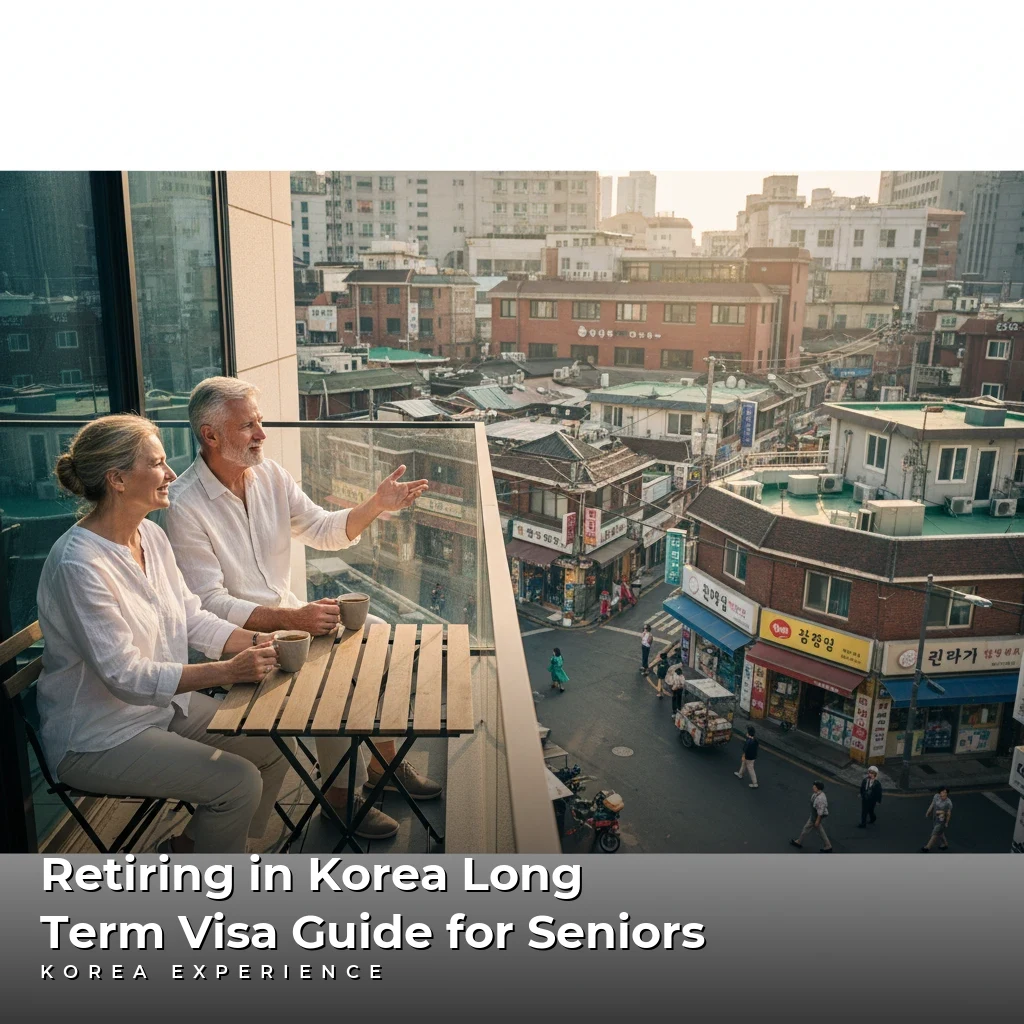
South Korea is rapidly becoming a bucket-list destination for active seniors and retirees. With its world-class healthcare system, safe streets, and vibrant blend of tradition and modernity, it offers an exceptional quality of life. However, unlike Thailand or the Philippines, South Korea does not offer a specific "Retirement Visa" for foreign nationals. This unique regulatory landscape requires potential expats to be strategic in how they approach long-term residency.
For international seniors wishing to spend their golden years in the Land of the Morning Calm, navigating the immigration system can feel daunting. Whether you are looking to invest in property on Jeju Island or planning an extended "slow travel" experience, understanding your visa options is critical to a successful transition.
For more details, check out our guide on Best Korea SIM Cards for Long-Term Travelers Beyond Airpo....
Key Takeaways
- 1Korea has no direct Retirement Visa; investment or long-term tourist strategies are required.
- 2Real Estate Investment (F-2) requires approx. $750,000 USD (1 Billion ₩) in specific zones.
- 3The F-1-D Workcation Visa allows a 1-2 year stay if annual income exceeds $64,000 USD.
The Reality of Retiring in Korea
The first thing to understand is that the South Korean immigration system is primarily designed to attract young labor, high-tech talent, and students. As of 2026, the demographic shift in Korea has opened some doors, but barriers remain high for those without active employment.
Related reading: Getting a post paid phone plan without a long term contract.
If you are a retiree without Korean heritage (F-4 visa) or a Korean spouse (F-6 visa), your options are generally limited to significant financial investment or maintaining a semi-retired status where you can prove active income from abroad.
You might also enjoy our article about Retirement planning for long term expats in south Korea.
📊 Retirement Landscape 2026
Despite these hurdles, the number of silver expats is growing. In 2025 alone, over 4,500 foreign nationals over the age of 60 were granted long-term residency through investment channels, a 12% increase from previous years.
Learn more in our comprehensive guide to Changing visa status while in Korea guide for expats.
Option 1: The "Golden Visa" (Real Estate Investment)
For retirees with substantial capital, the Public Business Real Estate Investment Migration System is the most secure path to long-term residency. This is effectively Korea's version of a "Golden Visa."
This pathway involves investing in government-approved real estate projects. In exchange, you receive an F-2 (Long-term Residency) visa, which can be upgraded to an F-5 (Permanent Residency) visa after five years of maintaining the investment.
📋 Investment Visa Facts
Where Can You Invest?
You cannot simply buy an apartment in Seoul to qualify. The investment must be in specific "Tourism and Leisure Cities." The most popular destinations for this are:
- Jeju Island: The most retiree-friendly location, offering a sub-tropical climate, English-friendly infrastructure, and a relaxed pace of life. It is located about 60 minutes by flight from Seoul.
- Incheon (Yeongjong & Cheongna): Located near the international airport, offering modern luxury condos.
- Busan (East Busan Tourism Complex): Coastal living in Korea's second-largest city.
- Yeosu (Gyeongdo): A scenic coastal city famous for its night seas and islands.
Financial Requirements
As of 2026, the investment threshold is set at 1 billion won (approximately $750,000 USD, depending on exchange rates). This amount was raised from ₩500 million in late 2023 to curb property speculation.
Depreciation Warning
Investment properties eligible for this visa are often "condotels" or tourist accommodation facilities. These may not appreciate in value as reliably as standard residential apartments in Seoul. View this as the cost of the visa rather than a high-yield financial investment.
The process generally takes 3 to 4 months from purchase to visa issuance. Once you have the F-2 visa, you can live anywhere in Korea, not just at your investment property, although you must retain ownership of the asset.
Option 2: The Digital Nomad / Workcation Visa (F-1-D)
If you are a "semi-retiree" who still consults, writes, or manages passive income streams that can be classified as remote work, the F-1-D Workcation Visa introduced recently is a game-changer.
While not strictly for retirees, it is age-neutral. If you are 65 but still serve as a remote advisor for a company back home, you qualify. This visa allows you to stay for one year, renewable for a second year, totaling 24 months.
Tourist vs. Nomad Visa
| Feature | Tourist (B-2) | Workcation (F-1-D) |
|---|---|---|
| Duration | 90 Days | 1 Year (Renewable) |
| ARC Issued | ❌ | ✅ |
| Banking Access | Restricted | Full Access |
Income Thresholds
To qualify, you must prove an annual income of at least double the Korean GNI (Gross National Income) per capita. In 2026, this requirement sits at approximately ₩85 million (roughly $64,000 USD) per year. You must provide tax returns or bank statements from your home country to verify this.
Pension income usually does NOT count toward the F-1-D income requirement unless it is structured as employment income or business profit. However, I have seen clients successfully use consulting contracts combined with dividend payouts to meet the threshold. Always consult an immigration lawyer before applying.
Option 3: Corporate Investment (D-8)
For the active retiree who wants to run a small business—perhaps a consulting firm, a gallery, or an import-export business—the D-8 Corporate Investment visa is a viable route.
This requires a minimum foreign direct investment (FDI) of ₩100 million (approx. $75,000 USD). You must incorporate a company in Korea and prove that the business is legitimate and operational.
D-8 Visa for Retirees
- ✓Lower capital requirement ($75k vs $750k)
- ✓Path to permanent residency (F-5)
- ✓Full healthcare access immediately
- ✗Must run an active business
- ✗Regular tax filings and audits
- ✗High administrative burden
This is not for those seeking a relaxing retirement. You will need to generate revenue and potentially hire Korean staff to renew the visa annually. However, for energetic seniors, it provides a sense of purpose and legal residency.
The "Visa Run" Strategy (B-1 / B-2)
Many retirees initially attempt to live in Korea on standard tourist visas. For citizens of the USA, UK, EU, and Canada, this usually grants a 90-day stay upon entry.
The strategy involves staying for 85 days, flying to a nearby country like Japan (Fukuoka is only a 50-minute flight from Busan), and returning to reset the 90-day clock.
Risk Assessment
Immigration officers are increasingly cracking down on "perpetual tourists." If you do more than two consecutive visa runs, you risk being denied entry, questioned aggressively, or given a shorter stay duration. This is not a sustainable long-term solution for retirement.
While this works for short-term "trial retirements" of 6-9 months, it prevents you from:
- Getting an Alien Registration Card (ARC).
- Signing long-term housing contracts (Wolse/Jeonse).
- Accessing National Health Insurance.
- Opening a full-service mobile phone plan.
Healthcare for Retirees in Korea
One of the biggest draws for retiring in Korea is the medical infrastructure. Hospitals in Seoul, like Asan Medical Center and Samsung Medical Center, consistently rank among the best globally.
If you hold a long-term visa (F-2, F-1-D, D-8), you generally become eligible for the National Health Insurance Service (NHIS) after living in Korea for six months.
💵 Healthcare Costs (Estimated)
Out-of-pocket cost
Standard consultation
For retirees on tourist visas, travel insurance is mandatory. A visit to the ER without insurance can cost upwards of $1,000 USD, whereas an insured visit might cost less than $100.
Cost of Living for Seniors
Korea offers a "first-world infrastructure at a mid-tier price point." While Seoul is expensive compared to Southeast Asia, it is significantly cheaper than New York, London, or Tokyo.
Housing (The Wolse vs. Jeonse System)
Retirees typically opt for Wolse (monthly rent with deposit).
- Deposit: 10 million - ₩50 million ($7,500 - $37,000 USD).
- Monthly Rent: 800,000 - ₩2 million ($600 - $1,500 USD) for a modern 1-bedroom or officetel in a good district.
The Classic 500(더 클래식 500)
Daily Expenses
- Public Transport: Seniors over 65 (mostly citizens/permanent residents) ride subways free, but foreigners usually pay roughly ₩1,400 ($1.05) per trip.
- Groceries: Local markets are 30% cheaper than supermarkets. A basket of fruit costs roughly ₩20,000 ($15).
- Dining Out: A hearty Korean stew (jjigae) costs about ₩10,000 ($7.50).
How to Prepare: A Step-by-Step Guide
If you decide to pursue the Investment Visa (F-2) or Workcation Visa, preparation is key.
Visa Application Journey
Financial Audit
Gather tax returns, bank statements, and investment capital.
Site Visits
Travel to Korea (B-2) to inspect real estate or consult lawyers.
Application
Submit documents to Korean Consulate or Immigration Office.
Arrival & ARC
Enter Korea, register fingerprints, receive ID card.
📖 Applying for the F-1-D (Workcation) Visa
Step 1: Proof of Employment
Obtain a Certificate of Employment and income proof from your foreign company.
Step 2: FBI/Police Check
Secure a criminal background check from your home country.
Step 3: Consulate Interview
Submit application at the Korean embassy in your home country.
Step 4: Entry & Registration
Upon arrival, visit the Immigration Office within 90 days to get your Alien Registration Card.
Cultural Considerations for Seniors
Korea maintains a Confucian respect for elders (hyo). As a senior, you will often be offered seats on the subway and treated with deference. However, the language barrier is significant.
While younger Koreans speak English well, the peer group for retirees (other seniors) often does not. I highly recommend learning the Hangul alphabet before arriving. It only takes about 3 hours to learn and helps immensely with reading menus and bus signs.
Alternatives: The F-2-R Regional Visa
A relatively new pilot program is the F-2-R (Regional Specialized Residency). This visa aims to populate rural areas suffering from demographic decline. While primarily targeting workers, some regions allow residency based on local investment or specific income criteria coupled with living in the designated area.
This requires living in areas like Jeonbuk, Gyeongbuk, or Chungnam provinces—roughly 2 to 3 hours by train from Seoul. The cost of living here is 30-40% lower than in the capital, making it an attractive option for budget-conscious retirees willing to live a quieter country life.
Frequently Asked Questions
❓ Retirement Visa FAQ
Have more questions?Contact us →
Retiring in Korea is a bold choice that rewards the adventurous. While the lack of a dedicated retirement visa presents a hurdle, the investment and digital nomad pathways offer viable routes for those who can meet the financial criteria. The combination of safety, medical excellence, and dynamic culture makes the effort worthwhile for many global citizens.
If you are considering this move, we recommend starting with a 3-month "test drive" on a tourist visa to see if the lifestyle—and the climate—suits you before committing to a long-term investment.
About the Author
Korea Experience Team
Written by the Korea Experience editorial team - experts in Korean medical tourism, travel, and culture with years of research and firsthand experience.
Explore more in Living in Korea
Everything expats and long-term visitors need to know — from visa requirements and housing to banking, healthcare, and daily life tips.
Browse All Living in Korea ArticlesContinue Reading
Explore more articles you might find interesting
Master the art of the Korean visa run in 2026. Comprehensive guide on routes, costs, immigration risks, and re-entry tips for long-term travelers.
A comprehensive guide to pensions, visas, healthcare, and housing for expats planning to retire in South Korea. Secure your future in the Land of Morning Calm.
The comprehensive step-by-step guide for moving to South Korea in 2026. Covers visas, housing, banking, and detailed costs for a seamless transition.
Complete guide to the 2026 F-2 resident visa in South Korea. Learn points requirements, income thresholds, and application steps for long-term residency.
Complete guide to South Korea F-6 marriage visa requirements including income limits, language tests, and interview tips for 2026 applicants.
Discover the best Korea SIM cards for long-term stays. Compare MVNOs, postpaid plans, and verification steps to save money and stay connected.