K-Culture

Why Koreans Love MBTI: Psychology Behind the 2026 Trend

Explore the deep psychological, social, and cultural reasons why MBTI continues to thrive in Korea, shaping identity and connections.

Why Koreans Love MBTI: The Psychology Behind the Trend in 2026

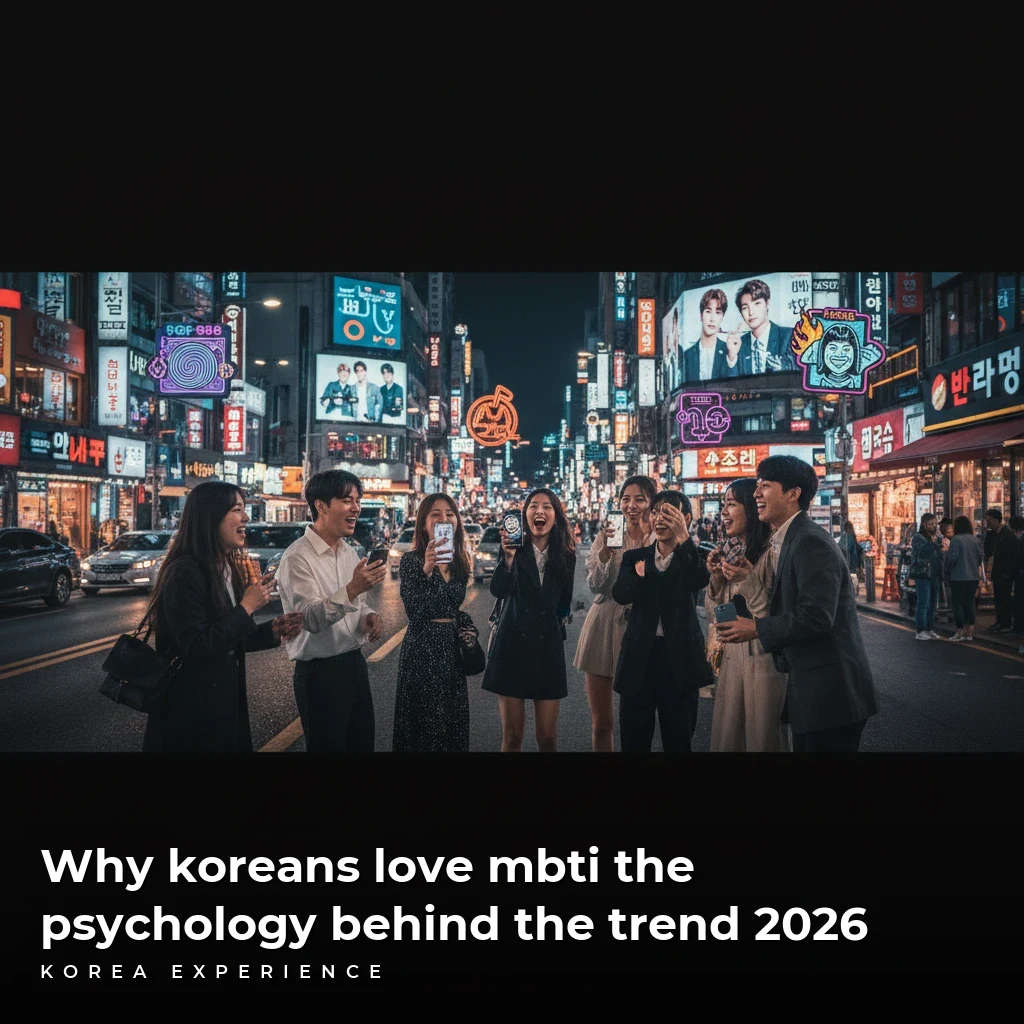
South Korea, a nation celebrated for its dynamic K-Pop, captivating K-Dramas, and cutting-edge technology, harbors another, perhaps less expected, cultural phenomenon: an enduring obsession with the Myers-Briggs Type Indicator (MBTI). While personality tests are common worldwide, Korea's embrace of MBTI transcends casual interest, permeating everything from dating apps and job interviews to celebrity discussions and everyday small talk. As we move into 2026, the question isn't whether MBTI is still relevant in Korea, but rather why its popularity endures, deeply embedding itself into the collective consciousness.

For international travelers and expatriates keen to understand the nuances of Korean society, grasping the psychology behind the MBTI trend is crucial. It's more than just a passing fad; it's a window into the values, communication styles, and social dynamics that define modern Korea. This comprehensive guide will delve into the profound psychological, social, and cultural reasons why Koreans love MBTI, offering insights that will enrich your understanding of this fascinating country and its people. You’ll learn how to navigate MBTI-infused conversations, understand its role in relationships, and appreciate its unique position within Korean culture.

The Ubiquitous Presence of MBTI in South Korea

Step into almost any social setting in Korea today, and you're likely to encounter a conversation about MBTI. From university campuses to corporate offices, the four-letter acronym has become an indispensable tool for self-identification and understanding others. This pervasive presence isn't accidental; it’s a reflection of deeper societal currents.

From Job Interviews to Dating Apps: Everyday Applications

The application of MBTI in Korea extends far beyond casual self-reflection. In the highly competitive job market, some companies, particularly smaller ones or startups, have been known to informally ask about an applicant's MBTI type. While not a formal hiring criterion, it can be used to gauge potential team fit or communication style during initial screening, reflecting a desire to build harmonious and efficient work environments. This practice, though debated, highlights the perceived utility of MBTI in understanding interpersonal dynamics.

On the romantic front, MBTI has become an explicit filter. Dating apps and matchmaking services often include a field for users to list their MBTI type, and it's common for individuals to state preferences for or against certain types when seeking a partner. Online communities and popular websites dedicated to relationship compatibility offer intricate charts and guides detailing which MBTI types are "soulmates" or "red flags," influencing everything from first dates to long-term relationship planning. Traditional arranged meetings, known as "sogaeting," or group blind dates, "mi-ting," frequently begin with an exchange of MBTI types, serving as an immediate ice-breaker and a quick way to assess initial compatibility.

The Language of Personalities: How MBTI Shapes Communication

MBTI has effectively introduced a new vocabulary into Korean social interactions. Instead of lengthy explanations about one's personality, a quick mention of "I'm an ISTJ" or "You seem like an ENFP" provides a shorthand for a complex set of traits. This allows for rapid categorization and a perceived deeper understanding, even in nascent relationships. It becomes a common language, facilitating quicker connections and often leading to shared laughter over common stereotypes associated with each type. For instance, an "E" (Extrovert) might be teased for their boundless energy, while an "I" (Introvert) might be affectionately chided for needing alone time after a social gathering. This shared understanding simplifies social navigation, reducing the effort needed to "figure out" a new person.

A Brief History of MBTI's Rise in Korea

While the Myers-Briggs Type Indicator originated in the Western world, its significant popularity in Korea is a more recent phenomenon, exploding in the 2010s and reaching a fever pitch by the early 2020s. Initially introduced through self-help books and corporate training programs, its accessibility through free online tests made it widely available to the public. The onset of the COVID-19 pandemic, with its increased social isolation, further fueled the MBTI craze. People spent more time online, exploring their identities and seeking ways to connect and understand themselves and others in a socially distanced world. Social media platforms, particularly Instagram, TikTok, and YouTube, became breeding grounds for MBTI content – from humorous skits about type interactions to detailed analyses of celebrity MBTIs, solidifying its place in popular culture.

The Psychology of Self-Discovery and Validation

At its core, the enduring appeal of MBTI in Korea lies in its profound psychological impact, offering both a path to self-discovery and a sense of validation in a often demanding society.

Seeking Understanding in a Collectivist Society

Korea is traditionally a collectivist society, where group harmony and social cohesion are highly valued. Individual expression, while increasingly encouraged, often navigates the complexities of fitting in and maintaining social order. In this context, MBTI offers a unique tool for self-understanding within the larger social fabric. It provides individuals with a framework to articulate their unique preferences and traits without directly challenging group norms. By identifying as a particular MBTI type, individuals can understand their strengths, weaknesses, and natural inclinations, providing a sense of individuality in a culture that often emphasizes the collective. It helps answer the inherent human question: "Who am I?"

The Appeal of Categorization and Simplification

The human brain naturally seeks patterns and categories to make sense of a complex world. MBTI, with its distinct 16 types, provides a simple, accessible system for categorizing personalities. This simplification is incredibly appealing in a fast-paced society where quick judgments and efficient communication are often prioritized. Instead of grappling with the intricate nuances of individual personalities, people can quickly assign a type, which then comes with a set of predefined characteristics. This cognitive shortcut simplifies social interactions, reducing ambiguity and fostering a sense of immediate understanding. It creates a common ground for discussion and comparison, making social engagements smoother.

Validation and Normalization of Traits

One of the most powerful psychological aspects of MBTI's popularity is the validation and normalization it offers. For individuals who might feel different or misunderstood, discovering their MBTI type and reading its descriptions can be a profound experience. It confirms that their unique ways of thinking, feeling, and behaving are not just personal quirks but part of a recognized pattern shared by others. An introvert, for example, might feel less guilty about needing alone time after a social event, understanding it as a fundamental aspect of their "I" preference rather than a personal failing. This normalization reduces anxiety and fosters a sense of belonging, assuring individuals that their internal experiences are valid and comprehensible. It builds self-acceptance and provides a vocabulary to explain oneself to others, potentially bridging gaps in understanding.

Table 1: Common Misconceptions vs. Korean Perceptions of MBTI

AspectCommon Misconception (Global)Korean Perception (Cultural)
Scientific BasisOften viewed skeptically; lacks strong empirical support.Less focus on scientific rigor; more on practical application.
PurposeSelf-reflection, career guidance.Social lubricant, relationship compatibility, team building.
SeriousnessA fun quiz; results taken with a grain of salt.Often taken quite seriously, influencing decisions.
FlexibilityPersonality can change over time.Results are often seen as relatively fixed traits.
PrivacyOften a personal disclosure.Commonly shared openly in social settings.

Social Dynamics and Relationship Building Through MBTI

Beyond individual psychology, MBTI profoundly shapes social dynamics and relationship building in Korea, acting as both an ice-breaker and a sophisticated filter.

Breaking the Ice: A Social Lubricant

In a culture that can sometimes appear reserved, especially with new acquaintances, MBTI serves as an excellent social lubricant. Asking "What's your MBTI?" is a less intrusive and more engaging way to initiate conversation than more direct personal questions. It bypasses initial awkwardness, immediately providing a topic of conversation. People can discuss the stereotypes of their types, share experiences, and playfully debate the accuracy of the descriptions. This quick foray into shared personal information creates a sense of connection and comfort, helping to build rapport much faster than traditional methods. It acts as a safe starting point for exploring deeper personalities without immediately demanding vulnerability.

Table 2: Traditional Ice-Breakers vs. MBTI Ice-Breakers in Korea

Ice-Breaker TypeTraditional Korean ApproachMBTI-Inspired Korean Approach
Initial Question"Where are you from?" "What do you do?""What's your MBTI?"
Information GainedBackground, profession, general status.Perceived personality traits, communication style.
Conversation FlowCan feel like an interview; formal.More playful, personal, and immediately engaging.
Depth of ConnectionSuperficial, gradually deepens with time.Starts with perceived personality insight; rapid connection.
Risk of AwkwardnessHigher, especially if status differences are present.Lower, as it's a shared cultural reference point.

MBTI influences how Koreans approach both personal friendships and professional collaborations. In friendship groups, understanding each other's MBTI types can lead to greater empathy and adjusted expectations. For example, friends might consciously give an "I" (Introvert) friend space to recharge after a busy day, or appreciate an "F" (Feeler) friend's emotional support, while understanding a "T" (Thinker) friend's more logical approach. This insight helps to preempt misunderstandings and foster stronger bonds based on perceived compatibility.

In professional settings, while not formally mandated, MBTI discussions can informally influence team assignments or project dynamics. Managers might jokingly suggest that "we need an 'J' (Judging) type to keep us organized" or "an 'P' (Perceiving) type to bring creative ideas." This informal application acknowledges different working styles and personality contributions, aiming to build more cohesive and understanding teams. It provides a common framework for discussing workplace roles and dynamics, often with a lighthearted but insightful tone.

MBTI as a Dating and Friendship Filter

The role of MBTI as a "filter" in relationships is particularly pronounced. People actively seek partners and friends whose types are deemed compatible according to popular MBTI lore. Websites, forums, and even casual conversations abound with discussions about which types make the "best couples" or "worst enemies." This can be a double-edged sword: while it provides a quick way to screen potential matches and reduce the perceived risk of incompatibility, it can also lead to premature judgments and overlook individuals who might be a good fit despite their type. The idea of "yeong-hon-ui jjak" (soulmate) is sometimes intertwined with MBTI compatibility, giving the test an almost deterministic power over romantic destinies. This filtering mechanism reflects a desire for efficiency and a reduction of uncertainty in the often complex world of human relationships.

Cultural Nuances: Conformity, Identity, and Group Harmony

The deep integration of MBTI into Korean society cannot be fully understood without considering its interplay with core Korean cultural values.

Fitting In vs. Standing Out: A Delicate Balance

Korean society often navigates a delicate balance between individual identity and collective harmony. While there's a growing emphasis on individuality and self-expression, the pressure to "fit in" and conform to group expectations remains strong. MBTI offers a unique solution to this dilemma. It allows individuals to articulate their unique personality traits within a recognized and accepted framework. By identifying with an MBTI type, one can express individuality (e.g., "I'm a unique INFJ") while simultaneously belonging to a recognizable category (e.g., "I'm one of the INFJs"). This dual function allows for both self-differentiation and social integration, making it a culturally palatable way to explore personal identity without excessively disrupting group cohesion. It provides a sanctioned space for self-expression.

The Role of 'Nunchi' and Social Cues

The concept of "nunchi" (눈치) is paramount in Korean social interactions. It refers to the subtle art of perceiving and understanding others' moods, unspoken intentions, and social cues to respond appropriately. MBTI, in many ways, complements nunchi. While nunchi relies on intuition and observation, MBTI provides a perceived blueprint for understanding those cues. If you know someone's MBTI type, you might feel you have a head start in understanding their nunchi – predicting their reactions, anticipating their needs, or interpreting their behavior. This perceived ability to "read" someone through their MBTI type enhances social predictability and helps individuals navigate complex social situations more effectively, reducing the likelihood of social faux pas. It's a shortcut to understanding the invisible social rules.

Group Identity in a Fast-Paced Society

Korea is a highly competitive and fast-paced society, from academic performance to career advancement. In this environment, a strong sense of group identity can provide comfort and support. MBTI creates new forms of group identity based on shared personality types. People often bond strongly with others of the same or compatible MBTI types, forming online communities, chat groups, and even offline gatherings. This "MBTI tribe" offers a sense of belonging and mutual understanding, providing a psychological refuge from societal pressures. It's a way to quickly find "your people" in a large, often anonymous urban landscape, fostering connections based on perceived inherent traits rather than superficial interests.

The MBTI trend in Korea isn't just about serious self-reflection; it's also a source of endless entertainment, commercial opportunities, and practical everyday applications.

Themed Cafes and Merchandise

The commercialization of MBTI is a testament to its deep penetration into Korean culture. In trendy districts like Hongdae, Gangnam, and Seongsu-dong, you can find cafes offering MBTI-themed drinks, snacks, or even personalized consultations. Pop-up stores frequently appear, selling a myriad of MBTI merchandise, from keychains and phone cases adorned with specific type descriptions to apparel and stationery. These products allow individuals to proudly display their MBTI type, turning it into a fashion statement and a conversation starter. The vibrant market around MBTI products reflects a desire to tangibly express one's identity and connect with others who share similar traits. Expect to see these types of niche businesses continuing to flourish into 2026, adapting to new trends and consumer demands.

Celebrity MBTIs and Public Discourse

Just as celebrities influence fashion and music, their MBTI types have become a regular feature in Korean entertainment news and fan discussions. K-Pop idols, actors, and variety show personalities frequently reveal their MBTI types, often as part of their promotional activities or on reality shows. Fans avidly discuss their idols' MBTIs, analyzing their public behavior through the lens of their type, predicting compatibility with other members, or creating humorous memes based on their known traits. This public discourse amplifies the MBTI trend, making it a common topic of conversation and further embedding it into the cultural mainstream. It creates a shared narrative and a sense of intimacy between fans and their favorite public figures.

Future Outlook: Will the MBTI Craze Continue in 2026?

While some might dismiss MBTI as a fleeting trend, its psychological and cultural roots in Korea suggest a deeper staying power. By 2026, it's highly probable that MBTI will continue to be a significant cultural touchstone, albeit perhaps evolving in its application. It may move beyond the initial fervent "craze" phase to become a more integrated, normalized part of social interactions. New iterations or spin-offs might emerge, but the underlying desire for self-understanding, social simplification, and validation that MBTI provides will likely remain. It has effectively created a new lexicon for personality and relationships, which isn't easily unlearned. The trend's resilience points to its fulfillment of genuine social and psychological needs within Korean society.

Table 3: Popular Korean MBTI Types and Associated Traits (General Examples)

MBTI TypeCommon Stereotypical Traits in KoreaWhy it's perceived as common/desirable (generalized)
ISTJDutiful, responsible, practical, traditional, hardworking.Aligns with values of diligence, stability, and reliability.
ISFJWarm, caring, protective, loyal, detail-oriented, supportive.Valued for nurturing qualities, strong relationships, and helpfulness.
**ESTJOrganized, decisive, assertive, efficient, leadership-oriented.Seen as effective leaders, good problem-solvers, and goal-driven.
ENFJCharismatic, empathetic, inspiring, people-focused, warm.Appreciated for social skills, emotional intelligence, and ability to connect.
INFPCreative, idealistic, empathetic, value-driven, individualistic.Respected for unique perspectives, sincerity, and depth of feeling.

Note: These are generalized perceptions and not scientific statements about personality.

For international travelers and expatriates, understanding the MBTI trend is more than just an academic exercise; it's a practical skill for deeper cultural immersion and successful social interactions in Korea.

Understanding the Conversation: When and How to Engage

You will undoubtedly be asked your MBTI type in social settings. Being prepared with an answer, or at least understanding what is being asked, can significantly smooth interactions. While you don't need to internalize all the stereotypes, knowing your own type can provide a quick entry point into conversations.

  • Tip 1: Take a test. Many free online MBTI tests are available in English. Take one before your trip so you have a general idea of your type. Even if you don't fully believe in it, having an answer demonstrates cultural awareness.
  • Tip 2: Engage playfully. Koreans often discuss MBTI with a sense of humor. Don't take it too seriously. Share some common traits of your type and relate them to personal anecdotes. This shows you're open to the conversation.
  • Tip 3: Don't over-rely on it. While useful for ice-breaking, remember that MBTI is a generalization. Use it as a starting point, not the sole determinant of a person's character.

Practical Tips for Integrating into Korean Social Circles

Leveraging MBTI can be a powerful tool for building connections:

  • Tip 1: Use it as a conversation starter. When meeting new Korean friends or colleagues, asking "What's your MBTI?" is a perfectly natural and expected way to break the ice. This shows your interest in their culture.
  • Tip 2: Observe and learn. Pay attention to how Koreans discuss MBTI. Notice the common characteristics attributed to each type and how people react to them. This will enhance your understanding of social dynamics.
  • Tip 3: Be open to discussing compatibility. If someone talks about MBTI compatibility in dating or friendship, try to understand their perspective. It's a way they process relationships. You can share your thoughts without needing to fully adopt their beliefs.
  • Tip 4: Internal Linking Opportunity: For more detailed advice on making friends in Korea and understanding social etiquette, check out our guide on "Korean Social Etiquette for Expats" or "Building Friendships in Seoul."

Where to Experience MBTI Culture Firsthand

To truly grasp the scale of the MBTI trend, seek out opportunities to experience it directly:

  • Online Platforms: Engage in Korean online communities (e.g., specific subreddits, KakaoTalk groups, or YouTube channels) where MBTI is a frequent topic of discussion. You'll see real-time application of the concepts.
  • Themed Cafes and Pop-ups: Keep an eye out for MBTI-themed cafes or pop-up events in popular areas like Hongdae, Gangnam, or Yeonnam-dong. These often offer merchandise and a fun, immersive experience.
  • Social Gatherings: During social gatherings or university events, listen to how MBTI is used in conversation. It's a direct window into its function as a social tool. Asking "What's your MBTI?" at a gathering of young Koreans will almost certainly lead to lively discussion.
  • Internal Linking Opportunity: Discover the trendiest cafes and unique experiences in Seoul with our "Ultimate Guide to Seoul's Hidden Gems."

Frequently Asked Questions (FAQ)

1. Is MBTI a scientific test?

While widely popular, it's important to note that the MBTI lacks strong scientific validation from the academic psychological community. It's generally considered a psychometric instrument rather than a robust scientific test. Its popularity in Korea stems more from its utility as a social tool and framework for self-understanding than from its scientific rigor.

2. Should I take an MBTI test before visiting Korea?

Yes, it's highly recommended! Taking a free online MBTI test before or during your trip will give you a general idea of your type. This allows you to engage more comfortably in MBTI-related conversations, which are common in Korea, and shows your interest in local culture.

3. How seriously do Koreans take MBTI results?

The seriousness varies. While some individuals take their MBTI results quite seriously, using them to guide relationship choices or career paths, others view it more as a fun ice-breaker or a tool for lighthearted self-reflection. It's generally taken more seriously than in many Western countries, where it might be seen as just another online quiz.

4. What are the most common MBTI types in Korea?

While specific statistics can fluctuate, certain types are frequently cited as being common, such as ISFJ, ISTJ, and ENFJ. However, all 16 types are represented, and discussions about the unique traits of each are widespread. The "most common" lists are often based on popular perception rather than official, widespread surveys.

5. Can MBTI help me make friends in Korea?

Absolutely! MBTI can be an excellent social lubricant and conversation starter. By understanding and discussing MBTI, you can quickly find common ground, share laughs over personality quirks, and demonstrate cultural awareness, all of which can facilitate making new friends and connections in Korea.

Conclusion

The enduring love affair between Koreans and MBTI is a captivating cultural phenomenon, deeply rooted in the nation's psychological, social, and cultural fabric. Far from a fleeting trend, its continued prevalence in 2026 demonstrates its powerful utility in a society that values both individual identity and collective harmony. MBTI offers a unique pathway for self-discovery and validation, a simplified language for navigating complex social dynamics, and a powerful filter for forming meaningful relationships.

For international visitors and expats, understanding why Koreans love MBTI is more than just appreciating a cultural quirk; it's about gaining a valuable lens through which to view Korean communication styles, social expectations, and relationship building. Embrace the opportunity to learn your own type, engage in playful discussions, and observe how this personality framework shapes everyday life. By doing so, you'll not only unlock a deeper understanding of Korea but also enhance your ability to connect with its fascinating people, making your experience in the Land of the Morning Calm all the richer and more rewarding.

About the Author

Korea Experience Team

Written by the Korea Experience editorial team - experts in Korean medical tourism, travel, and culture with years of research and firsthand experience.

⚠️ Medical Disclaimer

The information provided on this website is for general informational purposes only and does not constitute medical advice. Always consult with qualified healthcare professionals before making any medical decisions.

Continue Reading

Explore more articles you might find interesting